
REVIEW · UK AUDIO TOURS
Cambridge Self Guided Walking Tour
Cambridge packs centuries of scholarship, religion, science, and river life into a compact walk. This self-guided route takes you from Christ’s Pieces and Parker’s Piece through old college streets, museum stops, King’s College Chapel, the Round Church, and the River Cam.
I like the freedom to choose audio or text, and I like the three weeks of access, which lets you split the route or repeat a favorite section. The main trade-off is simple: there is no in-person guide, and some major sights, including King’s College Chapel and the Round Church, require separate admission.
Key points to know before you go
- Helen’s human-recorded commentary: Choose audio or written information in the app, with no computer-generated voice.
- A useful 2 to 3 hour route: Start at Cambridge Bus Station and finish near Cambridge University Library on West Road.
- Museums add real substance: The route includes the geology, zoology, archaeology, anthropology, and science collections around central Cambridge.
- College history is woven into the walk: See Emmanuel College, Corpus Christi, King’s College, Trinity College, and the Senate House area.
- You get three weeks of access: Use the GPS route, map, photos, videos, recommendations, and stop-by-stop information at your own pace.
- Budget price, limited personal help: At $12.22 per person, it is inexpensive, but you must manage the app, route, timing, and admissions yourself.
Starting at Christ’s Pieces and Parker’s Piece
The route begins near Christ’s Pieces, close to Cambridge Bus Station on Drummer Street. This is a practical starting point if you arrive by bus, and the opening section gives you a quick grounding in Cambridge and its past before the route moves into the university quarter.
You then reach Emmanuel College, known for its academic reputation. One useful detail here is the connection with John Harvard. He was baptized at the college chapel and later became a benefactor of Harvard University in the United States.
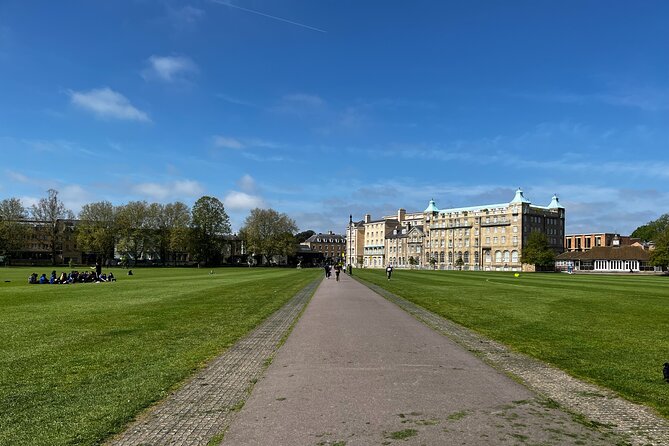
The next main stop is Parker’s Piece, a broad public park in the center of Cambridge. Edward Parker gave part of the land to the city in 1613, which explains the name. The park gives the walk a welcome change of pace before you move into a denser run of museums and university buildings.
Allow about 10 minutes at both Christ’s Pieces and Parker’s Piece according to the planned timing. You can move faster if you are eager to reach the museums, but these open spaces help you understand how close the city center and university grounds are to one another.
More Self-Guided Walking Tours in the UK
- London: Royal Walking Tour and Buckingham Palace Audio Tour
★ 4.8 · 154 reviews - London: Self-Guided Notting Hill Walking Tour with an APP
★ 4.3 · 120 reviews - Buckingham Palace: Walking Tour with Entry & Audio Guide
★ 5.0 · 91 reviews
A museum stretch built around science and nature
One of the strongest parts of the route is the run of university museums. This section gives the walk more depth than a simple college-photo tour. You are led toward collections that cover geology, zoology, archaeology, anthropology, and the history of science.
The geological museum takes you on a huge journey through time, from the meteoritic material that helped form planets to fossils showing how life developed in the oceans, on land, and in the air. That 4.5-billion-year scope gives you a sense of the museum’s purpose, even if you only have time for a short visit.
The University Museum of Zoology adds a more immediate look at animal life. Its galleries include moths, monkeys, mammoths, and manatees, with subjects ranging from extinction and survival to evolution and exploration.
Several named objects give you a reason to look closely:
- A 21-meter fin whale, Cambridge’s largest resident
- A giant ground sloth
- One of the most complete Dodo skeletons in the United Kingdom
- Captain Cook’s conch
The route also points you toward the Museum of Archaeology and Anthropology. Its holdings number more than 800,000 objects, supported by a photographic archive of more than 100,000 field photographs and negatives, plus over 30,000 groups of historical documentary records.
The Whipple Museum focuses on the history of science. Its collection includes scientific instruments, apparatus, models, pictures, prints, photographs, books, and related material. This is a good reminder that Cambridge’s story is not only about famous colleges. It is also about how people measured, observed, recorded, and explained the world.
The practical point is important: this walking tour gives you access to information about these museums, but the full route can take longer than two or three hours if you enter several of them. Treat the stated time as the walking and listening portion, then add museum time according to your interests and opening hours.
The Pitt Building and the Fitzwilliam Museum
The Pitt Building offers a short architectural pause. It was built in 1833 and named for William Pitt the Younger, who served as British prime minister in the late eighteenth and early nineteenth centuries.
The route allows about five minutes here, so do not expect a long visit. Use it as a waypoint between the university museums and the southern part of the city center.
The Fitzwilliam Museum is one of the most impressive buildings along the route. Its neoclassical design was completed in 1848, with grand columns inspired by ancient Greek and Roman temples, a dome, and large lion statues beside the entrance.
The building alone earns a stop, even if you are not planning to enter. Admission is not listed as included, so you should regard any interior visit as separate from the $12.22 tour price.
Punting history at Mill Lane
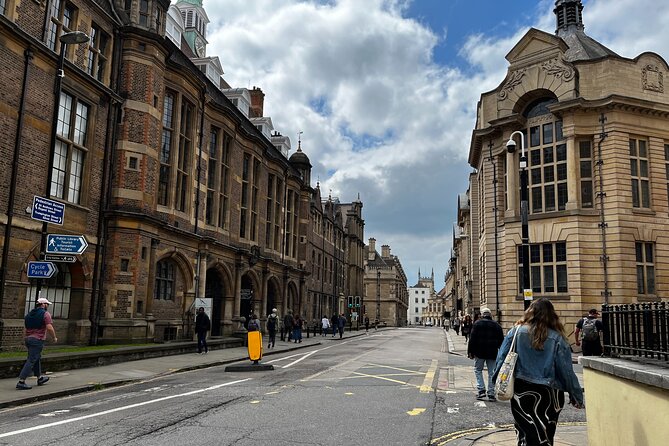
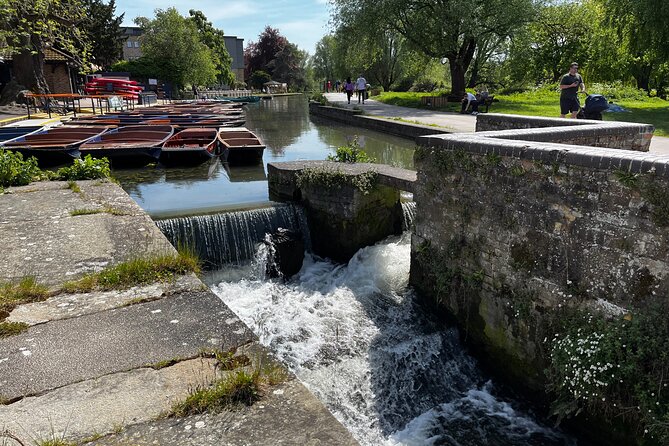
At Scudamore’s Mill Lane Punting Station, the route turns to Cambridge’s best-known river activity. You hear about the company’s founder, Jack Scudamore, a boat builder who visited the Henley Royal Regatta and saw how popular punting had become among upper- and middle-class visitors.
The stop is not a punting trip. It is a short history point, planned for about 10 minutes. That distinction matters if you are comparing this walk with a guided river tour. You will learn about the boating tradition, but you will not be taken onto the River Cam as part of this experience.
Same place, a different route to walk:
- London: Emirates Stadium Entry Ticket and Audio Guide
★ 4.7 · 5,513 reviews - Westminster Abbey Entrance Ticket Including Audio Guide
★ 4.0 · 661 reviews - London: British Museum Audio Tour & Priority Entrance Ticket
★ 4.5 · 631 reviews - Western Approaches Self Guided Tour
★ 5.0 · 505 reviews
The Mathematical Bridge and Corpus Christi College
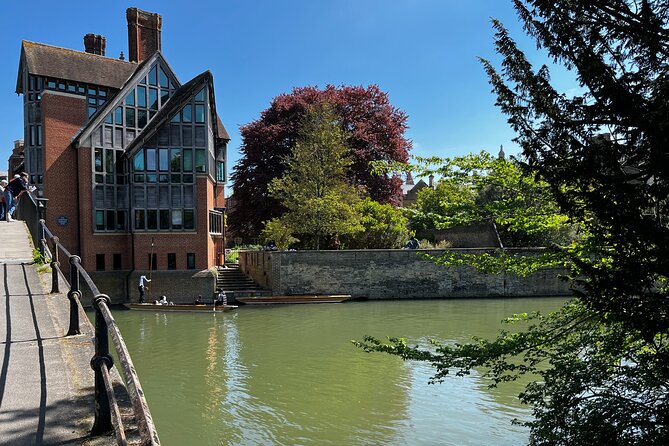
The Mathematical Bridge is a wooden footbridge across the River Cam. It links two parts of Queen’s College and has become one of Cambridge’s most recognizable small structures.
The planned stop is only five minutes, which is enough for a look and a photo. The route then continues to Corpus Christi College, founded in 1352 by the Guild of Corpus Christi and the Guild of the Blessed Virgin Mary.
These stops show the appeal of a self-guided walk. You can hear the key facts, pause to look around, and decide for yourself how long the scene deserves. A live guide might keep a group moving, but the app lets you linger when a bridge, college gate, or riverside view catches your attention.
Bene’t Street, where Cambridge feels less staged
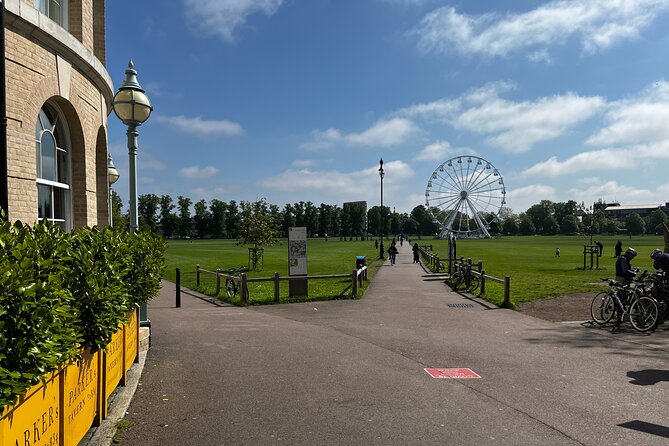
Bene’t Street is one of the most interesting stretches because it is not presented as one of the city’s headline sights. It is an old street named after St Bene’t’s Church, and the planned 15-minute stop gives you more time here than at several of the grander landmarks.
I like this kind of pause. Famous colleges can make Cambridge feel like a sequence of formal facades, while an older city street helps you picture the place as a working town as well as a university center.
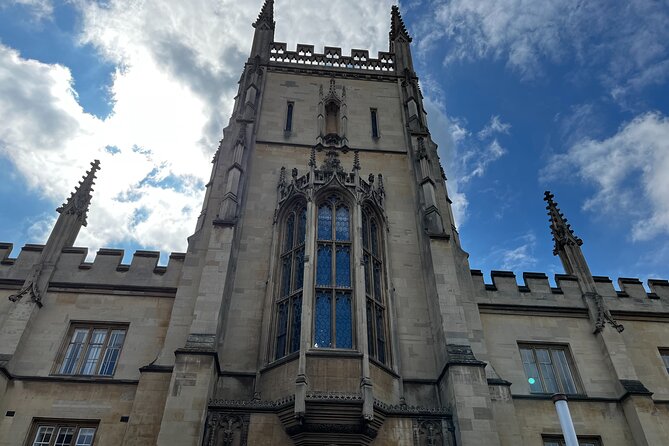
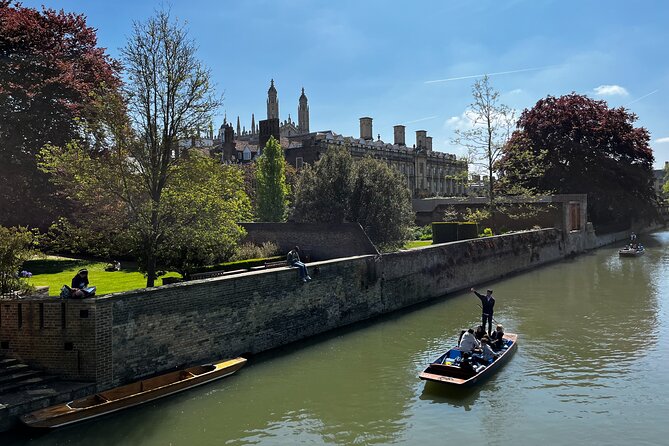
The route then reaches King’s College Chapel, one of Cambridge’s defining landmarks. The site began as floodplain beside the River Cam and later held medieval buildings. The chapel is a paid attraction, so admission is not part of the tour price.
The planned 15-minute stop is enough for an exterior look and basic context. If you want to go inside, check the chapel’s current admission arrangements and allow more time than the walking schedule suggests.
Great St Mary’s and Cambridge Market Square
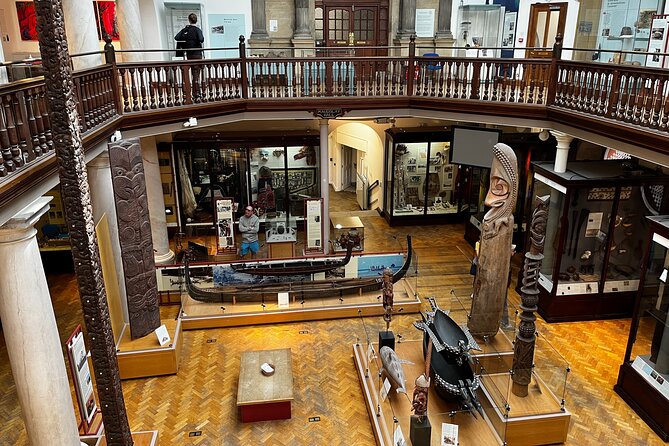
Great St Mary’s, officially the Church of St Mary the Great, reaches back to the twelfth century. Most of the current building dates from the late fifteenth and early sixteenth centuries.
Like King’s College Chapel, it requires separate admission according to the tour details. The route gives you about 10 minutes here, so you can decide if the church deserves a longer visit during your free time.
Next comes Cambridge Market Square beside the historic Guildhall. The square has hosted one of the country’s oldest and largest open-air markets. Its central location makes it a useful place to pause, look at the surrounding streets, and see a more everyday side of Cambridge.
The market stop is planned for 15 minutes. Market activity can vary, and the information provided does not promise a particular vendor or event, so think of this as a city-center orientation point rather than a guaranteed food stop.
Trinity College, the Round Church, and Senate House
The walk continues toward Trinity College, founded by Henry VIII in 1546. It is Cambridge’s largest college by land area and student population.
The route does not state that college entry is included. You should follow the app’s directions and current access rules rather than assume that every college courtyard is open. Universities are working institutions, and access can change.
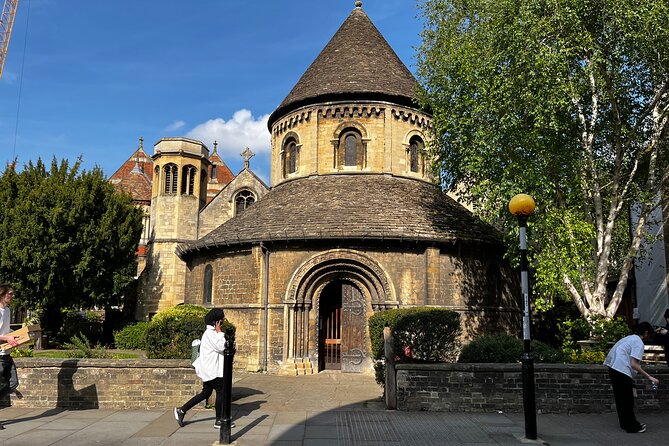
The Round Church, officially the Church of the Holy Sepulchre, dates from 1130. Crusaders who had returned from the Holy Land founded it. Its unusual circular design makes it easy to identify, and its story adds a religious and medieval layer to a route otherwise dominated by colleges and museums.
Admission is not included, and the planned stop is 10 minutes. If you plan to enter, give yourself extra time and check the church’s current opening arrangements.
Nearby, the Senate House provides another architectural marker. It is a neoclassical building designed by James Gibbs and completed in 1730. Together, the Senate House and surrounding colleges show how Cambridge’s academic identity was given a grand civic setting.
Garret Hostel Bridge and the final walk to the library
Garret Hostel Bridge brings you back to the River Cam and the physical setting of Cambridge. At this point, the floodplain is only about four meters above sea level, while the riverbed is about two meters above sea level. The coastline at King’s Lynn lies almost 50 miles away.
Those figures may sound technical, but they help explain why the river and low ground matter so much to the city’s development. The planned 10-minute stop gives you time to take in the bridge and river setting without rushing.
The final destination is Cambridge University Library on West Road. The library building dates from the early twentieth century and includes attractive internal architectural details. The route ends here, leaving you free to continue exploring Cambridge on your own.
The endpoint is useful because it gives the walk a clear finish rather than sending you back to the starting point. It also means you should think about your return journey before setting out, especially if you arrived at the bus station with luggage or a fixed departure time.
How the app works in real use
You receive three weeks of unlimited access to the self-guided tour. The package includes a map, GPS route, directions, stops, audio, written material, videos, photos, recommendations, and a before-you-go section on the electronic ticket.
Helen provides the audio commentary, and the voice is described as human rather than computer-generated. You can also use the written version. That choice matters because some people prefer to read quietly, pause often, or move at a different pace from the audio.
The app sends a prompt when you reach a stop. You can use that as a simple walking companion, letting the route tell you when to look up information. You still need to watch your surroundings and follow the map, since this is not an in-person guide physically leading you through the streets.
The private format means only your group participates, but there is no live guide included. Most people can take part, service animals are allowed, and the starting point is near public transportation.
Is $12.22 good value?
At $12.22 per person, the price is low for a two- to three-hour city walk with three weeks of access. You are paying for the route design, recorded commentary, written information, GPS directions, and the ability to use the material more than once.
The value is strongest if you want structure without a fixed group schedule. You can pause for a museum, stop for food, return to a college area, or use the route over more than one day during the access period.
The price is less of a bargain if you want a person to answer questions, adjust the route, or explain what you are seeing in real time. You also need to budget separately for paid entries such as King’s College Chapel, Great St Mary’s, and the Round Church.
Who should choose this Cambridge walk?
I would choose this tour if you like independent sightseeing but still want a clear route. It suits solo visitors, couples, families who prefer short listening sections, and anyone arriving without much knowledge of Cambridge.
It is also a good fit if you want more than college exteriors. The geology, zoology, archaeology, anthropology, and science stops give the walk a broader subject range.
You might prefer a live guide if personal conversation is central to your trip, or if you want someone to handle changes in access and timing. You should also avoid squeezing every museum and paid interior into the stated two or three hours. The route works best when you treat it as a flexible framework rather than a race.
Should you book it?
Book this Cambridge self-guided walk if you want an affordable introduction with strong control over your time. The combination of Helen’s audio, written text, GPS prompts, and three weeks of access gives you room to explore at your own pace.
Skip it if you need a live expert beside you or want admissions and a punting trip included. For everyone else, the price is modest, the route covers a wide range of Cambridge sights, and the museum section gives it more substance than a basic city stroll.
FAQ
Where does the Cambridge self-guided walking tour start?
It starts at Cambridge Bus Station on Drummer Street, Cambridge CB1 1NE, United Kingdom.
Where does the tour end?
It ends at Cambridge University Library on West Road, Cambridge CB3 9DR. You are free to continue exploring Cambridge after reaching the endpoint.
How long does the walk take?
The estimated duration is two to three hours. Visiting museums or paid attractions can make your day longer.
What language is offered?
The tour is offered in English.
Is there an in-person guide?
No. This is a self-guided experience using an app, audio commentary, written information, maps, and GPS directions.
Who provides the audio commentary?
Helen provides the audio guide. The information states that the voice is not computer-generated.
How long can I use the tour?
You receive three weeks of unlimited access to the self-guided tour in the app.
Are admission tickets included?
Admission is not included for King’s College Chapel, Great St Mary’s Church, the Round Church, and Cambridge University Library. The tour details mark several other stops as free, but you should check current access rules for college grounds and museums.
Does the tour include a punting trip?
No. The walk stops at Scudamore’s Mill Lane Punting Station and provides information about Jack Scudamore and the company’s history, but it does not include a boat ride.
Is the tour suitable for most people?
Most people can participate, and service animals are allowed. The route is near public transportation and operates daily from 12:00 AM to 11:30 PM during the stated operating period.
Just added around the UK
- Inverness and Outlander Private Self-Guided Walking Tour★ 5.0 · 4 reviews
- Inverness Quest: Self Guided City Walk & Immersive Treasure Hunt★ 4.0 · 5 reviews
- Discovering Inverness: A Self-Guided Audio Tour of the Capital of the Highlands★ 4.5 · 19 reviews
- Glasgow Private Self-Guided Tour★ 4.0 · 21 reviews
- Falmouth Tour App, Hidden Gems Game and Big Britain Quiz (1 Day Pass) UK★ 4.5 · 3 reviews
- A Walk through Tudor Ipswich Tour and Exploration Game★ 4.5 · 3 reviews
- The Slow Food Capital of England: A Self-Guided Tour in Ludlow★ 4.5 · 9 reviews
- Highlights from Edinburgh’s Old Town: A Self-Guided Audio Tour★ 5.0 · 4 reviews
UK Audio Tours, compared.

London: Emirates Stadium Entry Ticket and Audio Guide
Read our review →
Westminster Abbey Entrance Ticket Including Audio Guide
Read our review →
London: British Museum Audio Tour & Priority Entrance Ticket
Read our review →

Golden Tours York Hop-on Hop-off Open Top Bus Tour with Audio Guide
Read our review →
Bath: Roman Baths Entry Ticket with Audio Guide
Read our review →
Canterbury Cathedral: Entry Ticket with Audio Guide
Read our review →Browse the lists this tour appears in