
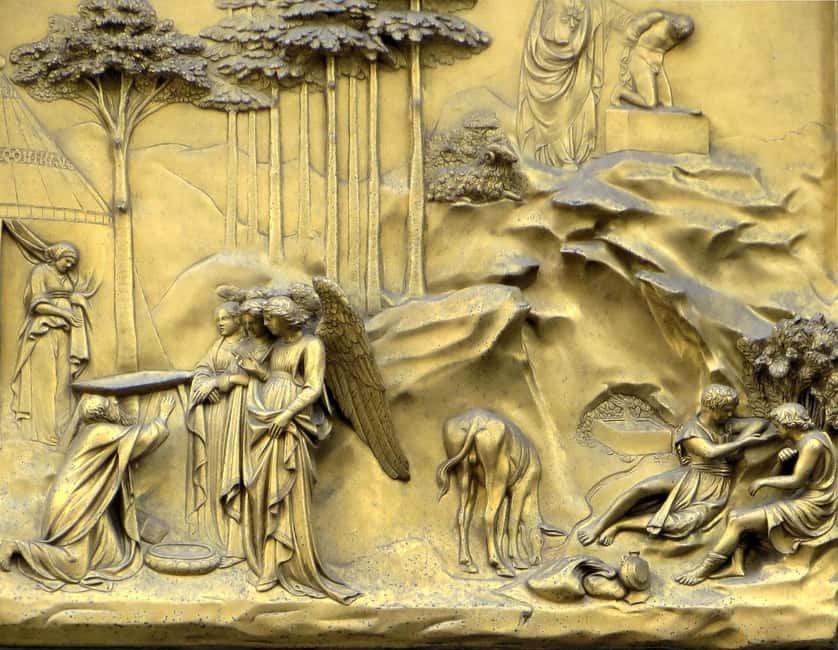
REVIEW · FLORENCE AUDIO TOURS
Florence: Palazzo Vecchio Entry Ticket with Audio Guide
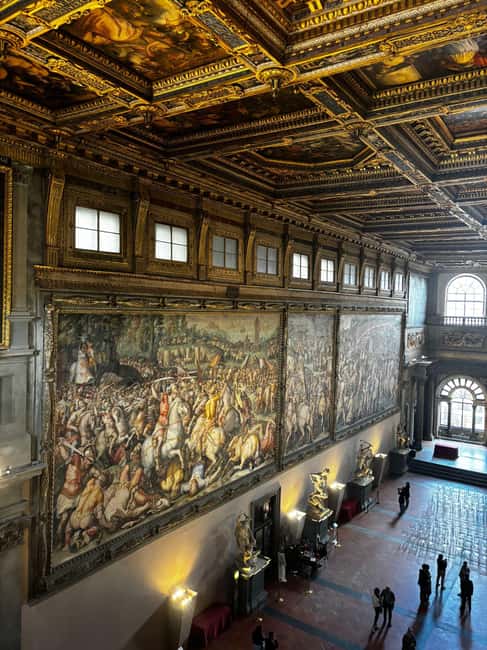
Palazzo Vecchio is Florence’s great civic palace, and its biggest room does not whisper. The Salone dei Cinquecento surrounds you with Vasari’s enormous frescoes, monumental sculpture, and the visual language of Medici power. This is where the city’s political story becomes physical: high ceilings, grand decoration, and a room built to impress.
I like the reserved entry because it gives you a fixed time and a separate entrance, though security checks can still slow things down. I also like the smartphone audio guide, which lets you choose your pace instead of trailing behind a guide’s schedule. The main drawback is simple: you must bring headphones, a charged smartphone, and an internet connection, and one hour can feel short if you stop often.
Key points to know before you go

- The Hall of the Five Hundred is the main event: Give this vast room enough time for its ceiling, frescoes, and sculptures.
- The visit begins behind Neptune’s Fountain: Look for the host with the GetYourGuide flag in Piazza della Signoria.
- This is self-guided, not a live museum tour: The host helps with entry, while your audio commentary comes through your phone.
- The Hall of Maps may have limited access: It is included when open, but official events or restoration can close rooms.
- Bring headphones and avoid backpacks: The audio guide needs your own earphones, and backpacks are not allowed.
- The $36 price buys convenience as much as admission: It works best if you value a reserved slot, a separate entrance, and commentary in your language.
Why Palazzo Vecchio deserves time on your Florence schedule
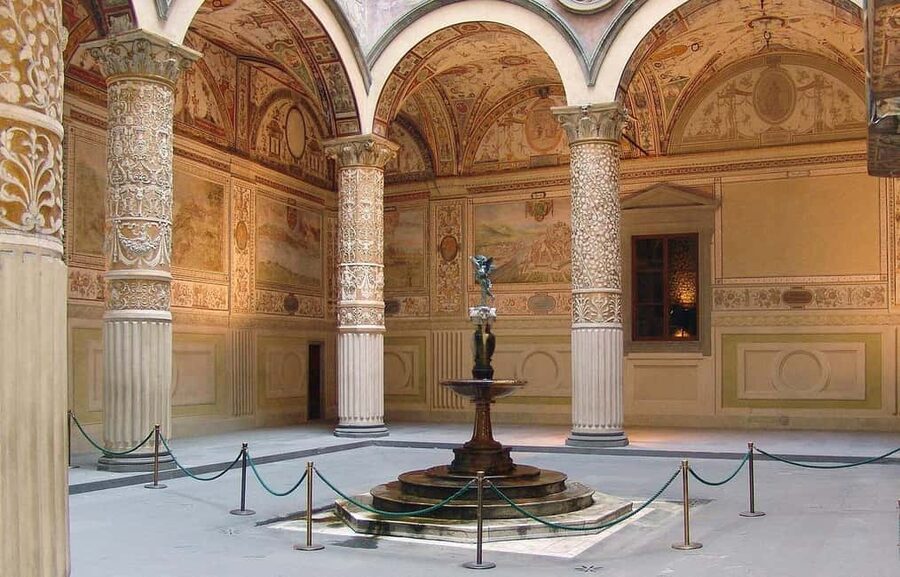
Palazzo Vecchio is not just another art museum. It was the working center of Florence’s civic power, and the building still feels tied to government, ceremony, and public life. You are walking through rooms designed to show authority, not simply to hang pictures.
That difference matters. In a conventional gallery, you look at one artwork at a time. Here, the room itself is part of the message. Painted walls, carved details, ceiling decoration, sculptures, and maps all work together to explain how Florence wanted to see itself.
The setting helps, too. Your visit starts in Piazza della Signoria, one of Florence’s most important public squares. The meeting point is behind the Fountain of Neptune. Look for a host holding a GetYourGuide flag, with English and Italian assistance available before you enter.
This arrangement suits you if you want help finding the correct entrance but prefer to explore alone afterward. It is not a traditional guided tour with a person talking continuously in every room. The host handles the meeting and entry process, then the digital audio guide gives you the commentary.
More Skip-the-Line Audio Guide Tickets in Florence
- Florence: Palazzo Vecchio Entrance Ticket & Audioguide
★ 4.4 · 4,822 reviews - Florence: Uffizi Gallery Timed Entry Ticket & Audio Guide
★ 4.2 · 2,794 reviews - Florence: Michelangelo’s David Entrance Ticket and Audio App
★ 4.3 · 1,901 reviews
Meeting at Neptune’s Fountain
Allow enough time to find the meeting point. Piazza della Signoria is easy to recognize, but it is a busy central square with several statues, entrances, and people meeting for different activities. The instructions specify the area behind Neptune’s Fountain, where the host will hold the GetYourGuide sign.
Your ticket is for a reserved time slot. That helps you plan your morning or afternoon, but it does not mean every part of the entrance will be instant. Mandatory security checks can create a wait, even with separate entry arrangements.
There are a few practical rules worth taking seriously. Backpacks are not allowed, and pets are not permitted. You should arrive with your headphones, smartphone, and an internet connection ready. If your phone battery is low, this is the wrong place to discover it.
The activity is wheelchair accessible, although access to particular rooms can still depend on temporary conditions inside the building. Some areas may close for restoration or official events, so your route can change on the day.
The Salone dei Cinquecento sets the tone
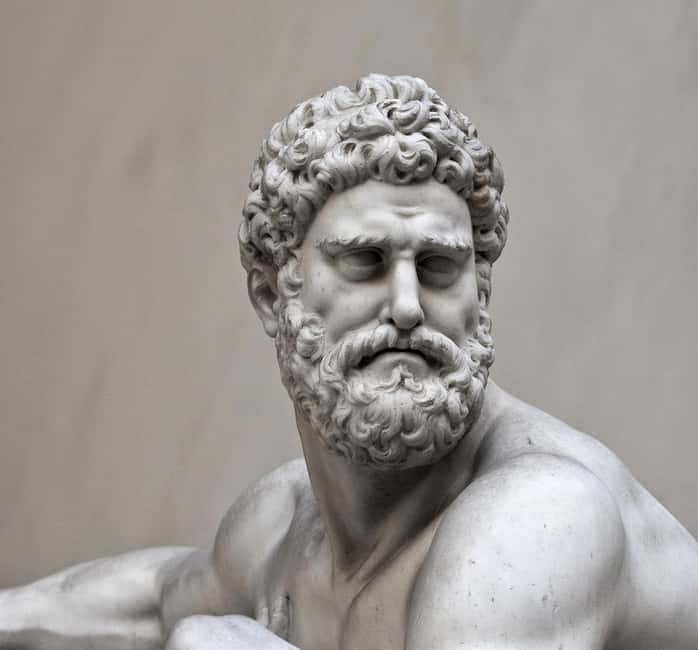
Once inside, make the Hall of the Five Hundred your first major priority. This is the palace’s grand showpiece, a vast chamber decorated with Vasari’s frescoes and monumental sculpture.
The scale is the first thing to notice. The room was made for civic meetings and public ceremony, so it does not feel intimate. Its size tells you that Florence’s ruling class wanted politics to look powerful, organized, and almost theatrical.
The audio guide can help you read the room instead of simply staring upward. Use it to connect the painted scenes, architecture, and political purpose. You will get more from the visit if you pause after each section rather than playing the commentary while rushing toward the next doorway.
The room also gives you an introduction to the palace’s larger theme: art here serves public identity. Vasari’s work is not decoration placed in an empty container. It fills a room meant to express Florence’s authority and the Medici family’s role in the city.
You may find the Hall of the Five Hundred more impressive for its scale than for the chance to examine small artistic details. If you want quiet, close looking at individual paintings, the palace may feel demanding. If you enjoy architecture, politics, and art working together, this is the strongest part of the visit.
Medici apartments and the private side of power
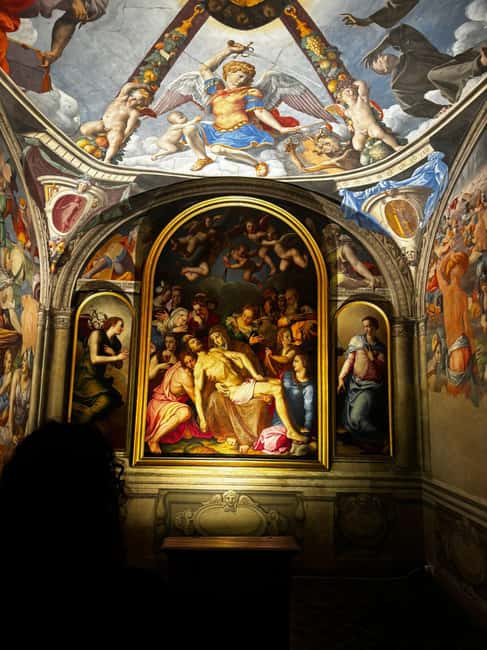
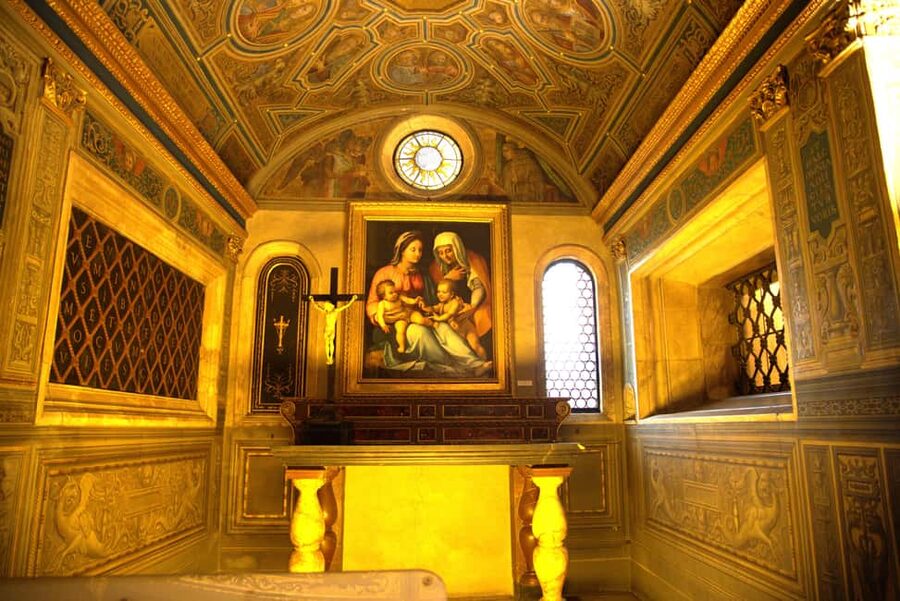
After the public grandeur, the Royal Apartments offer a more personal view of the people who ruled Florence. These rooms were connected with the Medici family’s private life, so they shift the mood from public assembly to household power.
The contrast is useful. The Salone dei Cinquecento tells you how the city wanted to appear before an audience. The apartments suggest how rulers lived and moved away from the civic crowd. Look for the difference in scale, decoration, and purpose as you pass from the large public hall into more controlled domestic spaces.
The audio guide is particularly helpful here because rooms can appear similar when you are moving quickly. Historical context gives each chamber a reason to matter. Instead of seeing only ornate ceilings and decorated walls, you can consider who used the room and how it fitted into the palace’s political life.
Do not expect a long private-palace visit within this one-hour format. You are getting an introduction to the apartments, not an exhaustive inspection of every corner. Take a few minutes for the rooms that catch your eye, then keep moving so you still have time for the maps and major artworks.
More Skip-the-Line Audio Guide Tickets in Italy
- Florence: Uffizi Gallery Reserved Entry Ticket & Audioguide
★ 4.5 · 970 reviews - Florence: Santa Maria Novella Entry Ticket & Audioguide
★ 4.3 · 717 reviews - Florence: Duomo Cathedral Timed Entry Ticket & Audio App
★ 3.7 · 472 reviews - Florence: Uffizi Official timed Entry Ticket & Audio Guide
★ 3.9 · 244 reviews
The Hall of Maps and Florence’s view of the world
The Hall of Maps is one of the most distinctive stops in Palazzo Vecchio. Its detailed cartography shows how people in Renaissance Florence pictured the wider world. Maps are valuable here not only as geographic records, but also as clues to the knowledge, ambitions, and assumptions of the period.
This room rewards patience. Look closely at the details and listen to the commentary before moving on. The maps may seem less instantly dramatic than Vasari’s enormous hall, but they give the visit a different kind of interest. You are seeing how geography became part of the palace’s story.
Access is not guaranteed. The Hall of Maps, along with other rooms or routes, may be unavailable during official events or restoration work. Do not build your entire decision around seeing one specific room. The palace still offers a worthwhile visit through its major halls, apartments, sculptures, and artworks if a section is closed.
The mention of hidden routes also makes this area appealing to curious visitors, but access to restricted areas or special itineraries is not included unless specifically stated. Stay with the ordinary visitor route rather than expecting secret passages as part of the ticket.
Renaissance artists in a political palace
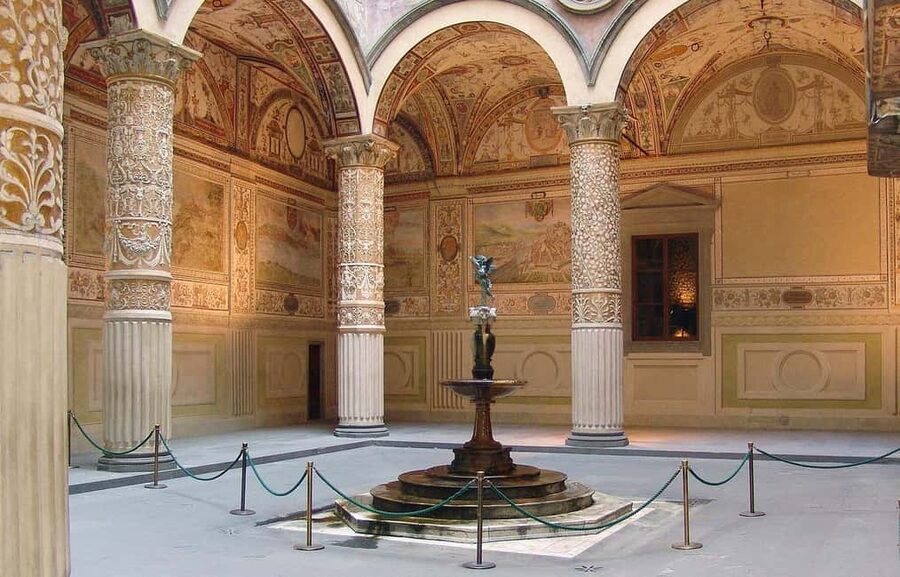
The experience brings you close to works associated with Vasari, Donatello, and Michelangelo. Their names matter, but the setting matters just as much. You are not seeing Renaissance art in isolation. You are seeing it in the building where Florence’s political and cultural identity took shape.
Vasari is central to the visit because his frescoes dominate the Hall of the Five Hundred. Donatello and Michelangelo add another layer, linking sculpture with the city’s civic ideals and the Medici period. The audio guide helps connect those artistic contributions to the palace rather than leaving you to identify names without context.
I recommend resisting the urge to photograph every decorated surface. A phone can record the room, but it cannot replace taking a moment to understand why a particular sculpture or fresco is placed there. Use the audio guide selectively, pause when a work interests you, and let less important details pass.
Because the guide is digital, you are free to spend more time with one artist and less with another. That flexibility is one of the best reasons to choose this format. A specialist in Renaissance painting might want more time with the frescoes, while a first-time visitor may prefer a broad tour of the building.
How the one-hour format works
The advertised duration is one hour, including the museum visit. That is enough for a focused introduction, but it is not enough for a slow, scholarly examination of every room.
If you are efficient, you can see the main highlights: the Hall of the Five Hundred, the Royal Apartments, the Hall of Maps if open, and selected works linked with major Renaissance artists. You will need to keep moving and avoid listening to every audio segment in full.
If you want a calmer visit, choose the rooms that matter most to you before entering. My priority order would be:
- Hall of the Five Hundred
- Royal Apartments
- Hall of Maps, if open
- Sculptures and works connected with Vasari, Donatello, and Michelangelo
The route begins and ends around Piazza della Signoria, so the experience fits neatly into a day of sightseeing in central Florence. You do not need transport between the meeting point and the palace. That makes it useful before lunch, between other city visits, or as a compact introduction to Florence’s civic past.
The small group is limited to 10 participants, but remember that the museum portion remains self-guided. A small group makes the entry process less unwieldy than a large tour, while the audio format lets you spread out once you are inside.
The audio guide: useful, but prepare your phone
The audio guide is offered in many languages, including English, Italian, French, German, Spanish, Portuguese, Chinese, Japanese, Korean, Dutch, Russian, Greek, and several others. That range is a major advantage if you are more comfortable learning in a language other than English or Italian.
The commentary comes in digital format through your own smartphone. You need an internet connection and your own earphones. Personal headphones are strongly recommended because they make it easier to hear the narration in large rooms and let you listen without disturbing other people.
This setup has both strengths and weaknesses. You control the volume, pace, and language, and you can pause when you want to look carefully. On the other hand, you are responsible for your device, battery, connection, and headphones. There is no live guide to answer follow-up questions or adjust the explanation to your interests.
The host or greeter speaks English and Italian. That is useful for the meeting and entry, but do not confuse it with a live, room-by-room tour in those languages. The main interpretation comes from the audio guide.
Is $36 a fair price?

At $36 per person, this is not the cheapest way to enter a museum. The value rests on convenience and structure rather than on a long guided experience.
I think the price makes sense if you want a reserved time slot, a separate entrance, and commentary in your preferred language. It is also a reasonable choice when your Florence schedule is tight and you do not want to spend time working out entry arrangements at the palace.
The value is weaker if you already know the building well, have your own detailed guidebook, or prefer to move through museums without commentary. Since the visit lasts only one hour and the audio guide uses your own phone, you are paying partly for advance planning and access rather than for a long personal tour.
Free cancellation up to 24 hours before the visit and the option to reserve now and pay later add useful flexibility. Those terms are practical when your Florence plans are still shifting, though you should still check the chosen time slot before booking.
Who should book this Palazzo Vecchio visit?
I would choose this experience for a first visit to Palazzo Vecchio, especially if you want the main rooms without committing to a half-day museum tour. It suits solo visitors, couples, and small groups who like to stop, listen, and move on at their own speed.
It is also a good fit for families with older children who can manage a phone-based guide. The large rooms and maps provide visual interest, but younger children may find one hour of historical commentary less engaging.
Art-minded visitors will appreciate the connection with Vasari, Donatello, and Michelangelo. History-minded visitors will get a clear sense of Florence as a city governed through ceremony, public art, and the Medici presence.
I would look elsewhere if you want a live expert who can answer questions, access to restricted routes, a tower climb, or a long and highly detailed art lesson. The ticket does not include tower access, and special itineraries are excluded unless specifically listed.
Should you book it?
Book it if you want a focused look at Florence’s civic palace, value a reserved entry, and are happy to guide yourself with your phone. The Hall of the Five Hundred alone gives the visit a strong visual center, while the apartments and maps add useful context about Medici life and Renaissance Florence.
Skip it if you dislike phone-based tours, cannot bring headphones, or want to climb the tower. Also keep your expectations sensible: one hour covers the major sights, not every detail.
For the best experience, meet the host behind Neptune’s Fountain with time to spare, carry headphones instead of a backpack, and enter with your phone ready. Then give the Hall of the Five Hundred your full attention before moving into the quieter rooms. That simple plan will help you get real value from the visit.
FAQ
Where does the Palazzo Vecchio experience begin?
It begins in Piazza della Signoria, behind the Fountain of Neptune. Look for the host holding the GetYourGuide flag.
How long does the visit last?
The stated duration is one hour. Check available starting times when selecting your visit.
Is the entry ticket reserved for a specific time?
Yes. Entry is valid for a reserved time slot, although security checks can still cause some waiting.
Is the audio guide included?
Yes. A multilingual digital audio guide is included with the museum entry.
What do I need to use the audio guide?
You need your own smartphone, an internet connection, and personal headphones or earphones.
Is the tower included?
No. Climbing the tower is not included in this experience.
Can I visit every room and special route?
No access is guaranteed to restricted areas or special itineraries. The Hall of Maps and other rooms may close temporarily for official events or restoration work.
Just added around Florence
- Florence: Uffizi Gallery Reserved Ticket & Digital Audio Guide★ 4.5 · 3 reviews
- Around Florence Hills: App‑Guided e‑Vespa Tour + Wine&Food★ 4.5 · 22 reviews
- Florence: Uffizi Gallery Audio Guided Tour led by Tour Leader★ 3.5 · 6 reviews
- Florence: Uffizi Gallery Timed Entry Ticket with Audio★ 3.0 · 3 reviews
- Uffizi Gallery: Self-guided App Visit & Optional Accademia Museum★ 4.0 · 19 reviews
- Uffizi Gallery Audio-Guided Visit with optional Accademia Gallery★ 3.5 · 42 reviews
- Uffizi Combined Ticket:UFFIZI, PITTI, BOBOLI & digital audioguide★ 4.0 · 26 reviews
- Accademia Gallery Skip the line Tickets with Audio Guide★ 4.0 · 10 reviews
Florence Audio Tours, compared.
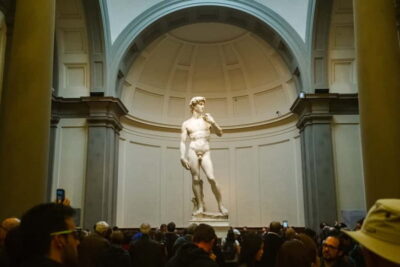
Florence: Timed Entry to Michelangelo’s David + Audio App
Read our review →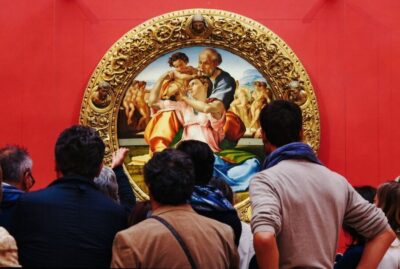
Florence: Uffizi Priority Ticket & Masterpieces Audio App
Read our review →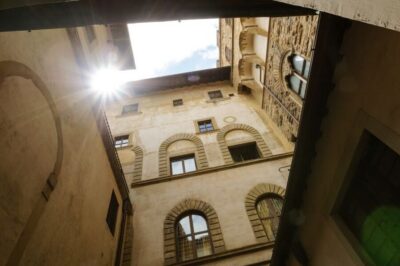
Florence: Palazzo Vecchio Entrance Ticket & Audioguide
Read our review →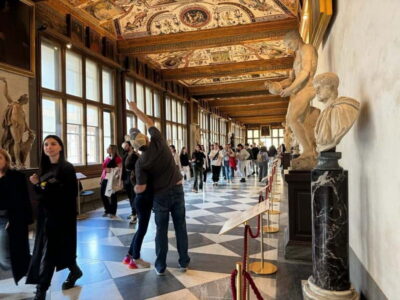
Florence: Uffizi Gallery Timed Entry Ticket & Audio Guide
Read our review →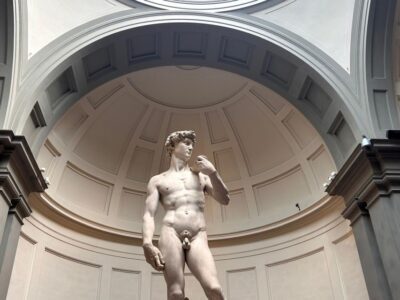
Florence: Michelangelo’s David Entrance Ticket and Audio App
Read our review →
Florence: Uffizi & Accademia Priority Tickets with Audio App
Read our review →
Florence: Eco-Friendly Golf Cart City Tour with Audio Guide
Read our review →
Florence: Uffizi Gallery Reserved Entry Ticket & Audioguide
Read our review →Browse the lists this tour appears in