REVIEW · FLORENCE AUDIO TOURS
Florence: Michelangelo’s David Entrance Ticket and Audio App
Michelangelo’s David is the reason most people come, and seeing the 17-foot marble figure in person has a force that photographs cannot match. I like the reserved entry, which can save you from a long ticket-office wait, and I like having an audio app instead of being tied to a guide’s pace. The catch is that this is not a live tour, and the Pop Guide app can be brief, hard to match with individual works, or unreliable if you have not prepared your phone.
I also like the freedom to linger at David, then move through the rest of the Accademia at your own speed. The main practical concern is timing: you must meet the host, collect the physical ticket, and reach the entrance at your assigned time. Even with a reservation, the museum may impose a 15 to 20 minute wait when the galleries are crowded.
Key points at a glance
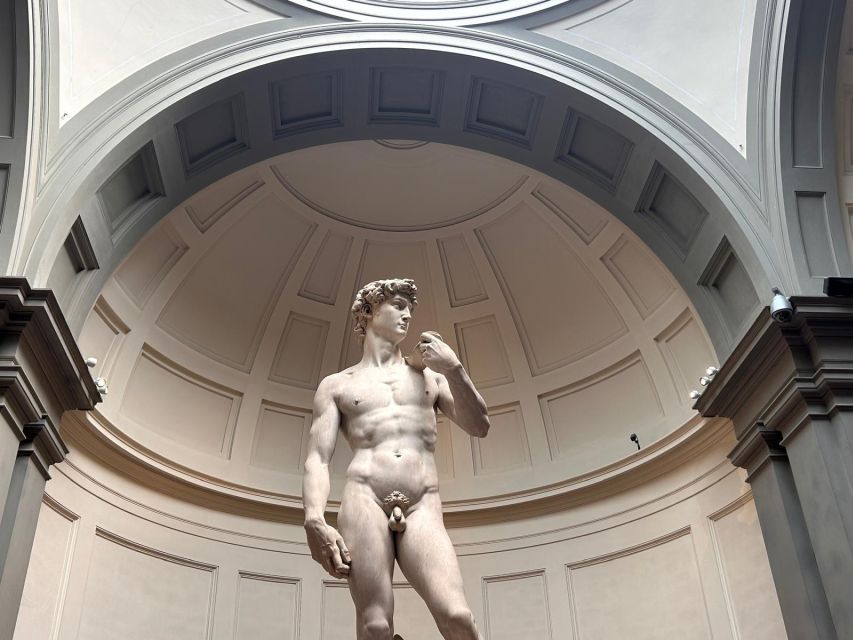
- David in the Hall of the Prisoners: See Michelangelo’s famous statue alongside his unfinished marble figures, which reveal how he carved.
- Timed entry from $38: The price is higher than a basic museum ticket, but it can be worthwhile when official tickets are sold out or the line is long.
- Pop Guide audio app: Download the app before arrival, bring headphones, and expect a flexible self-guided visit rather than a full live tour.
- More than one masterpiece: Giotto, Botticelli, medieval altarpieces, plaster models, and Medici musical instruments fill out the visit.
- Simple meeting point: Find the host near the Carrefour Express supermarket and look for the white flag marked ENJOY ROME.
- About three hours available: The ticketed experience is listed as three hours, though the actual museum visit can be shorter if David is your main goal.
Why seeing David in person is different
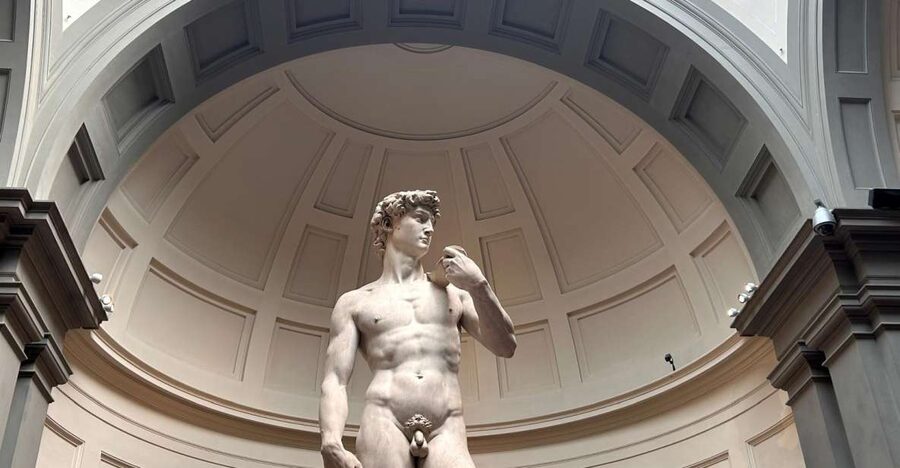
You may know David from books, screens, and souvenir shops. None of that prepares you for the statue’s scale. Michelangelo’s figure is much larger than life, and the details become clearer as you walk around it: the hands, the tension in the neck, the alert expression, and the carefully balanced pose.
David was carved from a single block of marble, and the statue’s finish gives the skin an almost warm presence. You can see why people often pause longer than planned. The room is crowded, but the space around the statue lets you view it from several angles.
The sculpture’s power is not only its technical skill. David represents the biblical hero before his fight with Goliath, and Michelangelo presents him as focused, watchful, and ready. You are looking at a religious subject that also became a symbol of Florence’s strength and independence.
Give yourself time here. It is easy to rush toward the famous statue, take a photograph, and leave. Instead, look upward, step to the side, and study the proportions. Some details that seem subtle in an image are striking in person because of the statue’s size.
More Skip-the-Line Audio Guide Tickets in Florence
- Florence: Palazzo Vecchio Entrance Ticket & Audioguide
★ 4.4 · 4,822 reviews - Florence: Uffizi Gallery Timed Entry Ticket & Audio Guide
★ 4.2 · 2,794 reviews - Florence: Uffizi Gallery Reserved Entry Ticket & Audioguide
★ 4.5 · 970 reviews
Meeting the host near Carrefour Express
The first step is not the museum entrance itself. You meet a member of the activity provider’s staff in front of the Carrefour Express supermarket, then exchange your voucher for a physical entry ticket.
Look for a person holding a white flag marked ENJOY ROME. The meeting point is intended to be easy to find, and the host directs you toward the correct queue once your ticket is ready. Arrive early enough to locate the meeting point without stress. Florence’s center is walkable, but a few minutes spent looking for the supermarket can matter when your ticket has a fixed entry time.
This handoff is useful because you do not simply show a phone voucher at the museum and hope for the best. You receive the ticket and instructions in person. The process is usually quick, but you should not treat the start time as a loose suggestion.
The host or greeter speaks English. After the ticket exchange, you are directed to a separate entrance for timed ticket holders. This is a ticket service with assistance at the start, not a guided tour through the galleries.
Timed entry and the real meaning of skip the line
The phrase skip the line needs a little explanation. You skip the ticket-office line by using a reserved ticket and a special entrance, but you do not always walk straight inside with no pause.
The museum can delay entry when many people are already inside. A waiting period of 15 or 20 minutes may occur under museum rules, and larger organizational delays are possible. The important advantage is that you avoid standing for hours to buy a ticket, particularly during busy periods or hot weather.
Your ticket is timed. If you arrive late, entry is not guaranteed, and a refund is not guaranteed either. Build in extra time for walking to the meeting point, finding the host, collecting the ticket, and joining the correct queue.
This arrangement is especially useful when the official museum tickets are sold out. The $38 price may be only a few euros more than buying directly, depending on the date. If you are choosing between losing a morning in line and paying extra for a timed entry, the added cost can make good sense.
If the museum has plenty of official tickets available at a lower price, the value is less clear. You are paying for convenience, ticket coordination, and the audio app, not for a longer or more private visit.
The Hall of the Prisoners and Michelangelo’s unfinished figures
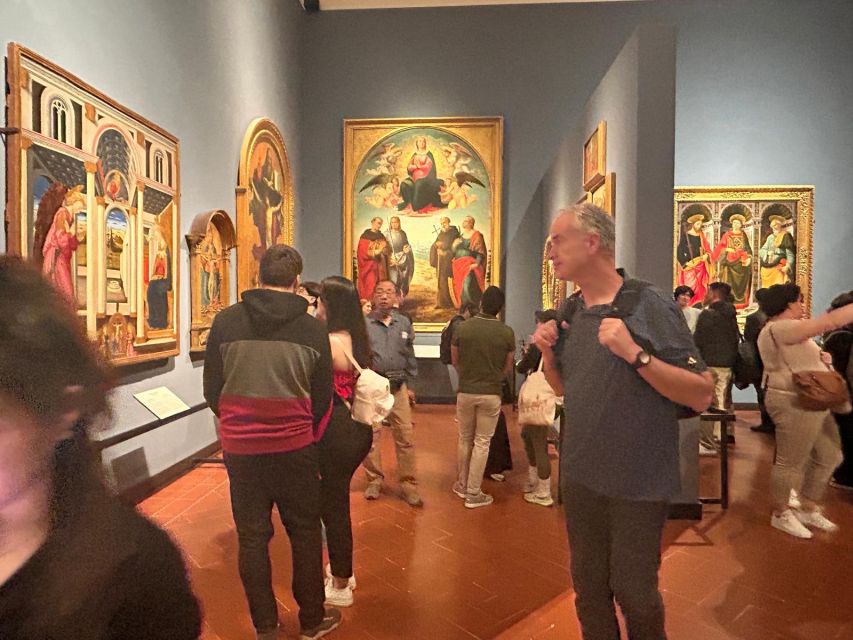
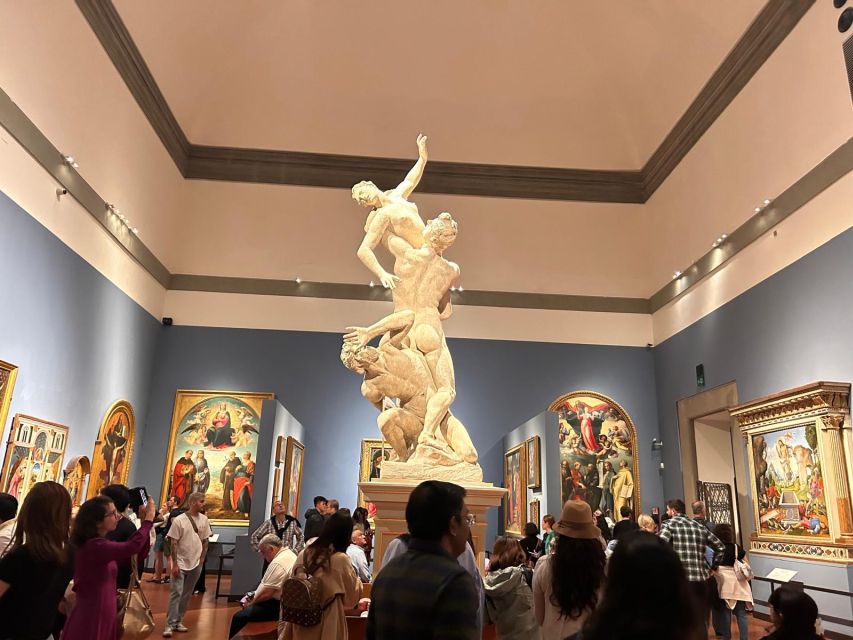
After entry, the main route leads toward David through the Hall of the Prisoners. Along the way, you see Michelangelo’s unfinished sculptures, often called the Prisoners or Slaves.
These figures appear to be struggling out of the marble. Their incomplete surfaces give you a rare look at the artist’s carving process. You can see where the stone remains rough and where the human form begins to emerge.
This is one of the most valuable parts of the visit for anyone interested in sculpture. David shows the finished result. The unfinished figures show the physical work behind it. They help you understand that Michelangelo did not simply create a smooth, perfect body from nowhere. He removed stone until the figure appeared.
The corridor can feel crowded, and people naturally slow down near the works. Use the audio app when you can, but do not worry if you prefer to study the marble quietly. The museum is small enough to explore without a strict route.
More Skip-the-Line Audio Guide Tickets in Italy
- Florence: Palazzo Vecchio Entry Ticket with Audio Guide
★ 4.4 · 837 reviews - Florence: Santa Maria Novella Entry Ticket & Audioguide
★ 4.3 · 717 reviews - Florence: Duomo Cathedral Timed Entry Ticket & Audio App
★ 3.7 · 472 reviews - Florence: Uffizi Official timed Entry Ticket & Audio Guide
★ 3.9 · 244 reviews
The Gipsoteca and nineteenth-century sculpture
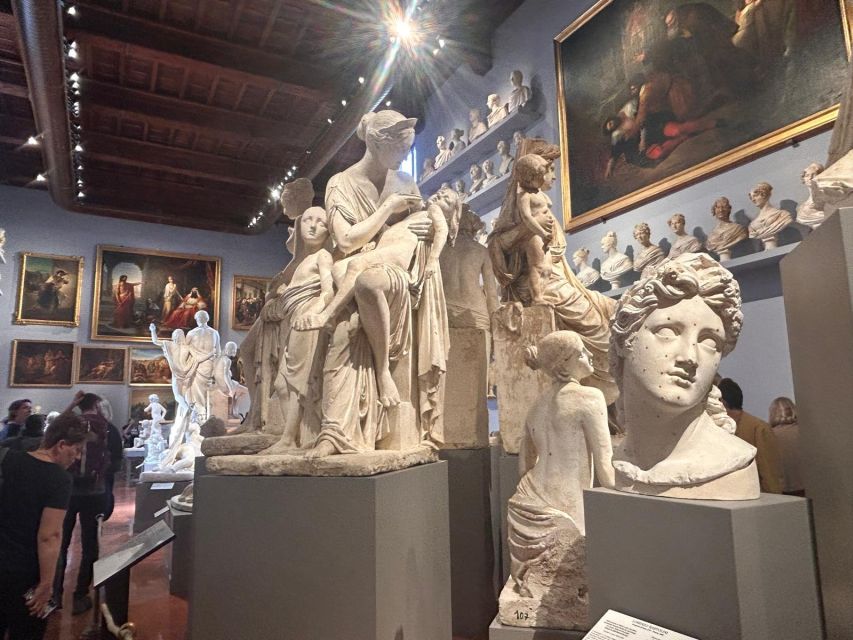
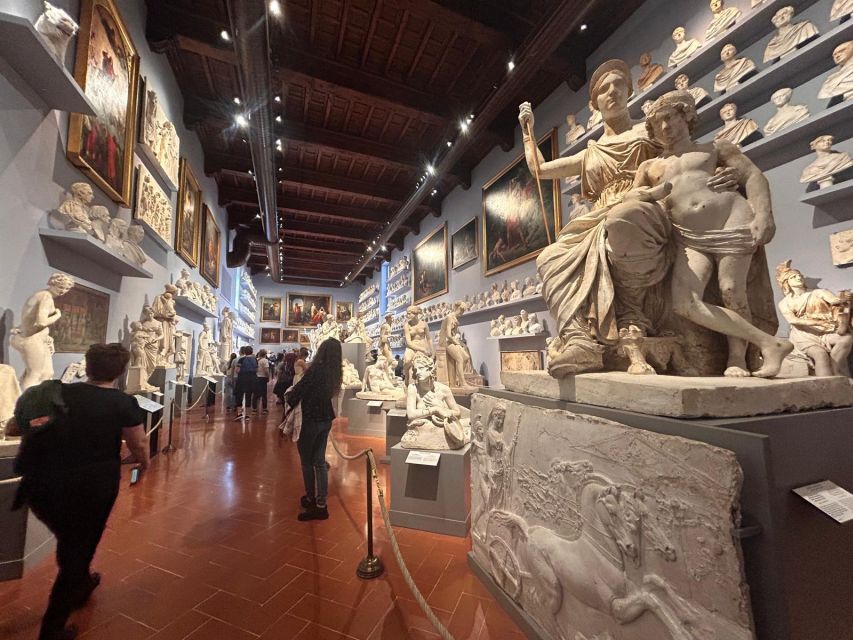
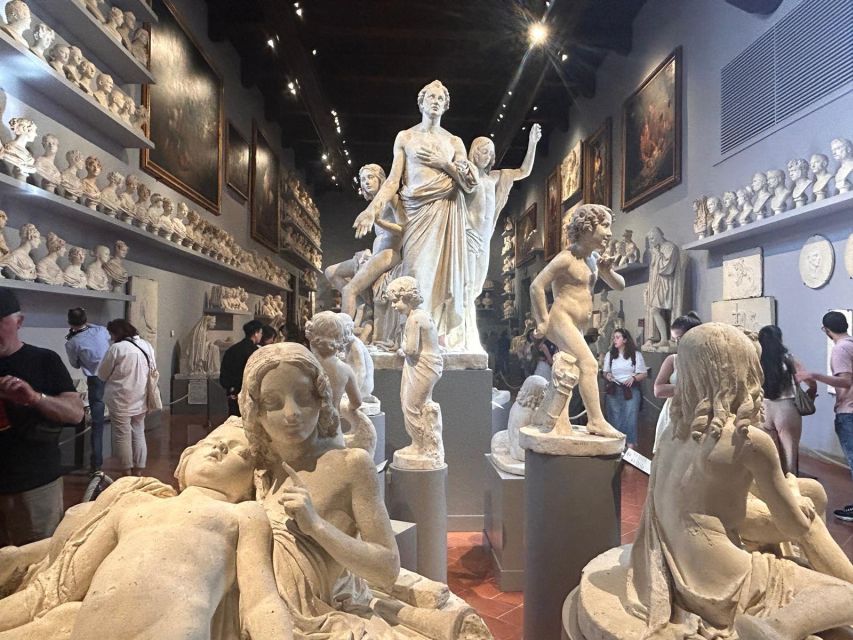
The Gipsoteca contains original plaster models made by Florentine sculptors in the nineteenth century. This room changes the mood after the intense focus on Michelangelo.
Plaster models were important working tools for sculptors. They allowed artists to plan a composition and refine the figure before producing a final work in marble or another material. The room gives you a broader view of Florence’s sculpture tradition, rather than treating David as the museum’s only worthwhile object.
You may find this section less instantly memorable than the main hall. Still, it rewards a slower look, especially if you enjoy the process of making art. It also helps explain why the Accademia is more than a single-statue stop.
Medici instruments and three Stradivarius violins
The museum also displays musical instruments from the Medici collection. Among them are three instruments made by Stradivarius.
This is an unexpected change of subject. After marble and painted panels, the delicate instruments show another side of court life in Florence. The Medici family supported music as well as visual art, and these objects connect the museum to the city’s wider cultural world.
The instruments are easy to overlook if you are moving quickly toward the painting galleries. If you have an interest in music, make sure you include this section. The audio app may provide useful context, though its coverage is not equally detailed for every object.
Medieval and Renaissance paintings by Giotto and Botticelli
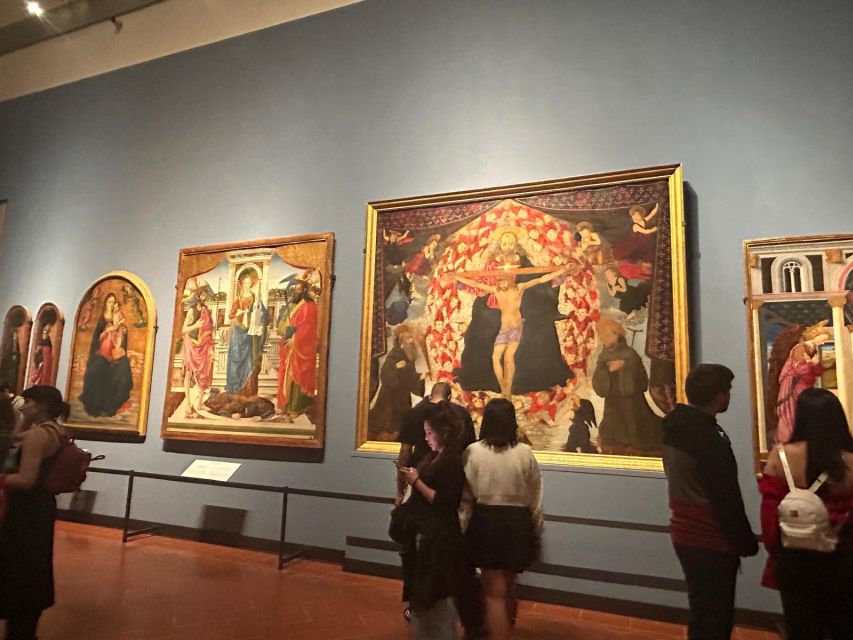
The painting galleries contain works by medieval and Renaissance artists, including Giotto and Botticelli. These rooms give you the visual setting for David’s period and help you see how Florentine art changed across several generations.
Giotto’s work is important for the move toward more natural-looking figures and emotional expression. Botticelli brings a later Renaissance elegance and delicacy. You do not need to know every artist or date to enjoy the contrast between the paintings.
The galleries also contain works that are less famous than David but valuable for showing how religious images were made for churches, chapels, and private devotion. Look at the gold backgrounds, repeated sacred figures, and carefully arranged panels. The museum’s collection is a reminder that Florence’s art story did not begin with Michelangelo.
The audio guide can help you pick out key works, but its coverage has limits. Some app users find it informative and easy to follow. Others have trouble locating the artwork that matches the audio or find that not every important point has a recording. Treat it as a helpful layer, not a substitute for a trained live guide.
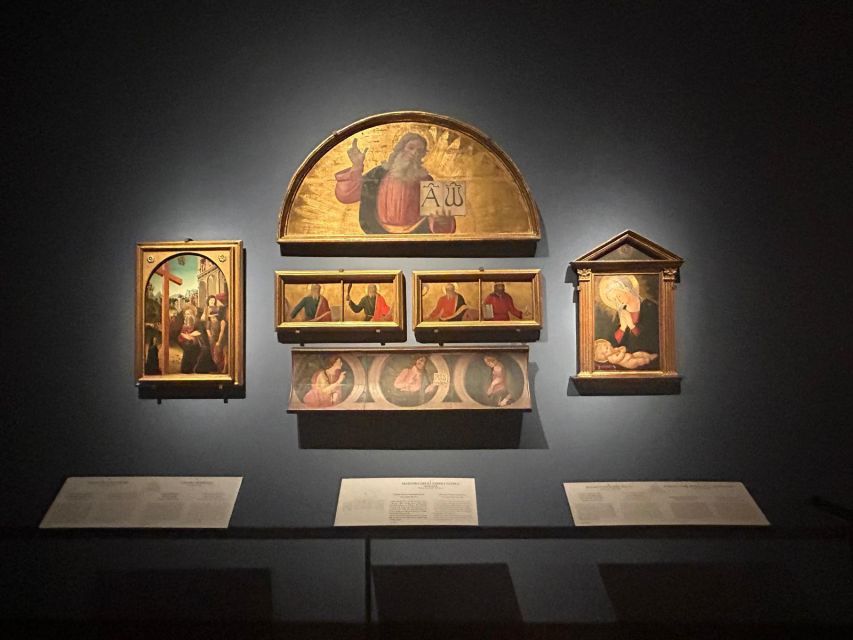
Medieval altarpieces on the top floor
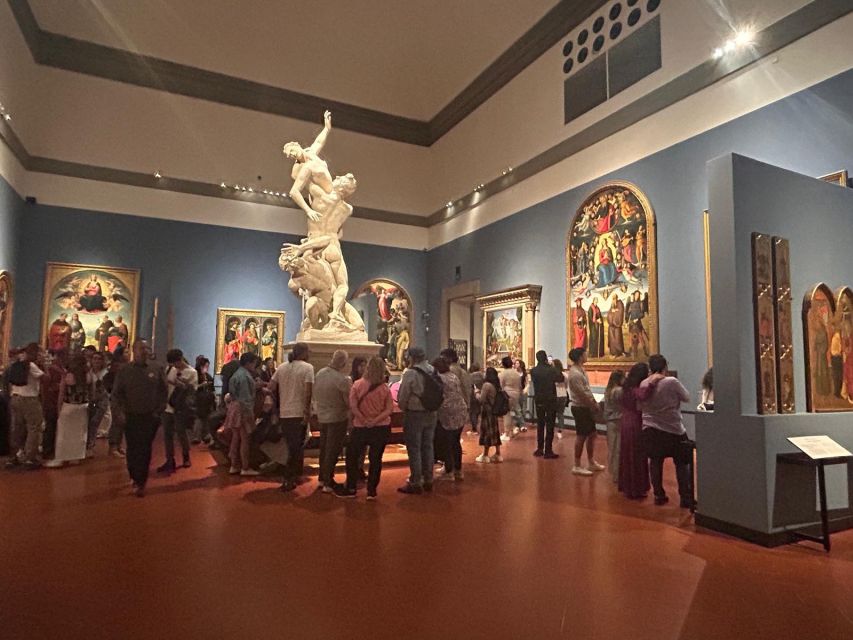
At the end of the route, go upstairs to see medieval altarpieces. This final section is quieter in subject and often less crowded than the room holding David.
Altarpieces were designed for religious spaces, and their arrangement matters. Look for the central figures, smaller surrounding panels, saints, decorative borders, and traces of the visual language used before the full Renaissance style developed.
It is easy to leave once you have seen David, especially if you have another Florence appointment. I recommend reaching the upper floor if your schedule allows. The altarpieces give the visit a proper beginning-to-end arc, moving from medieval religious art through Renaissance painting and sculpture.
Using the Pop Guide app well
The audio guide is delivered through the Pop Guide application. Download it before you arrive, charge your phone, and bring your own headphones. At the meeting point, you receive login credentials or access details.
Preparation matters. A weak phone battery, missing headphones, or a last-minute download can turn a useful guide into a nuisance. Do not rely on the museum to provide a headset.
The app suits you if you want to stop and start commentary as you move. You can spend extra time with David, skip a room that does not interest you, and continue without waiting for a group.
Its weaknesses are worth knowing. Audio points may not always be easy to match with the correct painting or sculpture. Some sections are brief, and reports of technical problems mean you should not make the app your only source of information.
If you want detailed interpretation, historical context, and the chance to ask questions, choose a live guided tour instead. If you prefer independence and only need clear background on the main works, the app is a sensible middle ground.
Is $38 a fair price?
At $38 per person, this is not the cheapest way into the Accademia. The value depends heavily on your date and how much you care about saving time.
I think the price is strongest in three situations:
- Official museum tickets are sold out.
- The ticket-office queue is long and you have a tight Florence schedule.
- You want a self-guided audio option without joining a live group.
The price is less attractive if you can buy a standard timed ticket directly for much less and do not plan to use the app. Several people simply use the entry service and ignore the audio guide, so do not pay extra expecting a full guided tour.
The service does provide more than a bare admission ticket. You get help finding the correct entrance, a physical ticket, timed access, and the Pop Guide application. For a first visit during a busy season, those pieces can save enough time to justify the difference.
Who should book this Accademia visit?
I would choose this experience for first-time visitors who have one clear priority: seeing David without gambling on a long queue. It also works well for families, since you can enter together and then move at your own pace.
Independent museumgoers will appreciate the lack of a fixed live-tour route. Art lovers who want detailed discussion should look for a tour with a live specialist instead.
The experience is wheelchair accessible, though timed museum entry can still involve waiting. Children aged 6 to 17 need a valid photo ID showing their date of birth to qualify for a discounted ticket. Without that document, the full adult fare may apply.
Do not bring pets, luggage, large bags, or other bags that the museum does not allow. Bring your passport or ID for children, headphones, and a fully charged smartphone.
Should you book it?
Book this if David is high on your Florence list and official tickets are unavailable or inconvenient. The separate entrance and host assistance remove much of the uncertainty, while the audio app lets you explore without a group.
Skip it if you already have a cheaper official ticket or want a serious art-history lesson from a live guide. The Pop Guide has useful moments, but it is not perfect, and the museum can still impose a short wait.
For most first-time visitors facing a busy date, I consider the convenience worth the extra cost. Just arrive early, download the app before meeting the host, bring earbuds, and leave enough time to see more than the famous statue.
FAQ
How long does the Accademia Gallery experience last?
The activity duration is listed as three hours. Your actual time inside the museum can vary, since the audio app allows you to move at your own pace.
What is included in the ticket?
The package includes a timed entrance ticket to the Accademia Gallery and access to the Pop Guide audio app.
Is there a live guide?
No. A host or greeter helps you exchange the voucher, collect the physical ticket, and reach the correct entrance, but the museum visit is self-guided.
Where do I meet the host?
Meet the activity provider’s staff in front of the Carrefour Express supermarket. Look for a person holding a white flag marked ENJOY ROME.
Do I need to download anything before arriving?
Yes. Download the Pop Guide audio guide application before you arrive. Bring your own headphones and a charged smartphone.
Can I enter if I arrive late?
Late entry is not guaranteed because the ticket is timed. A refund is also not guaranteed for late arrivals, so allow extra time to find the meeting point and collect your ticket.
Can children receive a discounted ticket?
Children aged 6 to 17 need a valid photo ID with their date of birth to qualify for a discounted ticket. Without the required ID, they may need to pay the full adult price.
More Smartphone App Tours in Florence
- Florence: Timed Entry to Michelangelo’s David + Audio App
★ 4.6 · 19,496 reviews - Florence: Uffizi Priority Ticket & Masterpieces Audio App
★ 4.2 · 6,402 reviews - Florence: Uffizi & Accademia Priority Tickets with Audio App
★ 4.4 · 1,253 reviews - Florence: Accademia Gallery David Entry & Audio Guide App
★ 4.2 · 406 reviews
Just added around Florence
- Florence: Uffizi Gallery Reserved Ticket & Digital Audio Guide★ 4.5 · 3 reviews
- Around Florence Hills: App‑Guided e‑Vespa Tour + Wine&Food★ 4.5 · 22 reviews
- Florence: Uffizi Gallery Audio Guided Tour led by Tour Leader★ 3.5 · 6 reviews
- Uffizi Gallery: Self-guided App Visit & Optional Accademia Museum★ 4.0 · 19 reviews
- Uffizi Gallery Audio-Guided Visit with optional Accademia Gallery★ 3.5 · 42 reviews
- Florence: Uffizi Gallery Timed Entry Ticket with Audio★ 3.0 · 3 reviews
- Medici Secrets & Mysteries: Interactive Walking Tour Game★ 4.5 · 36 reviews
- Uffizi Combined Ticket:UFFIZI, PITTI, BOBOLI & digital audioguide★ 4.0 · 26 reviews
Florence Audio Tours, compared.
Florence: Timed Entry to Michelangelo’s David + Audio App
Read our review →
Florence: Uffizi Priority Ticket & Masterpieces Audio App
Read our review →
Florence: Palazzo Vecchio Entrance Ticket & Audioguide
Read our review →
Florence: Uffizi Gallery Timed Entry Ticket & Audio Guide
Read our review →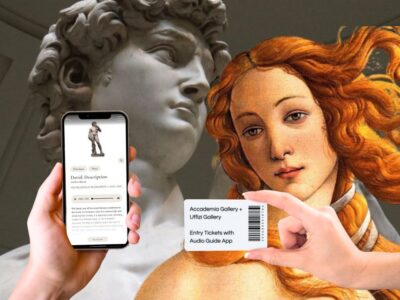
Florence: Uffizi & Accademia Priority Tickets with Audio App
Read our review →
Florence: Eco-Friendly Golf Cart City Tour with Audio Guide
Read our review →
Florence: Uffizi Gallery Reserved Entry Ticket & Audioguide
Read our review →