
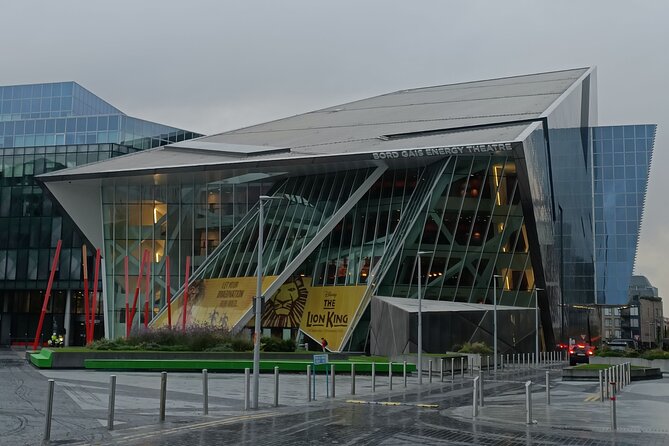
REVIEW · DUBLIN AUDIO TOURS
A Self Guided Walking Tour of Dublin’s Docklands
Dublin’s Docklands packs centuries of trade, emigration, labor history, and modern city life into a short walk beside the River Liffey. I like the way this tour links major sights such as the Custom House and Famine Memorial with lesser-known details, including the old Diving Bell and Scherzer Rolling Lift Bridges. The audio narration also keeps the pace manageable, which is useful when you want context without joining a fixed group.
I especially like the offline maps and audio, since you can save mobile data and keep walking if your signal is weak. The $11.99 price is fair for unlimited use, but remember that this is not a live guided walk. You need your own smartphone and headphones, and the tour is non-refundable after booking.
Key points at a glance

- A compact route with a lot of variety: Cover the Custom House, Connolly Station, the IFSC, the Jeanie Johnston, and Grand Canal Square in about 50 minutes to 1 hour 10 minutes.
- Strong maritime focus: See the old Diving Bell, sea lock, seafarers’ memorial, rolling lift bridges, and ship replica.
- A clear view of Dublin’s past and present: Move from Georgian trade buildings and labor landmarks to glass offices, modern bridges, and new waterfront buildings.
- Useful offline access: Download the audio, map, and geodata before walking so you do not need to rely on mobile data.
- Easy public transport access: Start near Busáras, nearby bus stops, and Tara Street DART station.
- Best for independent visitors: You set the pace, pause when you want, and can use the audio later as a virtual audiobook.
Why Dublin’s Docklands makes a good walking route
The Docklands is one of Dublin’s most useful areas for understanding how the city changed. It began as a working port tied to trade, shipping, and emigration. Today, the same broad waterfront includes financial offices, apartment buildings, cultural venues, transport hubs, bridges, and public squares.
That mix gives this tour a clear purpose. You are not simply walking from one photo stop to another. The route shows how Dublin moved from a maritime economy to a modern business district while keeping reminders of labor, migration, and loss close to the river.
The walk is GPS guided rather than led by a person. You listen through your phone as you move between stops. The route takes about 50 minutes at a steady pace, though the stated duration can stretch to 1 hour 10 minutes if you stop for photos or spend time looking at the buildings.
I would allow the longer amount of time. The route includes bridges, memorials, transport buildings, and public spaces that deserve more than a quick glance.
More Self-Guided Walking Tours in Dublin:
- Dublin Walking Tour with Audioguide on Your Smartphone
★ 4.0 · 13 reviews - Sofia: City Monuments Guided Walking Tour with Audio Guide
★ 4.5 · 825 reviews - Florence: 2.5 hour Audio Guided Walking Tour led by Host
★ 4.6 · 293 reviews
Starting at the Custom House
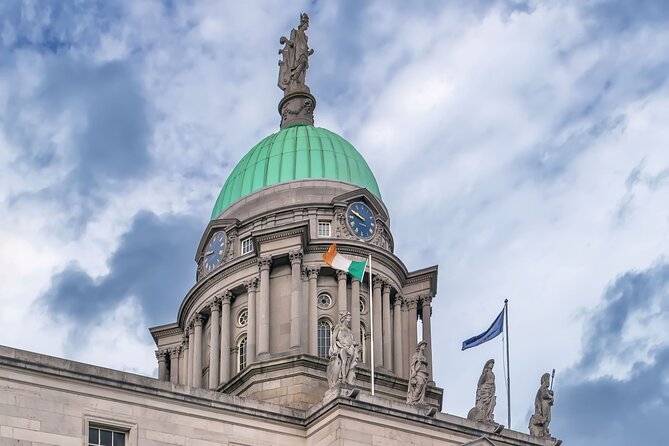
The tour begins at the Custom House on North Wall in Dublin 1. This neoclassical building once served as the center of Irish trade and commerce, so it is a fitting place to start a walk about the Docklands.
The building gives you an immediate sense of the district’s former purpose. Before the glass towers and modern offices, this part of Dublin was closely tied to ships, cargo, customs, and the movement of goods. The audio helps frame what you are seeing instead of leaving the building as a fine but isolated facade.
From here, the route takes you along the quayside. Historic warehouses appear beside newer development, making the changing character of the area easy to read. I find this one of the strongest parts of the walk because the old and new are visible at the same time.
You will also pass the memorial to James Connolly and Liberty Hall Theatre. Connolly is important to Ireland’s independence story and to the fight for workers’ rights. Liberty Hall adds another layer, connecting the Docklands to Dublin’s labor movement.
These stops matter because they prevent the tour from becoming only an architecture walk. The waterfront is also a place shaped by politics, work, and social change.
Busáras, Connolly Station, and the working city
The route continues past Busáras, Dublin’s central bus station, and Connolly Train Station. These are practical buildings, but they help show how the Docklands remains connected to the wider city.
Busáras is a major transport point, while Connolly Station serves domestic and international routes. Passing both places gives the walk a sense of movement. People are not only visiting the Docklands. They are arriving, leaving, commuting, and crossing through it.
The tour then passes the IFSC, Dublin’s International Financial Services Centre. This is where the area’s modern economic role becomes most obvious. Multinational companies and financial institutions now occupy space once linked to warehouses and port work.
I like this contrast because it makes the district’s change concrete. The Docklands did not lose its connection to commerce. The kind of commerce simply changed.
The route also includes the Triumphal Arch, described as a monument connected with Dublin’s maritime heritage and economic prosperity. It is a reminder that the district’s fortunes have long been tied to trade and shipping.
Bridges, river views, and engineering details
The Scherzer Rolling Lift Bridges offer one of the more unusual sights on the route. These were built to help maritime traffic pass through the area, and their design gives you a practical look at how the docks functioned.
This is the sort of detail I value in a walking tour. You might otherwise pass the bridges, notice their shape, and keep moving. The audio gives the engineering a reason to matter.
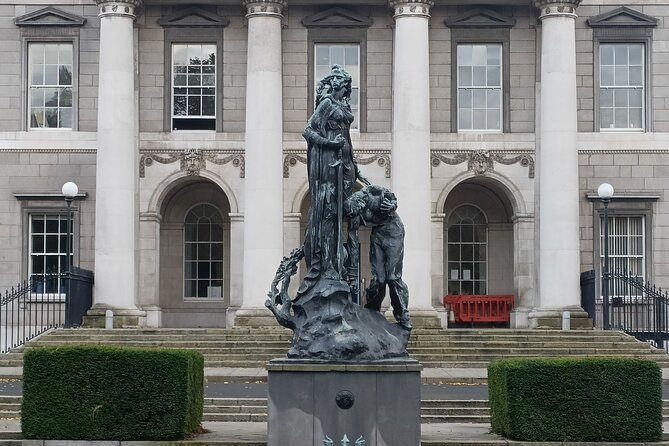
Next comes the Famine Memorial, one of the most serious stops on the walk. It honors those who suffered during Ireland’s Great Famine in the 19th century. The memorial brings the broad story of migration down to human scale, especially in a district connected with ships and departures.
You then cross the River Liffey on the Seán O’Casey Bridge. The crossing offers views of the river, waterfront buildings, and the city skyline. It also breaks up the route nicely. Instead of staying on one side of the water, you get a clearer sense of the Docklands as a connected area.
The bridge is a practical part of the walk, but it also works as a viewing point. You can pause here without needing a special detour.
More Audio Tours in Dublin:
- Christ Church Cathedral Entrance Ticket & Self-Guided Tour
★ 4.6 · 773 reviews - Dublin Ghost Hunt Exploration Game and Tour
★ 4.0 · 34 reviews - Private Dublin Treasure Hunt Self Guided Tour
★ 4.5 · 14 reviews - Dublin Self-Guided Murder Mystery Tour by Temple Bar
★ 3.5 · 12 reviews
Ships, seafarers, and the memory of emigration
After crossing the river, the route passes a memorial to Irish seafarers who lost their lives at sea. This stop brings the maritime story back to people who worked on the water, rather than focusing only on buildings and infrastructure.
You also see a replica of the Jeanie Johnston. The original ship carried Irish emigrants to North America during the Great Famine. Its presence connects the Docklands with one of the most important movements in Irish history: people leaving Ireland in search of safety and a new life.
The combination of the seafarers’ memorial and the ship replica gives this section emotional weight. The river was a route for trade, but it was also a route taken by families facing hunger and uncertainty.
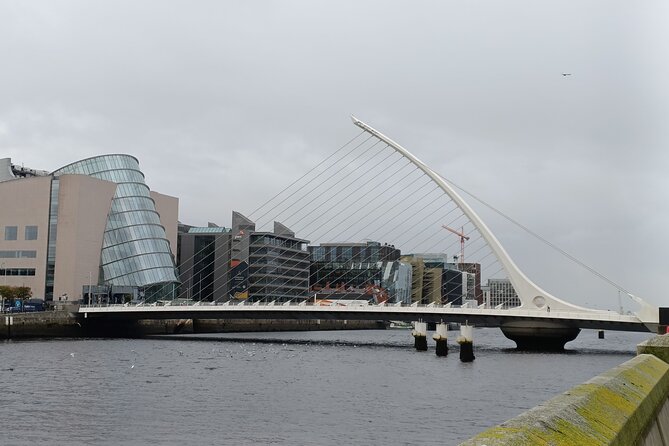
The Samuel Beckett Bridge changes the mood again. Its distinctive modern form is one of the Docklands’ best-known pieces of recent architecture, and its name links the waterfront with one of Ireland’s major writers.
You also pass the Convention Centre Dublin, a modern venue for conferences, exhibitions, and events. Together, the bridge and convention center show how the area now presents itself as a contemporary international district.
Admiral Brown, the Diving Bell, and the East-Link
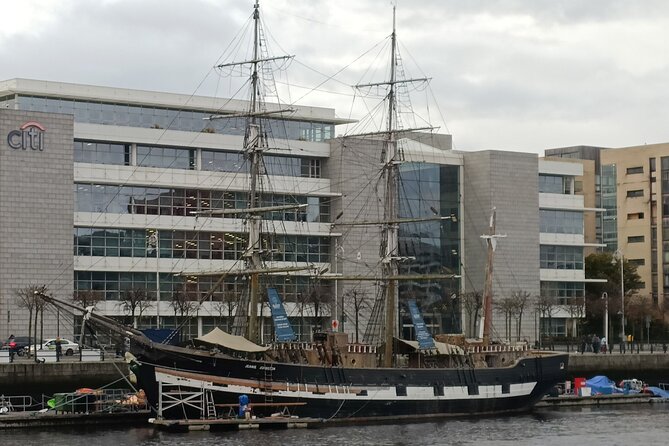
The statue of Admiral William Brown adds an international detail to the walk. Brown was born in Ireland and later founded the Argentine Navy. His story shows how people from this small island carried their skills and ambitions abroad.
The old Diving Bell is another fine stop. It was used for maintenance work in Dublin’s port, giving you a direct link to the practical tasks needed to keep the docks operating.
These details are easy to miss without explanation. They also make the route feel less predictable. You get major landmarks, but you also get objects tied to the daily work of the port.
The tour then passes the Tom Clarke Bridge, also known as the East-Link Bridge. It is an important transport connection between north and south Dublin. Like the earlier bridges, it helps you see the Docklands as a functioning part of the city rather than a preserved historic quarter.
The route also goes by BrewDog Outpost Dublin. This brewery offers craft beer and a lively setting, so it can serve as a useful pause if you want a drink after the walk. Since the tour is self-guided, you decide whether to keep moving or stop.
Grand Canal Docks and the final stretch
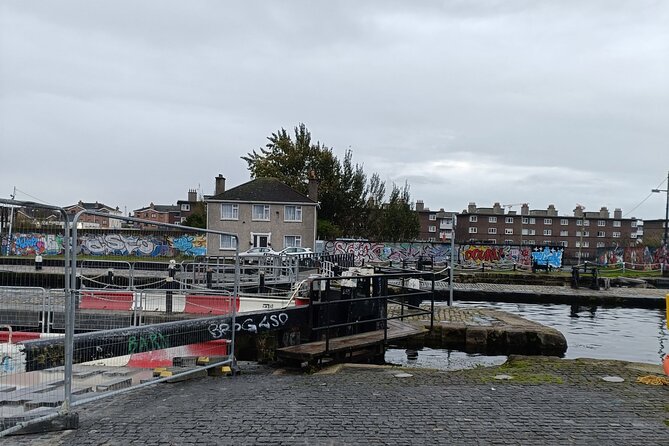
The sea lock is one of the most practical sights on the latter part of the route. It regulates water levels in the docks, a reminder that the waterfront still depends on working infrastructure, not only attractive public spaces.
The Grand Canal Docks sign marks the entrance to the historic canal basin. From there, the walk continues around Hanover Quay, where residential and commercial buildings share the waterfront.
This section gives you a clear look at the area’s newer identity. Offices, apartments, studios, and public spaces now sit close to the old dock system. The change is not hidden, and that is part of the point. You can see the former industrial district being used for modern city life.
Hanover Quay Studios adds a cultural note. The recording studio complex has been used by musicians and artists, so the Docklands story is not limited to shipping, finance, and transport.
The walk ends at Grand Canal Square, a large public space with modern architecture and cultural attractions. The final stop is Red Sticks Dublin, a landmark sculpture on the Grand Canal. Ending here gives the route a clear finish rather than dropping you beside an ordinary street.
What the audio format gets right
The audio guide is designed for independent use, so you are not tied to a guide’s walking speed or a group’s interests. You can pause the recording, take photographs, and spend longer at the Famine Memorial, bridges, or ship replica.
The narration comes from a local insider, and the guide is easy to understand. The manageable pace is especially helpful if you are trying to orient yourself in a new part of Dublin.
You also receive directions to the starting point, plus offline access to the map, audio, and geodata. Download everything before you begin. That saves data and reduces the need to keep checking your connection.
A useful extra is the virtual playback option. You can listen to the tour like an audiobook from anywhere, even when you are not walking the route. That adds value if you want to hear the historical background before visiting the Docklands or revisit it later.
The main limitation is obvious: there is no live person to answer questions. If you prefer conversation, spontaneous recommendations, or a guide who can adjust the route, this will feel limited. If you like privacy and control, the format works well.
Timing, transport, and practical details
The start point at the Custom House is easy to reach by public transport. Busáras and nearby bus stops are close, and Tara Street DART station is also convenient. The starting point is about a 10-minute walk from O’Connell Street and roughly 15 to 20 minutes from College Green.
The finish at Red Sticks Dublin is on the Grand Canal. Since the walk ends in a different area from where it starts, plan your next move before setting off. The route is not a return loop.
Bring your own smartphone and headphones. They are not supplied. Comfortable walking shoes are sensible, though the tour is short enough for most people who can take part in an ordinary city walk. Service animals are allowed, and the tour is near public transport.
The tour is private in the sense that only your group participates, but it remains self-guided. No live guide joins you.
At $11.99 per person, I see good value for solo visitors, couples, and small groups who want a focused introduction to the Docklands. You are paying for the route, narration, directions, offline materials, and unlimited lifetime use before and after the booking date. You are not paying for entry to attractions, a physical guide, or equipment.
The non-refundable policy deserves attention. Since you cannot cancel or amend the booking for a refund, confirm your schedule and make sure your phone and headphones are ready before buying.
Who should choose this Docklands walk?
I would choose this tour if you have already seen central Dublin’s main streets and want to understand the waterfront. It also works well if you have limited time and want a route that combines major buildings, memorials, bridges, and transport landmarks.
It suits independent visitors who like to stop often, take photos, or listen at their own speed. The unlimited access is useful if you want to spread the walk over more than one visit, though the route itself is short.
Families may appreciate the brief format and the mix of ships, bridges, and unusual equipment. The self-guided setup also means you can pause when needed rather than hold up a group.
I would hesitate if you want a full-day historical tour, a personal guide, or detailed access inside the buildings along the route. Most stops are viewed from the outside, and the audio is the main source of explanation.
Should you book it?
Book this walk if you want an inexpensive, flexible way to connect Dublin’s maritime past with its modern Docklands. The best parts are the clear pacing, offline access, and range of stops, from the Custom House and James Connolly memorial to the Jeanie Johnston, Samuel Beckett Bridge, and Grand Canal Square.
Skip it if you dislike listening through a phone or need a guide for questions and conversation. For everyone else, $11.99 buys a well-planned introduction to a part of Dublin that is easy to overlook and surprisingly full of stories.
FAQ
How long does the walking tour take?
The tour takes approximately 50 minutes to 1 hour 10 minutes, depending on your walking speed and how long you stop at each location.
What language is the tour offered in?
The tour is offered in English.
Where does the tour begin?
It begins at the Custom House on North Wall in Dublin 1, County Dublin.
Where does the tour end?
It ends at Red Sticks Dublin in Dublin Docklands, on the Grand Canal near Grand Canal Square.
Do I need a smartphone?
Yes. You must bring your own smartphone to use the audio and GPS tour.
Are headphones provided?
No. You need to bring your own headphones.
Can I use the tour without mobile data?
Yes. The audio, maps, and geodata are available offline, which helps reduce data use during the walk.
Is there a live guide?
No. This is a self-guided GPS audio tour. The narration is provided through your phone.
Can I use the tour more than once?
Yes. The tour includes unlimited lifetime use before and after your booking date, as well as a virtual playback option for listening from elsewhere.
Is the tour refundable if I cancel?
No. The experience is non-refundable and cannot be changed after booking for any reason.
Just added around Dublin
- Turtle Bunbury’s Dublin: A Self-Guided Audio Tour from a Celebrated Author★ 5.0 · 3 reviews
- Dublin Old Town: Famous Pubs Exploration Game and Tour★ 4.0 · 7 reviews
- Marlay Park’s Heritage: A Self-Guided Tour of Dublin’s Playground★ 5.0 · 3 reviews
- Self-Guided Scavenger Hunt: Dublin Adventure★ 3.5 · 6 reviews
- Dublin Self-Guided Murder Mystery Tour by Temple Bar★ 3.5 · 12 reviews
- A Self-Guided Stroll Along Dún Laoghaire’s East Pier★ 4.5 · 6 reviews
- Dublin Scavenger Hunt and Highlights Self Guided Audio Tour★ 4.5 · 4 reviews
- The Dublin Incident: Alien, Whiskey & Clues Exploration Game★ 4.0 · 6 reviews
Dublin Audio Tours, compared.
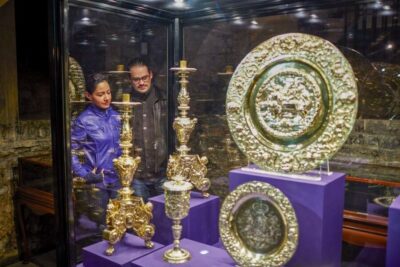
Christ Church Cathedral Entrance Ticket & Self-Guided Tour
Read our review →

Dublin Walking Tour with Audioguide on Your Smartphone
Read our review →
Dublin Self-Guided Murder Mystery Tour by Temple Bar
Read our review →
Dublin Old Town: Famous Pubs Exploration Game and Tour
Read our review →
A Self-Guided Stroll Along Dún Laoghaire’s East Pier
Read our review →
The Dublin Incident: Alien, Whiskey & Clues Exploration Game
Read our review →Browse the lists this tour appears in