
REVIEW · ITALY AUDIO TOURS
Brindisi Walking Tour with Audio and Written Guide by a Local
Brindisi’s story unfolds along a compact route from a former military bastion to the harbor. For about $7.21, you use your phone to explore churches, Roman remains, a museum, and the waterfront without waiting for a group or following a guide’s timetable. Matteo’s route also includes local restaurant suggestions, which gives the walk a useful food angle.
I like the freedom to stop, linger, or finish the last section along the water. I also like the mix of major sights and smaller historical details, especially the Roman columns and the city’s link with pilgrims traveling from Rome to Jerusalem. The main drawback is simple: this is not a personal walking tour. You need a working internet connection, and the pronunciation of some Italian names in the audio may sound awkward.
Key points at a glance
- Self-guided route: Walk from Bastione San Giacomo to the Monument to the Italian Sailor at your own pace.
- Nine historical stops: See castles, San Giovanni al Sepolcro, archaeological remains, the cathedral, museum, Roman columns, and harborfront sights.
- Useful phone-based format: Audio and written notes are available in English, Spanish, Italian, German, and French.
- Good food advice: The guide includes suggestions for authentic local restaurants, including places near the harbor.
- Budget-friendly price: At $7.21 per person, it costs far less than a private guide, but you provide the technology and navigation.
- Plan for connectivity: The tour has no offline version, and headphones are not included.
What this Brindisi walk really offers
This is best understood as a digital city walk, not a traditional tour. You do not meet Matteo or another guide at the starting point. Instead, you receive instructions and activate the guide from your voucher, then follow the route using your smartphone and Google Maps.
That arrangement works well in Brindisi because the route links several central sights in a logical order. You can pause for coffee, spend longer in the museum, or stop for lunch without holding up anyone else. If you prefer a guide who points out details in person and answers questions as you go, this format will feel limited.
The walk takes about two to three hours, depending on how long you spend at the stops. The listed maximum of 108 participants matters less than it would on a standard group tour, since you are not walking as one large crowd. Still, the number suggests this is a widely available digital product rather than a private experience.
More Self-Guided Walking Tours in Italy
- Florence: 2.5 hour Audio Guided Walking Tour led by Host
★ 4.6 · 293 reviews - Verona Walking Tour with Audio and Written Guide by a Local
★ 4.5 · 157 reviews - Renaissance & Medieval Florence Guided Walking Tour plus mobile App
★ 4.0 · 140 reviews
Starting at Bastione San Giacomo
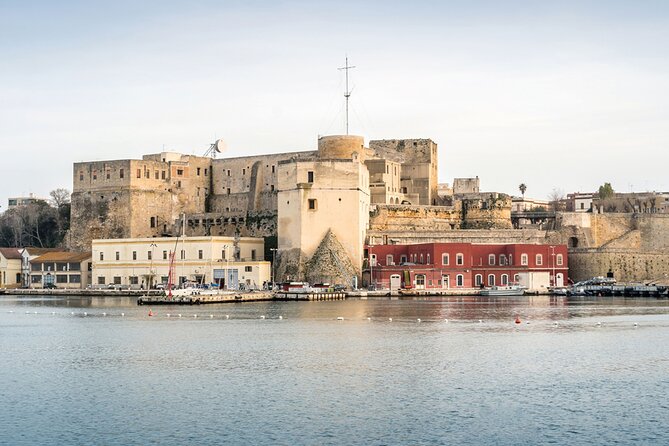
The meeting point is Bastione San Giacomo on Via Nazario Sauro. The bastion is dedicated to Saint James, the patron saint of Spain, and its later uses tell you something about Brindisi’s practical past. Once its military role ended, it became a public slaughterhouse, an oil depot, and a customs house.
That change from defense structure to working city facility gives the walk a grounded opening. You are not starting with a polished monument alone. You are starting with a building that adapted to the needs of the town.
From here, the route continues toward the Castello di Terra, also called the earth castle. Emperor Frederick II ordered its construction, creating the first nucleus of what became one of Brindisi’s four historic castles. The name can sound modest, but the site helps explain how imperial power shaped the city.
The first two points are presented as part of the route before the numbered stops begin. Read the directions carefully at the start, since this is where you get your bearings. Google Maps integration helps, but the route is not described as a fully GPS-led walk with constant automatic prompts.
San Giovanni al Sepolcro and Brindisi’s medieval crossroads
The first formal stop is Tempio di San Giovanni al Sepolcro, a small church linked to the Canons Regular of the Holy Sepulchre. It existed before 1128, when the first document mentioning it was recorded.
The church’s name points to its connection with the Holy Sepulchre, and its presence reflects Brindisi’s place on routes leading toward Jerusalem. You get about 20 minutes of suggested attention here, but admission is not included. The available information does not state an admission price or opening schedule, so check locally if you want to go inside.
This is a good point to use both parts of the guide. The written text lets you scan details at your own pace, while the audio gives you something to listen to as you look around. If the pronunciation of Italian names bothers you, rely more heavily on the written guide for exact place names.
San Pietro degli Schiavoni below the modern city
The Area Archeologica di San Pietro degli Schiavoni offers a different kind of stop. Its name comes from a Slavic community that settled in this part of Brindisi from the fifteenth century onward. The community included Greeks and Albanians and eventually formed a settlement centered on the church of San Pietro.
The church itself has left no visible material remains, but the archaeological area preserves a layer of the city’s past beneath the modern streets. This is the sort of stop that benefits from explanation. Without context, exposed ruins can be hard to read. The audio and written notes help connect the site to migration, settlement, and the changing makeup of Brindisi.
Admission is free, and the suggested visit lasts about 20 minutes. That makes it an easy stop to keep even if you are watching the clock before a train, ferry, or meal.
Same place, a different route to walk:
- Rome: Pantheon Fast-Track Ticket and Official Audioguide
★ 4.5 · 27,353 reviews - Rome: Colosseum & Forum with Audio Guide App -Optional Arena
★ 4.2 · 24,770 reviews - Venice: Grand Canal Gondola Ride with App Commentary
★ 4.1 · 23,020 reviews - Florence: Timed Entry to Michelangelo’s David + Audio App
★ 4.6 · 19,496 reviews
Brindisi Cathedral and the road toward Jerusalem
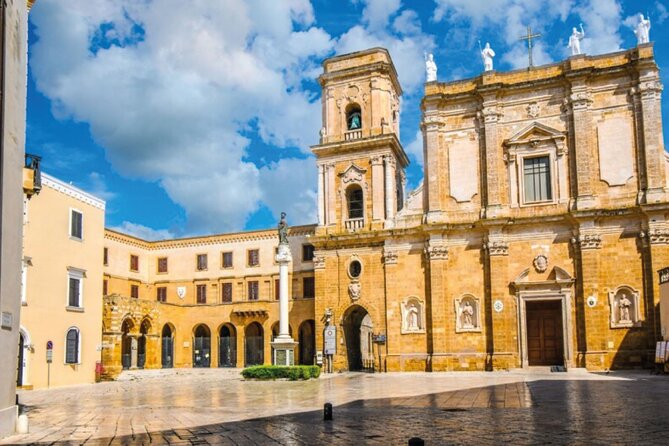
The Cattedrale di San Giovanni Battista shows Brindisi’s recovery under Norman support. Its construction marked a new phase for the city as Norman power expanded eastward.
The cathedral also connects directly to Brindisi’s role as a commercial and religious gateway. The city became an important stopping point for people traveling from Rome toward Jerusalem, and its position on the eastern edge of Italy gave it real practical value.
You have about 20 minutes here, with free admission listed. The guide focuses on the cathedral’s role in the city’s rebirth rather than treating it as an isolated church. That wider setting is useful. You begin to see Brindisi not merely as a port with Roman leftovers, but as a place repeatedly shaped by trade, empire, faith, and movement.
Because the tour is self-guided, you can sit quietly or look around after the audio ends. That freedom is one of the strongest reasons to choose this format.
The Francesco Ribezzo Museum and Messapian Brindisi
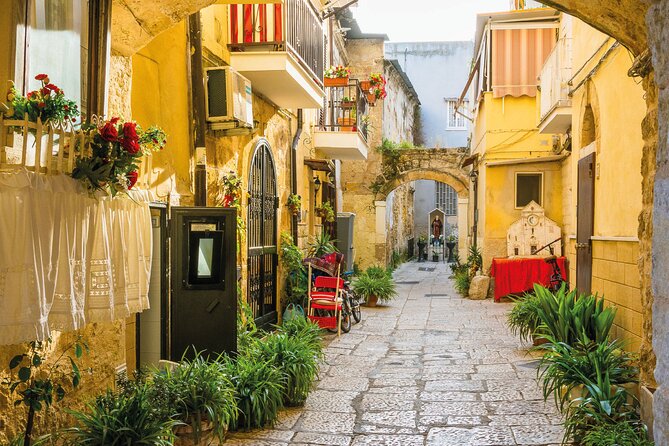
The Museo Archeologico Francesco Ribezzo is the longest planned stop, at about 30 minutes. It was founded in 1884 and is named for Francesco Ribezzo, a scholar of the Messapian civilization of the region.
The collections cover several sections, including antiquarian objects, inscriptions, statues, prehistoric material, Messapian finds, Roman archaeology, and underwater archaeology. That range gives you a useful overview of the area’s past rather than one narrow collection.
Admission is listed as free. Even so, museum hours and access can change, and the guide does not provide a guaranteed opening schedule. If this is a priority, make it your first timing check when you arrive in Brindisi.
I would give the museum the full half hour if it is open. The earlier archaeological stop introduces the city beneath the streets. The museum then supplies objects and context that help make those remains easier to understand.
Roman columns on Via Colonne

The Roman columns at Via Colonne 53 are among Brindisi’s best-known symbols. The guide presents three main theories about their origin, with the most accepted explanation placing their construction around AD 110 under Emperor Trajan.
According to that theory, the columns marked the end points of the ancient Appian Way. This is a powerful detail because it turns the site into more than a pair of old columns. It links Brindisi to one of the Roman world’s major roads and helps explain why the city mattered as a transport and trading center.
The stop takes about 10 minutes and is free. It is short, but do not rush past it. The written notes are particularly useful here because the competing theories give you something to consider while you look at the remains.
Virgil, the harborfront stairs, and the final walk
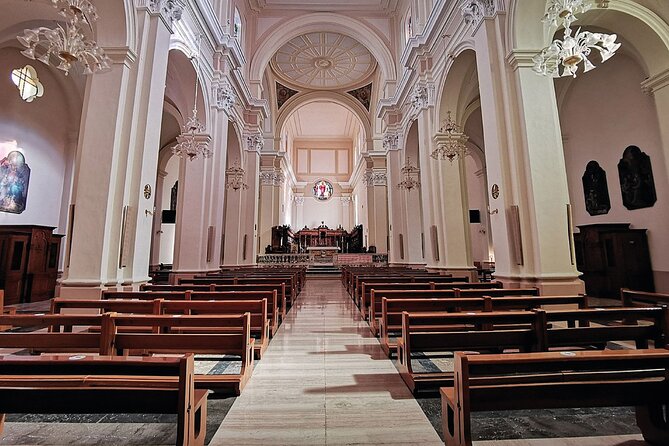
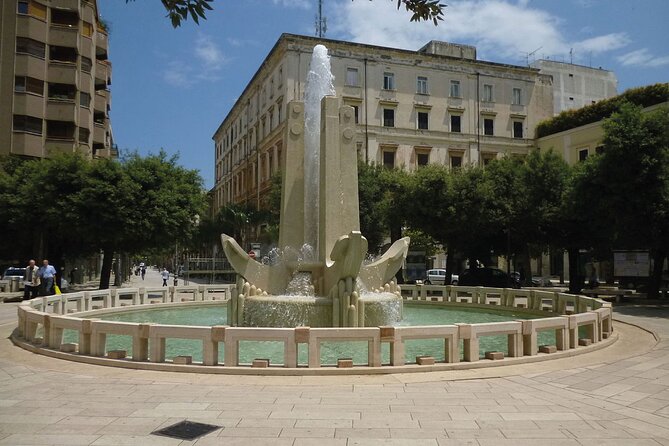
The Monumento a Virgilio marks the staircase connecting the historic center with the waterfront. It is named for Virgil, the first-century BC poet, and the guide explains the connection between the poet and Brindisi.
This is another brief stop, planned for about 10 minutes. Its value comes from the transition. You move from the inland streets toward the port, following a route that has long connected Brindisi’s city center with the sea.
The next section is Lungomare Regina Margherita, a waterfront promenade with views across the port. The suggested time is 15 minutes, but this is the easiest place to slow down. You can listen while walking, pause on the seafront, or continue at your own pace.
One strong feature of the route is that the last part can be enjoyed as a waterfront stroll rather than a tight sequence of stops. If you prefer a little space after museums and churches, this section gives the walk a relaxed finish.
The Monument to the Italian Sailor

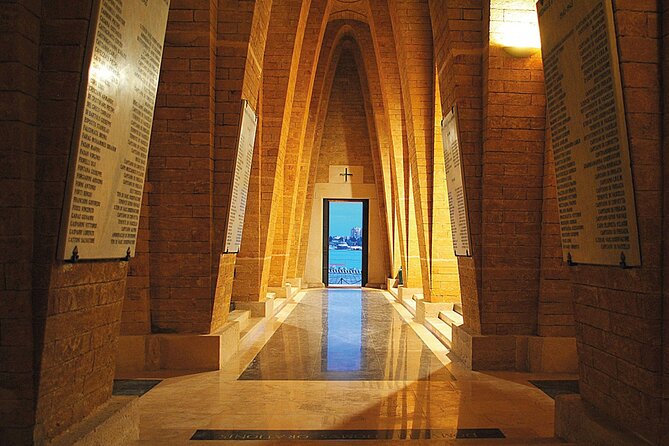
The tour ends at the Monument to the Italian Sailor on Via Ammiraglio Millo. The monument was planned after the First World War to honor sailors who died in service. Other Italian port cities, including La Spezia, Trieste, and Venice, also sought to host the work, making Brindisi’s connection to the monument part of the story.
The suggested stop lasts about 20 minutes. Admission is not included, and the listed ticket cost is €3. That extra fee is small, but you should know about it before arriving.
The end point is practical. You finish beside the port instead of returning to the starting point, so plan your next move before you begin. The tour does not include transport back to Bastione San Giacomo.
Audio quality, written information, and navigation
You can use the guide in English, Spanish, Italian, German, or French. The combination of audio and written text is helpful because you are not forced to listen continuously. You can read a section before entering a site, replay audio, or use the written directions when a place name is difficult to recognize.
The largest technical limitation is internet access. You need a smartphone with an internet connection, and the tour does not offer an offline version. A traveler with poor cell coverage could have trouble opening the next section or following the map.
Bring headphones if you have them. They are not supplied, though you can listen through your phone’s speaker. Headphones are more discreet in churches and museums, and they make it easier to hear in open areas near the port.
The audio pronunciation has also drawn criticism. Some Italian names are pronounced with a noticeably American accent, and certain local place names may not sound the way you hear them in Brindisi. That does not remove the historical information, but it can make it harder to match the audio with signs or map labels. The written guide is your best backup.
The food advice adds real value
The restaurant suggestions are one of the more useful extras. The guide points you toward local food, including places near the harbor. One suggested spot is Antica Osteria La Sciabica, where you might find focaccia and spritzes beside the waterfront.
The value here is not that the tour becomes a food walk. It does not. The value is that you receive practical ideas for what to do after the monuments, and you can use the route to place a meal at a sensible point in your day.
The food advice also suits the independent style of the walk. You are not being ushered into a fixed restaurant or given a timed group meal. You can choose a recommendation, keep exploring, or save the suggestions for later.
Price, timing, and who should book
At $7.21 per person, this is inexpensive for a two to three-hour introduction to Brindisi. A private guide would offer conversation and personal explanations, but this digital format costs far less and lets you set the pace. Group discounts may also be available.
I see the price as good value if you plan to visit several of the listed sites and want background rather than simple map directions. It is less useful if you only have time for the waterfront or already know Brindisi well.
Book this if you:
- Like exploring independently
- Want audio and written information in one guide
- Have reliable internet access
- Prefer stopping for food, photos, or quiet time without a group
- Want a low-cost introduction to Brindisi’s main historical sights
Choose an in-person guide instead if you want detailed answers, natural Italian pronunciation, help entering sites, or someone to adjust the route around your interests.
The walk is offered daily from midnight to 11:30 PM according to the stated operating hours, but that does not mean every attraction is open at all times. Plan the museum and church portions during suitable daytime hours. Free cancellation is available if you cancel at least 24 hours before the start time. Cancellations inside that window are not refunded.
Should you book this Brindisi self-guided tour?
I would book it as a low-cost orientation to Brindisi, especially if you are comfortable using your phone and prefer independence. The route covers a useful spread of the city: imperial buildings, medieval churches, archaeology, Roman monuments, the cathedral, museum collections, and the port.
I would not book it expecting a local person beside you. The guide’s strengths are its price, structure, flexibility, and food suggestions. Its weak points are the need for internet, the lack of included headphones, the €3 monument ticket, and uneven pronunciation in the audio.
For a first look at Brindisi, this is a sensible tool. Start with a charged phone, read the activation instructions carefully, bring headphones, and keep the written guide open as you walk.
FAQ
Is this a guided walking tour with a person?
No. It is a self-guided digital visit using audio, written information, and map directions. You do not meet an in-person guide.
Where does the Brindisi walk start?
It starts at Bastione San Giacomo, Via Nazario Sauro 6, 72100 Brindisi.
Where does the tour end?
It ends at the Monument to the Italian Sailor, Via Ammiraglio Millo 2, 72100 Brindisi.
How long does the tour take?
The estimated duration is two to three hours, depending on how long you spend at each stop.
What language options are available?
The audio guide and written text are available in English, Spanish, Italian, German, and French.
Do I need internet access?
Yes. You need a smartphone with an internet connection to activate and use the digital guide. There is no offline version.
Are headphones included?
No. You can listen through your smartphone speaker, or use your own headphones.
Is admission to the attractions included?
Most listed stops are free or have no included admission charge. The Monument to the Italian Sailor requires a separate €3 ticket, and admission to San Giovanni al Sepolcro is not included.
Is the tour suitable for most people?
Most travelers can participate, and service animals are allowed. The route is near public transportation.
What is the cancellation policy?
You can receive a full refund by cancelling at least 24 hours before the experience start time. Cancellations or changes made less than 24 hours ahead are not refunded or accepted.
Just added around Italy
- Genoa Historic Centre Quest: A Self-Guided Puzzle Adventure★ 4.0 · 3 reviews
- Genova Walking Tour with Audio and Written Guide by a Local★ 4.5 · 33 reviews
- Self-Drive (No Licence) Boat Rental in Portofino Gulf★ 5.0 · 12 reviews
- Finance and Nobility: Explore medieval Genoa on a self-guided audio tour★ 4.5 · 7 reviews
- Florence: Uffizi Gallery Reserved Ticket & Digital Audio Guide★ 4.5 · 3 reviews
- Around Florence Hills: App‑Guided e‑Vespa Tour + Wine&Food★ 4.5 · 22 reviews
- Florence: Uffizi Gallery Audio Guided Tour led by Tour Leader★ 3.5 · 6 reviews
- Uffizi Gallery: Self-guided App Visit & Optional Accademia Museum★ 4.0 · 19 reviews
Italy Audio Tours, compared.
Rome: Pantheon Fast-Track Ticket and Official Audioguide
Read our review →
Rome: Colosseum & Forum with Audio Guide App -Optional Arena
Read our review →
Venice: Grand Canal Gondola Ride with App Commentary
Read our review →
Florence: Timed Entry to Michelangelo’s David + Audio App
Read our review →
Rome: City Sightseeing Hop-on Hop-off Bus with Audioguide
Read our review →
Venice: La Fenice Opera House Entry Ticket with Audio Guide
Read our review →
Rome: Colosseum, Forum, Palatine Hill Entry & Audioguide App
Read our review →Browse the lists this tour appears in