

REVIEW · ITALY AUDIO TOURS
Pompeii: Entry Ticket with Audio Guide
Pompeii is not a single monument. It is a full Roman city, with streets, shops, temples, baths, theaters, villas, and an amphitheater spread across a huge archaeological site. The volcanic ash that destroyed the city also preserved ordinary details, from lunch counters to painted walls, making this one of Italy’s most affecting history stops. I especially like the freedom to set your own pace and the option to choose between the basic Pompeii visit and the wider Pompeii+ ticket.
The audio guide gives useful context when a bare wall or broken column needs an explanation, and its map helps you find your way through the sprawling ruins. I also like that luggage storage is available and that the ticket can be held on your phone. The main catch is simple: Pompeii is much bigger than most people expect, and unclear signs around the ticket offices can cost you time.
Key points to know before you go

- Choose your Pompeii carefully: Pompeii Express covers the ancient city only, while Pompeii+ adds three suburban villa sites.
- Plan for a long walk: Six hours and more than 22,000 steps can pass quickly, and even a full day may not cover everything.
- Pick up the audio device at Porta Marina Superiore: You need a valid ID as a deposit, and Bluetooth headphones do not work with it.
- Use the voucher route: A phone voucher can save you from the longest ticket-buying queues, but it does not always mean instant entry.
- Bring sun protection and water: Shade is limited, paths can be uneven, and summer heat makes the site tiring.
- The audio guide is helpful but not perfect: It offers clear commentary and a working map, though the many numbered clips can take time to manage.
What the $40 Pompeii ticket actually gives you
At about $40 per person, this is not the cheapest archaeological admission in Italy. The value comes from the size of Pompeii and the time saved by arranging entry before you arrive. A walk-up ticket can involve a long wait, especially during busy periods, while a phone voucher gives you a more organized way into the site.
The price includes a reserved entry ticket, either Pompeii Express or Pompeii+. You also receive access to a digital audio guide in English, Italian, Chinese, Japanese, Portuguese, Russian, German, and French. If you select the physical audio guide option, you collect a device at the official desk near the entrance.
This is a good deal if you plan to spend several hours exploring. It is less convincing if you only have two hours and mainly want to see a few famous streets. Pompeii is so large that a short visit can feel rushed, even with advance entry.
The ticket is valid for one day. You can cancel up to 24 hours before the visit for a full refund, and a reserve-now, pay-later option is available. The site is wheelchair accessible, though some ancient paving and paths remain uneven.
More Skip-the-Line Audio Guide Tickets in Italy
- Rome: Pantheon Fast-Track Ticket and Official Audioguide
★ 4.5 · 27,353 reviews - Venice: La Fenice Opera House Entry Ticket with Audio Guide
★ 4.6 · 11,742 reviews - Rome: St. Peter’s Basilica & Dome Entry Ticket & Audio Tour
★ 4.2 · 7,537 reviews
Picking between Pompeii Express and Pompeii+
The Pompeii Express ticket covers the ancient city itself. This is where you find the main streets, public buildings, temples, shops, theaters, baths, villas, and amphitheater. For a first visit, it already provides more than enough to fill a day.
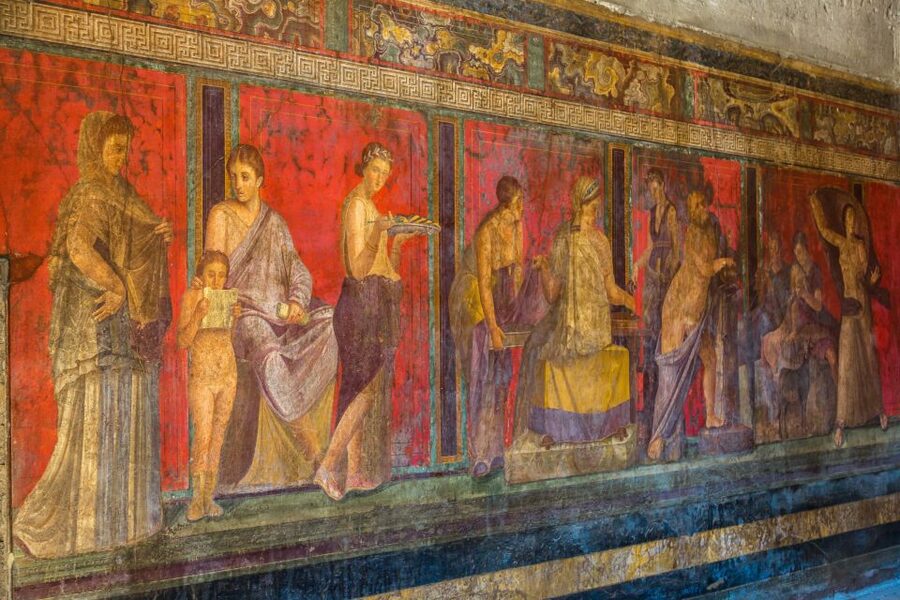
The Pompeii+ ticket also includes the Villa of the Mysteries, Villa of Diomedes, and Villa Regina in Boscoreale with its Antiquarium. The Villa of the Mysteries is the strongest reason to pay the extra amount. Its preserved frescoes give you a better sense of the color and decoration that once filled Roman houses.
Pompeii+ makes the most sense if you have a full day and want more than the central ruins. Check the timing carefully. The last entry for Pompeii+ is 3:30 p.m. from November 1 through March 31, and 5:30 p.m. from April 1 through October 31.
If your schedule is tight, choose Pompeii Express and spend your time inside the ancient city. If you have several hours and care about villas and frescoes, Pompeii+ is the stronger choice. One visitor who chose the Plus option found the Villa of the Mysteries especially worthwhile, but reaching all the separate areas requires time and energy.
Getting your ticket at Porta Marina Superiore

The meeting instructions deserve close attention. You can show your phone voucher at the Porta Marina Superiore or Piazza Esedra ticket office. However, the audio guide desk at Porta Marina Superiore is often the most useful place to start when you have selected the audio option.
The address is Via Villa dei Misteri n. 2, at the Porta Marina Superiore area. Several people have found the entrance arrangements confusing, with different lines and staff pointing them toward different counters. Do not automatically join the longest general ticket line. Look for the audio guide kiosk or ask staff where voucher holders should go.
The practical sequence is:
- Have your voucher open on your phone.
- Go to the correct ticket or audio guide counter.
- Collect your entry ticket.
- Pick up the physical audio guide if you selected it.
- Show a valid passport, identity card, or other accepted ID for the device deposit.
Some people report quick collection, while others still wait at the box office. That difference may depend on the entrance, time, and crowd level. Advance booking helps, but it does not guarantee that every queue disappears.
The audio device must be returned to the same official desk after your visit. This is a minor nuisance if you leave through another part of the site, so allow time to walk back. A valid ID is required as a deposit, and Bluetooth headphones do not work with the device.
Walking into a city stopped in AD 79

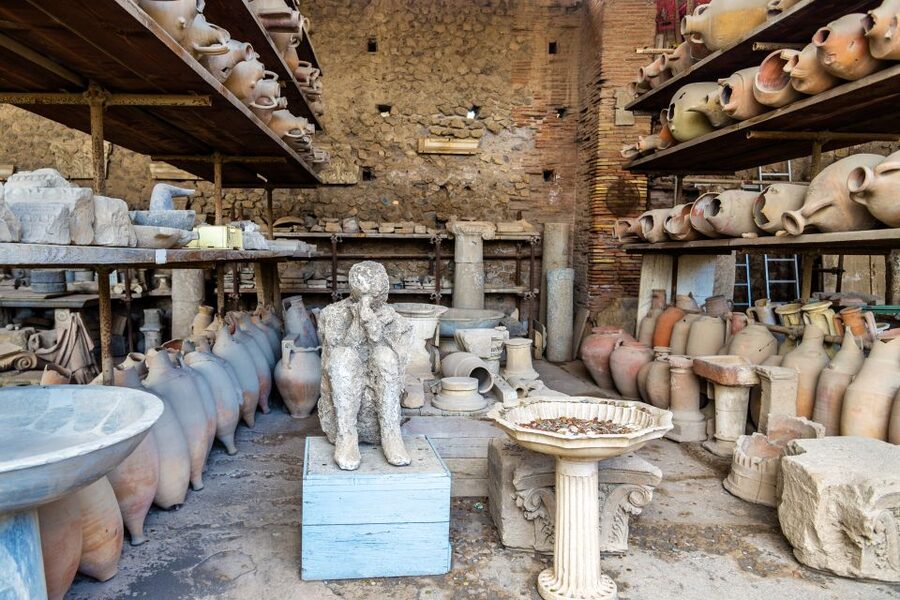
The eruption of Mount Vesuvius caught Pompeii’s roughly 11,000 residents by surprise on August 24, AD 79. Ash buried the city, and that sudden burial preserved a remarkable record of Roman life.
You enter streets where the stone paving still sets the rhythm of the old city. This is what makes Pompeii different from a single Roman ruin. You are not simply looking at a temple or theater. You are moving through neighborhoods and public spaces, with homes, businesses, religious buildings, and civic structures arranged around you.
The experience works best when you slow down. Look at the wheel marks in the roads, the painted walls, the mosaics, and the counters where food was served. The remains can appear plain at first, but the audio guide helps explain what each building did and how it fitted into daily life.
Bring a map if you can. A printed map or the audio guide map helps you mark the areas you have seen. Without one, it is easy to walk past an important house or repeat the same route.
Same place, a different route to walk:
- Rome: Colosseum & Forum with Audio Guide App -Optional Arena
★ 4.2 · 24,770 reviews - Venice: Grand Canal Gondola Ride with App Commentary
★ 4.1 · 23,020 reviews - Florence: Timed Entry to Michelangelo’s David + Audio App
★ 4.6 · 19,496 reviews - Rome: City Sightseeing Hop-on Hop-off Bus with Audioguide
★ 4.0 · 16,045 reviews
Temples, baths, and the public side of Pompeii

The temples of Venus, Apollo, and Jupiter give the site its grand religious frame. They also help you understand the city’s layout, since Pompeii was organized around public spaces as much as private homes.
The baths are another highlight. Their mosaics and remaining architectural details show how much care Romans gave to communal bathing. The audio commentary is particularly useful here because the surviving rooms may not explain themselves clearly.
The market area brings Pompeii down to everyday scale. You can imagine people stopping for food, meeting friends, or handling routine business before the eruption. That ordinary side of the city is one reason Pompeii feels so immediate.
Some buildings may be closed for restoration or safety work. You can sometimes hear an explanation for a room you cannot enter, which is frustrating. The preservation work is necessary, but it means the exact route and open buildings may change.
Houses, frescoes, and the Villa of the Mysteries

The House of the Faun is one of the major private residences in the ancient city. Its Hellenistic design and scale give you a sense of how wealthy Roman households used courtyards, reception rooms, mosaics, and decorative art.
The Villa of the Mysteries, included with Pompeii+, offers a different kind of visit. Its frescoes remain the main attraction, with painted scenes that give the villa a strong visual identity. The additional suburban sites require more planning, but they reward anyone interested in Roman domestic life and painted interiors.
Do not expect every villa to be open at every moment. Restoration work and changing access can affect what you see. This is another reason to treat the audio guide as a supplement rather than a promise that every commentary stop will match an accessible room.
Theaters and amphitheater
The amphitheater lets you picture Pompeii as a city of public entertainment. Stand in the seating area and consider the scale of the crowd that once gathered there. The structure is less polished than a modern arena, but its form is easy to understand.
The theaters offer a quieter look at Roman performance spaces. They are useful stops if you want a break from the long streets and large houses. The audio guide adds context about how the spaces worked, but you can also appreciate their shape and acoustics without listening to every clip.
Because the site is so broad, you may need to choose between seeing every major building and spending time inside a few. I prefer the second approach. Rushing from stop to stop turns Pompeii into a checklist.
How useful is the audio guide?

The audio guide is worth choosing if you want structure without joining a guided group. It explains daily life, buildings, and historical details in clear language, and the map helps you orient yourself.
The physical device has one advantage over a phone: it will keep working if your battery dies. One practical approach is to use the digital guide for written explanations and the physical device as a backup. The phone version uses battery, so bring a charged phone or a portable battery if you plan to stay for hours.
The system can take a few minutes to understand. There are many numbered clips, and the menu can feel cluttered. Some explanations may not line up perfectly with the building in front of you, especially if access has changed.
Headphones are not included. Bluetooth headphones do not work with the official device, so check what you have before collecting it. You can also explore without a guide, but Pompeii’s limited interpretation boards make some kind of map or commentary useful.
Heat, walking, food, and practical comfort

This is a walking day. Several hours can mean more than 20,000 steps, and uneven ancient paving demands attention. Wear supportive sports shoes rather than sandals or fashionable footwear with little grip.
Sun protection matters. Bring a hat, water, and an umbrella if you have one. Shade can be limited, especially across broad open streets and exposed ruins. A small supply of sandwiches or cereal bars is sensible for a long visit.
There is a cafe on site, with fresh food and cold drinks. It can be a useful pause rather than a reason to cut the visit short. Toilets are available in several places, but a map helps you find them.
Free luggage storage is available, which is helpful if you arrive with bags. Still, keep your phone, ID, water, and sun protection easy to reach.
Pompeii is wheelchair accessible, though the ancient surfaces are not uniformly smooth. If you have mobility concerns, plan a slower route and allow extra time.
How long should you spend at Pompeii?
Two hours can give you a taste of the site, but it will not allow a complete visit. You can see several major areas in that time, especially if you arrive with a clear route, but you will leave large parts unexplored.
Three to four hours is a better minimum for the principal ruins. A full day gives you room to pause, listen to the audio guide, visit more houses, and consider Pompeii+ sites.
The sheer size surprises many people. Even after arriving around 10 a.m. and staying until roughly 6 p.m., it is possible to miss whole sections. That is not a flaw in the ticket. It is a reminder to decide what matters most before you enter.
If you are visiting with children, a shorter route may work better. A late afternoon visit can also suit a family if you accept that you will not see everything. Check the closing time and the last entry time for your ticket option before setting out.
Who should book this Pompeii experience?
I would choose this ticket if you want independent exploring, need flexible pacing, or prefer listening to selected explanations rather than following a guide. It also suits anyone visiting from Naples, Sorrento, or the Amalfi Coast who wants to arrange admission without buying a full transport package.
The audio guide is especially useful for first-time visitors who want more context than the signs provide. Pompeii+ suits history fans, photographers, and anyone with a full day for villas and frescoes.
I would be cautious if you have only a short window, dislike long walks, or do not want to manage ticket counters and audio equipment. In those cases, a shorter focused visit may be more realistic than trying to conquer the entire city.
Should you book the Pompeii ticket?
Yes, if Pompeii is high on your list and you can give it at least three hours. The advance voucher, self-guided format, luggage storage, and optional audio guide make the visit practical, while the ruins themselves provide an experience that no short museum stop can match.
Choose Pompeii Express for the main city. Pay for Pompeii+ when you have enough time to reach the suburban villas, especially the Villa of the Mysteries. Bring ID, water, sturdy shoes, sun protection, and a map or charged phone.
The main warning is not the archaeology. It is the scale. Pompeii rewards patience, but it punishes a rushed schedule.
FAQ
What does the Pompeii Express ticket include?
It includes entry to the ancient city of Pompeii. It does not include the suburban villas, including the Villa of the Mysteries, Villa of Diomedes, and Villa Regina.
What does the Pompeii+ ticket include?
Pompeii+ includes the ancient city of Pompeii plus the Villa of the Mysteries, Villa of Diomedes, and Villa Regina in Boscoreale with the Antiquarium.
Is an audio guide included?
A digital audio guide is available with the booking. A physical audio guide is included only if you select that option.
Where do I collect the audio guide?
Collect it at the official audio guide desk beside the ticket office at Porta Marina Superiore, at Via Villa dei Misteri n. 2.
Do I need identification to collect the physical audio guide?
Yes. A valid identity document is required as a deposit for the audio guide device.
Can I use Bluetooth headphones with the audio guide?
No. Bluetooth headphones do not work with the official audio guide device.
What languages are available for the audio guide?
The available languages are English, Italian, Chinese, Japanese, Portuguese, Russian, German, and French.
What is the last entry time for Pompeii+?
From November 1 through March 31, the last entry is 3:30 p.m. From April 1 through October 31, the last entry is 5:30 p.m.
Is Pompeii wheelchair accessible?
Yes, the archaeological site is wheelchair accessible, although some ancient paths and paving are uneven.
What should I bring?
Bring your passport or ID card, comfortable walking shoes, water, and sun protection. A charged phone is useful if you plan to use the digital audio guide.
Just added around Italy
- Genoa Historic Centre Quest: A Self-Guided Puzzle Adventure★ 4.0 · 3 reviews
- Genova Walking Tour with Audio and Written Guide by a Local★ 4.5 · 33 reviews
- Self-Drive (No Licence) Boat Rental in Portofino Gulf★ 5.0 · 12 reviews
- Finance and Nobility: Explore medieval Genoa on a self-guided audio tour★ 4.5 · 7 reviews
- Florence: Uffizi Gallery Reserved Ticket & Digital Audio Guide★ 4.5 · 3 reviews
- Around Florence Hills: App‑Guided e‑Vespa Tour + Wine&Food★ 4.5 · 22 reviews
- Florence: Uffizi Gallery Audio Guided Tour led by Tour Leader★ 3.5 · 6 reviews
- Florence: Uffizi Gallery Timed Entry Ticket with Audio★ 3.0 · 3 reviews
Italy Audio Tours, compared.

Rome: Pantheon Fast-Track Ticket and Official Audioguide
Read our review →
Rome: Colosseum & Forum with Audio Guide App -Optional Arena
Read our review →
Venice: Grand Canal Gondola Ride with App Commentary
Read our review →
Florence: Timed Entry to Michelangelo’s David + Audio App
Read our review →
Rome: City Sightseeing Hop-on Hop-off Bus with Audioguide
Read our review →
Venice: La Fenice Opera House Entry Ticket with Audio Guide
Read our review →
Rome: Colosseum, Forum, Palatine Hill Entry & Audioguide App
Read our review →
Rome: St. Peter’s Basilica & Dome Entry Ticket & Audio Tour
Read our review →Browse the lists this tour appears in