

REVIEW · CANADA AUDIO TOURS
Old Town Quebec Secrets: Private Exploration Game and Tour
Quebec City turns sightseeing into a treasure hunt with this self-guided puzzle walk through Old Quebec. Instead of following a guide carrying a flag, you use the Questo app to move from one historic site to the next, solving location-based challenges along the way. The route brings together grand landmarks, odd little details, and stories that are easy to miss on a normal stroll.
I like two things right away: the game works without mobile data, and you can start, stop, or pause it when your own schedule calls. The low price also makes it a good value for families, since children play free. The main catch is that this is not a live tour, and a few clues may be outdated or worded poorly.
Key points at a glance
- Tourny Fountain begins the hunt: Study Mathurin Moreau’s 1853 fountain and solve a clue before moving on.
- Old Quebec’s famous landmarks come with puzzles: The route includes Saint-Louis Gate, the Ursulines, Notre-Dame-de-Québec, and Place Royale.
- Small details matter: You may need to inspect a cannonball caught in an elm tree or read clues around historic squares.
- No internet connection is needed: Download or open the game as directed, then play offline.
- You control the pace: The experience lasts about 90 minutes, but you can pause and resume without rescheduling.
- The price suits families: It costs $9.29 per person, with group discounts and free play for kids.
A sightseeing game instead of a standard walking tour
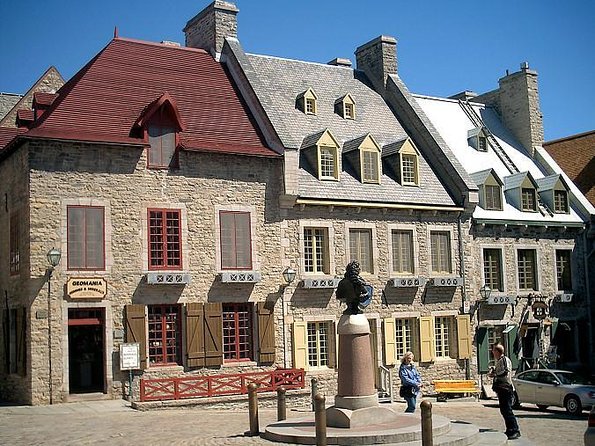
This experience gives you a different way to see Quebec City. You are not simply listening while someone explains the next building. You look around, spot a detail, answer a question, and earn the next stop.
That format works especially well in Old Quebec, where historic clues are built into the streets. A gate has a story. A church has a connection to the British Crown. A tree may hold a strange object in its roots. The game asks you to pay attention to things you might otherwise walk past.
The app guides you step by step to Place Royale, while the full route covers much more of the old city. The stops include sites in Upper Town and Lower Town, so you get a useful sense of how Quebec City’s historic areas connect.
You should allow about an hour and a half. That is long enough to feel like a proper outing, but short enough to fit between meals, museum visits, or a larger day of sightseeing.
More Scavenger Hunts in Canada
- Street Art Exploration Game and Self-Guided Tour in Ottawa
★ 4.0 · 20 reviews - Vancouver Old Town Treasure Hunt: Self-Guided Walking Game
★ 4.5 · 12 reviews - Ottawa Mystery Quest: Self-Guided Detective Adventure
★ 4.0 · 11 reviews
Starting with the Tourny Fountain
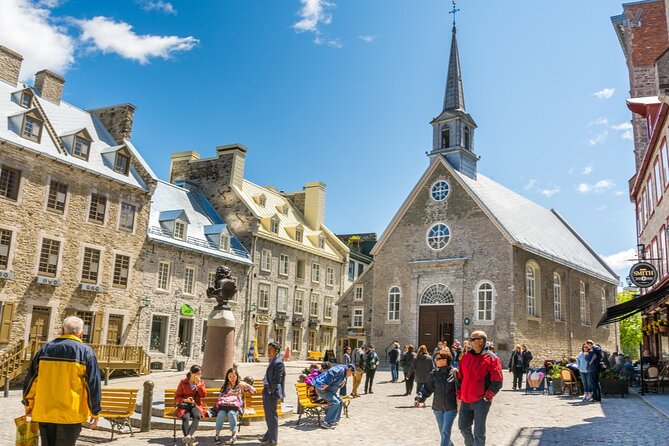
The route begins at the Tourny Fountain, near the Parliament area. The fountain is not just decoration for a quick photograph. It was designed by French sculptor Mathurin Moreau in 1853, exhibited at the 1855 World’s Fair in Paris, and produced in six copies.
Your first challenge asks you to inspect the fountain and find an answer. That opening sets the tone for the whole activity. You need to use your eyes, not just your phone.
This is a good start for families because the task is simple and physical. Children can look for details while adults absorb the setting and background. It also gives you a quick introduction to the game mechanics before the route reaches more complicated historic sites.
Saint-Louis Gate and the old city walls
Saint-Louis Gate brings you into one of the clearest reminders that Quebec City was a fortified settlement. The first gate at this location dates to the late 17th century, during the French Regime.
The gate also reflects the city’s later British history. During the British Regime, the army closed the doors at night to limit movement between the city and the surrounding areas. That policy restricted trade and slowed development, a useful reminder that walls could protect a city while also making daily life harder.
The puzzle makes you stop and examine the gate rather than simply pass beneath it. You get a compact history lesson, then a reason to look closely at the structure itself.
Expect some walking on streets and slopes as the route continues. Old Quebec is compact, but it is not flat. Comfortable shoes will help, especially if you pause often to study clues.
The elm tree and the cannonball mystery

One of the route’s more unusual stops is the old elm on Rue Saint-Louis, near Rue du Corps-de-Garde. A large cannonball appears to be trapped in its twisted roots.
The sight has long caught the attention of people passing by. Calèche drivers point it out, and curious visitors stop to wonder how the cannonball got there and when it became lodged in the tree.
This is exactly the kind of stop that makes a puzzle walk worthwhile. A standard historic tour may focus on major buildings and famous battles. This clue sends you toward a small, curious feature that you might miss while hurrying to the next landmark.
The challenge also gives the experience a lighter mood. Old Quebec history includes war, religion, colonial government, and fires. A strange cannonball in a tree offers a welcome change of pace.
Same place, a different route to walk:
- Sunwapta River Self-Drive Rafting Trip
★ 5.0 · 235 reviews - Private Self-guided River Rafting Tour in Calgary
★ 5.0 · 182 reviews - Vancouver Bike or Ebike Rental – Self Guided Map provided
★ 5.0 · 149 reviews - Mont-Tremblant: Treetop Observatory and Self-Guided Walk
★ 4.7 · 130 reviews
The Ursulines and Montcalm’s chapel
The Couvent des Ursulines introduces the religious and educational side of Quebec’s past. Founded in 1639, it is the oldest institution of learning for women in North America.
The convent’s chapel is also tied to the Battle of the Plains of Abraham. French general Louis-Joseph Montcalm was buried there after dying in the 1759 battle that changed the fate of New France.
This stop rewards you for knowing a little context. The building is not simply an old convent. It represents the work of women who taught and served the colony, while the chapel connects the site to one of the most important military moments in Canadian history.
The game format keeps the visit active. Instead of receiving every detail at once, you solve a question and then learn why the place matters. For children or anyone who prefers doing to listening, that can make the story easier to remember.
Cathedral of the Holy Trinity and British Quebec

The Cathedral of the Holy Trinity offers a different architectural and religious perspective. Built in 1804, it was the first Anglican church constructed outside Britain.
The church was designed in a neoclassical Palladian style, modeled after St Martin-in-the-Fields in Trafalgar Square. It became a National Historic Site of Canada in 1989.
This stop broadens the picture of Quebec City. It is easy to think of Old Quebec only through its French Catholic identity, but British rule left a strong mark on the city. The cathedral gives you a visible example of that change.
The puzzle asks you to inspect the site and find the answer needed to continue. That keeps the stop from becoming a quick look at a facade. You are encouraged to notice its design and place it within the city’s larger history.
The squares, city hall, and changing names
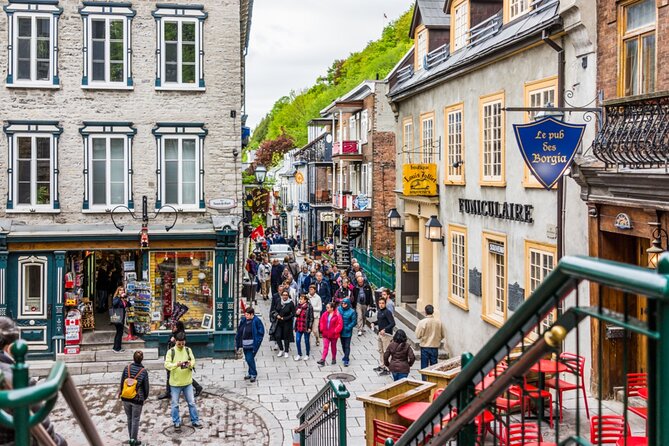
The route includes the public square now known as Place de l’Hôtel-de-Ville. Its names have changed over time. It was once called Grande Place, Grande Place de la Haute Ville, and Place du Marché. After city hall was built, it was renamed Place de l’Hôtel-de-Ville in 1900, though other names remained in use into the 20th century.
That detail shows how public spaces change with a city’s needs. A market square, civic square, and religiously associated square can occupy the same physical place while reflecting different eras.
City hall itself was inaugurated on September 15, 1896. The building slopes downward because it was constructed on a hill, and the site had earlier been home to the Jesuit College, later known as the Jesuit Barracks, from the 1730s to 1878. Quebec City Hall became a National Historic Site of Canada in 1984.
The slope and layered history make this a good place to slow down. You can look at the building while solving the clue, then take a moment to notice how the street layout reveals Quebec’s uneven terrain.
The Seminary and François de Laval
The Séminaire de Québec connects the route to the organization of the Catholic colony. François de Laval founded the society of Catholic priests in 1663. He later became the first bishop of Quebec.
The seminary trained priests, worked to evangelize Indigenous peoples, and administered the colony’s parishes. That gives you a concise explanation of how religion, education, and government were closely linked in New France.
This is one of the stops where the puzzle adds useful structure. A large complex can be difficult to understand when you see it without context. The challenge points you toward a particular fact, making the building easier to place in Quebec’s development.
Champlain’s monument and the painter Jean-Paul Lemieux

Another stop features a monument honoring Samuel de Champlain, the founder of Quebec City. Created by sculptor Paul Chevré, it was inaugurated in 1898.
The route also includes a connection to Jean-Paul Lemieux, one of Canada’s leading 20th-century painters. Lemieux lived from 1904 to 1990 and worked in several styles across five artistic periods.
These two stops add art and public memory to the history route. The Champlain monument shows how later generations chose to honor the city’s founder. The Lemieux clue shifts your attention from colonial history to Canadian art.
I like this mix because it prevents the walk from becoming a parade of military dates and religious buildings. You get architecture, public monuments, visual art, and stories about the people who shaped Quebec’s identity.
Place Royale, the cradle of French North America
The route eventually leads to Place Royale, a key destination in Lower Town. This is the precise location where Samuel de Champlain built the first permanent French settlement in the Americas.
His first habitation, built in 1608, served as a fort, storehouse, trading post, and residence. Place Royale is therefore often called the cradle of French North America.
The setting is especially effective for a self-guided game because the place rewards close observation. You can consider how one small settlement served many purposes, then compare that early outpost with the stone buildings and busy public spaces that came later.
The app guides you here step by step, so follow its directions carefully. The end point is on Rue des Pains Bénits in the Place Royale area.
Parliament and Notre-Dame-de-Québec
The itinerary also takes in the Parliament Building, an eight-floor structure designed by Eugène-Étienne Taché and built from 1877 to 1886. It houses the Parliament of Quebec, made up of the Lieutenant-Governor and the National Assembly.
The building adds a later political chapter to the route. After stops focused on New France, churches, gates, and early settlement, Parliament shows Quebec as the seat of provincial government.
Notre-Dame-de-Québec brings you back to the city’s Catholic foundations. It has served as the first Catholic parish in North America since 1664. It became a cathedral in 1674 when it became the seat of the Diocese of Quebec, and a basilica two centuries later.
The church has endured shelling, fires, reconstructions, and renovations. That difficult past helps explain why Old Quebec’s historic buildings should not be viewed as frozen relics. Many have survived because they were repaired and rebuilt again and again.
How the app-based format affects your visit
The biggest advantage is freedom. You can play at any time after booking, pause when you want, and continue without arranging a new start time. That is useful if you want to stop for lunch, take photographs, browse a shop, or visit a church along the way.
You also do not need an internet connection to play. That matters in a dense stone-built area where your signal may be less reliable, and it prevents the activity from using mobile data as you walk.
The tradeoff is the lack of a physical guide. Nobody is there to answer a question, adjust the pace, or add an extra story when you become interested in a particular building.
The game depends on accurate clues and clear wording. One clue can be frustrating if construction changes the view or if the wording is not precise. Hints are available, and they may be necessary for some challenges. If you are competitive, a flawed clue can take some of the fun out of the score.
Price, group size, and who gets the most value
At $9.29 per person, this is an inexpensive way to spend roughly 90 minutes in Old Quebec. The value is strongest if you want an activity rather than a formal history lecture. You get a route, puzzles, background information, and the freedom to move at your own pace.
Kids play free, which improves the deal for families. Group discounts are available, and a group larger than 15 can make multiple bookings. Since this is a private activity, only your group takes part.
The price is less attractive if you expect a polished, guide-led tour with dependable explanations at every stop. You are paying for a digital game and a prepared route, not for a person who can interpret every detail in real time.
I would choose it for families, couples who enjoy riddles, architecture fans, history-minded visitors, and anyone who wants to see Old Quebec in a less standard way. I would skip it if you dislike using your phone while sightseeing or want a detailed, uninterrupted lecture.
Practical details before you book
The meeting point is listed at 3004 Av. Honoré-Mercier. From there, the app gives step-by-step directions toward Place Royale, and the experience ends on Rue des Pains Bénits.
The activity is offered in English. Service animals are allowed, and the route is near public transportation. Most people can participate, but remember that Old Quebec includes hills, uneven streets, and stops where you need to stand and inspect surroundings.
Confirmation arrives at booking. You can cancel for a full refund up to 24 hours before the start time. Cancellations within 24 hours are not refunded, and changes inside that window are not accepted.
Should you book Old Town Quebec Secrets?
Book this game if you want low-cost, flexible sightseeing with a puzzle element. It does a fine job of sending you toward places you might not notice on a normal walk, including the cannonball tree, the Ursulines, historic gates, public squares, and Place Royale.
The strongest reason to choose it is the blend of play and place. The route gives you a reason to look closely, while the historical notes explain why the details matter.
Go in with realistic expectations. You will not have a live guide, and an occasional clue may need a hint or may not reflect a recent change in the city. If that sounds manageable, this is a clever way to spend 90 minutes discovering Old Quebec with your own small group.
FAQ
How long does Old Town Quebec Secrets take?
The activity lasts approximately 1 hour and 30 minutes.
Does the game require an internet connection?
No. The game can be played offline without mobile data or an internet connection.
Is a physical tour guide included?
No. This is a self-guided experience played through the Questo app.
Where does the activity start and end?
It starts at 3004 Av. Honoré-Mercier in Quebec City. The app guides you to Place Royale, and the listed end point is Rue des Pains Bénits.
What language is the experience offered in?
The experience is offered in English.
Can I pause the game and continue later?
Yes. You can begin and pause the game when it suits you, and the experience can be played anytime after booking without rescheduling.
What is the cancellation policy?
You can cancel for a full refund up to 24 hours before the experience start time. Cancellations or changes made less than 24 hours before the start time are not accepted, and the amount paid is not refunded.
More Old Town Audio Walks in Canada
- Riga: Canal Boat Tour with Drink & Old Town Audio Tour
★ 4.4 · 684 reviews - Dresden: Old Town Self-Guided Scavenger Hunt Tour
★ 4.5 · 151 reviews - Sibiu Old Town Exploration Game and Self-Guided Tour
★ 4.5 · 82 reviews - Pisa: Historic Center Tour by Bike Self-Guided
★ 4.4 · 68 reviews
Just added around Canada
- Halifax Explosion Smartphone Audio Walking Tour★ 4.0 · 3 reviews
- Explore Halifax with 3 Unique Smartphone Audio Walking Tours★ 4.0 · 16 reviews
- Smartphone Audio Driving Tour between Collingwood and Toronto★ 4.5 · 3 reviews
- Self Guided Audio Driving Tour of the North Shore of PEI★ 4.0 · 24 reviews
- Charlottetown Audio Walking Tour★ 5.0 · 7 reviews
- A 7th-Gen Local’s View of Downtown Charlottetown: An Audio Tour★ 4.5 · 27 reviews
- The Sights of Canmore: a Smartphone Audio Walking Tour★ 4.0 · 4 reviews
- Sydney Cape Breton Self-Guided Walking Tour and Scavenger Hunt★ 3.0 · 3 reviews
Canada Audio Tours, compared.



Vancouver Bike or Ebike Rental – Self Guided Map provided
Read our review →
Mont-Tremblant: Treetop Observatory and Self-Guided Walk
Read our review →



Vancouver to Whistler Seaplane Day Trip: Self-Guided Adventure
Read our review →Browse the lists this tour appears in