
REVIEW · IRELAND AUDIO TOURS
Maria Edgeworth Center-A Self-Guided Audio Tour
Maria Edgeworth’s story comes alive inside an old school building in Edgeworthstown, where an English audio tour links her novels to education, invention, local politics, and the people who shaped 19th-century Ireland. You’ll see family artifacts, books, letters, portraits, and a recreated schoolroom.
I like the clear focus on education, not just literature, and the way the tour places Edgeworth beside figures such as Jane Austen, Walter Scott, William Wordsworth, and Oscar Wilde. I also like the freedom to move at your own pace for about an hour to 90 minutes.
The main consideration is that this is a self-guided experience, so you won’t have a live guide answering questions as you go. Staff members such as Matt and Janine may help orient you, but the core tour depends on the audio presentation and museum displays.
Key points to know before you go
- Maria Edgeworth’s life takes center stage: Learn about one of the most successful English-language novelists of her era and her links with major literary figures.
- The old schoolroom adds local context: A recreated 19th-century classroom explains hedge schools and the development of Ireland’s primary education system.
- The Edgeworth family worked far beyond literature: Richard Lovell Edgeworth appears as an inventor, surveyor, educator, and active supporter of new teaching methods.
- You can explore at your own speed: The audio format suits visitors who prefer pauses for books, letters, portraits, and older artifacts.
- The price is modest: At $9 per person, the visit offers a useful indoor history stop for about one to 1.5 hours.
- The centre is highly accessible for a broad audience: It accepts mobile tickets, allows service animals, sits near public transportation, and is suitable for most participants.
Why Maria Edgeworth still matters in Edgeworthstown
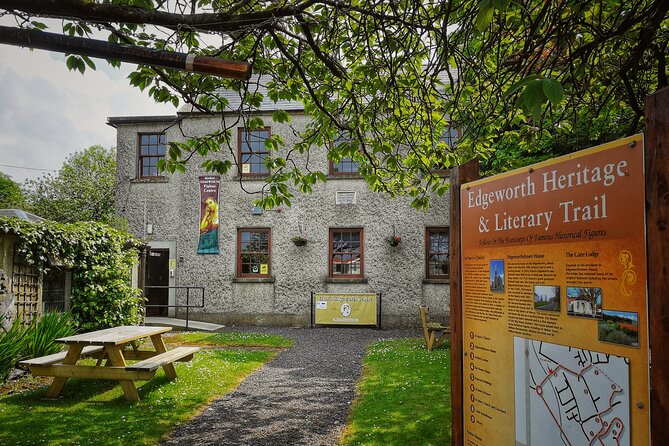
Maria Edgeworth is often introduced as a contemporary of Jane Austen, but this centre gives you a fuller picture than a simple literary comparison. Her work sits within a busy family world of education, science, land, invention, and social reform.
She became one of the best-known English-language novelists of her time. Her father, Richard Lovell Edgeworth, helped guide her education and encouraged her writing. He was also an inventor, surveyor, and educator, so the family story is not limited to books and authorship.
That broader setting is one of the strongest reasons to visit. You are not simply looking at a writer’s biography. You are seeing how a family in provincial Ireland took part in debates about how children should learn, how schools should be organized, and how education could become a public responsibility.
I find this especially useful if Maria Edgeworth is new to you. The centre gives you enough background to make her name meaningful before you read her work. If you already know her novels or letters, the displays help connect the writing to family relationships and the local setting that shaped her life.
More Audio Tours in Ireland:
- St Patrick’s Cathedral: Self-Guided Cathedral Admission
★ 4.5 · 2,126 reviews - Christ Church Cathedral Entrance Ticket & Self-Guided Tour
★ 4.6 · 773 reviews - Self-Guided Bike Tour of Killarney National Park, Muckross Gardens & Waterfall
★ 5.0 · 223 reviews
Entering the Maria Edgeworth Visitor Centre
The centre occupies an old school building dating from 1840. That fact immediately gives the visit a practical sense of place. You are learning about education inside a building that once served that very purpose, rather than in a modern gallery detached from the subject.
The rooms are arranged around the Edgeworth family, with particular attention to Maria. Expect portraits, books, letters, printed material, and artifacts connected with the family and the period. Some items date back to the 18th century, giving the displays a physical link to the world in which the Edgeworths lived.
The presentation is compact, so you will not spend hours walking through a large museum complex. That is a plus if you are passing through Edgeworthstown and want a focused cultural stop. It also means you should give the audio guide your full attention. The information is concentrated into a relatively small space.
Staff can add a personal welcome. Matt and Janine have helped visitors understand the family story and get oriented in the centre. If you arrive with questions about Maria, local history, or family connections, it is worth asking before starting the audio tour. The main format remains self-guided, but a friendly introduction can make the visit easier to follow.
Following Maria Edgeworth through the audio guide
The English audio guide leads you through Maria’s life and times. It is designed to bring together her literary career, her family background, and the wider world around her.
The format gives you control. You can pause to look closely at a portrait or letter, then continue when you are ready. You can also spend less time on a section that interests you less and more time with the subjects that matter most to you. That flexibility is useful in a small museum, where the ideal pace varies from person to person.
Allow at least an hour. The stated duration is about one hour to 90 minutes, and the displays reward a slower pace. One visitor spent three hours with the audio, images, and letters, which suggests that the official time is a sensible minimum rather than a strict limit for anyone who enjoys reading.
The audio format also helps connect objects that might otherwise seem separate. A portrait becomes part of a family story. A book points toward Maria’s literary career. A schoolroom display explains why education mattered so much to the Edgeworth family.
The tradeoff is straightforward: you get independence, but not continuous conversation. If you prefer asking questions as soon as they occur, a live walking tour with Matt, followed by the centre, may suit you better. The self-guided visit works best when you are happy to listen, read, and make your own connections.
The recreated 19th-century classroom
The schoolroom is one of the most effective parts of the visit because it turns an abstract subject into a physical setting. Here, you learn about Ireland’s hedge schools and the Edgeworth family’s efforts to make education a government priority.
Hedge schools were informal schools that developed in Ireland, often outside the official school structure. The centre places this tradition alongside the later creation of the Primary School System in 1831. The Edgeworth family played an important part in that development, and the schoolroom helps explain why their educational work deserves as much attention as Maria’s novels.
I like this section because it widens the story. Maria Edgeworth is not presented only as a famous author in a literary timeline. You also see the family as part of a changing society, one in which teaching methods and public education were being debated and reshaped.
The setting may also bring back memories for anyone familiar with older schoolrooms. The displays connect classroom objects and methods with the history of Irish education. For families, this can give children a concrete way to think about how school has changed. For adults interested in social history, it provides a direct link between local education and national policy.
Do not rush through this room simply because the literary material seems more obvious. The education story is one of the centre’s most distinctive features.
Same place, a different route to walk:
- Cork: City Gaol Tour with Audio Guide
★ 4.8 · 108 reviews - Medieval Mile Museum Self Guided Audio Tour
★ 5.0 · 91 reviews - Donegal Coast One Day Self-Guided E-Bike Tour
★ 5.0 · 66 reviews - Dublin Ghost Hunt Exploration Game and Tour
★ 4.0 · 34 reviews
The Edgeworth family beyond Maria
Maria’s achievements make up the centre’s main focus, but the family around her gives the visit its wider shape. Richard Lovell Edgeworth receives particular attention because his work crossed several fields.
He was an inventor, surveyor, and educator. His support helped Maria develop as a writer, while his own interests placed the family within the scientific and educational changes of the period. The displays also introduce the achievements of other family members, creating a picture of a household that was unusually active in public ideas.
This part will appeal to you if you enjoy family history. One visitor arrived while researching family connections through the Akenhams and found the centre useful for understanding the Edgeworth family tree. The museum cannot replace detailed genealogical research, but it can give names and relationships a setting.
The family story also helps explain why Maria’s work developed as it did. Her writing did not come from isolation. It grew within a household where education, invention, discussion, and reform were part of daily life.
Literary connections from Goldsmith to Wilde
The audio tour connects Edgeworthstown with a long list of literary figures, including Oliver Goldsmith, Sir Walter Scott, William Wordsworth, and Oscar Wilde. These links help place Maria Edgeworth in the wider English-language literary world.
The comparison with Jane Austen is particularly useful. Both writers are often discussed together because they were major novelists of the same period, but the centre encourages you to see Maria on her own terms. Her Irish setting and interest in education give her work a different social and political frame.
You do not need to arrive as a literary specialist. The centre is built to introduce Maria to people who know little about her. You may leave with enough context to choose one of her books, or to understand why her work once carried such weight.
If you already enjoy reading letters, the displays may hold your attention longer. The combination of audio, pictures, and correspondence makes the visit feel more personal than a row of book covers and dates. You can see the writer as part of a family and community, not simply as a name in a classroom anthology.
Artifacts, letters, and the pleasure of a slower visit
The centre contains valuable artifacts, including material dating from the 18th century. The exact display can include portraits, books, letters, and other pieces connected with the Edgeworth family.
The best approach is to resist treating the audio guide as a soundtrack that you must finish quickly. Stop when a letter catches your eye. Read a panel twice if a family relationship is unclear. Take time with the older objects, since their value is partly in their age and physical presence.
This is also why the visit can last longer than the advertised hour. The main route may be completed in 60 to 90 minutes, but someone interested in Maria’s writing, family connections, or Irish education can spend much longer.
A small outdoor seating area is available, and tea and coffee may be offered. Since refreshments are not the main purpose of the visit, treat this as a useful extra rather than a reason to plan a long café stop.
Is $9 good value?
At $9 per person, the centre is fairly priced for a focused cultural visit lasting about an hour to 90 minutes. You receive admission and the self-guided audio experience, with access to displays that cover literature, family history, education, and local heritage.
The value is strongest if you are already in or near Edgeworthstown. You can combine the centre with a walk through town or with a separate guided walk. One particularly useful pairing is a historical walk with Matt followed by the self-guided museum tour. The outdoor walk gives you a sense of the town, while the centre fills in the Edgeworth family story and preserves the artifacts indoors.
The price may feel less worthwhile if you expect a large museum with many rooms or a long guided presentation. This is a small, focused centre. Its strength is the quality and subject matter of the interpretation, not the scale of the building.
For readers interested in Irish literature, education, local history, or family research, $9 buys a solid hour of context. It is also a sensible rainy-day stop and an easy addition to a broader visit in County Longford.
Timing, access, and practical details
The experience is offered in English and uses a mobile ticket. Confirmation is provided when you book, so keep the booking details available when you arrive.
Most people can participate, and service animals are allowed. The centre is near public transportation, which makes it more practical if you are not driving. Specific parking details are not provided, so do not build your plans around a particular parking arrangement.
Plan for one hour at a minimum and up to 90 minutes for a normal visit. Add extra time if you want to read closely or combine the centre with a town walk. The tour is self-guided, so your timing is not tied to a group departure.
Free cancellation is available if you cancel at least 24 hours before the start time. Cancellations made less than 24 hours ahead, along with late changes, are not refunded.
Who will enjoy this visit most?
I would recommend the centre to readers who like literary places with a strong local connection. It is also a good choice if you want to understand how education developed in Ireland, rather than seeing Maria Edgeworth only as a novelist.
Families can use the old schoolroom to make the subject more concrete. People tracing Irish ancestors may find the family displays helpful as background, especially if Edgeworth names appear in their research. Readers of Maria Edgeworth’s books or collected letters will gain useful context from the portraits, correspondence, and family material.
You may want to choose a different format if you need a live guide throughout. The centre offers a self-guided audio experience, not a scheduled lecture. Still, staff members such as Matt and Janine can help with orientation, and a separate historical walk can add the conversation and local detail that the audio format cannot provide.
Should you book the Maria Edgeworth Centre?
Book it if you want a modestly priced, focused visit that links Maria Edgeworth’s writing with Irish education and family life. The recreated classroom, older artifacts, letters, and audio narration give the centre more substance than its small size suggests.
I would especially choose it if you are already in Edgeworthstown, have an interest in Jane Austen’s contemporaries, or are tracing family connections. Give yourself more than the bare minimum if you enjoy reading displays.
Skip it only if you are looking for a large museum, a live guide from start to finish, or a major attraction that fills half a day. For most visitors with an interest in literature, education, or local history, $9 and an hour or two make this an easy addition to an Ireland itinerary.
FAQ
How long does the Maria Edgeworth Centre tour take?
The experience lasts approximately one hour to one hour and 30 minutes. You may spend longer if you read the displays closely or take extra time with the books, letters, portraits, and artifacts.
Is the tour guided by a person?
The main experience is a self-guided audio tour in English. Staff members, including Matt and Janine, may help welcome and orient you, but the tour itself is not led continuously by a live guide.
What does the tour cover?
It covers Maria Edgeworth’s life and literary career, her family, the work of her father Richard Lovell Edgeworth, Irish hedge schools, the development of the Primary School System in 1831, and the centre’s historical artifacts.
Is admission included?
Yes. Admission to the Maria Edgeworth Visitor Centre is included in the experience.
How much does the experience cost?
The listed price is $9 per person.
Is the centre suitable for most people?
Most travelers can participate, and service animals are allowed. The centre is also near public transportation.
Can I cancel for a refund?
You can cancel up to 24 hours before the experience start time for a full refund. Cancellations or changes made less than 24 hours before the start time are not accepted for a refund.
Just added around Ireland
- Ferry ticket – Day return ticket to Inishbofin Island from Cleggan. Self Guided.★ 5.0 · 3 reviews
- Galway by eBike: Must-Do Independent Half-Day Activity!★ 5.0 · 9 reviews
- Galway’s City Centre: A Self-Guided Audio Tour★ 5.0 · 7 reviews
- Turtle Bunbury’s Dublin: A Self-Guided Audio Tour from a Celebrated Author★ 5.0 · 3 reviews
- Dublin Old Town: Famous Pubs Exploration Game and Tour★ 4.0 · 7 reviews
- Marlay Park’s Heritage: A Self-Guided Tour of Dublin’s Playground★ 5.0 · 3 reviews
- Self-Guided Scavenger Hunt: Dublin Adventure★ 3.5 · 6 reviews
- Dublin Self-Guided Murder Mystery Tour by Temple Bar★ 3.5 · 12 reviews
Ireland Audio Tours, compared.
St Patrick’s Cathedral: Self-Guided Cathedral Admission
Read our review →
Christ Church Cathedral Entrance Ticket & Self-Guided Tour
Read our review →
Self-Guided Bike Tour of Killarney National Park, Muckross Gardens & Waterfall
Read our review →


Browse the lists this tour appears in