

REVIEW · USA AUDIO TOURS
French History Tour of Detroit A Self-Guided Audio Tour App
Detroit’s French story begins before the auto plants, skyscrapers, and modern riverfront. This self-guided audio tour takes you to Ste. Anne de Detroit, old cemeteries, Belle Isle, Grosse Pointe, and several museums to show how a French outpost became an American city. Along the way, you hear about Antoine Cadillac, Native nations, British soldiers, Catholic settlers, fur trading, and battles along the Detroit River.
I like the way the tour connects places that are easy to miss, especially the reinterred graves at Mount Elliott Cemetery and the old battlefield site at Elmwood Cemetery. I also like the freedom of using your own car. For $20 per person, the audio can serve a whole carload, making it a strong value for a family or small private group.
The catch is practical: the app may not guide you perfectly from stop to stop, and parking can be difficult at Hart Plaza and some downtown sites. You need to study the route before setting out, and you should check museum hours carefully. The tour is best treated as a flexible day out, not a tightly managed excursion.
Key points to know before you go
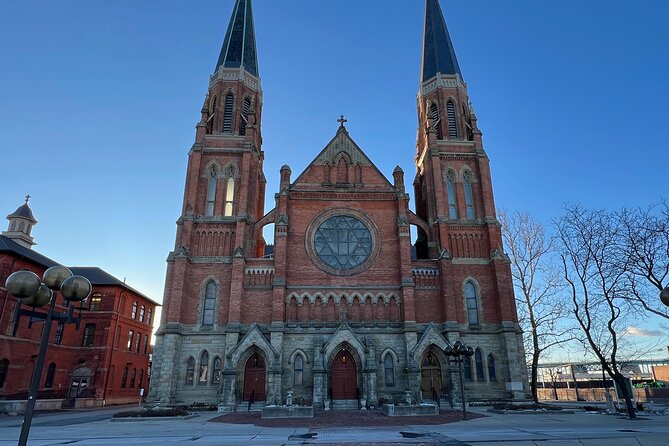
- French Detroit reaches far beyond downtown: The route links Ste. Anne’s, cemeteries, Belle Isle, Grosse Pointe, and three major cultural institutions.
- The narrator is a Detroit historian: The audio focuses on early settlement, Native nations, Catholic roots, war, and the city’s later growth.
- Your own car is essential: This is a private, self-guided auto tour, not a walking group with a live guide.
- The best value comes from sharing: The $20 price is per person, but the audio works well for a carload of people.
- Museums turn a short drive into a full day: The outdoor stops can be covered in two or three hours, while the museums can stretch the experience toward six hours.
- Plan around opening days: Some sites may not be open on Monday or Tuesday, and admission is extra at Ste. Anne’s, the Detroit Historical Museum, and the Detroit Institute of Arts.
French Detroit begins at Ste. Anne’s
Start at the Basilica of Sainte Anne de Détroit on St. Anne Street. Founded by Antoine Cadillac and Father Constantin De L’Halle, the parish is presented as the second-oldest continuously operating Catholic parish in the United States. That claim gives the tour its first big lesson: Detroit was not born as an industrial city. It began as a French and Catholic outpost at the edge of Louis XIV’s empire.
The audio explains why the city’s early story cannot be separated from Native American history. French traders and settlers lived beside Native communities, including the Wendat and other nations, while the river and straits made Detroit valuable for trade and military control.
This opening stop also introduces the darker side of the past. You hear about the slaughter of more than a thousand Fox Indians in a battle tied to control of the straits. The tour does not treat French Detroit as a quaint colonial postcard. It shows a contested place shaped by alliances, trade, religion, and violence.
Admission to Ste. Anne’s is not included. The stop itself takes about 15 minutes, so you can use it as a quick beginning or spend longer if the church is open and you want to look around. The official operating window for the experience runs from 9 a.m. to 9 p.m., but individual sites can keep different hours.
More Smartphone App Tours in the USA:
- San Francisco: Alcatraz Ticket, Ferry, & Self-Guided App
★ 4.5 · 2,460 reviews - Self-Guided Smartphone Ghost Walking Tour in Salem
★ 4.5 · 225 reviews - Waimea Canyon & Na Pali Driving Tour app
★ 4.5 · 116 reviews
Hart Plaza and the river that shaped the city
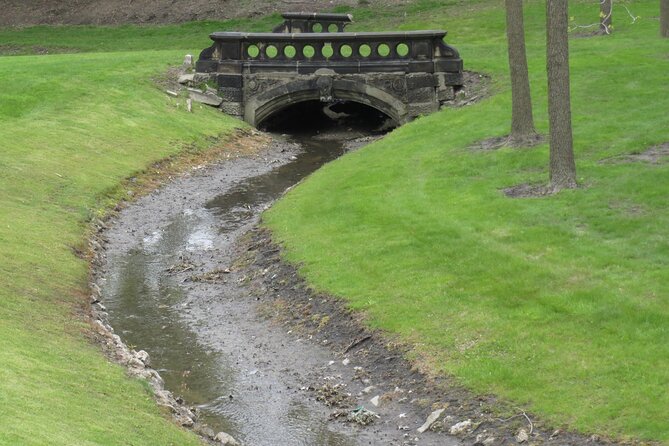
After Ste. Anne’s, the route heads toward Riverside Park and Hart Plaza. The river is the main character here. It carried people, goods, soldiers, and news, and its narrow passage helped make Detroit a strategic post.
At Hart Plaza, the audio discusses the Wendat and other Native communities who lived in relative peace with the French. You also learn why Fort Pontchartrain was built at this location. The fort’s position made sense because Detroit controlled movement through the straits connecting Lake St. Clair and Lake Erie.
Hart Plaza is also the tour’s clearest parking warning. Downtown parking can be awkward, especially if you want to leave the car and explore. You can still see the river from the vehicle, and one account of the tour found downtown parking manageable with a $10 payment that provided access to several venues. Treat that as a useful possibility, not a guaranteed rate.
The audio then points out two of Detroit’s oldest surviving houses, dating from 1826 and 1840. The discussion of ribbon farms is especially useful. These long, narrow farm parcels ran back from the river, giving each family access to water. Some Detroit streets preserve the names of the farms that once lined them.
Mount Elliott Cemetery and the missing markers
Mount Elliott Cemetery adds a personal layer to the story. About 1,800 people originally buried at Ste. Anne’s were later reinterred here. The audio explains the sad problem of lost markers, then directs you toward tombs and family plots connected with early French settlers and other important Detroit residents.
Cemeteries are often the strongest stops on a history tour because they put names and families beside the larger political story. Here, you get a sense of how long French Catholic roots continued in Detroit after British and American control changed the city.
The stop lasts about 20 minutes and is free. You should expect a quiet, observational visit rather than a formal cemetery program. Bring patience for the audio and give yourself enough time to locate the areas being described.
Elmwood Cemetery and Bloody Run

Elmwood Cemetery contains one of the tour’s most striking historical sites. Parent’s Creek became known as Bloody Run after more than 100 British soldiers were ambushed and killed while crossing a bridge during the 1763 uprising led by Chief Pontiac.
The image is grim, but it explains the instability of the period better than a list of dates. Detroit sat in a zone where French, British, and Native interests overlapped. The handover of imperial power did not make the region peaceful.
The audio also leads you to tombs and family plots associated with French settlers. The contrast matters. One moment you are hearing about an armed uprising, and the next you are looking at the family histories of people who built homes, raised children, and helped shape the city’s institutions.
Elmwood is free and takes about 15 minutes in the planned schedule. The tour works best here if you pause the audio when needed and allow yourself to look around rather than treating the cemetery as a quick drive-by.
More History Tours in the USA:
- Santa Fe Historic Downtown Smart Phone Audio App Self Guided GPS Walking Tour
★ 4.5 · 112 reviews - Savannah’s Historical District: A Self-Guided Audio Tour
★ 4.5 · 69 reviews - Self Guided Detroit’s Spirit and History Solo Walking Tour
★ 4.5 · 41 reviews - Salida History Audio Tour l A Self-Guided Wild West Experience
★ 5.0 · 41 reviews
Belle Isle, from Swan Island to a Detroit park
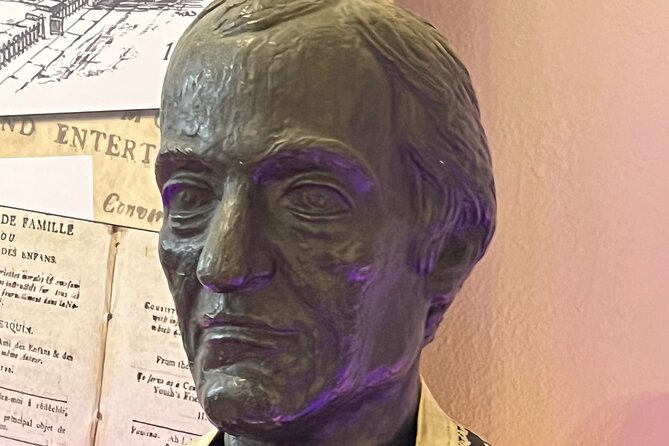
Belle Isle gives the route breathing room. The tour circles the island and points out notable locations, including the place connected with the first victims of the 1763 Native uprising led by Chief Pontiac.
You also hear how the island’s name changed over time. It was once called Swan Island, then Hog Island, and later Belle Isle. Those names reflect changing languages, owners, and ideas about the place.
The island stop is planned for about 30 minutes, though the schedule allows time to stop and enjoy it. That flexibility is useful. You can stay in the car and follow the audio, or pause to walk and take in the setting along the river between the United States and Canada.
Belle Isle is one of the tour’s most appealing stops because it links military history with a place people visit for recreation. The story is not confined to plaques and graveyards. It unfolds beside water, roads, parks, and views.
Mariner Park and the Fox Creek stories
At Mariner Park, you stop beside Windmill Pointe Lighthouse, described as one of Michigan’s oldest lighthouses. The route also follows Altar Road and Fox Creek, whose name is tied to the Fox Indian tribe.
The audio uses this stretch to explain Grand Marais and Fox Run. These names preserve clues about the wetlands, waterways, and Native presence that shaped the area before modern development. The route then passes through the Grand Marais district on the way to Grosse Pointe.
This is a short stop, about 10 minutes, so do not expect a long walk or a formal lighthouse visit. Its value comes from the way the audio connects place names with earlier geography and people.
The Provençal House in Grosse Pointe
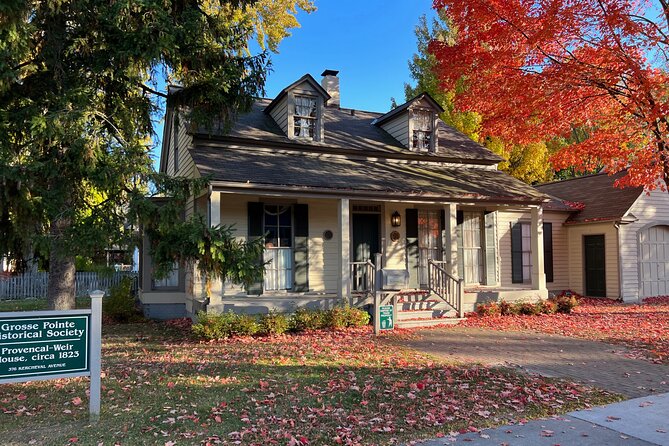
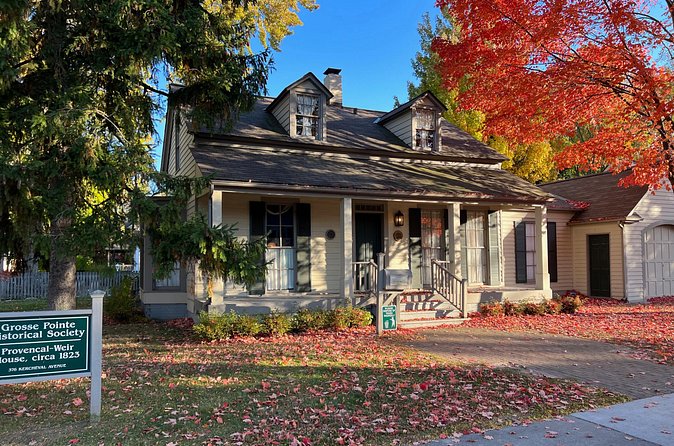
At 376 Kercheval Avenue, you stop at the Provençal House, described as the oldest house in Grosse Pointe. It was built before Grosse Pointe existed as the place name you know today.
The story centers on Pierre Provençal and his wife, Euphemia St Aubin. During the cholera epidemics of 1832 and 1834, they worked with orphans and offered charitable help. Their story gives the tour a welcome change of scale. Instead of forts and battles, you hear about two people responding to a public health crisis in their community.
The stop lasts about 10 minutes. Admission is not included and is likely unavailable, so plan to appreciate the house from the outside and through the audio rather than counting on an interior visit.
Detroit Historical Museum: where the river bends
The Detroit Historical Museum is where the outdoor route becomes a museum visit. The recommended Where the River Bends exhibit focuses on the French era of Detroit and gives you a more organized setting for the people and events introduced in the car.
Allow about an hour. Admission is not included, and museum hours matter. The tour information notes that some sites are not open on Monday and Tuesday, so check before building your day around this stop.
I especially like placing this museum after the cemeteries and riverfront. You arrive with a working sense of the geography, which makes the exhibits easier to follow. If you only have time for one indoor history stop, this is likely the most direct match for the tour’s subject.
The Detroit Institute of Arts and French domestic life
The Detroit Institute of Arts adds a different view of the French period. The suggested Fashionable Living exhibit focuses on furniture and furnishings used by French citizens in the 1700s.
This stop matters because political history can feel distant. Furniture, rooms, and household objects show how people lived, what they valued, and how status appeared in daily life. You are no longer looking only at forts, graves, and battle sites. You are seeing the material world of French Detroit.
Plan about two hours here if you want to enjoy the museum beyond the specific exhibit. Admission is extra. The museum is also described as having been rated number one in the United States by USA Today, but the real reason to include it is its ability to give the French story a human, domestic scale.
The Burton Collection at the Detroit Public Library
The final stop is the Detroit Public Library, home of the Burton Collection. It is described as the world’s largest collection of books, documents, and maps relating to the French era in Detroit.
The planned visit takes about an hour and is free. This is a strong ending for anyone who enjoys primary sources. Maps can show how the river and farms shaped settlement, while documents and books preserve the names and decisions behind the larger story.
Do not expect this stop to work like a standard tourist attraction with a quick viewing route. Its appeal is strongest if you enjoy documents, research, and the way historians reconstruct the past.
How the six-hour schedule really works
The listed timing adds up to roughly six hours, but the day is flexible. The outdoor stops take about two hours if you move steadily. The three indoor visits can add four hours, not counting driving, parking, meals, or time spent walking.
You can compress the route into two or three hours by listening from the car and skipping longer museum visits. Or you can make a full day of it by spending an hour at the Detroit Historical Museum, two hours at the Detroit Institute of Arts, and an hour at the library.
The audio works through your phone and can be connected to your car’s sound system. That makes a major difference. A car speaker is easier for everyone to hear than a phone held between passengers, especially when the route crosses several parts of the city.
The app’s GPS coordination may not be perfect. Study the route before you leave, keep the stops in order, and do not assume the app will always tell you exactly where to turn. This is the main place where a little preparation pays off.
Is $20 a good deal?
At $20 per person, the value depends on how many people share the car and how much of the route you complete. For one person, the price is fair for a six-hour experience with a substantial amount of history. For a family or private group, the cost becomes more attractive because the same audio can play for everyone in the vehicle.
The admission costs are separate. You may pay for Ste. Anne’s, the Detroit Historical Museum, and the Detroit Institute of Arts, while Hart Plaza, the cemeteries, Belle Isle, Mariner Park, the Provençal House exterior, and the library are listed as free stops. Parking is another possible expense, especially downtown.
I would not compare this with a live guided tour. You are paying for the route, narration, and freedom to set your own pace. If you want conversation, instant answers, and someone handling directions, this may feel too do-it-yourself.
Who should book this experience?
You should consider it if you enjoy local history, Catholic history, Native American history, cemeteries, and museum visits. It is also a good fit if you have a car and want a private route rather than a fixed group schedule.
Families may like the freedom to shorten the outdoor portions or pause for food. History-minded visitors will get the most from the links between French settlement, Native nations, British control, and early American Detroit.
I would be cautious if you dislike driving in unfamiliar areas, need perfect GPS directions, or want every stop open on a fixed day. The route crosses several sections of Detroit, and parking takes more thought than the low price might suggest.
Should you book the French History Tour of Detroit?
Book it if you want a broad introduction to Detroit’s French and Native past and are willing to manage the route yourself. The strongest parts are the narrator’s historical detail, the river-centered geography, the cemeteries, Belle Isle, and the chance to continue the story in three cultural institutions.
Skip it if you want a polished, guided excursion with guaranteed access to every site. For the right audience, though, $20 buys a useful foundation and a flexible day exploring the parts of Detroit that are easy to miss.
FAQ
Where does the French History Tour of Detroit start?
It starts at the Basilica of Sainte Anne de Détroit, located at 1000 St Anne St, Detroit, Michigan 48216.
Where does the tour end?
The activity ends back at the meeting point.
How long does the tour take?
The approximate duration is six hours, including the outdoor stops and suggested museum visits. You can shorten it to about two or three hours by limiting your time at the museums.
Is this a guided walking tour?
No. It is a self-guided audio tour app designed for a private auto tour. Your group participates on its own.
What language is the audio tour offered in?
The audio tour is offered in English.
Is transportation included?
No. You use your own vehicle for the auto route.
Are admission fees included?
No. Admission is not included at Ste. Anne de Detroit, the Detroit Historical Museum, or the Detroit Institute of Arts. The other listed stops are described as free, though the Provençal House may not be available for entry.
Can I use public transportation to reach the tour?
The meeting area is near public transportation, but the experience itself is designed as an auto tour.
Is the tour private?
Yes. Only your group participates.
Can I cancel or change the booking?
No. The experience is non-refundable and cannot be changed for any reason.
Just added around the USA
- Smartphone-Guided Walking Tour of Downtown Indianapolis Sights & Stories★ 4.0 · 25 reviews
- Springfield Self-Guided Walking Audio Tour★ 4.0 · 5 reviews
- Smartphone Guided Indianapolis Downtown Sites Audio Walking Tour★ 4.5 · 7 reviews
- Indiana Dunes National Park Self-Guided Audio Tour★ 3.5 · 4 reviews
- Self-Guided Audio Driving Tour in Kancamagus Highway★ 4.5 · 6 reviews
- An Epic Scavenger Hunt: Bloomington Scenic Southern Indiana★ 3.5 · 6 reviews
- Huntsville Rocket City Smart Phone Self Guided Audio (GPS/APP) Walking Tour★ 4.5 · 5 reviews
- Sights of Downtown Houston Smartphone Audio Walking Tour★ 4.0 · 7 reviews
USA Audio Tours, compared.
Fort Sumter Admission and Self-Guided Tour with Roundtrip Ferry
Read our review →
San Francisco: Alcatraz Ticket, Ferry, & Self-Guided App
Read our review →
Los Angeles: Hop-On Hop-Off Bus Tour with Audio Guide
Read our review →
City Sightseeing Hop-On Hop-Off Bus Tour with Audio Guide
Read our review →
Medieval Torture Museum Ticket with Audio Guide and Ghost Hunting
Read our review →

Ryman Auditorium Self-Guided Tour with Souvenir Photo Onstage
Read our review →
Red Rock Canyon Self-Guided Electric Bike Tour
Read our review →Browse the lists this tour appears in