

REVIEW · USA AUDIO TOURS
Self Guided Detroit’s Spirit and History Solo Walking Tour
Detroit’s story comes alive in the space between its grand buildings and small downtown corners. This self-guided route takes you from Parker’s Alley through the Belt, Campus Martius Park, the Guardian Building, and Hart Plaza, using short audio segments and phone directions to connect architecture with the city’s difficult past and hopeful revival.
I love the freedom to pause, rewind, or stop for lunch whenever you want. I also like the price: at $9.75 per person, it is an easy way to get oriented before spending more time around downtown. The main drawback is simple: you are responsible for downloading and accessing the app, and one technical snag can delay the whole experience.
Key points to know before you book

- Parker’s Alley opens the tour with Black Detroit history, introducing Thomas Parker, one of the city’s first Black landowners.
- The route covers major downtown sights in under an hour, making it useful on a first afternoon in Detroit.
- The Guardian Building is a highlight, especially if you enjoy Art Deco detail and grand civic interiors.
- You control the pace, with the option to stop for pizza, cocktails, shopping, or a longer look at any landmark.
- There is no in-person guide, so bring a charged phone and allow time to register on the WalknTours app.
- The tour ends at Hart Plaza, a useful location for continuing along the riverfront or attending a festival.
What this Detroit walk actually gives you

This is not a long historical survey of Detroit. It is a compact introduction to downtown, built around seven stops and a route that usually takes 45 minutes to an hour. If you listen quickly and walk straight through, you can finish within that estimate. If you pause inside buildings, stop for food, or replay a section, plan on spending closer to a couple of hours.
The route has a useful shape. It begins near Buddy’s Pizza at the Madison Building on Broadway Street and finishes at Hart Plaza. Along the way, the app points out details you could easily miss on your own, including the story behind Parker’s Alley and the meaning of the Spirit of Detroit sculpture.
The tone is not simply celebratory. You hear about Detroit’s difficult decades, the empty or underused spaces that once made downtown feel less welcoming, and the work involved in bringing those places back into public use. That balance matters. You get more than a parade of pretty buildings, but you also are not asked to treat the city only as a story of decline.
Because this is a private activity for your group, you do not have to keep up with strangers or worry about missing a guide’s explanation in a noisy street. That is especially useful for families, couples, or anyone who prefers to stop often.
More Self-Guided Walking Tours in the USA
- Self Guided Classic Freedom Trail Location Aware (GPS) Walking Audio Tour
★ 4.5 · 258 reviews - Self-Guided Smartphone Ghost Walking Tour in Salem
★ 4.5 · 225 reviews - Cape Cod & Provincetown Self-Guided Driving & Walking Audio Tour
★ 4.0 · 207 reviews
Parker’s Alley and the story of Thomas Parker
The first stop is Parker Street, known locally as Parker’s Alley. It is a brick-lined passage named for Thomas Parker, a free Black man who was one of Detroit’s first Black landowners.
This is a strong place to begin because it shifts your attention away from the biggest buildings. Detroit history is not only about auto companies, towers, and civic projects. It also includes the people who established themselves in the city when property ownership was far from equally available.
You spend about three minutes here, but the stop gives the route a human starting point. Look around before moving on. The small scale of the alley makes a useful contrast with the skyscrapers ahead.
The Belt turns an old alley into public art
The next stop is the Belt, an alley in what was once Detroit’s garment district. Its name comes from the shape of that former district, which resembled a belt.
The alley is part of a larger effort by the Library Street Collective to rethink underused areas in the city. Here, the experience shifts from early Black landownership to modern public art and urban renewal. You are looking at a space that once served a practical purpose and now invites people to linger.
The app gives you a reason to enter places that might otherwise seem like shortcuts rather than destinations. That is one of the tour’s best qualities. It does not simply send you down the most obvious downtown streets.
Spend three minutes here if you are moving fast, but you may want longer if the art catches your eye. The route is flexible, so you can stop the audio and continue later without losing your place.
Campus Martius Park and Detroit’s change of mood
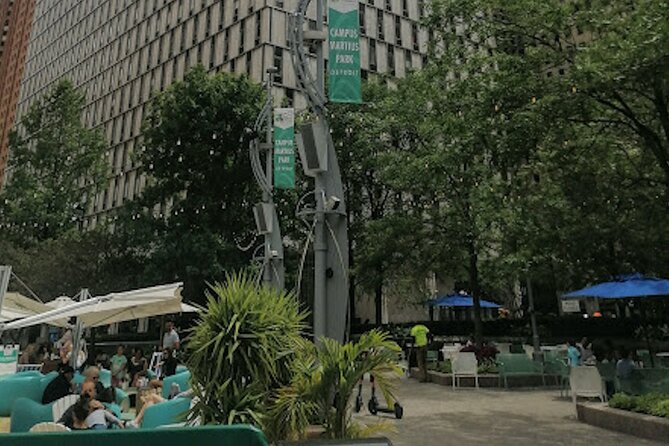
Campus Martius Park is the route’s central public square. Created in its current form in 2004, it has become one of downtown Detroit’s main gathering places. USA Today named it one of the top 10 public squares in the United States.
The important point is not just the award. The park represents how much the feel of this part of downtown has changed. The area was once a place many people avoided on foot. Today, it is a spot for hanging out, seasonal events, and city life.
You get about five minutes of recorded context here. That is enough to understand why the square matters, but not enough to cover every event, building, or design detail around it. Treat this as a starting point, then look around at your own pace.
This is also a practical place to make the tour your own. Seasonal shops and nearby places to eat can turn a short stop into a longer break. One useful approach is to pause the audio before ordering something, then resume once you are ready.
Same place, a different route to walk:
- Fort Sumter Admission and Self-Guided Tour with Roundtrip Ferry
★ 4.5 · 3,343 reviews - San Francisco: Alcatraz Ticket, Ferry, & Self-Guided App
★ 4.5 · 2,460 reviews - Los Angeles: Hop-On Hop-Off Bus Tour with Audio Guide
★ 3.7 · 2,030 reviews - City Sightseeing Hop-On Hop-Off Bus Tour with Audio Guide
★ 3.0 · 1,083 reviews
The Penobscot Building reaches into Detroit’s skyline
The Penobscot Building dates from 1928. At the time it was completed, it ranked as the fourth-highest building in the United States and the eighth-highest in the world.
The description of its shape is memorable. The tower rises above you with a series of setbacks near the top, giving it the look of a cliff edge. This is a good example of why an audio route helps. You may notice the height and decoration, but the historical ranking and architectural form add another layer to the view.
The stop lasts about three minutes. That is enough for a quick look from street level, though the route does not turn into a full architectural tour. If towers are your main interest, you will want to spend extra time studying the exterior.
The Penobscot also helps place Detroit in its national context. In the late 1920s, this was a city building on a very large scale. The skyscraper is not just a backdrop for the walk. It is evidence of the confidence and economic power Detroit once projected.
The Guardian Building rewards a slower stop
The Guardian Building is the architectural centerpiece of the route for many people. Completed in 1929 as the Union Trust Building, it has the colorful tilework and strong geometric design associated with American Art Deco. Its original nickname, the Cathedral of Finance, tells you how grand the building was meant to feel.
You are given about five minutes here, but I would not rush. The interior is frequently singled out as a favorite part of the walk, and for good reason. The building offers a strong contrast to the plain streets outside, with a more ornate sense of ceremony and scale.
The Guardian Building is also a useful reminder that Detroit’s finest architecture is not always found in a museum. A working downtown building can hold some of the city’s most striking design.
There is one practical caution: access to an interior building can vary. The tour includes the Guardian Building as a stop, but it does not promise a private visit or an extended interior tour. If the doors are open, take your time and look carefully. If access is limited, the exterior still gives you plenty to see.
The Spirit of Detroit explains a familiar symbol
The Spirit of Detroit statue is one of the city’s best-known public symbols. The figure holds a golden sphere with rays meant to represent light from God, while the people in the other hand symbolize human relationships.
The explanation is brief, around five minutes, but it helps you read a sculpture that can otherwise seem familiar and self-explanatory. The image appears across Detroit, so understanding the symbolism gives added meaning to signs, logos, and public references you may notice later.
This stop works best if you take a moment to look beyond the statue itself. Consider how a civic sculpture becomes part of a city’s identity. The Spirit is not presented as a remote monument. It is treated as a figure people recognize and care about.
The app format is useful here because you can listen without being hurried along. You can stand back, take photos, or replay the explanation before heading toward the final stop.
Joe Louis brings civil rights into the route
The Joe Louis Monument adds a personal and political note to the walk. Louis is remembered as a boxing champion, but his public role reached beyond the ring.
The narration explains his opposition to segregation and Jim Crow laws. It also covers his encouragement of young Black men to join the U.S. Army during World War II, even though the military itself remained segregated. His reason for supporting the war was blunt: America had serious problems, but Hitler was not going to solve them.
That context gives the monument more weight. You are not simply looking at a sculpture honoring an athlete. You are considering the choices made by a prominent Black American during a period when patriotism and racial equality did not comfortably align.
The stop takes about three minutes. It is short, but it adds a valuable layer to a route otherwise centered on buildings, parks, and urban renewal.
Hart Plaza gives the walk a clear finish
The walk ends at Hart Plaza, at 1 Hart Plaza. The plaza opened in 1975 and has hosted festivals and special events ever since. Its large ring, Transcending, honors the working men and women who built Detroit.
Ending here makes sense. The route begins with an individual landowner and ends with a public tribute to the people who built the city. Between those points, you have seen financial power, public space, art, civic identity, and the city’s effort to reuse neglected places.
Hart Plaza is open from 12:00 a.m. to 11:30 p.m. daily during the stated operating period. The late hours give you flexibility, though the audio tour itself is best experienced when you can comfortably see the streets and buildings around you.
How the app-guided format works in practice
You receive a mobile ticket and use the WalknTours app for directions and audio. There is no person waiting at the starting point, and no guide leading a group from stop to stop.
That gives you several advantages:
- You can start without coordinating with a group.
- You can pause for food, drinks, shopping, or photos.
- You can replay information you missed.
- You can move more slowly if walking is difficult.
- You avoid trying to hear a guide over city noise.
The route has been praised for clear directions and a logical order. It can also be easier than following a live guide when you want to stop often. One useful example is starting with Buddy’s Pizza, then pausing the tour during the meal and continuing afterward.
The tradeoff is technical. You need a smartphone, the WalknTours app, and an account. One person had trouble logging in because the app account was separate from the booking account. That is a fixable problem, but it can be frustrating if you wait until you are standing on Broadway Street.
I recommend downloading the app and registering before you leave your hotel. Keep your booking information available, and make sure your phone has enough battery for the walk. The tour is offered in English.
Price, timing, and who gets the best value
At $9.75 per person, this is a low-cost introduction to central Detroit. The price makes the most sense if you want useful context without paying for a longer guided outing.
The booking information also notes that only one tour is needed per group, so check the checkout details carefully if you are traveling with other people. The listed price is per person, but the tour is private for your group. That distinction is worth confirming before payment.
The usual timing is 45 minutes to an hour. In practice, your total outing can be longer because the app lets you stop anywhere along the route. That flexibility makes the tour more valuable than a simple timed audio file.
I would choose this for:
- A first visit to downtown Detroit
- A short stay with less than half a day available
- Couples or families who dislike large groups
- Solo visitors who want a planned route
- Anyone interested in architecture and urban renewal
- People who like to combine sightseeing with food and drinks
I would choose something else if you want a live guide, detailed architectural instruction, or a full survey of Detroit beyond the downtown core.
Weather, walking comfort, and practical limits
This is an outdoor walking experience, so rain can quickly change your plans. One person stopped after the first location because of bad weather and switched to indoor activities. The cancellation policy allows a full refund if you cancel at least 24 hours before the start time, but changes or cancellations within 24 hours are not refunded.
The route is manageable for many people, and the directions have been easy to follow even for someone recovering from an injury. Still, the streets and walking paths may not feel comfortable to everyone. One experience included concerns about people drinking and smoking in a park area, along with loud music and litter.
That does not define the whole walk, but it is fair to keep in mind. Downtown conditions can vary by block and by time of day. If you feel uneasy, pause the tour and decide whether to continue.
Service animals are allowed, public transportation is nearby, and most people can participate. The tour does not provide an in-person guide, so you need to manage your own route and pace.
Should you book the Detroit Spirit and History walk?
Book it if you want a cheap, flexible introduction to downtown Detroit and are comfortable using an app. The strongest parts are the Guardian Building, the explanation of the Spirit of Detroit, Parker’s Alley, and the way the route connects old Detroit with its current revival.
Skip it if you need a person beside you, dislike downloading apps, or want a longer historical tour with extensive commentary. For everyone else, $9.75 buys a well-shaped hour of sightseeing, with the freedom to turn that hour into a relaxed afternoon.
FAQ
How long does the walking tour take?
The stated duration is approximately 45 minutes to one hour. You can take longer because the app allows you to pause and continue later.
Is there an in-person guide?
No. This is a smartphone-guided walking tour operated through the WalknTours app.
Where does the tour start?
It starts at Buddy’s Pizza, Madison Building, 1565 Broadway Street, Detroit, Michigan 48226.
Where does the tour end?
The route ends at Hart Plaza, 1 Hart Plaza, Detroit, Michigan 48226.
Is the tour available in languages besides English?
The experience is offered in English.
Can I cancel for a refund?
Yes. You can receive a full refund if you cancel at least 24 hours before the experience start time. Cancellations or changes made within 24 hours are not refunded.
More History Tours in the USA
- Santa Fe Historic Downtown Smart Phone Audio App Self Guided GPS Walking Tour
★ 4.5 · 112 reviews - Savannah’s Historical District: A Self-Guided Audio Tour
★ 4.5 · 69 reviews - Salida History Audio Tour l A Self-Guided Wild West Experience
★ 5.0 · 41 reviews - Historic Bar Harbor Self-Guided Walking Audio Tour Guide
★ 4.5 · 38 reviews
Just added around the USA
- Smartphone-Guided Walking Tour of Downtown Indianapolis Sights & Stories★ 4.0 · 25 reviews
- Springfield Self-Guided Walking Audio Tour★ 4.0 · 5 reviews
- Smartphone Guided Indianapolis Downtown Sites Audio Walking Tour★ 4.5 · 7 reviews
- Indiana Dunes National Park Self-Guided Audio Tour★ 3.5 · 4 reviews
- Self-Guided Audio Driving Tour in Kancamagus Highway★ 4.5 · 6 reviews
- An Epic Scavenger Hunt: Bloomington Scenic Southern Indiana★ 3.5 · 6 reviews
- Huntsville Rocket City Smart Phone Self Guided Audio (GPS/APP) Walking Tour★ 4.5 · 5 reviews
- Sights of Downtown Houston Smartphone Audio Walking Tour★ 4.0 · 7 reviews
USA Audio Tours, compared.

Fort Sumter Admission and Self-Guided Tour with Roundtrip Ferry
Read our review →
San Francisco: Alcatraz Ticket, Ferry, & Self-Guided App
Read our review →
Los Angeles: Hop-On Hop-Off Bus Tour with Audio Guide
Read our review →
City Sightseeing Hop-On Hop-Off Bus Tour with Audio Guide
Read our review →
Medieval Torture Museum Ticket with Audio Guide and Ghost Hunting
Read our review →

Ryman Auditorium Self-Guided Tour with Souvenir Photo Onstage
Read our review →
Red Rock Canyon Self-Guided Electric Bike Tour
Read our review →Browse the lists this tour appears in