REVIEW · TOURS
Chichen Itza: Self-Guided Tour with Audio Narration & Map
Chichén Itzá is far easier to appreciate when you know what you are looking at, and this $9.99 self-guided audio tour gives you that context without tying you to a group. Once downloaded, it uses GPS rather than mobile data, so you can walk from El Castillo to the ball court, pause in the shade, and continue when ready.
I like the hands-free narration and the freedom to wander off for photos or souvenirs, then return to the route. I also like the low price, especially when a private guide would cost much more. The main catch is simple: you must download and test the app before reaching the site, and a small number of users have had trouble with access or battery life.
Key points to know before you go
- More than 37 audio stops: Hear about El Castillo, the Great Ball Court, Tzompantli, El Caracol, Las Monjas, and other major buildings.
- Works offline after setup: Download the tour on strong Wi-Fi or cellular service before arriving at Chichén Itzá.
- GPS triggers the stories: The narration begins as you reach points along the route, with text and images available in the app.
- Plan on substantial walking: The route covers more than 1.5 miles, and the full circuit is described as more than 2 miles.
- English only: No live guide is provided, and the tour does not include the archaeological site admission ticket.
- Lifetime access: You can pause, replay, and use the tour again on another visit or trip.
Why an audio tour helps at Chichén Itzá

The famous pyramid is easy to recognize. The harder part is understanding the buildings scattered beyond it. Chichén Itzá is not one monument with a few ruins around it. It is a large ceremonial center with ball courts, platforms, temples, an observatory, carved columns, and smaller structures that make little sense without explanation.
That is where this app earns its modest price. On-site signs are limited, so you can look at a building without learning much about its purpose, decoration, or place in Maya and Toltec culture. The app supplies short explanations as you move, using audio, photographs, text, and a suggested route.
I especially like the ability to listen while standing in the shade instead of gathering around a guide in full sun. You can stop the narration, replay a section, read the text, or skip a building that does not interest you. The experience feels more like having a private route in your pocket than joining a fixed group.
The information is not a university lecture. One user found the narration too brief, and another felt it left out broader subjects such as why the city was abandoned and how Maya customs worked. I think of it as a practical introduction to the ruins, not a complete course on Maya civilization.
More Audio Tours in the world:
- Barcelona: Sagrada Familia Entry Ticket with Audio Guide
★ 4.6 · 105,312 reviews - Rome: Pantheon Fast-Track Ticket and Official Audioguide
★ 4.5 · 27,353 reviews - Barcelona: Casa Batlló Entry with Self-Audioguide Tour
★ 4.7 · 25,359 reviews
Download the app before entering the site
The most important practical step is also the easiest to overlook. After booking, you receive setup instructions and a password by email and text. Search for audio tour if the message is not immediately obvious, then download the separate Action’s Tour Guide app while you still have a strong connection.
Enter the password, open the tour, and make sure the route loads. A few users have reported that the app asked for the code again or would not open at first. Closing and reopening the app solved one such problem, but I would not wait until you are standing at the entrance to troubleshoot.
Bring headphones or earbuds. The GPS narration is designed to start automatically when you reach each point, and headphones let you hear it clearly without disturbing other people. Couples can share one tour by using wireless earbuds, one earbud each, which keeps the total cost at $9.99 for two people if you are comfortable doing so.
Your phone battery matters. The route takes about two hours for many people, and GPS plus audio can use power. A portable charger is a smart addition. The app works offline after download, but your phone still needs functioning GPS.
Starting at the handicraft market
The route begins near the handicraft market at the Chichén Itzá archaeological zone. This is a useful place to get oriented before the main monuments begin. The opening narration introduces the site as a former Maya center and sets up the broad idea that you are walking through a place shaped by different peoples over many centuries.
Do not rush the first few minutes. You need to stand at the correct starting point so the GPS knows where you are. One useful feature is the ability to pause or wander away, but the route works best once you understand its direction and pace.
The market is also a reminder that the tour does not include admission. You must buy or arrange your Chichén Itzá entrance separately. The audio tour begins at the site, but it is not an entry pass, reservation, or attraction ticket.
El Castillo and the Great Ball Court
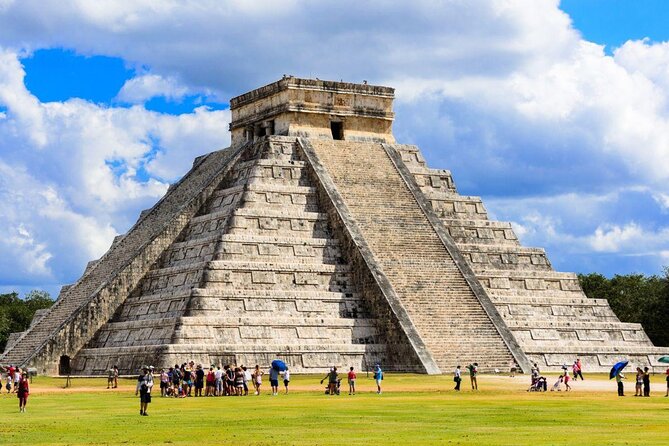
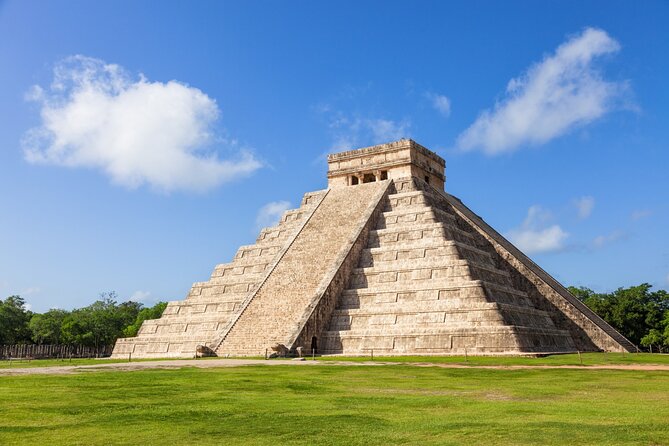
El Castillo, also called the Pyramid of Kukulkan, is the natural centerpiece. The app explains its connection to Kukulkan, the feathered serpent deity, and points out features of its design that are easy to miss when you are simply photographing the pyramid.
You cannot climb the pyramid, so the experience depends on your ability to look closely from ground level. The narration gives you a reason to study the shape, stairways, and proportions instead of treating the building as a quick photo stop.
Next comes the Gran Juego de Pelota, or Great Ball Court. This is far more than an open field. Carved reliefs run along the walls, including scenes of ball players, and the audio helps you notice details that are easy to overlook from the path.
The route allows about ten minutes at El Castillo and five minutes at the ball court, but you should treat those times as guides rather than rules. If the app moves ahead while you are taking pictures, you can replay the material or manually start a story.
Same place, a different route to walk:
- Rome: Colosseum & Forum with Audio Guide App -Optional Arena
★ 4.2 · 24,770 reviews - Venice: Grand Canal Gondola Ride with App Commentary
★ 4.1 · 23,020 reviews - Amsterdam: 75 Minute City Canal Cruise with Audio Guide
★ 4.4 · 19,938 reviews - Florence: Timed Entry to Michelangelo’s David + Audio App
★ 4.6 · 19,496 reviews
Tzompantli and the Eagles and Jaguars Platform
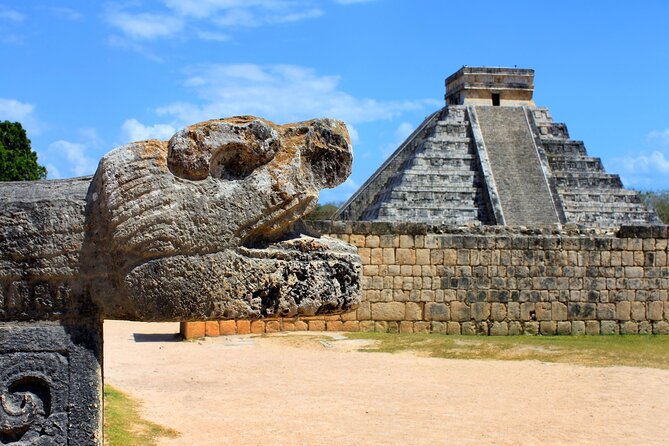
Tzompantli is one of the darker stops. Its name means skull rack, and the carvings show warriors, human heads, skulls, snakes, and eagles. The narration gives the platform a cultural setting that a brief sign may not provide.
This is also a good example of why an audio guide can be useful. Without explanation, the carved figures can blend into the larger collection of stonework. With a few minutes of context, you understand that the platform carried a serious ceremonial and political message.
Nearby, the Eagles and Jaguars Platform is a square, open structure with stairs on all four sides. It appears to have served as a public stage for ritual, dance, or speeches rather than supporting a temple.
I like the contrast between these two stops. One focuses on powerful carved imagery, while the other raises questions about public ceremonies and gatherings. The app keeps both explanations short, so you can listen without losing too much time in the heat.
El Caracol, the Maya observatory
El Caracol is among the most interesting buildings on the route. The circular upper structure is associated with astronomical observation, and the tour explains how Maya observers watched the stars and tracked planetary movement.
The building is important because it connects architecture with careful observation of the sky. You are not just looking at a rounded ruin. You are considering how the Maya used buildings, calendars, and celestial movement to organize religious and civic life.
The route data lists El Caracol twice, once as a main stop and again later among the southern structures. That may reflect different points or repeated content within the app. If the narration seems to repeat itself, you can skip or replay it rather than losing time.
The approach to El Caracol also makes the walking requirement clear. Chichén Itzá is spread out, and you will spend much of the visit moving between monuments rather than standing at one central plaza.
The wider story of Chichén Itzá

One longer section gives a broad explanation of Chichén Itzá as a major center of the Yucatán Peninsula. The site developed over nearly 1,000 years, and its surviving monuments show Maya construction methods alongside elements linked to central Mexico and Toltec influence.
This is the part that helps connect the separate buildings. El Castillo, the Temple of the Warriors, El Caracol, and the smaller structures are not random ruins. Together, they show a changing city shaped by different traditions and periods.
The app’s overall strength is this connection between place and story. You hear the explanation near the building itself, then look up and match the words to stone. Its limitation is depth. If you want a detailed account of political history, daily life, writing systems, or the reasons the city declined, you may need another source as well.
Temple of the Warriors and the Red House
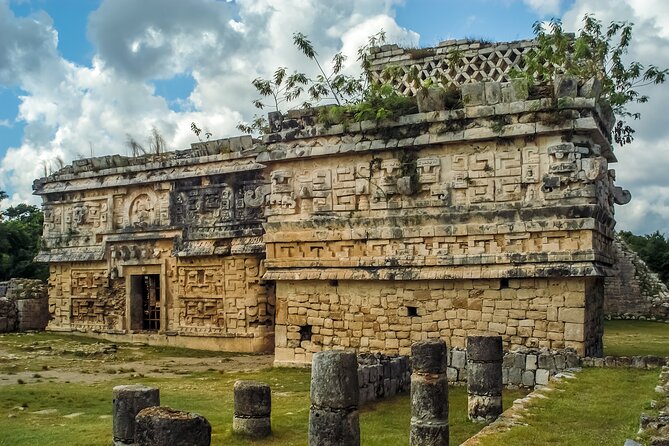
The Temple of the Warriors is easy to spot because of its broad, tiered form and the rows of columns in front. The structure has three lower levels and a smaller temple above, while roughly 200 columns carry carvings of Toltec-style warriors and other scenes.
The audio gives you time to examine those columns. I recommend listening before walking close to the details, then pausing the narration while you look. That simple habit works well throughout the site.
The Red House, also known as the House of Little Holes, is smaller and more easily missed. Its name comes from latticework near the top that resembles a pattern of small openings. The Maya name Chichanchob may refer to those holes.
This stop shows the value of a planned route. If you only follow the largest crowds, you can focus on El Castillo and the Temple of the Warriors and miss the smaller buildings that help explain how broad the complex really is.
The Ossuary and Las Monjas
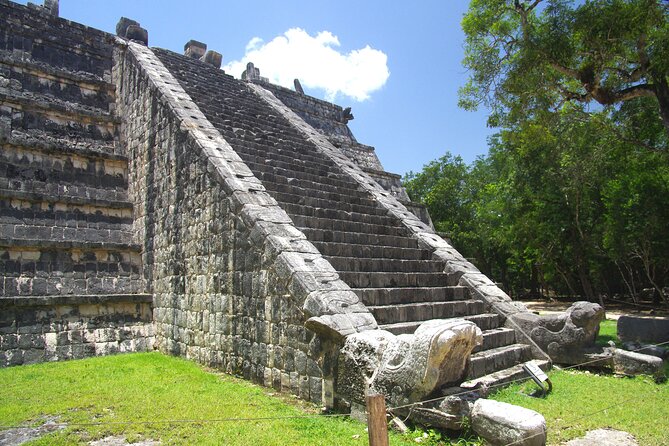
The Ossuary, also called El Osario or the High Priest’s Grave, is another pyramid with a story beneath it. Archaeologists found human remains and seven tombs in a cavern under the structure, leading to its modern name.
The route includes separate references to the Ossuary and El Osario. Expect some overlap in the explanations, but use the repetition to inspect the pyramid and surrounding details at a slower pace.
Las Monjas, or the Nunnery, is one of the most important buildings in the southern area. Its walls contain many inscriptions, including references to a ruler named Kakupakal. The name is misleading by modern standards, since the building was not a convent in the European sense.
I find Las Monjas especially worthwhile for readers who want to see writing and decoration rather than only massive pyramids. The carved texts point to rulers and events, giving the building a more direct connection to the people who used the city.
La Iglesia and the final stretch
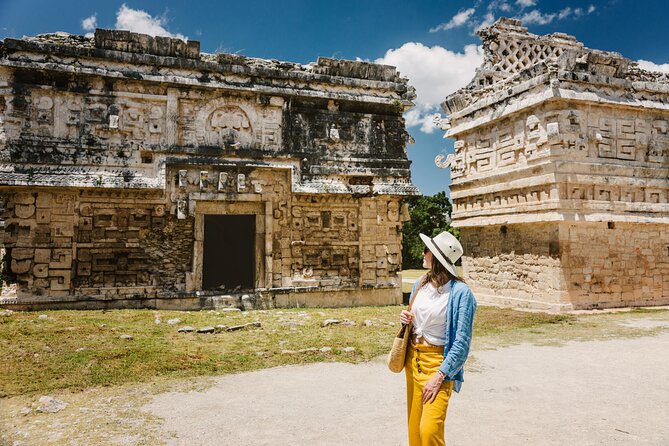
La Iglesia is one of the site’s most photographed smaller buildings. Its exterior is covered with decorative veneer, and masks of Chac appear on the upper levels. Look closely and you may also find representations of an armadillo, crab, snail, and tortoise among the decoration.
This is a fine final stop because it rewards patience. The building is not as imposing as El Castillo, but its surface is full of small details. The audio encourages you to study the facade rather than walk past it on the way out.
The full route takes roughly one to two hours if you move steadily, while the advertised experience allows about two to three hours. Your actual time depends on how long you spend taking pictures, resting, replaying stories, and exploring side paths.
There are refreshment stalls and a sitting area within the complex, which helps on a hot day. Still, bring water, wear sensible walking shoes, and plan breaks. The route covers more than 1.5 miles, with some descriptions putting the full walk at more than two miles.
Value at $9.99
At $9.99 per person, this is inexpensive compared with hiring a private guide. It is also a practical choice if you want to avoid moving at another group’s pace. You pay for an explanation of the main monuments, a route, offline maps, and repeat access, but you still need to buy the Chichén Itzá entrance ticket separately.
The value is strongest for independent visitors who want more than bare signs but do not need a long academic presentation. You can split the tour between two people with shared headphones, making the price even easier to justify.
The price does not erase the app’s weak points. The content can feel brief, the route may trigger a little early in places, and the narration quality may not suit every listener. One user found the voice and pronunciation difficult, while others found the narration clear and useful. I would download a sample or test the app before entering if possible.
Who should choose this tour
I would choose this tour if you want privacy, a low cost, and control over your schedule. It suits solo visitors, couples, and families who want to stop for photographs, rest in the shade, or repeat a story without holding up a group.
It is also useful for people who do not want to hire a private guide but still want structure. The GPS route keeps you moving through the main areas, while the map helps you regain your place if you wander.
I would choose a live guide instead if you want to ask questions, discuss uncertain parts of Maya history, or receive a long explanation of the site’s political and religious background. The app gives you a solid on-site introduction, but it cannot respond to your questions or adjust its explanation to your interests.
Book it only after checking the practical basics: you need an iPhone with iOS 15 or later, an Android device with version 9 or later, or a GPS-enabled iPad or tablet with cellular capability. The tour is offered in English, and free cancellation is available up to 24 hours before the start time. Inside the final 24 hours, refunds are not available.
Should you book the Chichén Itzá audio tour?
I think this is a smart buy for an independent visit, provided you prepare the app before leaving reliable internet. At $9.99, it adds useful context to a major archaeological site without forcing you into a group or paying private-guide prices.
Choose it for flexibility and value, not for exhaustive scholarship. If you bring headphones, a charged phone, and a little patience at the start, you can explore El Castillo, the ball court, El Caracol, Las Monjas, and the smaller temples at your own pace.
FAQ
Does this tour include admission to Chichén Itzá?
No. The $9.99 price covers the self-guided audio tour and app features, but the Chichén Itzá entrance ticket, attraction passes, reservations, and entry fees are not included.
Is the tour guided by a person?
No live guide meets you at the start. Walk with Action provides a self-guided app with audio narration, text, images, GPS guidance, and a suggested route.
How long does the tour take?
Plan on about two hours for the main route. The advertised duration is approximately two to three hours, while the audio route itself is described as taking about one to two hours depending on your pace.
How many stops are included?
The route contains more than 37 audio stories and covers major areas including El Castillo, the Great Ball Court, Tzompantli, the Eagles and Jaguars Platform, El Caracol, the Temple of the Warriors, the Ossuary, Las Monjas, and La Iglesia.
Does the app work without internet?
Yes, after you download the tour. You must download the app and tour content using strong Wi-Fi or cellular service before arriving. GPS works offline once the tour is installed.
How do I start the tour?
Open Action’s separate audio tour app at Chichén Itzá, select the appropriate tour if more than one option appears, and go to the stated starting point. The first story should begin when you reach its GPS location.
Do I need headphones?
Headphones or earbuds are recommended for the best experience. Couples can share one tour by using one wireless earbud each.
What devices are recommended?
The recommended devices are an iPhone running iOS 15 or later, an Android device running version 9 or later, or an iPad or tablet with GPS and cellular connectivity.
Is the tour available in languages other than English?
The supplied tour information lists English as the available language. It does not list Spanish, French, German, or other language versions for this experience.
Can I pause or reuse the tour?
Yes. You can pause the tour, take breaks, replay stories, skip stops, and explore side areas before returning to the route. The purchase provides lifetime access with no expiry, so you can use it again on another trip.
Just added around the world
- Dolmabahce Palace Skip the Ticket Line Entry with Audio Guide★ 4.0 · 6 reviews
- Istanbul Bosphorus Sightseeing Cruise with Audio Guide★ 5.0 · 67 reviews
- Basilica Cistern Skip-the-Ticket-Line Entry with Audio Guide★ 4.0 · 4 reviews
- Hagia Sophia Skip-the-Line Ticket with Audio Guide★ 5.0 · 4 reviews
- Cistern of Theodosius Entry Ticket & Audio Guide★ 3.5 · 6 reviews
- Maria Edgeworth Center-A Self-Guided Audio Tour★ 5.0 · 21 reviews
- Self-Guided Tour of Ísafjörður: Art, History, and Architecture★ 5.0 · 23 reviews
- Inverness Quest: Self Guided City Walk & Immersive Treasure Hunt★ 4.0 · 5 reviews
Tours, compared.
Barcelona: Casa Batlló Entry with Self-Audioguide Tour
Read our review →
Rome: St. Peter’s Basilica & Dome Entry Ticket & Audio Tour
Read our review →
Krakow: Auschwitz-Birkenau Guided Tour or Self-Guided Tour
Read our review →
Rome: Hop-on Hop-off Sightseeing Bus Tour with Audioguide
Read our review →
Istanbul: Bosphorus Sightseeing Cruise Tour with Audio Guide
Read our review →
Barcelona: Palau de la Música Self-Guided Tour
Read our review →
Fort Sumter Admission and Self-Guided Tour with Roundtrip Ferry
Read our review →