
REVIEW · ITALY AUDIO TOURS
Bologna Murder Mystery: Self-Guided City Quest
Bologna’s old center becomes your game board in this self-guided murder mystery, which links city sights through 11 puzzles and a fictional story. You begin near Porta Galliera and work toward Piazza Rossini, using the Questo app to find clues and answer questions at real monuments.
I like the freedom to start any time, pause for a coffee, and continue when ready. I also like the low $6 price, especially for a private group, and the fact that the game works without an internet connection. The tradeoff is that the mystery may feel thinner than the sightseeing: the puzzles and city facts are the main event, while the plot is more of a walking framework.
Key points before you play
- An hour through central Bologna: The route links gates, markets, theaters, churches, towers, and university sites.
- Eleven location puzzles: You look closely at your surroundings to answer questions and move to the next stop.
- No live guide: The Questo app gives directions and story prompts, so your group explores on its own.
- Flexible timing: The activity is available 24 hours a day, and you can pause or resume as needed.
- A strong $6 value: The price is modest for a private activity, especially when shared among friends or family.
- Best for curious walkers: You’ll get the most from it if you enjoy noticing small details and solving clues.
Bologna becomes your playing field
This is not a standard guided walk. Nobody meets you with a sign, and no guide leads the group from one sight to the next. Instead, you use a mobile access code and the Questo app, which sends you step by step through Bologna.
The basic rhythm is simple. Reach a location, read the short historical note, inspect the nearby building or monument, and answer the challenge. A correct answer sends you onward. The goal is not speed alone. You are encouraged to look around, which can make you notice details that are easy to miss on a normal stroll.
The route lasts about one hour, though your pace can change that. A group that stops for photos or pauses the game will need longer. Since you choose your own starting time, you can fit it between meals, museum visits, or a wider walk around the center.
The activity is offered in English. It is private, so only your own group takes part. That makes it a better fit for families or friends who want to joke, argue over answers, and set their own pace without keeping up with strangers.
More Scavenger Hunts in Italy
- Angels & Demons Rome Scavenger Hunt: The Illuminati Escape Game
★ 4.5 · 103 reviews - Florence Self-Guided Treasure Hunt & Medici Mystery Walking Tour
★ 5.0 · 69 reviews - Siena Medieval Power Quest: Self-Guided Family Feud Game
★ 4.5 · 38 reviews
From Porta Galliera to the Piazzola market
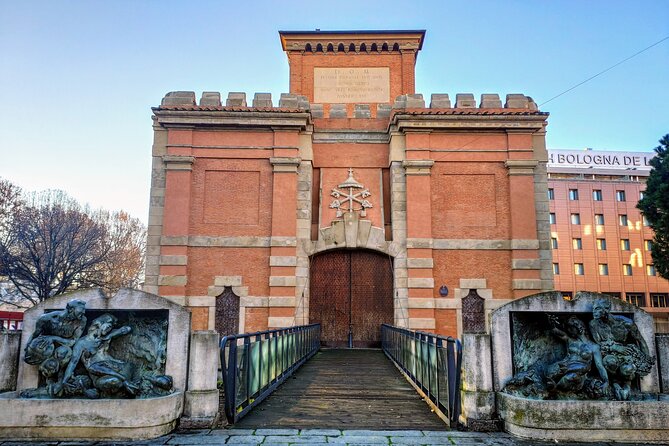
The starting point is at P.za XX Settembre, 15, near Porta Galliera. This former gate belonged to Bologna’s outer medieval walls and is the most ornamented of the surviving gates. Its current form dates from 1659 to 1661 and was designed by Bartolomeo Provaglia.
This is a good opening clue because the gate gives you something solid to inspect. You are not simply told that a monument exists. You must look around and find the detail that answers the first challenge. That small act changes the way you walk. Instead of checking the app every few seconds, you scan the stonework and surrounding area.
The next section takes you toward Piazza VIII Agosto. On Fridays and Saturdays, the square hosts the large Piazzola market, with more than 400 street stalls. The market can add plenty of visual noise and activity to the route, so finding the right detail may require patience.
If you play on a market day, allow extra time to cross the square and keep your group together. If you play on another day, the space should be easier to read. Either way, this stop shows the game’s strength: it uses ordinary city places, not just famous monuments, as part of the challenge.
Theater, fountain, and a curious mystery
The Arena del Sole comes next. This historic theater traces its origins to 1810 and reopened in 1995 after eight years of reconstruction. You will look for a clue here, then receive the next location through the app.
The theater stop adds a different kind of city story. Bologna is not only a city of churches and medieval towers. Its public life also includes performance spaces and long-running cultural institutions. The short information supplied in the game gives you a reason to pause rather than walk past.
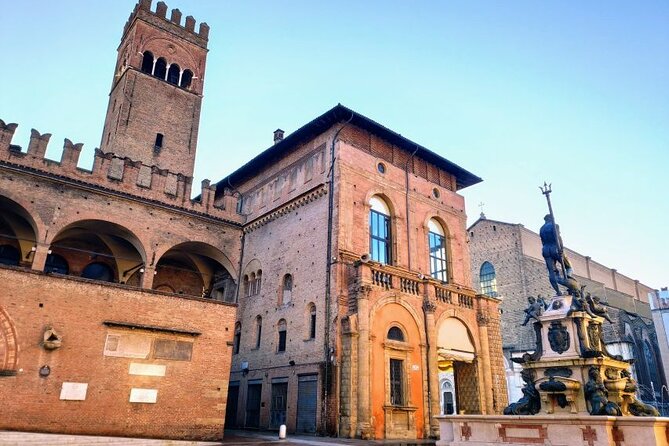
The route then brings you to the Fountain of Neptune. The fountain was completed in 1565, and the large bronze Neptune was installed around 1567. The sculpture was an early design by Giambologna, who had also submitted a model for Florence’s Fountain of Neptune but lost that commission to Baccio Bandinelli.
This is one of the route’s strongest stops because the fountain is visually easy to recognize, yet the story behind it is less obvious. The challenge asks you to examine what is in front of you. I would give this puzzle a little breathing room, since the square can be full of people and the sculpture has plenty of details to take in.
The murder mystery provides a reason to move from place to place, but the real reward here is the sequence of small historical facts. You learn why a gate was built, how a theater changed, and who shaped a major fountain. The plot may not always connect these facts tightly. That is the main weakness of the format.
Churches with very different personalities
One stop focuses on an oratory built between 1481 and 1497 by the Celestine fathers of the nearby church of San Giovanni Battista. The small church was built in an area below a structure connected with Bologna’s early medieval walls. An ancient image of the Madonna had been placed there under a simple shelter.
This clue rewards careful looking, but it may be less immediately clear than the Fountain of Neptune or the Two Towers. The app’s instructions matter here. Follow them closely, and resist the urge to jump ahead if the location seems uncertain.
The route then reaches the Basilica of San Petronio on Piazza Maggiore. The basilica is dedicated to Saint Petronius, Bologna’s fifth-century bishop and patron saint. Construction began in 1390, and the main facade remains unfinished.
San Petronio is one of the city’s essential sights, so including it gives the game a useful anchor. You can treat the puzzle as a quick reason to inspect the facade, then spend more time here if you have not visited before. The activity itself is not a full church tour, so do not expect detailed coverage of the interior or its art.
Next comes a Baroque church begun in 1687 to 1690 under Giovanni Battista Bergonzoni. Its elliptical design has a dome by Giuseppe Tubertini, completed in 1787, while the facade was not added until 1905. Inside is Niccolò dell’Arca’s 1463 sculptural group, Sorrow over Dead Christ.
This stop offers a useful contrast with San Petronio. Instead of one enormous civic basilica, you get a church with a more focused architectural plan and a major work of sculpture. If the site is open when you pass, the sculpture gives the stop extra value. The game itself may not leave enough time for a long visit, so consider returning later if art is your main interest.
More Murder Mystery Trails in Italy:
- Paris Murder Mystery: Death on the Seine Quest and Tour
★ 4.0 · 42 reviews - Liverpool Ghost Hunt: Paranormal Detective Self-Guided Game
★ 4.5 · 26 reviews - The Astronomer’s Legacy: Prague Self Guided Mystery Game
★ 5.0 · 17 reviews - Murder Detective Self-Guided Tour in Manchester
★ 3.5 · 16 reviews
Bologna’s towers and university quarter
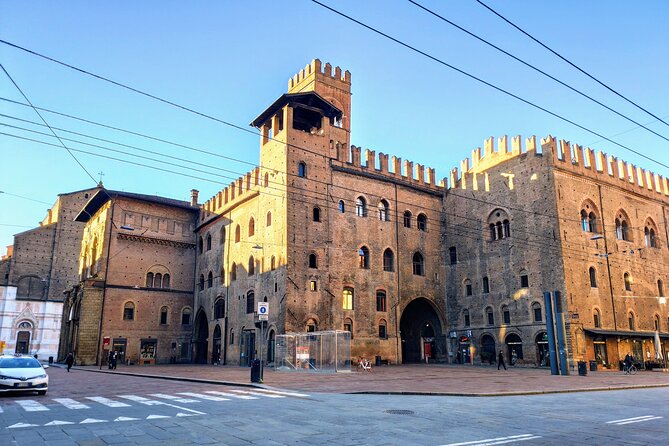
The Two Towers are among Bologna’s clearest symbols. The taller tower is the Asinelli, while the shorter Garisenda leans more noticeably. Their names come from the families traditionally credited with building them between 1109 and 1119.
This is a natural puzzle location. The towers are easy to identify, and their different heights and angles give you something concrete to compare. You may want to pause here even after solving the challenge, since the pair helps explain Bologna’s medieval character better than a paragraph of app text can.
The route then turns toward the area connected with the University of Bologna, described as the oldest university in Europe. Before the university had a dedicated base in the Renaissance, classes were held in professors’ homes or public spaces. Many professors lived nearby.
This is a particularly good idea for a city quest because it connects a present-day street with an older use. You are asked to think about how teaching worked before purpose-built university buildings shaped academic life. The stop is less about a single grand facade and more about reading the area as a former place of study.
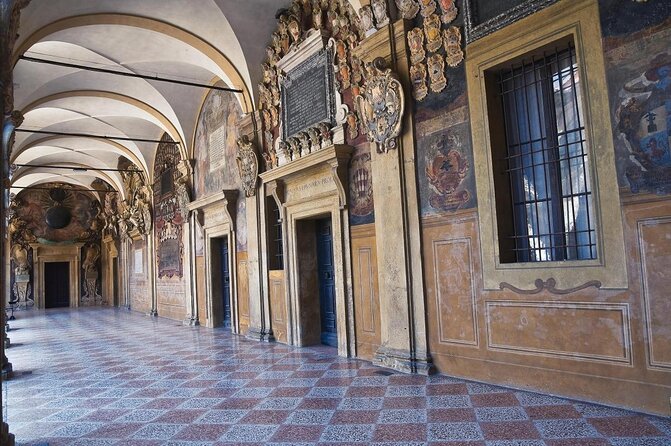
The Archiginnasio adds a stronger architectural focus. Construction began in late February 1562, and the building opened on October 21, 1563. It was called the Archiginnasio after the classical term for Bologna’s Studium, the early name for the university.
The building is an important part of Bologna’s university story, but the game’s quick format means you should not confuse this activity with a full visit. The route gives you a prompt, a fact, and a puzzle. You supply the extra time if you want to study the building in greater detail.
Montagnola, the cathedral, and the final approach
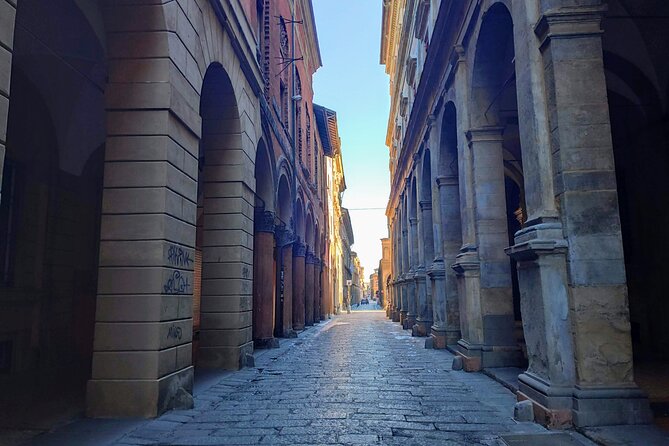
The Park of Montagnola was originally created in 1805 under Napoleonic rule, with its design commissioned from Giovanni Battista Martinetti. It provides a change of pace after the denser streets and major stone monuments.
A park can be a useful place for a puzzle because you are asked to look around rather than simply identify a famous facade. It may also offer a brief open-air pause for your group. The route is still short, so do not expect a long park walk or a separate nature activity.
Bologna Cathedral, dedicated to Saint Peter, is another major religious stop. It serves as the city’s cathedral and the seat of the Archbishop of Bologna. Most of the current building dates from the 17th century, with some parts from the late 16th century.
Its inclusion adds another layer to the city’s religious architecture. San Petronio is the famous basilica on Piazza Maggiore, while the cathedral represents Bologna’s formal episcopal center. The distinction is useful if you are trying to understand the city rather than simply collect photographs.
The final location is Palazzo dei Banchi on Piazza Maggiore. It was the last building erected in the square and was designed by Vignola in the 16th century. Its ornate facade was intended to hide the narrow lanes of the market behind it. The name comes from the currency exchange banks once found there.
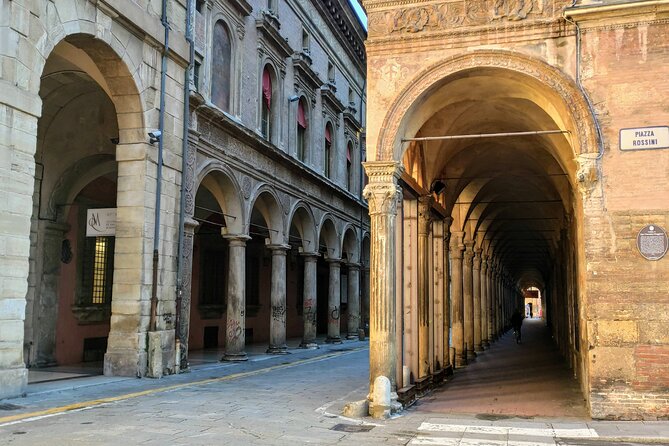
The activity ends at P.za Rossini, 1, and the app guides you there step by step. Because the route crosses several central areas, you finish near more sightseeing rather than at an isolated meeting point. That makes it easy to continue exploring after the game.
What the app format gets right
The best feature is control over your time. You can begin at any hour, stop when someone needs a break, and resume without a group waiting. The listed hours run from midnight to midnight every day, so you are not tied to a morning departure or a fixed afternoon slot.
The offline play feature also matters. Once you have access to the game, you do not need an internet connection while solving the route, so the activity should not use your mobile data as you move through Bologna. Keep the access code available, and follow each instruction carefully.
The challenges are not just trivia questions detached from the city. You must inspect real places to progress. That makes the activity more engaging than listening to a list of dates, especially for children and adults who enjoy a clear goal.
The format also gives you privacy. Your group can work out answers at its own speed, and nobody else’s pace controls the walk. Service animals are allowed, public transportation is nearby, and most people can participate.
What may frustrate you
The route can be confusing at times. The app directs you step by step, but you still need to match its instructions with the streets and buildings around you. If your group gets turned around, take a moment to reread the prompt instead of rushing to the next answer.
The story is another mixed point. It supplies a playful reason to explore, but the plot may not always make perfect sense. If you want a carefully written detective story with a strong ending, this may feel light. If you mainly want a fun walking structure with history notes, the loose mystery matters less.
Also remember that this is not a guided tour. There is no person to answer follow-up questions, explain a church interior, or adjust the route when the market is crowded. You get independence, but you also do the navigating and interpreting yourself.
Is $6 a fair price?
At $6 per person, the value is strong for a private, app-based activity lasting about an hour. A couple pays little for a structured walk, while a family or group of friends can use the game as an inexpensive shared activity. Group discounts may improve the price further.
The price does not buy entry to churches, museums, or monuments. It buys the mobile access code, 11 puzzles, the story, directions, and the sightseeing framework. If you were already planning to walk through central Bologna, the game adds a purpose without adding much cost.
I would not choose it as your only introduction to Bologna. The historical notes are short, and the route cannot provide the depth of a dedicated guide or museum visit. But as a first-hour orientation, a family activity, or a break from formal sightseeing, it earns its place.
Who should book it?
You should book this if you like walking, phone-based puzzles, and the freedom to set your own pace. It is especially suitable for families with older children, couples who enjoy solving clues, and groups of friends who want an activity that is more active than a standard audio guide.
It is less suitable if you dislike using an app, want a live expert, or prefer a tightly plotted mystery. It also may not satisfy you if your main goal is detailed art, architecture, or church interpretation.
You can cancel for a full refund if you do so at least 24 hours before the start time. Changes or cancellations within 24 hours are not refundable.
FAQ
How long does the Bologna Murder Mystery take?
The activity takes about one hour. Your group may need longer if you pause, take photos, or spend extra time at the sights.
Where does the activity start?
It starts at P.za XX Settembre, 15, 40121 Bologna BO, Italy, near Porta Galliera.
Where does the activity finish?
It finishes at P.za Rossini, 1, 40126 Bologna BO, Italy. The Questo app guides you there step by step.
Is a tour guide included?
No. This is a self-guided activity played through the Questo app. A mobile access code, 11 puzzle challenges, the mystery storyline, and directions are included.
Do I need an internet connection while playing?
No. The game does not require an internet connection while you play, so it will not use your mobile data during the route.
Can I pause the game or choose my start time?
Yes. You can choose your own beginning and end time, and pause or resume the activity as needed. It is offered every day, around the clock.
Should you book it?
Book it if you want a low-cost way to turn a central Bologna walk into a shared puzzle. The route covers an unusually broad mix of places, from Porta Galliera and Montagnola to San Petronio, the Two Towers, the Archiginnasio, and Palazzo dei Banchi.
Skip it if you want a live guide or a finely developed murder plot. For most independent visitors, the best way to view it is as an entertaining city orientation with historical clues, not a full sightseeing tour. At $6, that is a fair trade, and the freedom to play on your own terms makes the format easy to fit into a Bologna visit.
Just added around Italy
- Genoa Historic Centre Quest: A Self-Guided Puzzle Adventure★ 4.0 · 3 reviews
- Genova Walking Tour with Audio and Written Guide by a Local★ 4.5 · 33 reviews
- Self-Drive (No Licence) Boat Rental in Portofino Gulf★ 5.0 · 12 reviews
- Finance and Nobility: Explore medieval Genoa on a self-guided audio tour★ 4.5 · 7 reviews
- Florence: Uffizi Gallery Reserved Ticket & Digital Audio Guide★ 4.5 · 3 reviews
- Around Florence Hills: App‑Guided e‑Vespa Tour + Wine&Food★ 4.5 · 22 reviews
- Florence: Uffizi Gallery Audio Guided Tour led by Tour Leader★ 3.5 · 6 reviews
- Uffizi Gallery: Self-guided App Visit & Optional Accademia Museum★ 4.0 · 19 reviews
Italy Audio Tours, compared.
Rome: Pantheon Fast-Track Ticket and Official Audioguide
Read our review →
Rome: Colosseum & Forum with Audio Guide App -Optional Arena
Read our review →
Venice: Grand Canal Gondola Ride with App Commentary
Read our review →
Florence: Timed Entry to Michelangelo’s David + Audio App
Read our review →
Rome: City Sightseeing Hop-on Hop-off Bus with Audioguide
Read our review →
Venice: La Fenice Opera House Entry Ticket with Audio Guide
Read our review →
Rome: Colosseum, Forum, Palatine Hill Entry & Audioguide App
Read our review →Browse the lists this tour appears in