REVIEW · ITALY AUDIO TOURS
Bologna: A Self-Guided Audio Tour from Porta Galliera to Le Tre Frecce
Bologna’s best introduction may be its contradictions: the city of red roofs, rich food, leaning politics, lost canals, medieval towers, and the world’s oldest university. This self-guided walk also tells the story of how the rebellious Bolognese kept their city from becoming part of the Vatican.
I like the location-aware narration, which starts and stops as you reach each point, and the route’s mix of major sights and odd little stories, such as the secret behind the Three Arrows. The offline maps and audio are especially useful if you want to save phone data or avoid wrestling with directions.
The main drawback is simple: you are on your own. The audio cannot answer questions, guide you inside churches, or adjust the route for construction. Allow 90 minutes for a direct walk, but plan more time if you stop for food, drinks, photos, or independent visits.
Key points to know before you go
- A history-packed route: Walk from Porta Galliera to Le Tre Frecce through Bologna’s political, religious, and culinary center.
- English audio only: The tour is narrated in English through the VoiceMap application.
- About 60 to 90 minutes: That is the walking time without long stops, though you can stretch it into a relaxed half-day.
- Offline access included: Download the audio, maps, and geodata before setting out.
- Great value at $11.99: The price covers lifetime access, making it inexpensive for solo visitors or small groups.
- No interior tours: Entry fees, food, drinks, transport, a smartphone, and headphones are not included.
Starting at Porta Galliera and the story of rebellion
The walk begins at Porta Galliera, at Piazza XX Settembre, near the edge of Bologna’s historic center. This is more than a convenient starting gate. The site recalls the 1848 rebellion in which Bolognese citizens forced a retreating Austrian army to leave the city.
That opening gives the tour a useful purpose. You are not just being pointed toward pretty buildings. You are being introduced to Bologna as a place with a strong civic identity and a habit of resisting outside control.
The route also uses Bologna’s many nicknames to frame the city. Red refers to the terracotta roofs and the city’s long left-leaning politics. Fat points to its generous, famously heavy cooking. Towered recalls the more than 100 medieval towers that once filled the city. Cultured refers to the university, founded in 1088 and widely recognized as the oldest in the world.
This is a good way to begin because Bologna can seem less immediately obvious than Florence or Venice. Its appeal comes through layers: arcades, student life, food shops, political history, and medieval streets. The audio helps you connect those pieces as you walk.
More Audio Tours in Italy:
- Rome: Pantheon Fast-Track Ticket and Official Audioguide
★ 4.5 · 27,353 reviews - Rome: Colosseum & Forum with Audio Guide App -Optional Arena
★ 4.2 · 24,770 reviews - Venice: Grand Canal Gondola Ride with App Commentary
★ 4.1 · 23,020 reviews
Napoleon’s garden and the open space of Piazza Otto Agosto
From Porta Galliera, the route passes Il Pincio, the entrance to Parco della Montagnola. The garden was commissioned by Napoleon and designed in a French style, giving you a change of mood after the fortification and rebellion at the starting point.
You then continue through Piazza Otto Agosto, a broad urban space with room to pause and get your bearings. The route is not limited to narrow medieval lanes. These larger spaces help explain how Bologna grew and changed over time.
The audio format works well here because you can keep walking while listening rather than stopping for a long lecture. The application uses your location to deliver the next part of the commentary as you reach the right area. You can also stop the walk if a market, café, or photo catches your attention.
Construction affected the start for one person using the tour, so check your surroundings and do not worry if the first few minutes are slightly confusing. Once you move past the starting area, the directions become easier to follow.
Bologna’s lost waterways along Canale delle Moline
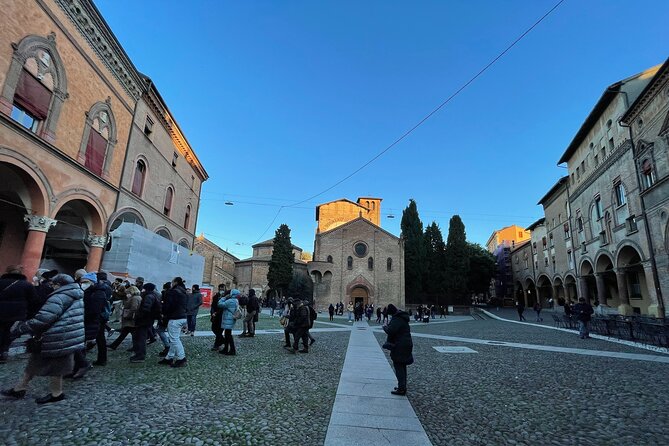
One of the more surprising parts of the route comes near Canale delle Moline. Bologna is not usually the first Italian city you associate with water, yet it once had a network of canals and rivers that made it resemble Venice in practical ways.
The canal story adds depth to an otherwise familiar walk down Via Indipendenza. You get a sense of how the city used water for work and movement, even though much of that network is now hidden or less obvious to the eye.
The route also touches on Bologna after the Risorgimento, the period when Italy was unified. That context gives Via Indipendenza more meaning than simply being a shopping street or a straight connection through the center. You are hearing how the city changed after the old political order gave way to modern Italy.
This is the sort of information that makes a self-guided walk worthwhile. A live guide might cover it too, but the app lets you hear it while standing near the relevant canal and street rather than reading a general city overview in a hotel room.
San Pietro and the center of civic Bologna
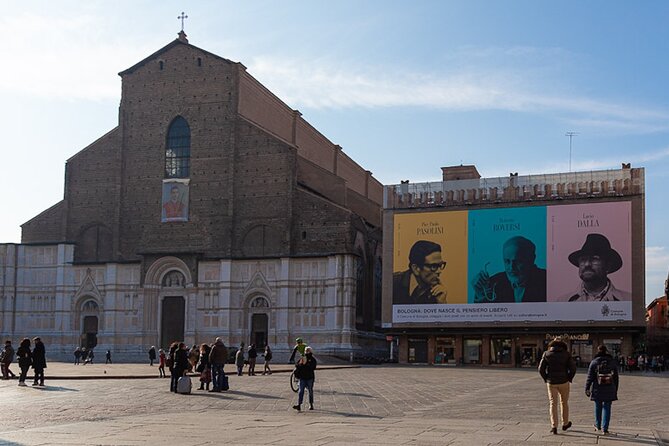
The walk continues past San Pietro and into the heart of Bologna. The route then reaches Piazza del Nettuno, where one of the tour’s more entertaining stories concerns the Fountain of Neptune.
The fountain’s sculptor had to work around a church prohibition that prevented Neptune from appearing too well-endowed. The solution was an optical trick involving the statue’s hand and body. The audio explains the joke and the way the sculptor managed to get past the restriction.
This kind of story keeps the tour from feeling like a list of dates and architectural labels. Bologna’s public art comes with politics, religion, vanity, and humor. You can look at the fountain with fresh eyes after hearing the explanation.
Piazza del Nettuno also places you close to San Petronio, Bologna’s largest and most important church. The route introduces the exterior and its importance, but it does not provide a guided visit inside. If you enter San Petronio or any other attraction along the way, you pay separately and explore independently.
That distinction matters. At $11.99, the experience is priced as an audio walk, not as an admission package or a private guided visit. You are paying for the route, narration, and interpretation.
Same place, a different route to walk:
- Florence: Timed Entry to Michelangelo’s David + Audio App
★ 4.6 · 19,496 reviews - Rome: City Sightseeing Hop-on Hop-off Bus with Audioguide
★ 4.0 · 16,045 reviews - Pompeii: Entry Ticket with Audio Guide
★ 4.1 · 13,491 reviews - Venice: La Fenice Opera House Entry Ticket with Audio Guide
★ 4.6 · 11,742 reviews
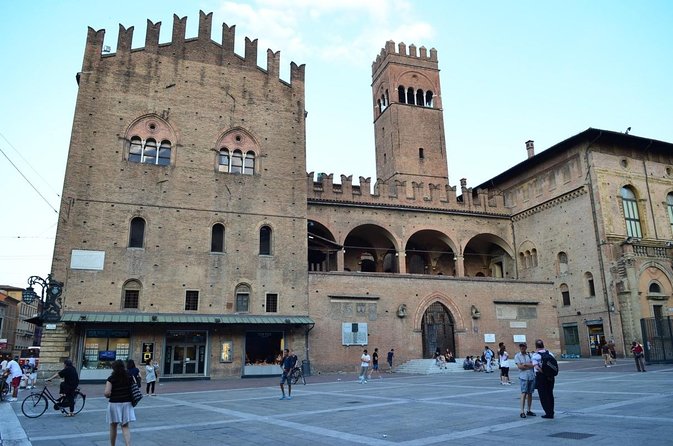
The Whispering Gallery beneath the Torre dell’Arengo
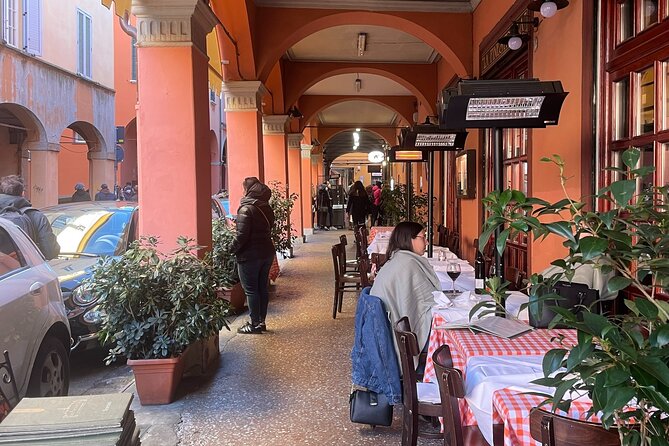
Under the Torre dell’Arengo, also called the Tower of Arengo, you reach the Whispering Gallery. The unusual acoustics allowed people standing at opposite corners to hear one another through the arches.
The audio connects this sound trick to a playful local legend about lovers whispering sweet nothings without their legitimate partners finding out. It is a small detail, but it gives the building a human scale. Medieval towers can seem remote when viewed only as monuments. A story about secret conversations makes the space easier to picture and remember.
This stop also shows why headphones are necessary. You need to hear the narration clearly in a public square, and the tour does not supply them. Bring your own headphones and a charged smartphone. The phone, headphones, and any mobile data needed before downloading are your responsibility.
San Petronio and the edge of the Quadrilatero
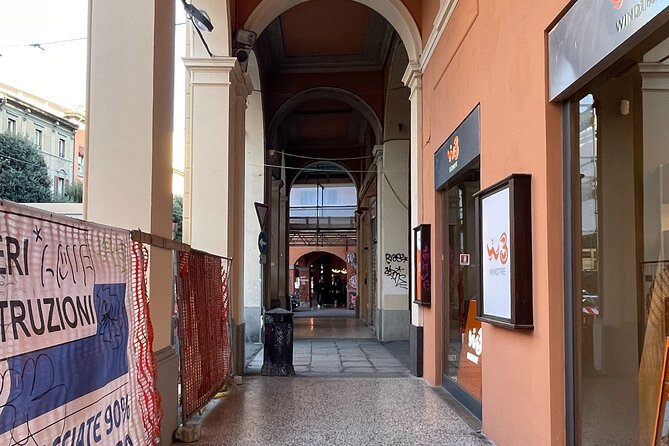
San Petronio is one of the route’s major visual anchors. Even if you only pause outside, its size and civic importance help explain Bologna’s ambition. The church is tied closely to the city rather than being presented only as a religious building.
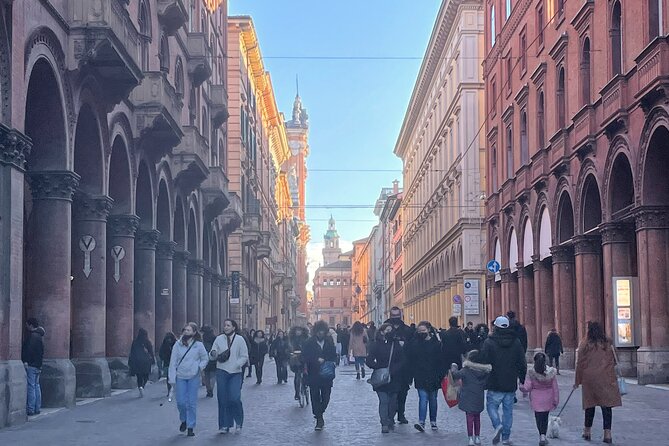
From there, the walk moves toward the Quadrilatero, Bologna’s compact market and dining district. This is where the city’s food nickname becomes very real. Cafés, restaurants, and food shops fill the neighborhood, making it a natural place to pause for a drink or meal.
The tour does not include food or drinks, which is actually useful for a self-guided route. You can choose your own stop instead of being tied to a fixed group schedule. One person completed the direct walk in about 90 minutes but extended the outing to around three and a half hours by researching extra details, stepping inside places, and stopping for an Aperol Spritz.
You can use the route in the same way. Treat the audio as the backbone of your visit, then add your own breaks. Just remember that extra time inside churches, shops, or attractions is not part of the guided commentary.
Via Rizzoli and Bologna’s famous Two Towers
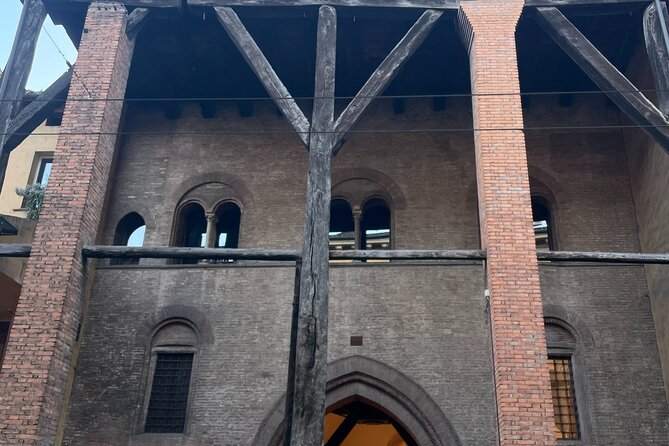
The route continues along Via Rizzoli, one of the main streets through central Bologna. From here, you take in the city’s famous Two Towers, Garisenda and Asinelli.
These towers are among Bologna’s clearest reminders of its medieval past, when powerful families built tall structures as symbols of wealth, rivalry, and protection. The tour does not simply point them out as postcard subjects. Their presence fits the larger story of the city once being crowded with more than 100 towers.
The two remaining towers also help orient you. After the open squares and major streets, they provide a strong visual marker as the route moves toward Piazza della Mercanzia. This part of the walk is easy to combine with your own sightseeing because you are already near several of Bologna’s central streets and food areas.
Do not expect a climb or interior visit as part of this experience. The route is a narrated walk past the sights. Any separate entry or activity would be arranged and paid for on your own.
Piazza della Mercanzia and the Three Arrows
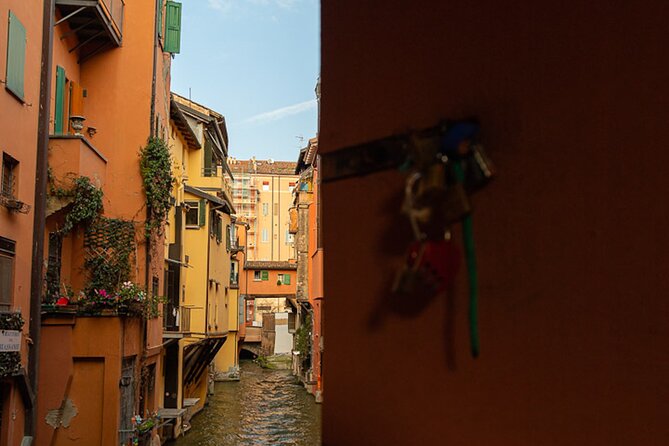
Piazza della Mercanzia brings the walk toward its final section. The square is connected to Bologna’s old commercial life, and it leads you toward the route’s endpoint at Le Tre Frecce on Strada Maggiore.
The Three Arrows are linked to several legends, including one involving nudity. The audio reveals the competing stories rather than leaving you with a bare name and a photograph. This is a fitting ending because it returns to the tour’s main strength: small, memorable details that make the city easier to understand.
The walk ends in front of Le Tre Frecce. From there, you can continue exploring on foot, stop for food in the nearby center, or use the route as a starting point for your own plans.
How the VoiceMap format works in practice
You receive lifetime access to the tour in English through the VoiceMap application. The audio, map, and geodata can be used offline, so download everything before starting.
The app tracks your position and delivers commentary as you reach each location. It can also pause and restart as you walk, which makes the experience more flexible than a fixed recording you must constantly manage.
That flexibility is the biggest advantage. You can move at your own pace, stop for a photograph, linger in the Quadrilatero, or take a drink break without holding up a group. You also avoid the pressure of keeping up with a guide.
The tradeoff is the lack of personal contact. There is no guide to answer a question, explain a detail in a different way, or reroute you if a street is blocked. This is a private activity in the sense that only your group participates, but it is not a live private guide service.
Is $11.99 good value for Bologna?
At $11.99 per person, I consider this a strong low-cost introduction to central Bologna. The price includes lifetime access rather than a single use, and the route covers political history, canals, public art, churches, food culture, market streets, towers, and local legends.
The value is best for someone who wants structure without paying for a full live tour. A solo visitor can follow the route without joining a group, while two or three people can share the same general plan and still keep their independence.
The price does not include transport, admission, food, drinks, a smartphone, or headphones. That keeps the cost clear, but you should budget extra if you want to enter San Petronio or other attractions along the way.
The experience is also non-refundable and cannot be changed after booking. Since construction or phone problems can affect any self-guided walk, download the material in advance and make sure your device is ready before you leave.
Who should choose this audio walk?
I would choose this for a first look at Bologna, especially if I had only part of a day and wanted a clear route through the historic center. It suits independent visitors who enjoy listening while walking and prefer to pause when something catches their eye.
It is also a practical choice for a last-minute visit when a live tour does not fit your schedule. You can start any time during the stated operating period and take as long as you like.
Families and small groups may appreciate the freedom to stop, though everyone needs to share the pace and listen through their own setup. People who want detailed questions answered, guided interiors, or personal recommendations should book a live guide instead.
Should you book it?
Book this tour if you want an inexpensive, well-organized introduction to Bologna with strong directions, entertaining local stories, and the freedom to stop for coffee or food. The route gives you more than a list of famous buildings, especially around the canals, Neptune’s fountain, the Whispering Gallery, and Le Tre Frecce.
Skip it if you expect a human guide, museum access, or a fully managed experience. For $11.99, though, it offers a smart way to get oriented, learn the city’s odd details, and decide where you want to spend more time afterward.
FAQ
How long does the Bologna audio tour take?
The walk takes about one hour to one hour and 30 minutes when followed directly. Stops for food, drinks, photos, or independent visits can make the outing much longer.
Where does the tour start?
It starts at Porta Galliera in Piazza XX Settembre, Bologna.
Where does the tour end?
The tour ends in front of Le Tre Frecce at Strada Maggiore 19.
What language is the audio tour offered in?
The tour is offered in English.
Is the audio available offline?
Yes. You receive offline access to the audio, maps, and geodata through the VoiceMap application.
Are museum and church admissions included?
No. The tour does not guide you through museums or other attractions, and any admission costs must be paid separately.
Do I need to bring anything?
You need your own smartphone and headphones. Transportation, food, and drinks are also not included.
Can I cancel or change the booking?
No. The experience is non-refundable and cannot be changed for any reason.
Just added around Italy
- Genoa Historic Centre Quest: A Self-Guided Puzzle Adventure★ 4.0 · 3 reviews
- Genova Walking Tour with Audio and Written Guide by a Local★ 4.5 · 33 reviews
- Self-Drive (No Licence) Boat Rental in Portofino Gulf★ 5.0 · 12 reviews
- Finance and Nobility: Explore medieval Genoa on a self-guided audio tour★ 4.5 · 7 reviews
- Florence: Uffizi Gallery Reserved Ticket & Digital Audio Guide★ 4.5 · 3 reviews
- Around Florence Hills: App‑Guided e‑Vespa Tour + Wine&Food★ 4.5 · 22 reviews
- Florence: Uffizi Gallery Audio Guided Tour led by Tour Leader★ 3.5 · 6 reviews
- Uffizi Gallery Audio-Guided Visit with optional Accademia Gallery★ 3.5 · 42 reviews
Italy Audio Tours, compared.
Rome: Pantheon Fast-Track Ticket and Official Audioguide
Read our review →
Rome: Colosseum & Forum with Audio Guide App -Optional Arena
Read our review →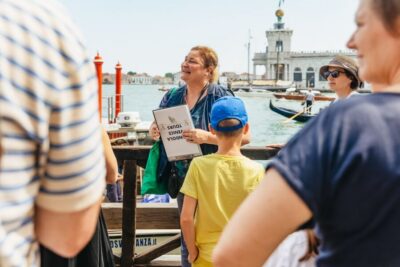
Venice: Grand Canal Gondola Ride with App Commentary
Read our review →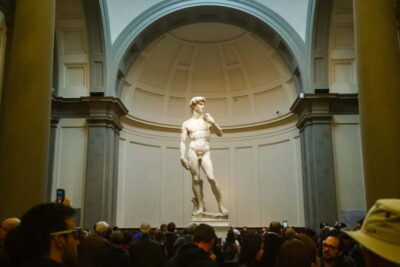
Florence: Timed Entry to Michelangelo’s David + Audio App
Read our review →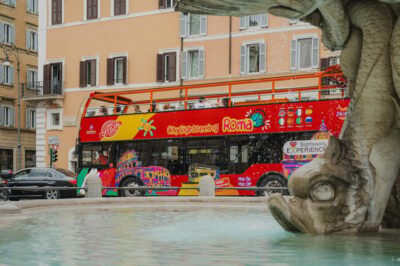
Rome: City Sightseeing Hop-on Hop-off Bus with Audioguide
Read our review →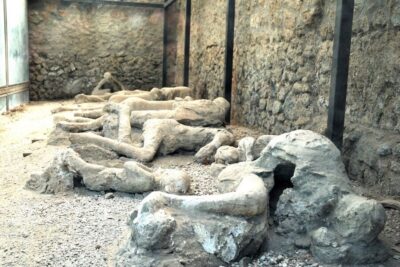
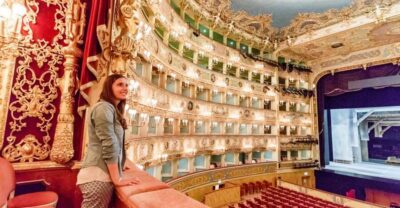
Venice: La Fenice Opera House Entry Ticket with Audio Guide
Read our review →