
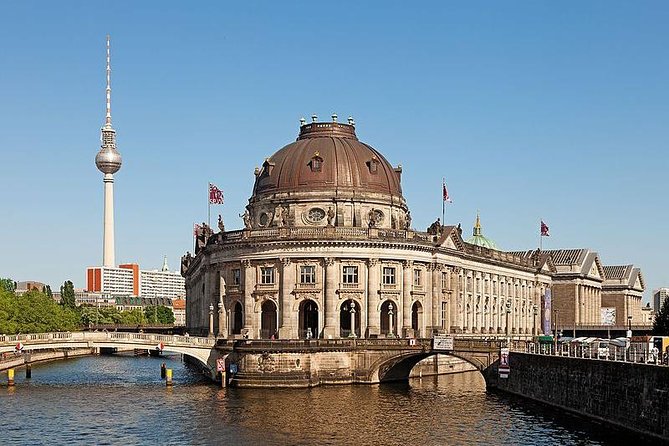
REVIEW · BERLIN AUDIO TOURS
Berlin’s Museum Island: A Self-Guided Audio Tour
Berlin’s Museum Island is more than a row of grand museums. In about 50 minutes, this self-guided walk uses the buildings around Lustgarten and Schlossbrücke to explain how Prussian power and the Enlightenment shaped Berlin. Bestselling author Rory MacLean provides the narration, and the VoiceMap app triggers each section as you move.
I like the freedom to start whenever you wish and the fact that the tour works offline after downloading. I also like its price: at $5, it is an inexpensive way to give your walk through central Berlin some purpose. The main drawback is the setup. You need to create a VoiceMap account and download the tour before reaching the site, and the tour is non-refundable if you change your plans.
Key points to know before you go
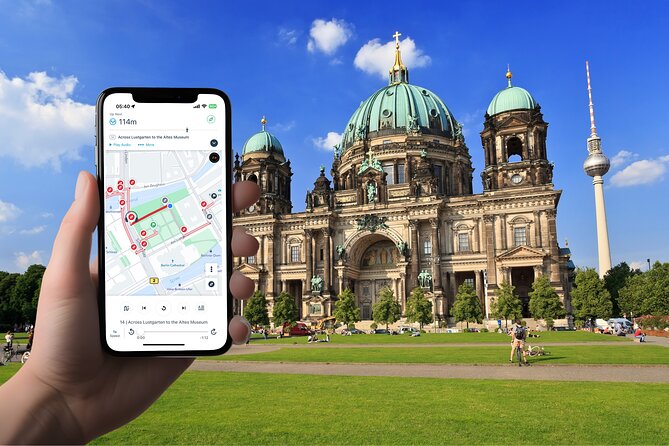
- Rory MacLean provides the narration: His audio takes you from Berlin’s old seat of power into the ideas behind Museum Island.
- The walk lasts about 50 minutes: It begins at Lustgarten and ends near the Museum for Pre- and Early History.
- The audio follows your location: VoiceMap uses your phone’s GPS to play sections at the intended spots.
- Download everything on Wi-Fi first: The tour works offline, but you should not wait until you reach Museum Island.
- Museum entry is separate: You may pause to visit museums, but tickets are not included.
- The $5 price buys lifetime access: This makes it useful if you want to repeat the walk or split it over more than one visit.
Starting at Lustgarten, Berlin’s old seat of power
The tour begins at Am Lustgarten 1, in front of the broad square known as Lustgarten. This is a fitting starting point because the square has served as Berlin’s seat of power for centuries. You are not simply beginning beside a convenient landmark. You are starting in the place where royal, military, political, and cultural authority came together.
The opening section sets up the central idea of the walk: Museum Island is not just a collection of museums. Its buildings reflect changing views of power, education, art, religion, and civilization. If you only have an hour in central Berlin, this context can help you see the square and surrounding buildings as parts of one story.
The audio is designed for a walking pace, with GPS activating sections at the right locations. That means you do not have to keep checking a printed route or guess where to stop. Still, pay attention to your phone. GPS audio tours work best when you keep the app open enough for it to track your position.
More Museum Audio Guides in Berlin:
- Paris: Louvre Museum Hosted Entry and Mona Lisa Audioguide
★ 4.6 · 5,235 reviews - Venice: St. Mark Basilica Ticket, Audioguide+History Gallery
★ 3.9 · 4,780 reviews - Rome: Borghese Gallery Skip-the-Line Ticket & Audioguide
★ 4.3 · 4,318 reviews
The rebuilt Berliner Schloss and the argument over Berlin’s past
From Lustgarten, the walk considers the Berliner Schloss, or Berlin Palace. The building has been treasured, destroyed, criticized, and rebuilt, so it offers a useful introduction to the city’s habit of arguing with its own past.
The tour explains the palace’s changing meaning and its connection to Berlin’s rulers. You also hear about Kaiser Wilhelm and the role the palace played in the story of Prussian militarism. The reference to 1914, when Kaiser Wilhelm sent a million men toward battles such as Verdun, Ypres, and Passchendaele, gives the building a far heavier weight than its ornate exterior might suggest.
The rebuilt Schloss is especially interesting because it asks a difficult question: how should a city restore a building connected to monarchy and war? The audio does not treat the palace as a simple postcard sight. Instead, it links architecture to the power systems that once operated from inside it.
That makes this part valuable for you if you want more than dates and building names. It also means the tone is not purely light or decorative. This is a walk about political ideas, historical memory, and the costs of power.
Crossing Schlossbrücke and reading Prussian symbols
The route continues across the famous Schlossbrücke, the bridge connecting the palace area with Museum Island. The bridge itself becomes part of the lesson. Its features reflect Prussia’s military philosophy, and the audio points out details that are easy to pass without noticing.
This is one of the strongest parts of the route because it turns a crossing into an observation stop. Instead of hurrying from one museum entrance to the next, you get a reason to look at the bridge’s sculptural program and ask what its creators wanted people to admire.
You will want to leave enough room around you as you walk. Schlossbrücke is a public crossing, and the tour is not a private guide leading your group through a reserved space. You move at your own speed, but you also need to remain aware of other people and your surroundings.
The narration also discusses the architects’ vision for keeping the original building’s character alive. That detail matters because the area combines old forms, later changes, destruction, and reconstruction. The result is not a single untouched historical scene. It is a place where several versions of Berlin appear at once.
Five museums and the Age of Enlightenment
Museum Island became a UNESCO World Heritage site because of its group of five major museums, which together trace the development of civilizations across the ages. This tour does not replace a full museum visit. Its job is to help you understand why these institutions were placed together and why the whole island matters.
The guiding idea is the Age of Enlightenment. The museums were connected to the belief that public access to art, archaeology, science, and human achievement could educate society. For you, that turns Museum Island from a set of impressive facades into a large public argument about learning.
You can pause the audio at any point to enter the German Historical Museum or other institutions near and on the island. This flexibility is useful, but remember that entrance fees are not included. A 50-minute audio walk can easily become a longer outing if you add museum visits, so check your available time before pressing play.
The tour is best used as an introduction. It gives you a framework for deciding which museum deserves your attention, rather than attempting to cover every collection in detail. If you already know Museum Island well, the historical links between buildings may still give your visit a fresh angle.
More Audio Tours in Berlin:
- Berlin: Solar Powered Sunset Catamaran Cruise & Audio Guide
★ 4.6 · 1,043 reviews - Berlin: Boat Sightseeing Cruise with Audioguide
★ 4.6 · 947 reviews - Berlin: Self-Drive Boat Tour
★ 4.9 · 430 reviews - Berlin Self-Drive Trabi Tour with Guide
★ 4.5 · 410 reviews
The Altes Museum and memories of wartime loss
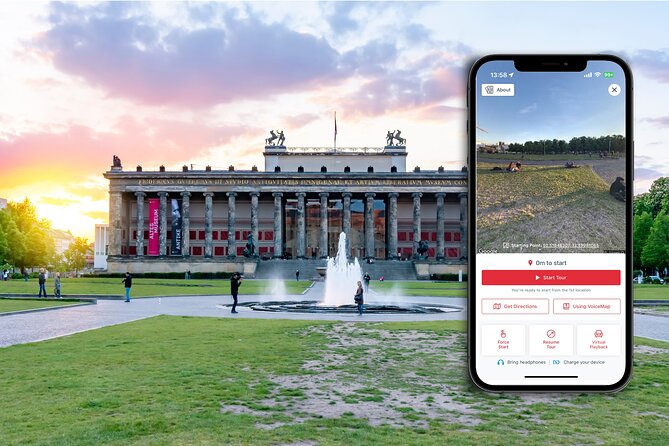
The Altes Museum is one of the key stops, and the audio focuses on the loss of many of its great murals in 1944. This section brings the story down from grand political ideas to the physical damage suffered by works of art and architecture.
The museum’s history is not only about construction and display. It is also about what war destroys, what later generations try to restore, and what can never be brought back exactly as it was. That is a useful reminder when looking at Berlin’s polished central monuments.
You also hear the words of a young factory worker from the 1850s describing his emotional first impression of the museum. This personal account adds a human scale to the Enlightenment story. The museum was not merely designed for princes and scholars. It could affect ordinary people encountering public culture for the first time.
I find that contrast particularly helpful. One moment you are considering royal authority and militarism. The next, you are hearing how a working person reacted to entering a museum. It shows why the public museum mattered as a social idea, not just as a building full of objects.
A flexible walk, not a guided group tour
This is a private activity in the sense that only your group participates, but it is not a live private guide. Rory MacLean’s recorded narration accompanies you through the VoiceMap application. You can start at your convenience, pause when you wish, and continue without trying to keep up with a group.
That arrangement suits independent visitors. You can stop for photographs, take a break, enter a museum, or replay a section if a point catches your attention. Lifetime access also means you can return to the route later rather than treating the $5 as a one-time purchase.
The trade-off is that no person is there to answer questions or adjust the route for your interests. If you want a conversation about Berlin’s architecture, a guide who reacts to your questions, or help navigating changes on site, this format will feel limited.
The walking requirement is modest, but you should have a moderate level of physical fitness. The route is short and described as an easy walk, yet you will be outdoors and moving between several public sites. Wear practical shoes, especially if you plan to add museum visits.
The VoiceMap setup matters more than the price
The $5 cost is the easiest part of this experience. The important practical detail is preparing the app before you go. Your booking confirmation includes a redemption code, and the instructions explain how to download the tour. You should complete those steps at home or at your accommodation using a strong Wi-Fi connection.
The VoiceMap app provides the audio, map, and geodata. Once downloaded, the tour works offline, so you do not need mobile data as you walk. This is a real advantage in a busy city, but it only helps if you finish the download before arriving.
A previous user reached the site expecting to activate the tour and discovered that an account and an additional download were still required. The sensible lesson is simple: redeem the code, install VoiceMap, create the account, and download the complete tour before leaving Wi-Fi.
The tour is available every day at all hours in the stated operating period, but the museums themselves have their own opening times and admission rules. The all-day availability applies to the audio walk, not to museum entry.
Who will get the most from this $5 tour
I would choose this walk if you have about an hour and want an introduction to Museum Island before deciding how to spend the rest of your day. It is also a good fit if you prefer setting your own pace and dislike being tied to a fixed departure time.
History-minded visitors will appreciate the links between the Schloss, Prussian militarism, the Enlightenment, and the public museum. The personal account from the 1850s and the story of the lost Altes Museum murals give the route more feeling than a basic orientation recording.
It also works well for repeat visitors. You may have seen the palace and crossed Schlossbrücke before without understanding the symbols and political ideas attached to them. Lifetime access lets you listen again on a later visit or use the walk as a quick refresher.
I would be more cautious if you are looking for a full tour of the museum collections. The audio stays outside and around the buildings, and museum tickets are not part of the purchase. You should also skip it if you cannot reliably prepare the app in advance, since the non-refundable policy leaves little room for a last-minute technical problem.
Should you book A Walk through Time on Museum Island?
Book it if you want a low-cost, self-guided introduction to Berlin’s central museum district and are willing to set up the app before you arrive. The combination of GPS narration, offline access, flexible timing, and lifetime use gives the $5 purchase good value.
Do not book it expecting a live guide, museum admission, or a detailed tour inside each institution. The best use is as a thoughtful outdoor introduction, followed by a separate museum visit if you have the time and budget.
For most independent visitors, the decision comes down to one question: do you want to understand what you are looking at as you walk? If yes, this short route adds useful context to the Schloss, Schlossbrücke, Lustgarten, and Altes Museum without demanding much money or time.
FAQ
Where does the Museum Island audio tour begin?
It begins at Lustgarten, at Am Lustgarten 1, 10178 Berlin, Germany.
Where does the tour end?
The stated endpoint is the Museum for Pre- and Early History at Bodestraße 1-3, 10178 Berlin.
How long does the tour take?
The tour lasts approximately 50 minutes.
Who provides the tour narration?
The audio tour is presented in the company of bestselling author Rory MacLean.
Does the tour work without an internet connection?
Yes. The VoiceMap application provides offline access to the audio, map, and geodata after you download the tour.
Are museum tickets included?
No. Entrance fees for museums and other attractions along the route are not included.
Just added around Berlin
- Love and War in Berlin: Self-Guided Story Puzzle Walk★ 5.0 · 7 reviews
- Self-Guided Audio Tour-The Fall of the wall: A light for humanity★ 4.5 · 8 reviews
- Berlin Highlights Self guided scavenger hunt and Walking Tour★ 4.5 · 4 reviews
- First Profiler Berlin: Private Self-guided Outdoor Escape Game★ 3.5 · 3 reviews
- Berlin Walking Tour with Audioguide on Your Smartphone★ 4.0 · 11 reviews
- Kreuzberg’s Secret Society: Exploration Game and Tour★ 4.5 · 3 reviews
- Berlin Scavenger Hunt and Highlights Self-Guided Tour★ 4.0 · 7 reviews
- Berlin World War II and Cold War Self Guided Tour via Mobile App★ 5.0 · 4 reviews
Berlin Audio Tours, compared.

Berlin: Solar Powered Sunset Catamaran Cruise & Audio Guide
Read our review →
Berlin: Boat Sightseeing Cruise with Audioguide
Read our review →


Berlin: Panoramic Boat Tour with Bilingual Audio Guide
Read our review →

Berlin: Self-Drive City Sightseeing Tour in a Mini Hot Rod
Read our review →
Browse the lists this tour appears in