

REVIEW · SWITZERLAND AUDIO TOURS
Self-Guided Audio Tour to the Many Faces of Geneva
Geneva’s landmarks take on a fresh shape here. The Jet d’Eau, Reformation Wall, St. Pierre Cathedral, and Flower Clock become more than photo stops as the audio links them to sins and virtues, from pride and anger to courage and justice. I like that the route begins beside Empress Sissi’s statue and ends at the Escalade Fountain, giving the walk a clear start and finish.
I also like the freedom to stop when you want, take shelter on a hot day, or linger at a sight that catches your interest. The directions include photos, and the route is private by design, with no group or live guide to manage. The main drawback is the technology: you need a reliable mobile data connection, and the tour cannot currently be downloaded for offline use.
Key points to know before you go
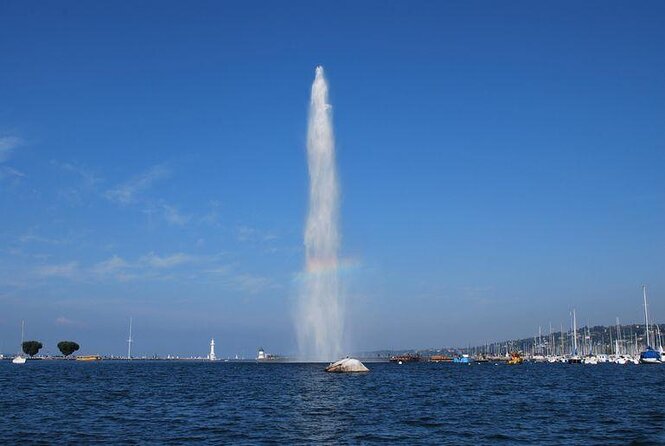
- A moral lens on Geneva: The commentary connects major sights with pride, mercy, temperance, courage, envy, anger, and other human qualities.
- A useful first walk: The route covers central Geneva in about one to two hours, making it handy for getting your bearings after arrival.
- Clear point-to-point directions: Photos and route instructions help you move from one stop to the next without a live guide.
- A fully flexible pace: You can pause for coffee, shade, photographs, or extra time inside the cathedral area.
- Bring your own tech: You need a charged phone, internet access, and headphones. Weak data coverage can cause audio interruptions.
- Best for curious listeners: This suits you if philosophy and religion interest you as much as dates and names.
Geneva through the lens of vice and virtue
This is not a standard city walk built around a long list of dates. Its central idea is that Geneva’s monuments can open a discussion about how people behave, how societies judge right and wrong, and how religious thought shaped the city.
That approach gives familiar sights a useful second layer. You will not simply hear that a fountain is famous or that a monument is old. You will hear why a particular place is linked with pride, mercy, courage, justice, or human weakness.
I find that especially useful in Geneva, a city with strong links to the Protestant Reformation, international law, humanitarian work, and political debate. The audio does not treat these subjects as separate boxes. Instead, it moves between public monuments, religious buildings, military figures, reformers, and ordinary city spaces.
There is a tradeoff. If you want a traditional guide packed with architectural facts, political dates, and short historical anecdotes, some sections may feel too philosophical. If you enjoy asking what a monument says about people and society, the unusual angle gives the walk its purpose.
More Audio Tours in Switzerland:
- Zurich: City Bus Tour with Audio Guide and Lake Cruise
★ 4.3 · 1,195 reviews - Basel: Sightseeing Bus Tour with Audio Guide
★ 4.1 · 377 reviews - Zurich City Tour with Audio Commentary
★ 4.0 · 372 reviews
Starting beside Empress Sissi’s statue
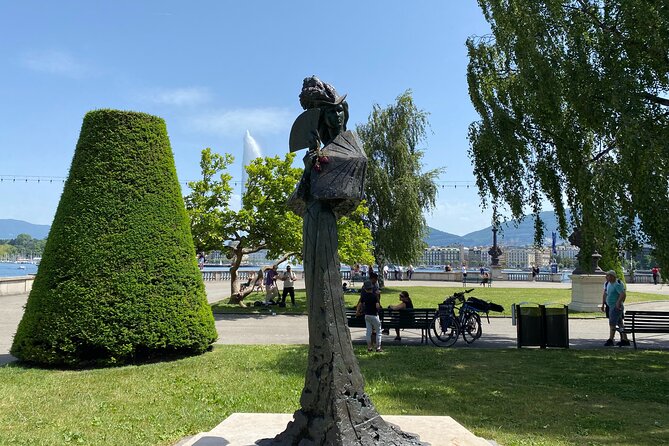
The route begins at the statue of Empress Elisabeth of Austria, commonly known as Sissi, on Quai du Mont-Blanc. Her death in Geneva was tragic and violent. The opening commentary looks at what happened, how it happened, and why an anarchist targeted her.
That is a strong opening because it places you beside a public memorial while asking you to think about political anger and personal loss. It also gives the walk an immediate human story rather than beginning with a broad introduction to Geneva.
Allow about ten minutes here. You can take in the statue, listen carefully, and get comfortable with the mobile audio format before setting off.
The Jet d’Eau and Brunswick Monument
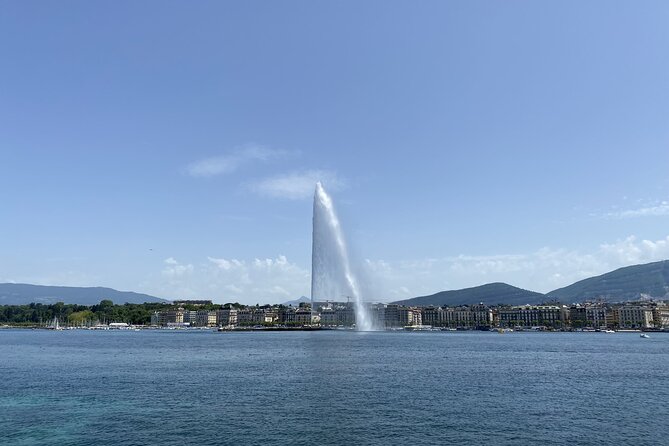
The next stop is the Jet d’Eau, Geneva’s famous lake fountain. You get about five minutes of commentary here, with attention not only to the spectacle of the water but also to the idea of how a public landmark might contribute to making the world better.
That question may sound grand for a fountain, but it fits the tour’s method. You are encouraged to look past the postcard view and consider the role symbols play in civic life.
From the lakefront, the route continues to the Brunswick Monument. This elaborate memorial was funded by a generous benefactor, and the audio explains the reason for his donation. You will also hear about the images of virtues worked into the monument.
This is a good example of what the walk does well. A monument that might otherwise be a quick photograph becomes a lesson in wealth, memory, generosity, and the way people try to shape how they are remembered.
Rousseau, national identity, and the Flower Clock
At the statue of Jean-Jacques Rousseau, the commentary turns inward. Rousseau was unusually open about his own failings, and this stop considers the sins he confessed.
You get about ten minutes here, which is enough time for the story to develop. The subject fits Geneva’s larger intellectual character. This is a city associated with debate, conscience, religion, and political ideas, and Rousseau’s self-examination adds a personal side to those themes.
The National Monument follows. Its story centers on a competition to choose the design for the monument, and you will learn why the winning proposal was selected. The stop is brief, about five minutes, but it adds a civic and national dimension to the route.
Then comes the Flower Clock, one of Geneva’s most familiar symbols. The audio connects it with pride, which gives you a reason to look at this cheerful, highly photographed feature in a less obvious way. Allow around ten minutes if you want to listen fully and take photographs.
This section works well for orientation. You move through major public spaces while the commentary shifts from private confession to public identity and civic display.
Same place, a different route to walk:
- Zurich: City Top Attractions Tour by Bus with Audio Guide
★ 4.3 · 282 reviews - Audioguided sightseeing cruise of Geneva
★ 3.5 · 144 reviews - Mt. Rigi Self-Guided Tour: Lake Lucerne Cruise and Mountain Spa
★ 4.5 · 83 reviews - The Many Faces of Geneva: Self-Guided Audio City Tour
★ 3.9 · 44 reviews
Religion, mercy, and Geneva’s courts
The Evangelical Lutheran Church of Geneva provides one of the clearest religious stops. The audio compares different religious views on how sins and good deeds affect salvation.
You do not need to be an expert in theology to follow the basic idea. The important point is that Geneva’s religious identity cannot be reduced to one simple slogan. Different Christian traditions have offered different answers about guilt, forgiveness, good works, and the fate of the soul.
Next door, the Palace of Justice brings the discussion into public life. The commentary explores its connection with mercy, shifting the question from personal salvation to how institutions judge and punish.
This pairing is one of the more thoughtful parts of the walk. A church and a courthouse sit close together, yet they represent different forms of judgment. One concerns moral and spiritual life. The other concerns law, evidence, and official decisions.
Place Bourg du Four and Geneva’s rougher past

At Place Bourg du Four, you learn about a monument connected with a Genevan champion of justice. The stop also looks at former red-light districts in the area.
This keeps the walk from presenting Geneva as nothing but polished monuments and lofty ideals. Cities have always contained contradictions. Public virtue and private vice often sit close together, and this stop makes that point in a direct way.
The ten-minute segment should give you time to notice the square itself as well as listen. The route does not only chase famous landmarks. It also uses older public spaces to show how Geneva’s social life changed over time.
St. Pierre Cathedral and the stone bench of judgment
St. Pierre Cathedral receives the longest stop, about twenty minutes, and rightly so. This is the heart of the route, both physically and thematically.
The cathedral is linked with temperance, the virtue of restraint and balance. The audio also points you toward the statue of the Prophet Jeremiah, often called the weeping prophet. That image gives the stop a somber emotional note, one that fits the wider discussion of sorrow, sin, judgment, and repentance.
The commentary then leads you toward the Town Hall. There, a stone bench is linked with the pronouncement of death sentences by Geneva’s judges.
This is the sort of detail you could easily miss while walking through the Old Town on your own. It gives an ordinary piece of stone a much heavier meaning. You are not only looking at grand architecture. You are also being asked to notice the places where decisions affected real lives.
Plan extra time around this stop if you want to look carefully at the cathedral and nearby streets. The official listening time is twenty minutes, but this is the point where pausing can add the most value.
The Reformation Wall and the difficult side of reform
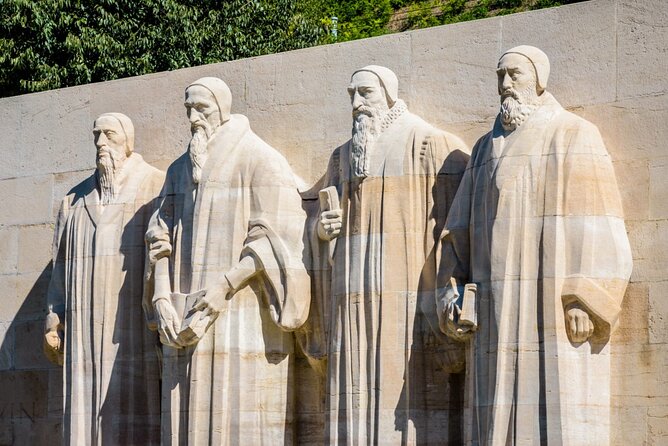
The Reformation Wall is one of Geneva’s essential sights, and the audio uses it to examine the people celebrated in the monument. You will hear which theologians were criticized for being inflexible, merciless, or heartless.
That is a useful correction to the usual quick explanation of the wall. Monuments often praise major figures without dwelling on their limits. Here, the commentary asks you to consider how reformers could be admired for conviction yet criticized for harshness.
This section may be especially valuable if you know little about the Reformation. It connects the monument to wider questions about power, belief, punishment, and tolerance. At the same time, it may feel too opinion-based if you are hoping only for neutral dates and names.
Dufour, Dunant, and the meaning of courage
The statue of General Guillaume-Henri Dufour introduces a military and civic figure. The audio considers his struggle against evil, giving the stop a moral reading rather than treating him only as a soldier.
Then the route turns to Henri Dunant, one of the founders of the Red Cross. His bust comes with a closer look at his life and some surprising parallels with Leo Tolstoy.
This is one of the route’s most appealing changes of pace. After the religious and judicial themes around the Old Town, Dunant brings the discussion toward humanitarian action. The focus is not just on an organization or a famous name. It asks what personal beliefs, failures, and ideals can lead someone toward a life of service.
Allow about ten minutes at the bust. The comparison with Tolstoy is not the sort of detail you normally get from simply passing by a statue, and it gives this section a more personal feel.
Finishing at the Escalade Fountain
The route ends at the Fontaine de l’Escalade, or Escalade Fountain, on Rue de la Confédération. Its story centers on the courage of the Genevans.
Ending here gives the walk a clean sense of purpose. You begin with a violent act against an empress and finish with a local story of collective bravery. Between those points, the route has moved through pride, justice, mercy, religious belief, punishment, reform, and humanitarian work.
The final stop is short, about five minutes. You can treat it as the endpoint or as a place to pause before continuing into central Geneva.
What the $13.29 price buys you
At $13.29 per person, the value depends on how much structure you want. You are paying for an English audio guide, professional voice recording, route instructions, photos, and commentary at thirteen central sights. There is no admission charge for the stops listed, so the cost is mainly for the interpretation and convenience.
That is a reasonable price if you would otherwise wander without context or pay for a larger guided group. It is also useful for solo visitors and couples who want a private experience without arranging a private guide.
The value is weaker if you already have strong knowledge of Geneva or prefer to read short historical plaques at your own pace. The moral and religious focus will not suit everyone, and you are not receiving a live person who can answer questions.
The flexibility helps make up for that limitation. You can pause for lunch, stop the audio on a busy street, or take breaks in hot weather. One useful feature of a self-guided walk is that you control the rhythm instead of keeping up with a group.
Phone, data, and practical planning
You need your own mobile phone, internet access, and headphones. The audio is delivered through a link after booking, and there is no live guide waiting at the meeting point.
The main technical warning is important: the tour depends on a good data connection. Slow loading and audio dropouts can interrupt the walk, and the tour cannot currently be downloaded for offline use. Check your connection before starting, charge your phone fully, and bring headphones that are comfortable for outdoor listening.
The route starts at Quai du Mont-Blanc 10, near the Empress Sissi statue, and ends at Rue de la Confédération 4. You can reach the area by public transportation, and the activity is private, so only your group takes part.
Most people can participate, and service animals are allowed. Free cancellation is available if you cancel at least 24 hours before the local start time.
Who should choose this Geneva walk?
I would choose this tour if you want a quick introduction to central Geneva with more meaning than a simple sightseeing loop. It works especially well on your first day, when you want to get your bearings while learning about the city’s religious and civic character.
It is also a good match for independent travelers who dislike fixed schedules. You can walk alone, with a partner, or with your own small group, and you can stop whenever you like.
I would skip it if your main goal is detailed architectural analysis, a chronological history lesson, or lively conversation with a local guide. The audio spends real time on philosophy, religion, morality, and human behavior. That is the point of the tour, but it is also the feature most likely to divide opinion.
FAQ
How long does the self-guided Geneva tour take?
The tour takes approximately one to two hours. The listed listening times add up to about 110 minutes, and you may need more time if you stop for photographs, breaks, or additional sightseeing.
What language is the audio guide in?
The audio guide is offered in English.
Is there a live guide?
No. You explore independently using a link provided after booking. The experience is private, so only your group participates.
What do I need to bring?
You need your own mobile phone with internet access and a headset. A strong data connection is important because the tour cannot currently be downloaded for offline use.
Where does the tour start and finish?
It starts near the Monument to Empress Sissi at Quai du Mont-Blanc 10. It finishes at the Fontaine de l’Escalade on Rue de la Confédération 4.
Do the stops require admission tickets?
The listed stops have no admission ticket charge. The price covers the audio guide, directions, photos, and commentary.
Can I cancel for a refund?
Yes. You can cancel at least 24 hours before the experience start time for a full refund. Cancellations or changes made less than 24 hours before the start time are not accepted for a refund.
Should you book it?
Book this walk if you want Geneva explained through justice, courage, religion, and human weakness, not just through monuments and dates. The clear directions and flexible pace make it a practical first look at the city, and the price is fair for a private audio route.
Before booking, be honest about your listening habits. You need dependable mobile data, and the commentary gives philosophy and religion nearly as much attention as conventional history. If that sounds appealing, this is an inexpensive way to see central Geneva with a stronger sense of purpose.
Just added around Switzerland
- Interlaken Scavenger Hunt and Sights Self-Guided Tour★ 5.0 · 4 reviews
- Attraction Ticket: Jungfraujoch Top of Europe self-guided trip★ 5.0 · 7 reviews
- Geneva Scavenger Hunt and Highlights Self Guided Audio Tour★ 5.0 · 5 reviews
- Unusual Audio Tour of Geneva★ 5.0 · 8 reviews
- Self-Guided Chamonix with Aiguille du Midi or Mer de Glace★ 3.5 · 35 reviews
- A Self-Guided Audio Tour of Geneva’s Old Town★ 4.5 · 7 reviews
- Zug Scavenger Hunt and Sights Self-Guided Tour★ 5.0 · 5 reviews
- Thun Scavenger Hunt and Sights Self-Guided Tour★ 5.0 · 3 reviews
Switzerland Audio Tours, compared.

Zurich: City Bus Tour with Audio Guide and Lake Cruise
Read our review →
Zurich: City Top Attractions Tour by Bus with Audio Guide
Read our review →
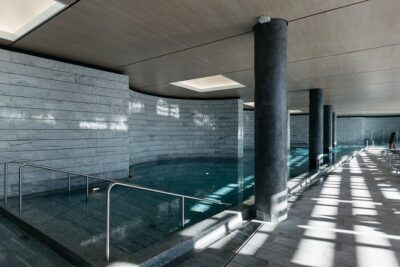
Mt. Rigi Self-Guided Tour: Lake Lucerne Cruise and Mountain Spa
Read our review →
The Many Faces of Geneva: Self-Guided Audio City Tour
Read our review →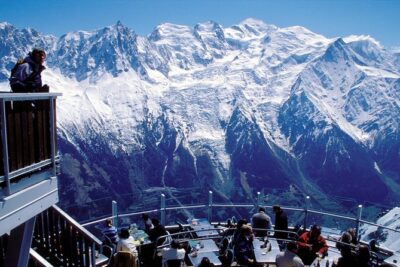
Self-Guided Chamonix with Aiguille du Midi or Mer de Glace
Read our review →Browse the lists this tour appears in