

REVIEW · USA AUDIO TOURS
Harpers Ferry Audio Tour History, Ruins and River Views
Harpers Ferry packs an astonishing amount of American history into a small town at the meeting point of the Potomac and Shenandoah Rivers. This self-guided audio walk connects John Brown’s raid, Storer College, Civil War sites, industrial ruins, and Appalachian Trail views in one route.
I like the freedom to move at my own pace, and I like that the audio starts automatically as I reach certain places. The price is also easy to justify at $9.99 per person, especially if you want context without joining a fixed group. The catch is the walking: steep hills, a staircase, and scattered stops make the full route tiring for some people.
Key points to know before you go
- GPS-triggered storytelling: The audio begins as you reach many locations, so you can look around instead of constantly watching your phone.
- A broad sweep of history: The route covers John Brown, African American education, Civil War strategy, industry, railroads, and the Appalachian Trail.
- Free to use at every listed stop: Your main cost is the audio app, though some museums or attractions may have separate arrangements.
- Download before arrival: Cell service is spotty at best, so do not wait until you reach town.
- Expect hills and stairs: The route includes Harper Cemetery, Bolivar Heights, Murphy Farm, and the Appalachian Trail Staircase.
- A flexible private experience: Your group follows the tour alone, with unlimited access after downloading it.
Why Harpers Ferry works so well as an audio walk
Harpers Ferry is not a place you understand by looking at one building. Its story is spread across riverbanks, hillsides, ruins, museums, churches, and former military sites. An audio tour helps link those pieces.
The route is designed to take about two hours, but that timing assumes a fairly steady pace. You will likely stop for photos, read historic markers, pause at overlooks, or spend extra time in a museum. Give yourself more time if you want the town to feel like a place rather than a checklist.
The GPS feature is the best part of the format. Once you reach a stop, the app can start the relevant narration. That lets you keep your eyes on the old foundations, the rivers, or the view instead of searching through a long menu of audio tracks.
There is a small learning curve. You need to figure out which direction to walk and where to find the map in the app. The map can be reached from the bottom of each screen, but it may not be obvious at first. Start at the Lower Town Train Station and follow the stops in order. You can technically begin elsewhere, but the story makes the most sense from the suggested starting point.
More History Tours in the USA:
- Santa Fe Historic Downtown Smart Phone Audio App Self Guided GPS Walking Tour
★ 4.5 · 112 reviews - Savannah’s Historical District: A Self-Guided Audio Tour
★ 4.5 · 69 reviews - Self Guided Detroit’s Spirit and History Solo Walking Tour
★ 4.5 · 41 reviews
Starting at the Lower Town Train Station
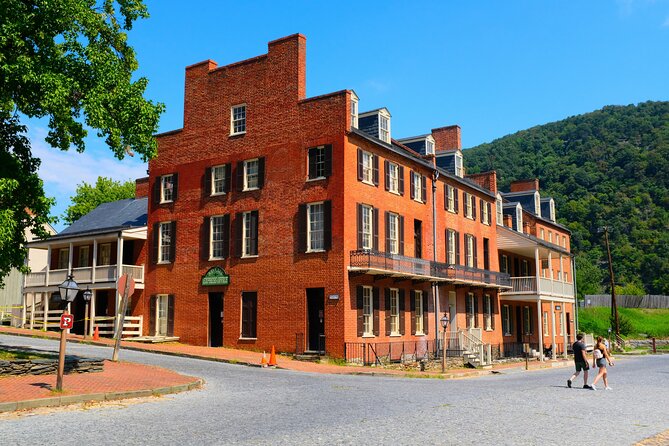
The tour begins at the Lower Town Train Station at 182 Potomac Street. This is a smart starting point because the station links Harpers Ferry’s present-day rail service with its old role as a transportation center.
The station is still active, which gives the stop a useful sense of continuity. Harpers Ferry was not merely an isolated village. Rail lines, rivers, roads, and the old ferry route all helped turn this narrow junction into a place of trade and conflict.
From here, the route moves through the town and then outward to hills and ruins. That mix is important. You are not simply walking between preserved buildings. You are also seeing how geography shaped military plans, industry, transportation, and settlement.
The Appalachian Trail and the town’s high points
The Appalachian Trail Conservancy Headquarters is one of the first stops. It offers a quick introduction to the 2,190-mile Appalachian Trail and its symbolic midpoint. The audio connects Harpers Ferry to long-distance hiking culture, adding a modern outdoor layer to the older stories around town.
The stop itself is brief, about 10 minutes. It is free, and it works well as an orientation point before the route becomes more focused on historic buildings and battle sites.
Harper Cemetery sits high above town and offers wide views. The cemetery includes soldiers, local residents, and people tied to Harpers Ferry’s development. This is a quiet pause in a route often filled with conflict, weapons, politics, and military movement.
The elevation is part of the point, but it also adds effort. If hills are difficult for you, do not underestimate this section. One person using the tour did not finish because the uphill walking became too much. That is useful warning, not a minor footnote.
Bolivar Heights adds another high viewpoint. The ridge was fought over during the Civil War because it gave armies a commanding position over Harpers Ferry. Here, the view helps explain the town’s military importance in a way that a map cannot.
Murphy Farm offers another change of tone. The area was once a battlefield and later hosted important Civil Rights speeches. Today it is a quieter place for reflection and broad views. Its value comes from the contrast between peaceful surroundings and the weight of what happened there.
John Brown, the armory, and Arsenal Square

The U.S. Armory Site is one of the essential stops. Harpers Ferry once held a major weapons factory, and its arsenal made the town a natural target for John Brown’s 1859 raid.
Only foundations remain in places, so do not expect a complete industrial complex. The audio fills in what is no longer visible, helping you picture a working armory where weapons production connected the town to national political tensions.
Arsenal Square continues that story. The open space marks part of the former arsenal and the explosive opening of John Brown’s raid. The area is quiet now, which makes the historical shift even sharper. You are looking at an ordinary public space while listening to the story of an event that helped push the United States toward war.
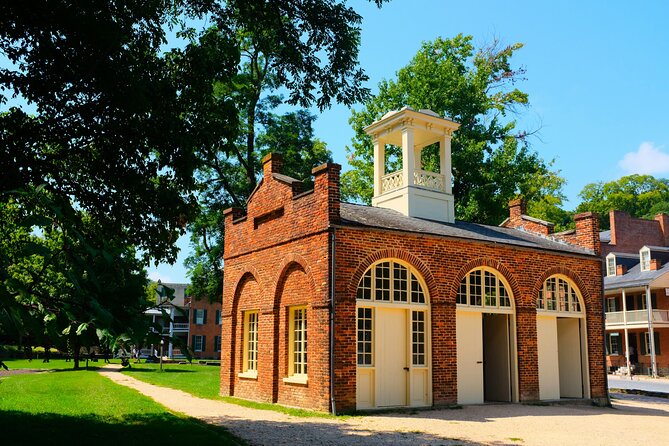
John Brown’s Fort is the emotional center of the route. The small brick building began as a fire engine house, then became the final stronghold of Brown and his followers. Its size is striking. The building is modest, but the consequences of the raid were enormous.
The tour does not need theatrical effects here. The physical setting does the work. The fort, the surrounding streets, and the nearby armory remains help you understand how tightly packed and tense the confrontation was.
More Audio Tours in the USA:
- Fort Sumter Admission and Self-Guided Tour with Roundtrip Ferry
★ 4.5 · 3,343 reviews - San Francisco: Alcatraz Ticket, Ferry, & Self-Guided App
★ 4.5 · 2,460 reviews - Los Angeles: Hop-On Hop-Off Bus Tour with Audio Guide
★ 3.7 · 2,030 reviews - City Sightseeing Hop-On Hop-Off Bus Tour with Audio Guide
★ 3.0 · 1,083 reviews
African American history and Storer College
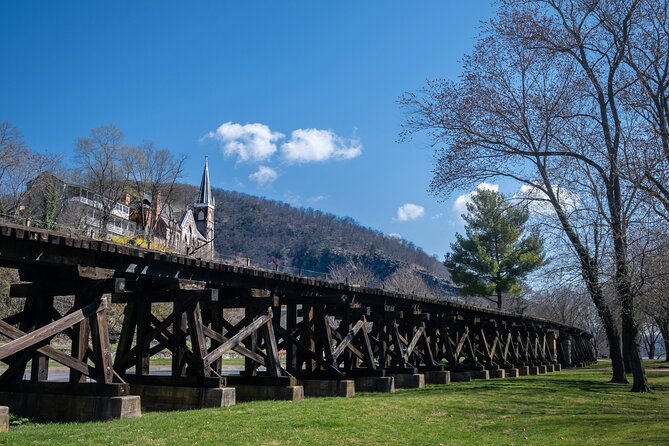
One of the most important parts of this route is its attention to Black life, education, and leadership after the Civil War. The Storer College Campus tells the story of a school founded to educate formerly enslaved people. It later became an important center for learning, leadership, and Civil Rights activity.
Lockwood House adds a more personal setting to that story. The house served Union officers and later housed leaders connected with Storer College. Its history links military administration with the growth of Black education in the Reconstruction era.
The route also includes a museum devoted to African Americans in Harpers Ferry, covering people who were enslaved, freed, educated, and resilient. At the time covered by this activity information, that museum is closed for renovations. Treat the stop as unavailable unless you confirm that it has reopened before your visit.
That closure matters because the museum would otherwise provide a concentrated presentation of stories that can be harder to see in the town’s streets. The outdoor stops still provide meaningful context, but you should not plan your day around entering this museum.
Storer College and the surrounding sites give the tour more balance than a route focused only on John Brown and the Civil War. Harpers Ferry was also a place where education offered a path to independence and public leadership.
Jefferson Rock, St. Peter’s, and the river junction

Jefferson Rock is one of the route’s best scenic pauses. The cliffside viewpoint is named for Thomas Jefferson, who admired the setting. From here, you can see why the town attracted attention long before the era of modern tourism.
This is more than a photo stop. The rivers, cliffs, and narrow valley explain why Harpers Ferry was useful, vulnerable, and hard to control. The audio encourages you to connect the scenery with the people and events tied to it.
St. Peter’s Roman Catholic Church sits on a dramatic hillside above town. Built to serve Irish immigrant families, the stone church also survived the Civil War. Its position gives you another angle on Harpers Ferry, one focused on faith, immigration, and community life.
The Point is the route’s great geographic payoff. Here, the Potomac and Shenandoah Rivers meet. Trade, travel, military movement, and settlement all depended on this junction.
The view is especially valuable because it explains the town in one glance. Harpers Ferry’s importance was not an accident of politics alone. Its rivers and steep ground made it a natural crossing point and a strategic prize.
The Original Site of the Shenandoah River Bridge reaches further back, to Robert Harper’s 18th-century ferry. That crossing helped launch the town. It is a good reminder that Harpers Ferry began as a practical transportation point before becoming known for weapons, raids, war, and national debate.
Virginius Island and the remains of industry
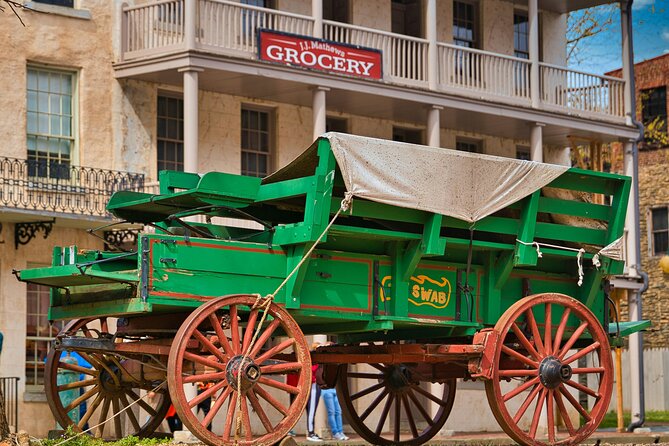
Virginius Island offers a different kind of stop. Once an industrial village powered by water, it is now a wooded area with ruins, trails, and moss-covered remains.
The ruins can be harder to read than a preserved building. You may need to look closely and let the audio explain how channels, machinery, and factories once fit together. That is exactly where this format helps.
Virginius Island shows that Harpers Ferry was not only a military or political stage. It was also a working industrial town. Water power supported production, jobs, and settlement, but the island’s decline left only fragments behind.
The five-minute timing listed for the stop is best understood as a minimum. If you enjoy ruins and want to inspect the remains, allow extra time. The route is more rewarding when you slow down here rather than rushing to the next named point.
White Hall Tavern and Harpers Ferry Public Square

White Hall Tavern brings the route back to everyday social life. The 19th-century tavern served travelers, residents, and Union soldiers. It is easy to picture the place as a meeting point where food, drink, news, and political arguments changed hands.
This stop helps keep the tour from becoming a string of battles and famous names. Harpers Ferry was also a town where people gathered, worked, traveled, and argued about current events.
Harpers Ferry Public Square continues that local story. The square has hosted markets, militias, protests, and parades. It remains one of the best places to feel the town as a living community rather than an open-air history exhibit.
The audio works well in these spots because you can compare the present-day setting with the events described. Read the markers, look at the buildings, and allow the narration to supply the missing layers.
The steep Appalachian Trail Staircase
The Appalachian Trail Staircase connects Lower Town with the trail and the higher ground above it. The stairs are steep and scenic, but they are also the clearest physical challenge on the route.
The staircase gives you a small taste of the effort required by the Appalachian Trail. It also changes your view of the town. From higher ground, the river junction and old streets make more sense as parts of one tightly packed geographic setting.
If you have limited stamina, plan carefully. The route is designed for walking, not for a trolley or shuttle, and the scattered high points cannot all be reached with minimal effort. You may choose to complete only the lower-town portion and still get a useful experience.
What $9.99 buys you
At $9.99 per person, this is a low-cost way to add structure and historical explanation to a visit. The app, downloadable tour, audio guide, and unlimited access are included. Children 10 and under are free, which improves the value for families.
The strongest value comes from the breadth of the route. One payment covers stories about the Appalachian Trail, John Brown, the armory, Black education, Civil War strategy, rail travel, religion, industry, and the rivers.
The weaker value appears if you expect a guided walking tour with a person leading the way. This is an app-based experience. You bring your own smartphone, manage the route, and decide how long to stay at each stop.
The tour is offered in English. It is available daily from 8:00 AM to 8:00 PM during the stated operating period, July 31, 2025 through March 6, 2027. Confirmation arrives when you book, and free cancellation is available until 24 hours before the start time. Inside that window, the price is not refunded.
Download the app and tour before you arrive. Cell service can be weak, and relying on a live connection may leave you stuck at the starting point.
Who should book this walk
I would choose this tour if you like history but do not want to follow a fixed guide or keep pace with a group. It suits people who want to pause at a view, read a marker, take photos, or skip ahead without asking permission.
It is also a good match for repeat visitors who want a stronger framework for the town. The route joins sites that can otherwise feel disconnected, especially Storer College, Virginius Island, Murphy Farm, and the armory remains.
Families can benefit from the freedom and the free admission for children 10 and under. Still, the hills and five-minute stop estimates may not reflect the effort needed between locations.
I would be cautious if you have trouble with steep walking or stairs. You can stop early, but the full route is not a flat stroll. Anyone hoping to ride between distant points should choose another format or plan a shorter section.
Should you book the Harpers Ferry audio tour?
Book it if you want a budget-friendly, self-paced introduction to Harpers Ferry and are comfortable using your phone. The automatic audio, strong river views, and wide range of subjects make it more useful than simply wandering from marker to marker.
Skip it if you need a fully guided experience, a simple flat route, or a clear app with no learning curve. For most independent visitors, the best plan is to download everything at home, start at the Lower Town Train Station, wear comfortable shoes, and treat the two-hour estimate as a starting point rather than a deadline.
FAQ
How long does the Harpers Ferry audio tour take?
The tour takes approximately two hours. You may need more time if you stop for photos, read markers, visit museums, or walk the route slowly.
Where does the tour start and end?
It starts at the Lower Town Train Station, 182 Potomac Street, Harpers Ferry, West Virginia 25425. The activity ends back at the meeting point.
Do I need to bring my own phone?
Yes. A smartphone is not included. The app and tour download are included, so download the content before you go because cell service is spotty at best.
Is the tour guided in person?
No. This is a self-guided audio tour for your private group. The GPS feature can start narration when you reach certain places.
Is the African American history museum open?
The museum is currently closed for renovations according to the provided activity information. Check its status before planning to visit it.
Can I cancel for a full refund?
Yes, if you cancel at least 24 hours before the experience start time. Cancellations or changes made within 24 hours are not refunded or accepted.
Just added around the USA
- Smartphone-Guided Walking Tour of Downtown Indianapolis Sights & Stories★ 4.0 · 25 reviews
- Springfield Self-Guided Walking Audio Tour★ 4.0 · 5 reviews
- Smartphone Guided Indianapolis Downtown Sites Audio Walking Tour★ 4.5 · 7 reviews
- Indiana Dunes National Park Self-Guided Audio Tour★ 3.5 · 4 reviews
- Self-Guided Audio Driving Tour in Kancamagus Highway★ 4.5 · 6 reviews
- An Epic Scavenger Hunt: Bloomington Scenic Southern Indiana★ 3.5 · 6 reviews
- Huntsville Rocket City Smart Phone Self Guided Audio (GPS/APP) Walking Tour★ 4.5 · 5 reviews
- Sights of Downtown Houston Smartphone Audio Walking Tour★ 4.0 · 7 reviews
USA Audio Tours, compared.
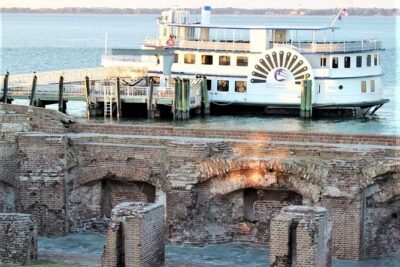
Fort Sumter Admission and Self-Guided Tour with Roundtrip Ferry
Read our review →
San Francisco: Alcatraz Ticket, Ferry, & Self-Guided App
Read our review →
Los Angeles: Hop-On Hop-Off Bus Tour with Audio Guide
Read our review →
City Sightseeing Hop-On Hop-Off Bus Tour with Audio Guide
Read our review →
Medieval Torture Museum Ticket with Audio Guide and Ghost Hunting
Read our review →

Ryman Auditorium Self-Guided Tour with Souvenir Photo Onstage
Read our review →
Red Rock Canyon Self-Guided Electric Bike Tour
Read our review →Browse the lists this tour appears in