
REVIEW · CANADA AUDIO TOURS
The Sights of Canmore: a Smartphone Audio Walking Tour
Canmore’s story comes into focus as you walk it: coal cars, a miners’ union hall, old barracks, mountain views, and odd public art all appear along one self-guided route. The GPS-triggered audio keeps you moving without a guide or group, while short trivia questions add a playful reason to pay attention.
I like the freedom to start, pause, and finish when it suits you, and I like that the commentary connects ordinary street corners with Canmore’s mining and railway past. The main catch is that you need your own charged smartphone or tablet, and the experience is best for people happy to follow directions and listen rather than join a live conversation.
Key points to know before you go

- A 5-kilometre return route: Plan on about 1½ to 2 hours, though you can take longer because the tour has no time limit.
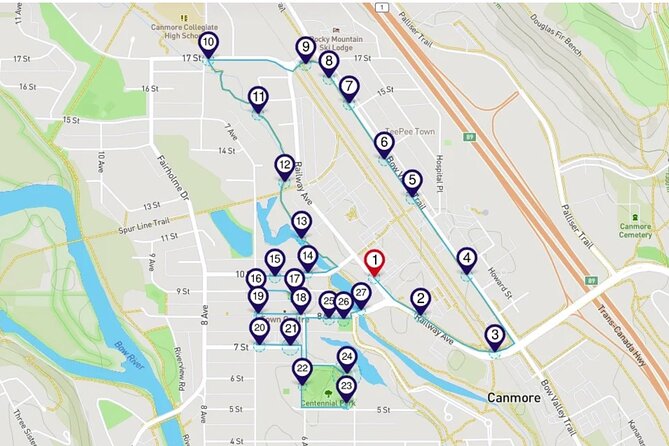
- Twenty named stops: Highlights include Policeman’s Creek Boardwalk, the coal mining cars, Canmore Museum, NWMP Barracks, and the Big Head Sculpture.
- Automatic commentary: Download the tour on Wi-Fi first, then let the live GPS map and location triggers guide you without using mobile data.
- A playful trivia option: After each piece of commentary, you can answer a location-based question on your device.
- Strong value at $8.22 per person: You get a private experience for your group, but admission fees and the device itself are not included.
- A walk with real local character: The route joins mountain scenery with stories about coal, railways, churches, bears, festivals, and public art.
Why this Canmore walk is more than a pretty stroll
Canmore is easy to admire from the pavement. The Three Sisters rise in the distance, the creek paths offer a quiet break, and Main Street is full of shops and places to eat. This tour adds the missing layer: why the town developed where it did, how coal shaped its early years, and how local landmarks still reflect that past.
The route begins at 909A Railway Avenue and covers about 5 kilometres out and back. The advertised walking time is roughly 90 minutes to two hours, but you are not pushed along. You can stop for photos, pause the audio, browse Main Street, or spend extra time at the boardwalk and parks.
The commentary is in English and plays automatically as you approach each point of interest. That is useful because you do not need to keep checking a written itinerary. The live map shows your position and the next part of the route, though you should still pay attention to street crossings and your surroundings.
The tone is not stiff. The tour includes a trivia game, and the available feedback specifically praises the funny commentary, the good length, the history, and the walking trails. The rating is 3.8 from four reviews, so I would treat this as a solid, affordable introduction rather than a polished substitute for an expert private guide.
More Self-Guided Walking Tours in Canada
- Mont-Tremblant: Treetop Observatory and Self-Guided Walk
★ 4.7 · 130 reviews - Halifax Churches, Gardens & Graveyards: a Smartphone Audio Walking Tour
★ 4.5 · 25 reviews - Halifax Boardwalk & Seaport: a Smartphone Audio Walking Tour
★ 4.0 · 19 reviews
Starting at Three Sisters Gallery and Railway Avenue

The opening stop is Three Sisters Gallery, where the audio sets up the walk and points you toward Canmore’s main sights, sculptures, and buildings from the coal-mining era. This is a sensible start because the tour is not just a string of scenic viewpoints. It gives you a reason to notice the town’s built details.
Soon you reach Bow Valley Trail and Railway Avenue. As you cross the railway tracks, the commentary explains the Canadian Pacific Railway and its effect on Canmore’s development. This is one of the useful early stops because the railway is easy to treat as background scenery, yet it helps explain how an isolated mountain community connected with the wider region.
The next stops keep you on or near Bow Valley Trail. At Sidney Street, you learn about the British red telephone box on the corner. At Hospital Place, you see a black bear sculpture and hear about black bears in Canmore and the Rocky Mountains.
A little farther along, the route points out a grizzly bear sculpture. Comparing the black bear and grizzly bear stops gives the walk a light touch, but it also breaks up the historical material. If you are walking with children, the sculptures and trivia may hold their attention better than a long block of dates.
Mountain names, an inukshuk, and Canmore’s coal story
At Bow Valley Trail and 15 Street, the route opens to mountain views to the north. The audio covers the names of Princess Margaret Mountain, Squaw’s Tit, Mount Charles Stewart, Mount Lady MacDonald, and Mount Grotto.
This is a good place to slow down. The value is not only the view, but the reminder that mountains carry human stories and changing names. One point needs care: the supplied tour information uses the name Squaw’s Tit, a historic mountain name that many people may find outdated or offensive. Listen for the context, and keep in mind that place names can reflect older attitudes as well as geography.
At 17 Street, you see a large inukshuk and hear about what inukshuks are. The stop adds a cultural element to a route otherwise focused heavily on coal, railways, civic buildings, and local attractions. The commentary is brief at each point, usually around three minutes, so it should not overwhelm your walk.
The coal mining cars monument at Railway Avenue is one of the route’s most important stops. Here, the audio explains how central mining was to Canmore in its early years. This is where the town’s history becomes tangible. Rather than hearing only about an industry in the abstract, you are looking at equipment associated with the work itself.
Policeman’s Creek Boardwalk and the longer scenic pause

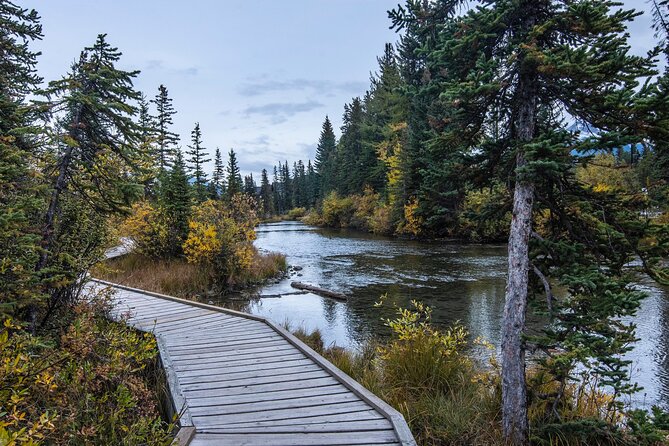
The tour then reaches Policeman’s Creek Boardwalk, where the suggested listening time is about ten minutes. This is one of the route’s best breaks from roadside stops.
As you walk part of the boardwalk, the commentary covers the Bow River, the Canmore Nordic Centre, festivals, and local events. The setting gives you room to look around instead of focusing on a single object. You might want to pause the tour here and enjoy the path at your own speed, especially if you are carrying food or stopping for photographs.
The boardwalk section also helps balance the industrial history. You get a sense of Canmore as it is now, a town shaped by outdoor recreation and public events as well as mining. The audio does not turn the walk into a wilderness hike, however. This remains an urban sightseeing route, with pavement, crossings, and street sections between the scenic areas.
More Smartphone App Tours in Canada:
- Icefields Parkway: a Smartphone Audio Driving Tour
★ 4.0 · 118 reviews - Cabot Trail: a Smartphone Audio Driving Tour
★ 4.5 · 118 reviews - Sea to Sky Highway: a Smartphone Audio Driving Tour
★ 4.0 · 32 reviews - Kelowna: Wine Tasting by E-bike, Smartphone Guide & Lunch
★ 4.8 · 30 reviews
Mount Rundle, Isabelle Dube, and the museum
After the boardwalk, the route moves to 10 Street and 6 Avenue for a view of Mount Rundle. This is one of the strongest scenic moments because the mountain is treated as a subject in its own right, not merely as a backdrop for a photo.
The next stop, at 719 10 Street, features a mural of Isabelle Dube and explains the tragic story connected with it. This kind of stop gives the tour a more personal side. The route is not limited to official monuments and attractive views. It also asks you to notice a piece of public art tied to a difficult local story.
You then pass the Canmore Museum and Geoscience Centre. The museum holds more than 10,000 artifacts and has welcomed visitors since 1984. The audio introduces the building, but museum admission is not included, so treat this as an outside stop unless you choose to visit separately.
That distinction matters when you compare costs. The $8.22 price covers the audio walk, map, and trivia, not entrance tickets. If you want a museum visit as part of your day, budget for it separately and check access before setting out.
Friendship Park, Main Street, and the old Canmore Inn
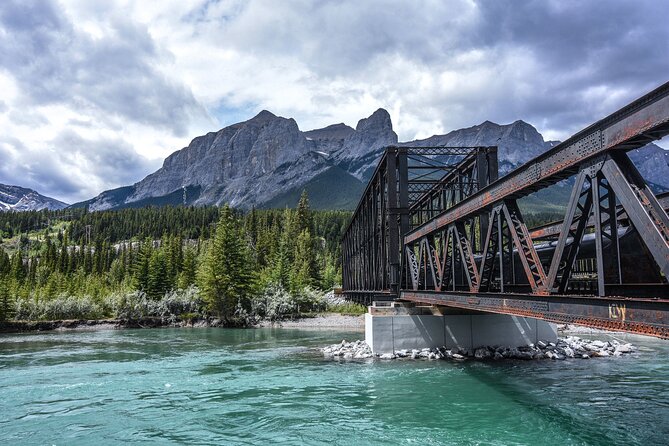
Friendship Park offers a short stop with an international connection. You learn what Canmore has in common with Higashikawa, Japan. The supplied information does not spell out the full connection, which makes this a good point to listen closely rather than expect a long lecture.
From there, the route continues along Main Street near 8 Avenue and 6 Street. You pass shops, restaurants, and galleries. This is a practical part of the walk because you can easily add a coffee, meal, or browse without abandoning the route.
The tour also points out Canmore Inn & Suites, described as a building dating to 1890 and connected with Count Eugene de Rambouville. The brief commentary format suits this kind of stop. You get a detail that might otherwise pass unnoticed, then continue on foot instead of spending too long at one building.
Main Street is also where the flexible format helps most. If you want to shop or eat, you can pause the tour and resume later. The experience is not tied to a live departure, and it can be used on a date other than the one selected when booking.
The Miners’ Union Hall and Centennial Park

The Canmore Miners’ Union Hall is another major historical stop. The audio explains why the building mattered and discusses the often contentious relationship between the town and its miners.
This is an important counterweight to a simple feel-good story about the coal era. Mining helped create Canmore, but work, labor, and town life did not always fit together neatly. The short commentary cannot provide the depth of a full museum program, yet it points you toward the social conflicts behind the town’s development.
Centennial Park gives you three things to notice: views of the Three Sisters, the Stan Rogers stage, and the annual events and festivals held there. Like Policeman’s Creek, this is a ten-minute section rather than a quick three-minute marker.
I would plan a pause here. The park brings together the scenery and public life of present-day Canmore. It also offers a natural place to stop listening for a moment, take in the mountains, and decide if you want to continue at once or stretch the walk into a longer outing.
Churches, law and order, and the Big Head Sculpture
The route then turns to Ralph Connor Memorial United Church, one of the earliest Presbyterian churches built in Alberta. The audio also explains the mystery behind the church’s name.
Next comes the NWMP Barracks, described as one of Canmore’s most important attractions. The stop covers the role of the barracks in maintaining law and order during the town’s rougher early years. This provides another useful piece of context: Canmore’s past involved not just miners and railway workers, but also the institutions trying to manage a growing community.
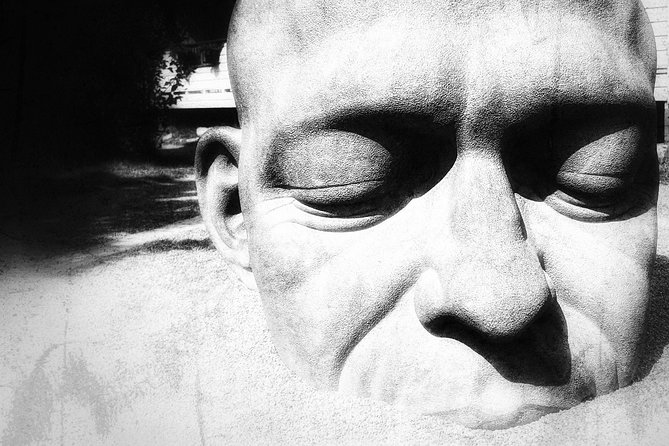
The final named stop is the Big Head Sculpture. The audio explains the unusual artwork and its connection to the name Canmore itself. Ending with a large, strange-looking sculpture is a smart choice. It leaves you with a memorable visual rather than one more conventional building.
The tour finishes back at the meeting point. Several nearby places are listed as possible extras, but they are not official points of interest on the route, so you can spend as much time there as you wish without treating them as required stops.
How the app works in real use
Download the tour over Wi-Fi before you leave. Once it is on your device, no signal is required and no mobile data should be used during the walk. That is a major practical benefit in a mountain town, where service can be less dependable than you expect.
The app combines a live GPS map with automatic audio. As you approach a point of interest, the commentary plays. The optional trivia question follows, and you tap your answer on the device.
You should bring headphones if you prefer private listening, though the supplied information does not specify any audio equipment. Keep your phone charged, and remember that the smartphone or tablet is not included.
The number of people selected at booking equals the number of devices that can download the tour. That matters for couples, families, or small groups. If everyone wants to follow the map and answer trivia independently, you need enough device access.
Because this is a private activity, only your group takes part. You avoid the fixed pace and crowd of a conventional walking tour, but you also lose the chance to ask a live guide a question or adjust the route around your interests.
Price, timing, and who gets the best value
At $8.22 per person, this is inexpensive for a 90-minute to two-hour activity. The value is strongest if you want structure and local context but do not need a museum ticket, transportation, or personal guiding.
The tour is also flexible beyond the booking date. You can start when you like, pause anywhere, and take as long as you need. The listed operating period runs from July 28, 2020 through February 16, 2027, with access shown every day from midnight to 11:30 p.m.
That wide schedule does not mean every stop will always be accessible. Recommended attractions may be closed or unavailable because of the season or circumstances beyond the operator’s control. The museum is specifically not included, and attraction admission in general is separate.
I would choose this for an independent couple, a family that likes small challenges, or anyone with a free morning or afternoon in Canmore. It is less suitable if you want a lively guide, detailed academic history, or a very short stroll with almost no street walking.
Service animals are allowed, the route is near public transportation, and most people can participate. Still, the tour data does not give a full accessibility assessment for every pavement section, boardwalk approach, or crossing, so check your own mobility needs before booking.
Should you book The Sights of Canmore?
Book it if you want an affordable introduction to Canmore that mixes coal-mining history, mountain views, public art, and local streets. The best reasons are the freedom to set your own pace, the automatic GPS narration, the coal cars and Miners’ Union Hall, and the pleasant pauses at Policeman’s Creek Boardwalk and Centennial Park.
Skip it if you strongly prefer a human guide or if you want every stop to include a long, detailed explanation. This is a light, practical audio walk with short sections and a playful trivia feature.
For most independent visitors, the low price makes it an easy add-on. Download it on Wi-Fi, begin with a full phone battery, leave room for breaks, and treat the route as a way to understand Canmore while you walk through it.
FAQ
Where does the Canmore audio walking tour start?
It starts at 909A Railway Avenue, Canmore, Alberta, T1W 1P3, Canada.
Where does the tour finish?
The activity ends back at the starting meeting point.
How long does the tour take?
The approximate duration is 1 hour 30 minutes to 2 hours. You can take longer because there are no time constraints.
How far do you walk?
The sightseeing route covers about 5 kilometres as a return walk.
What language is the audio tour offered in?
The tour is offered in English.
Do I need mobile data during the walk?
No. You should download the tour over Wi-Fi first. After downloading, no signal is required and the tour does not use data during the walk.
Is a smartphone or tablet included?
No. You need to provide your own smartphone or tablet.
Are attraction admissions included?
No. Attraction tickets are not included. Admission to the Canmore Museum and Geoscience Centre is also separate.
Can I pause and resume the tour?
Yes. You can start and stop anywhere along the route and use the tour at a flexible time.
Is this a group tour?
No. It is a private activity for your group only. The number of people selected at booking corresponds to the number of devices that can download the tour.
Just added around Canada
- Smartphone Audio Driving Tour between Huntsville & Toronto★ 4.5 · 4 reviews
- Halifax Explosion Smartphone Audio Walking Tour★ 4.0 · 3 reviews
- Explore Halifax with 3 Unique Smartphone Audio Walking Tours★ 4.0 · 16 reviews
- Smartphone Audio Driving Tour between Collingwood and Toronto★ 4.5 · 3 reviews
- Self Guided Audio Driving Tour of the North Shore of PEI★ 4.0 · 24 reviews
- Charlottetown Audio Walking Tour★ 5.0 · 7 reviews
- A 7th-Gen Local’s View of Downtown Charlottetown: An Audio Tour★ 4.5 · 27 reviews
- Sydney Cape Breton Self-Guided Walking Tour and Scavenger Hunt★ 3.0 · 3 reviews
Canada Audio Tours, compared.



Vancouver Bike or Ebike Rental – Self Guided Map provided
Read our review →
Mont-Tremblant: Treetop Observatory and Self-Guided Walk
Read our review →


Vancouver to Whistler Seaplane Day Trip: Self-Guided Adventure
Read our review →Browse the lists this tour appears in