

REVIEW · CANADA AUDIO TOURS
Sights of Moose Jaw Smartphone Audio Walking Tour
Moose Jaw’s story gets especially entertaining when your walk reaches Prohibition-era bootlegging, Al Capone lore, and haunted buildings. This self-guided audio tour adds those stories to a relaxed stroll through the city center, with commentary playing automatically as you approach each location.
I like the freedom to stop and start whenever you wish, and I like the built-in trivia game, which gives you a reason to look closely at each building. The main drawback is practical: you depend on your phone, and one user ran out of battery before reaching the end.
The tour costs only $6.71 per person, covers more than 30 sites, and takes about one to two hours at a steady pace. You can take longer if you pause for photos, food, or a closer look inside attractions.
Key points to know before you go
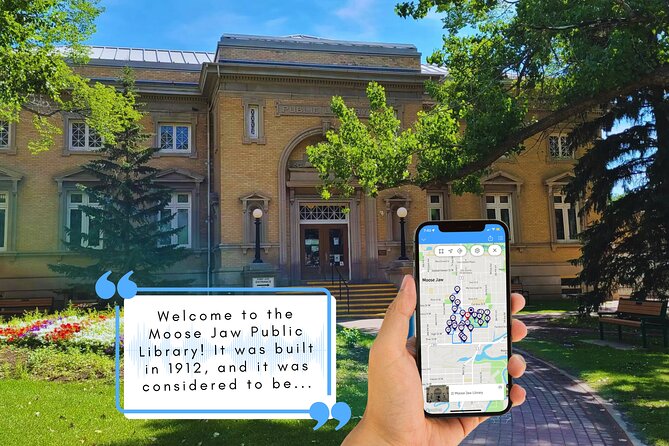
- GPS-triggered storytelling: Commentary starts as you approach each stop, so you do not need to keep checking written directions.
- A broad downtown route: The walk includes Crescent Park, churches, railway sites, murals, civic buildings, theaters, and historic homes.
- Prohibition and mystery: Expect stories about bootleg liquor, Al Capone, a haunted dining parlour, and Moose Jaw’s unusual past.
- Flexible timing: Download the tour over Wi-Fi, then use it later without a mobile signal or data.
- Low-cost sightseeing: At $6.71 per person, the tour is a useful introduction before paying for attractions such as the Tunnels of Moose Jaw.
- Bring a charged phone: The audio and GPS are central to the experience, and headphones are optional.
Starting in Crescent Park
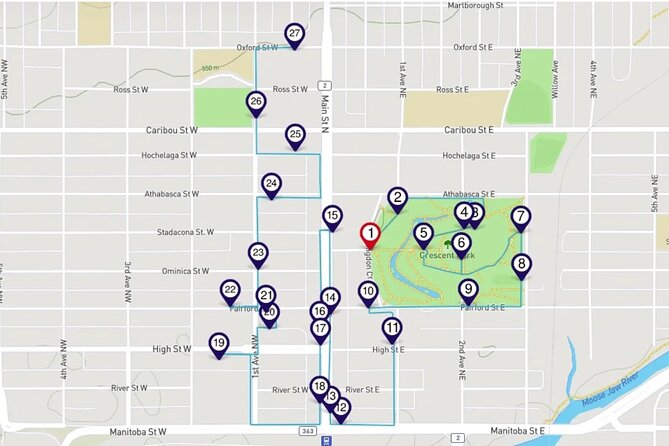
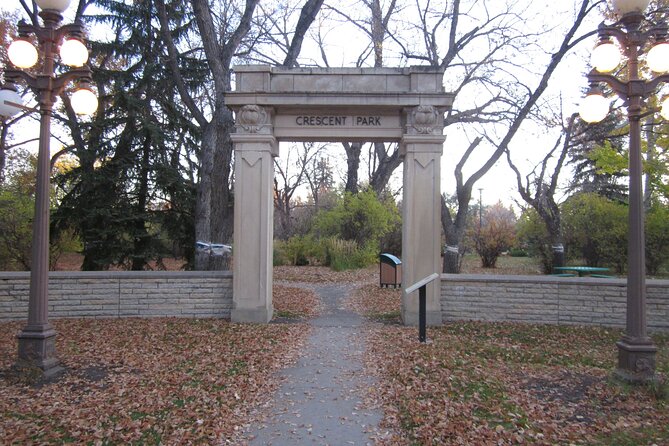
The walk begins at Crescent Park on Langdon Crescent, a sensible place to start because several early stops sit close together. You begin near the Moose Jaw Public Library, then move through the park and its surrounding streets while your phone shows your position and the next stop.
The audio is designed to play automatically when you get close to a location. That matters because you can keep your eyes on the buildings, fountains, murals, and streets instead of constantly searching a map.
The opening stretch introduces you to the city through public spaces rather than a single museum. You visit the library, the Crescent Park Amphitheatre, the Cenotaph, and the park fountain. Each stop takes about five minutes, although the listed time refers to the audio segment, not the time you may want for photographs or quiet looking.
At the amphitheatre, you hear how the venue came together in 1972 and learn about the painted murals nearby. The Cenotaph offers a more solemn pause. It is a First World War and Second World War memorial, also called the Cross of Sacrifice, designed by Reginald Bloomfield and built by the Moose Jaw Marble and Granite Company in 1923.
The fountain brings the tone back to everyday town life, with commentary about the park’s water fountains and waterfalls. This early section works well if you want a gentle introduction before reaching the more unusual stories later in the walk.
More Self-Guided Walking Tours in Canada
- Mont-Tremblant: Treetop Observatory and Self-Guided Walk
★ 4.7 · 130 reviews - Halifax Churches, Gardens & Graveyards: a Smartphone Audio Walking Tour
★ 4.5 · 25 reviews - Halifax Boardwalk & Seaport: a Smartphone Audio Walking Tour
★ 4.0 · 19 reviews
Railway stories and the city’s mineral waters
From Crescent Park, the route takes in the old Canadian National Railway station and the Crescent Park Tennis Club. The railway station gives you a chance to consider how transport shaped Moose Jaw, while the tennis club comes with its own claim to fame.
The route then reaches the Moose Jaw Natatorium, now associated with the Phyllis Dewar Outdoor Pool. Here, the subject is the famous Moose Jaw Mermaid. The stop is brief, but it adds local color and keeps the walk from becoming a string of formal architectural descriptions.
One of the most useful stops is Temple Gardens Hotel and Spa. You learn how Moose Jaw’s natural geothermal mineral waters were discovered by accident in 1910. If the spa is open and you want to visit, remember that admission is not included in the tour. The audio stop and the paid attraction are separate experiences.
That distinction matters throughout the walk. You are buying the commentary, route, map, and trivia, not entry to the city’s attractions. The tour can point you toward the Tunnels of Moose Jaw, Temple Gardens, and other sites, but you should budget separately if you plan to go inside.
Churches, political buildings, and bootleg liquor
The middle section shifts into the city’s streets, where the buildings themselves become the main sights. St. Mark’s Presbyterian Church gets an unusual historical treatment, including stories about the church and its occupants over the years.
A nearby building now used as a political office has passed through several different roles. It is a good reminder that historic downtown buildings often have more than one identity. You then reach St. Aidan Anglican Church, a Gothic Revival building completed in 1909. The commentary explains why its design deserves closer attention.
The railway returns as a major theme at the CPKC rail yard. Here, the story turns to Prohibition and the station’s role as a funnel for bootleg liquor. The subject fits Moose Jaw’s reputation for secret tunnels and illicit activity, but the tour also points to the location’s later, ironic future.
The route then brings you to the Tunnels of Moose Jaw, the paid attraction most closely linked to the city’s bootlegging stories. The audio tour gives you the Al Capone angle and explains the popular Moose Jaw connection, but it does not include admission.
This is one place where you may want to pause the walking tour and take a separate visit. The audio stop gives you context from the street. A ticketed visit can provide a more developed indoor experience, if available when you go.
City Hall, Zion United Church, and downtown landmarks
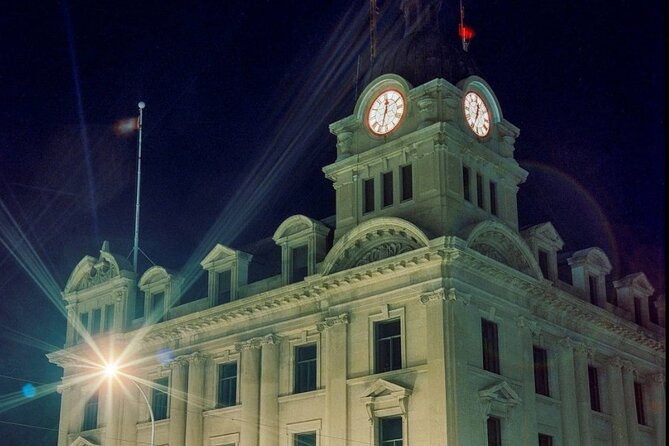
Moose Jaw City Hall is another useful stop because the commentary connects its stone-colored exterior with fossils. That sort of detail is exactly what makes a self-guided walk worthwhile. Without background, you might simply pass a civic building. With a short explanation, you have a reason to inspect its materials and design.
Zion United Church follows, with an interesting historic fact tied to the building. The church is imposing, and its position along the route makes it an easy stop even if you are mainly interested in downtown architecture.
The former Eatons building adds a retail chapter. Eatons was one of Canada’s iconic department stores, and the stop places this local building within that wider Canadian shopping story.
At the Capital Theatre, now associated with the Mae Wilson Theatre, the focus moves to performance history. You learn about the building’s role in theatrical and performing arts life. The Moose Jaw Cultural Centre, including the former Army and Navy Store, continues the look at downtown streetscape and changing commercial use.
The Walter Scott Building brings in the person connected with its name and the purpose of the building when it was constructed. Then Mosaic Place shifts the subject from old architecture to modern public life, with stories about sporting events, music, and performances held there.
These stops are not all dramatic on their own. Their value comes from the range. In less than two hours, you move from churches and department stores to theaters, arenas, railway sites, and public buildings. You get a sense of how the downtown has been used across different periods.
More Smartphone App Tours in Canada:
- Cabot Trail: a Smartphone Audio Driving Tour
★ 4.5 · 118 reviews - Icefields Parkway: a Smartphone Audio Driving Tour
★ 4.0 · 118 reviews - Sea to Sky Highway: a Smartphone Audio Driving Tour
★ 4.0 · 32 reviews - Kelowna: Wine Tasting by E-bike, Smartphone Guide & Lunch
★ 4.8 · 30 reviews
Murals, land titles, and public memory
Moose Jaw’s murals are a recurring part of the route, and the tour points out several of the more prominent examples. One named stop is the Breaking New Ground mural, which illustrates the process of gaining land ownership in Saskatchewan.
That is a useful subject for a walking tour because it connects a large public artwork with a specific part of the province’s development. You are not just looking at painted walls. You are being given a reason to ask what the image is saying about settlement and ownership.
The Land Titles Building, built in 1910, adds a more formal version of the same theme. Its role in the transfer of land titles in the region helps explain why this building mattered at the turn of the century.
You also reach the Old Fire Hall, where the commentary covers the building’s past, and the Moose Jaw Courthouse, a National Historic Site. The courthouse stop is especially helpful for anyone who enjoys civic architecture and public institutions, though the tour does not claim that every interior will be open.
The route’s many short stops make it easy to adjust your pace. If a building catches your attention, pause the tour and look around. If a location is closed or inaccessible, continue to the next point without losing the whole experience.
Haunted dining, Métis history, and local personalities

Hopkins Dining Parlour gives the walk a change of mood. It is known as one of Saskatchewan’s most haunted places, and the commentary tells you who is said to be connected with the haunting. This stop will appeal to you if you like a little folklore mixed into an architecture walk.
The Tribute to the Métis mural shifts the focus to Louis Riel, a Métis leader associated with the North West Rebellion. It is one of the route’s more significant historical stops because it introduces a major part of western Canadian history through public art.
Central Collegiate Institute is more than 110 years old and remains one of Saskatchewan’s oldest operating public schools. The audio tells you about notable people the school has hosted. This gives the final stretch a human angle, moving beyond buildings and into the people connected with Moose Jaw.
The last named stop is the Latimer Residence at 37 Oxford Street West. This two-and-a-half-story, brick-clad house was completed in 1905 and sits on a tree-lined street beside homes of a similar age and scale. The house has retained many original features, making it a fitting endpoint for a walk that has focused so heavily on old buildings.
The tour ends at the Latimer residence rather than returning you to Crescent Park. Plan for that when arranging your day. The stated endpoint is 37 Oxford Street West, and the route covers enough ground that you should not assume you will finish where you began.
How the phone tour works in real life
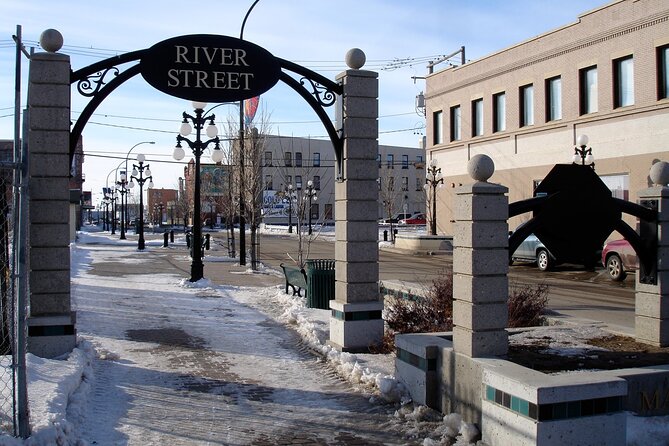
The tour is built for people who do not want to follow a guide or keep to a fixed departure time. After booking, download it over Wi-Fi. Once downloaded, no signal or mobile data is required during the walk.
The live GPS map shows your location and the next point. Audio plays when you get close to a stop, and an optional trivia question follows the commentary. You tap your answer on the device, so the game is simple rather than elaborate, but it gives children and competitive adults an extra reason to stay engaged.
You can pause, stop for lunch, restart later, or spread the route across more than one outing. The tour is yours to keep and can be used on flexible dates, not only the date selected at booking.
The number of people selected at booking equals the number of devices on which you can download the tour. That is worth checking if two people want to follow along on separate phones.
The phone is also the experience’s weak point. Keep the battery full, especially since GPS and audio can use power. Headphones are optional because the sound can play through the phone speaker, but headphones may help on busier streets or if you prefer not to share the commentary.
Price, pace, and who gets the best value
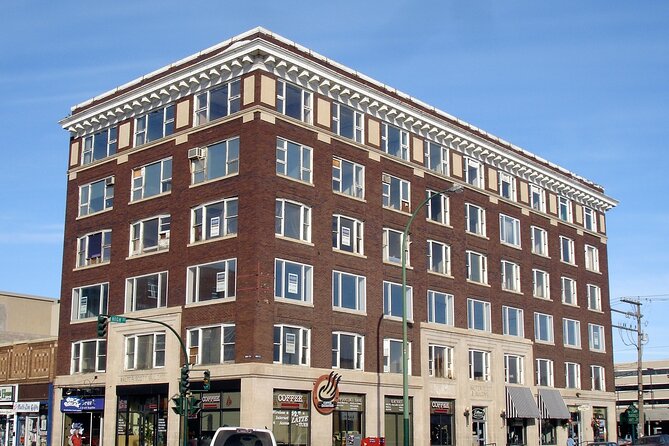
At $6.71 per person, this is inexpensive sightseeing. The value is strongest if you want an overview of Moose Jaw before deciding which places deserve more of your time and money.
The tour covers more than 30 locations, although the listed route includes 28 named stops plus additional nearby points and mural references. At one to two hours, it is short enough to fit into a larger Moose Jaw visit but substantial enough to give your walk a clear purpose.
You get customer support by phone and email, a GPS map, automatic audio, trivia, flexible use, and no time limit. You do not get a smartphone, headphones, or attraction tickets.
I would choose this for independent visitors, couples, families with older children, and anyone who likes history in small portions. It also suits people who dislike crowded groups or who want to stop for photos and coffee without holding up a guide.
It is less suitable if you want a live person answering questions in the moment. The commentary cannot adapt to your interests, and some stops may be closed or inaccessible because of the season or circumstances beyond the operator’s control.
The experience is private in the simple sense that only your group takes part. You are not joining a scheduled crowd. Service animals are allowed, the route is near public transportation, and most people can participate, though you should expect a walking tour rather than a vehicle-based outing.
Should you book the Sights of Moose Jaw tour?
Book it if you want a cheap, flexible introduction to central Moose Jaw with more personality than a bare map. The combination of murals, churches, railway stories, mineral waters, Prohibition tales, civic buildings, and local folklore gives you a broad look at the city.
Bring a fully charged phone, download everything on Wi-Fi, and allow more than the listed audio time if you want photographs or plan to visit the Tunnels of Moose Jaw. If you prefer a live guide or need detailed access information for every interior, choose a conventional guided visit instead.
For most independent sightseers, this is a smart first walk. It helps you get your bearings, gives the downtown buildings some meaning, and leaves you free to follow your own pace.
FAQ
How long does the Moose Jaw audio walking tour take?
The tour takes approximately one to two hours. You can take longer because there are no time constraints and you may stop, pause, or restart the route.
Where does the tour start and end?
It starts at Crescent Park on Langdon Crescent in Moose Jaw. It ends at 37 Oxford Street West, at the Latimer Residence.
Do I need mobile data during the walk?
No. Download the tour over Wi-Fi before you begin. The supplied information says no signal or mobile data is needed during the tour.
Are attraction tickets included?
No. The tour does not include admission tickets. This applies to recommended attractions such as the Tunnels of Moose Jaw and Temple Gardens Mineral Spa.
Can I use headphones?
Yes, but headphones are optional. The audio can also play through your smartphone or tablet speaker.
What is the cancellation policy?
You can cancel for a full refund at least 24 hours before the experience start time. Cancellations or changes made within 24 hours are not accepted for a refund.
Just added around Canada
- Smartphone Audio Driving Tour between Huntsville & Toronto★ 4.5 · 4 reviews
- Halifax Explosion Smartphone Audio Walking Tour★ 4.0 · 3 reviews
- Explore Halifax with 3 Unique Smartphone Audio Walking Tours★ 4.0 · 16 reviews
- Smartphone Audio Driving Tour between Collingwood and Toronto★ 4.5 · 3 reviews
- Self Guided Audio Driving Tour of the North Shore of PEI★ 4.0 · 24 reviews
- Charlottetown Audio Walking Tour★ 5.0 · 7 reviews
- A 7th-Gen Local’s View of Downtown Charlottetown: An Audio Tour★ 4.5 · 27 reviews
- The Sights of Canmore: a Smartphone Audio Walking Tour★ 4.0 · 4 reviews
Canada Audio Tours, compared.


Vancouver Bike or Ebike Rental – Self Guided Map provided
Read our review →
Mont-Tremblant: Treetop Observatory and Self-Guided Walk
Read our review →


Vancouver to Whistler Seaplane Day Trip: Self-Guided Adventure
Read our review →Browse the lists this tour appears in