
REVIEW · BERLIN AUDIO TOURS
Love and War in Berlin: Self-Guided Story Puzzle Walk
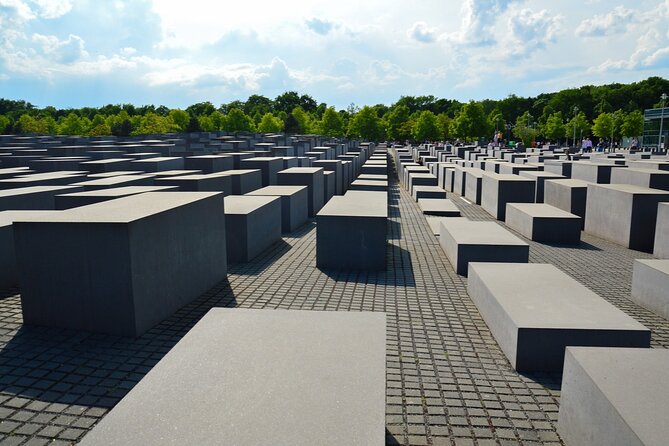
Berlin’s past unfolds here as a game rather than a lecture. You follow clues from the World Clock in Alexanderplatz through central Mitte, past monuments tied to Prussia, communism, Nazism, and the Second World War, ending at the Memorial to the Murdered Jews of Europe.
I like the very low price and the freedom to start when you choose, stop for a coffee, or pick up the story later. I also like the route’s range, from Neptune’s fountain and the old city hall to the site of Hitler’s former bunker and the scar of the 1933 book burning.
The catch is that this is not a guided tour. A few clues can be fussy, and one question may require a precise answer, so you need patience, a charged phone, and a willingness to look closely.
Key points at a glance
- Start at the World Clock: Begin in Alexanderplatz, where a puzzle introduces the route and sends you toward the next stop.
- Walk through many sides of Berlin: The route links Prussian monuments, GDR symbols, Nazi-era sites, and modern memorials.
- Play without a live guide: This private activity uses your phone and can be played in English, with no contact with a tour leader.
- Take control of the timing: Start any hour during the stated 5:00 AM to 9:00 PM operating window, pause whenever you wish, and resume later.
- Expect about one hour: The walk is compact and centered on Berlin’s Mitte district, though puzzle-solving and stops can affect the pace.
- Pay only $6 per person: That is excellent value if you enjoy self-guided sightseeing, but less so if you want detailed personal commentary.
Starting beneath Alexanderplatz’s World Clock
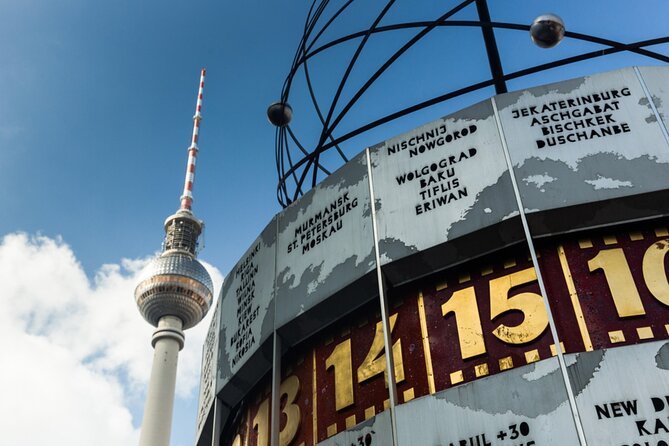
Your first location is the Urania World Clock, the large turret-style clock in Alexanderplatz. Its metal rotunda lists the current time in 148 major cities, giving you an easy first puzzle and a clear public meeting point.
The game asks you to inspect the surroundings and find an answer before it reveals the next location. That small task changes the way you look at a familiar square. Instead of simply crossing Alexanderplatz, you begin checking details, reading signs, and searching the architecture for useful clues.
From the start, you should think of this as a walking game with historical content, not a standard audio tour. The app guides you from one place to the next, but you supply the attention. That works well for couples, families with older children, and friends who like solving things together.
Alexanderplatz is near public transportation, so getting to the start is straightforward. The route finishes at Cora-Berliner-Straße 1, beside the Memorial to the Murdered Jews of Europe, rather than returning you to Alexanderplatz. Plan your next stop from the finish point.
More Scavenger Hunts in Germany
- Berlin: Self-Guided Family and School Class Scavenger Hunt
★ 4.6 · 128 reviews - Berlin: Scavenger Hunt Self-Guided Tour
★ 4.6 · 79 reviews - Berlin Kreuzberg: Scavenger Hunt Self-Guided Tour
★ 4.1 · 19 reviews
Rathaus and Neptune: Berlin before the dictatorships
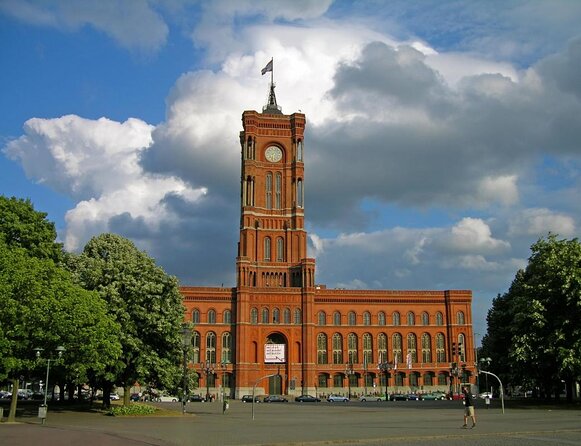
The next section brings you to the Rathaus, Berlin’s red-brick town hall. Hermann Friedrich Waesemann designed it between 1861 and 1869 in a Northern Italian High Renaissance style, while its tower recalls Notre-Dame de Laon in France.
The clue here asks you to look at the building and its surroundings. This is a useful early lesson in how the game works: the city itself supplies the answer. You do not need a museum ticket, and you are not waiting for a guide to gather a group.
At Neptune Fountain, you get a closer look at a grand public monument from imperial Berlin. Built in 1891 and designed by Reinhold Begas, it places the Roman god Neptune at the center of the composition.
The fountain is scheduled for about 10 minutes. That is enough time to inspect the sculpture, solve the question, and hear the place’s story without turning the stop into a long art lesson. You may find the puzzle easy here, or you may need to study the details carefully, depending on the question presented in the app.
Marx and Engels Forum, where Berlin changes political direction
The route continues to Marx-Engels-Forum, a public park created by the former East German government in 1986. It is named for Karl Marx and Friedrich Engels, the authors of The Communist Manifesto and two major figures in socialist thought.
This stop helps the tour move beyond a simple Second World War checklist. Berlin’s political story did not end in 1945. The capital was later divided, and East Germany used monuments and public spaces to promote its own version of German identity.
You will again search for an answer at the site before the app opens the next part of the story. That format gives you a reason to stop and notice the statues and urban setting, though it also means the experience depends on your willingness to read and inspect rather than simply listen.
Lustgarten and Neue Wache: power, war, and remembrance
Lustgarten sits on Museum Island near the former Berlin City Palace. The park has served several roles over time, including a parade ground, a setting for mass rallies, and a public park.
Its changing purpose makes it a strong stop on a route about power. A public square can be a garden, a ceremonial space, or a political stage, depending on who controls the city. The puzzle gives you a reason to look past the open space and consider how Berlin has repeatedly rewritten its public centers.
Nearby, Neue Wache offers a more focused memorial experience. Karl Friedrich Schinkel designed this neoclassical building between 1816 and 1818 as a guardhouse for the royal palace and a memorial to the Liberation Wars.
The route uses these places to connect older Prussian memory with the later history of war and dictatorship. You will not get the sustained explanation of a specialist guide, but the sequence makes sense as a quick introduction to how Berlin has remembered conflict.
More Scavenger Hunts in Berlin:
- Berlin Prenzlauer Berg: Scavenger Hunt Self-Guided Tour
★ 4.6 · 14 reviews - Berlin Scavenger Hunt and Highlights Self-Guided Tour
★ 4.0 · 7 reviews - Berlin Highlights Self guided scavenger hunt and Walking Tour
★ 4.5 · 4 reviews - First Profiler Berlin: Private Self-guided Outdoor Escape Game
★ 3.5 · 3 reviews
Bebelplatz and the book burning of May 1933
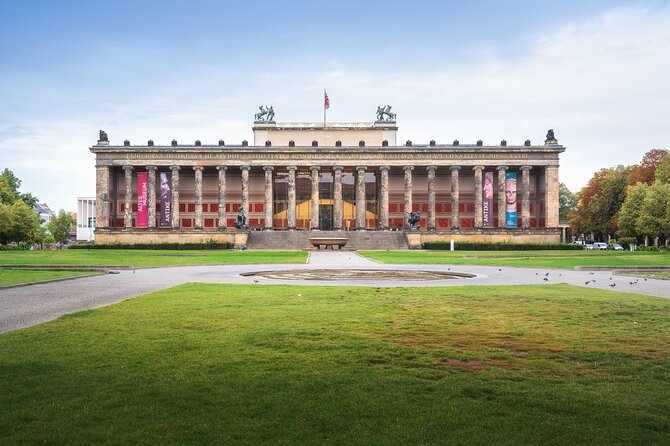
Bebelplatz is one of the route’s most important stops. On the evening of May 10, 1933, Nazi-backed student groups held a notorious book burning here and in other German university cities.
The stop is scheduled for about 10 minutes. That may be enough for the puzzle and a brief pause, but I would not rush this one. The event marked an attack on free thought and culture, and the square can feel deceptively calm compared with the act that took place there.
This is also a place where the game format has both value and limits. The question makes you observe the square and engage with its memorial details, which is more active than passively hearing a date. At the same time, a short phone-based explanation cannot provide the full political background that a dedicated guide or museum visit could offer.
Take the clue seriously and check your answer carefully. One recurring issue with this type of activity is that a nearly correct response may not unlock the next location if the app expects exact wording or spelling.
Gendarmenmarkt and the route’s grand civic center
Gendarmenmarkt is one of the most impressive architectural settings on the walk. Its name comes from the Gens d’armes cuirassier regiment, whose former stables once occupied the area.
The square is framed by two churches and the Konzerthaus Berlin, a concert hall built between them. The puzzle encourages you to inspect this formal setting rather than merely cross it on the way to somewhere else.
The planned time here is about 10 minutes. That is a sensible pause for a quick look and a clue, though you may want longer if you care about architecture. The route gives you the main facts, but it does not replace an architectural tour of the square.
This is also one of the places where crowds or temporary events can affect the experience. A seasonal market once forced players to make a few detours, so keep your eyes open and do not assume the most direct path will always be clear.
The Hamburg state representation and modern federal Berlin
The walk then passes the state representation of Hamburg on Jägerstraße. This classicist townhouse is used for meetings, political events, and contact between Hamburg and Germany’s federal government.
The stop adds a useful modern layer to the route. Berlin is not only a city of royal buildings, war ruins, and memorials. It is also the working capital of a federal state, where the 16 German states take part in national politics through the Bundesrat.
You may find this location less visually dramatic than Bebelplatz or Gendarmenmarkt. Its value comes from the contrast. The puzzle shows how an ordinary-looking city building fits into Germany’s political system, giving the walk a present-day endpoint before it reaches its final memorial.
The former bunker site and the Holocaust Memorial
The final section leads toward the site of Hitler’s former war bunker and then to the Memorial to the Murdered Jews of Europe. The bunker itself is not a preserved tourist attraction, and the experience presents the location as part of the city’s difficult wartime story.
That distinction matters. You are not entering an underground bunker or touring preserved rooms. You are passing through a place where the physical remains are limited, while the historical weight comes from what happened there and from the way Berlin has chosen to mark the area.
The route ends at the Holocaust Memorial on Cora-Berliner-Straße. The memorial was designed by New York architect Peter Eisenman after a national competition and opened in 2005 following years of political debate.
This is a serious place to finish a playful activity. The contrast can work, because the clues have led you from public clocks and fountains toward a site devoted to the murder of Europe’s Jews. Still, I would slow down at the end and give the memorial your full attention rather than treating it as just the final checkpoint.
The tour’s stated duration is about one hour. Puzzle-solving speed, photo stops, temporary crowds, and how long you spend at the memorial can make the actual outing shorter or longer. The route is manageable, but you should not expect a full-day historical tour.
What the $6 price really buys you
At $6 per person, this is one of the least expensive ways to get a structured introduction to central Berlin. The value is strongest if you want a private activity, prefer setting your own schedule, or enjoy learning through challenges.
You are paying for the digital game, route, clues, and historical material. You are not paying for a person who can answer follow-up questions, adjust the story to your interests, or explain a complicated point in detail.
The private format can also help if you want to avoid joining a group. Only your party takes part, and there is no physical guide or required meeting time beyond choosing when to begin. The game can be played offline, which is helpful if you do not want to rely on a mobile data connection during the walk.
Group discounts are available, though the exact saving is not stated. If you are traveling with several people, check the price shown for your party before booking.
How the puzzle format works in practice
You use your phone to move through the route. At each location, the app asks you to find an answer in the surrounding area, then uses that answer to reveal the next stop and the story connected with it.
The design is easy to follow, but not every question has the same level of difficulty. Some clues may feel obvious, while others require a close look. One question may demand a very precise answer, so reread the clue and enter the wording carefully if the app does not accept your first attempt.
A charged phone is essential, even though the game works offline. You should also wear comfortable shoes and allow a little extra time for pauses. The route is open Monday through Sunday from 5:00 AM to 9:00 PM under the stated operating hours, and you can start at any hour within that period.
The activity is offered in English. Service animals are allowed, public transportation is nearby, and the tour is listed as suitable for most participants. No separate accessibility details are provided, so anyone with specific mobility needs should check the route and surfaces before booking.
Who should choose this Berlin walk
I would recommend it to first-time visitors who want a quick orientation to central Berlin and do not want to commit to a longer guided tour. It also suits people who already know the center but want a fresh reason to notice details they usually pass.
Families with older children may enjoy the clue-solving format more than a straight lecture. Couples and friends can divide the searching and compare answers. Solo visitors can play too, although the puzzle element may be more fun with someone else.
This is less suitable if you want an expert-led explanation of Nazi Germany, the Holocaust, or Berlin’s political architecture. The route touches serious subjects, but its short, game-based format can only cover the basics.
Should you book it?
Book this walk if you want a flexible, inexpensive way to connect major sights in Mitte. The mix of Alexanderplatz, Gendarmenmarkt, Bebelplatz, Marx-Engels-Forum, and the Holocaust Memorial gives you a useful first framework for Berlin’s layered past.
Skip it if you dislike phone puzzles, need a human guide, or want long historical discussions at each stop. For everyone else, $6 is a fair price for an hour of self-guided sightseeing, especially when you value privacy, offline play, and the freedom to pause. Just bring patience for exact answers and leave enough time to treat the final memorial as more than a finish line.
FAQ
How long does the self-guided puzzle walk take?
The activity lasts approximately one hour. Your pace, puzzle-solving time, breaks, and time spent at the stops can change the total duration.
Where does the walk start?
It starts at Alexanderplatz, at Alexanderpl. 1, 10178 Berlin, Germany, near the World Clock.
Where does the walk finish?
The walk ends at Cora-Berliner-Straße 1, 10117 Berlin, Germany, beside the Memorial to the Murdered Jews of Europe.
Is a physical tour guide included?
No. This is a self-guided activity played on your mobile device, with no physical tour guide.
Is the game available in English?
Yes. The activity is offered in English.
Can I pause the tour and continue later?
Yes. You can start at a time that suits you, take breaks, and resume later.
Do I need an internet connection to play?
No. The game can be played offline.
Can I cancel for a full refund?
Yes, if you cancel at least 24 hours before the local start time. Cancellations made less than 24 hours in advance are not refunded, and changes within that period are not accepted.
Just added around Berlin
- Self-Guided Audio Tour-The Fall of the wall: A light for humanity★ 4.5 · 8 reviews
- Berlin Highlights Self guided scavenger hunt and Walking Tour★ 4.5 · 4 reviews
- First Profiler Berlin: Private Self-guided Outdoor Escape Game★ 3.5 · 3 reviews
- Berlin Walking Tour with Audioguide on Your Smartphone★ 4.0 · 11 reviews
- Kreuzberg’s Secret Society: Exploration Game and Tour★ 4.5 · 3 reviews
- Berlin Scavenger Hunt and Highlights Self-Guided Tour★ 4.0 · 7 reviews
- Berlin World War II and Cold War Self Guided Tour via Mobile App★ 5.0 · 4 reviews
- Berlin Wall: Greatest Escapes Self-Guided Walking Adventure★ 4.5 · 27 reviews
Berlin Audio Tours, compared.
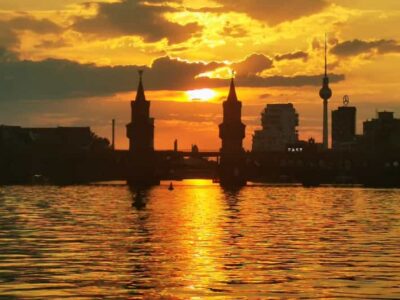
Berlin: Solar Powered Sunset Catamaran Cruise & Audio Guide
Read our review →
Berlin: Boat Sightseeing Cruise with Audioguide
Read our review →
Berlin: Panoramic Boat Tour with Bilingual Audio Guide
Read our review →

Berlin: Self-Drive City Sightseeing Tour in a Mini Hot Rod
Read our review →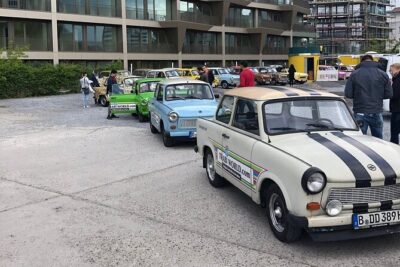
Browse the lists this tour appears in