
REVIEW · BERLIN AUDIO TOURS
Berlin Walking Tour with Audioguide on Your Smartphone
Berlin’s big story unfolds along this easy-to-follow route from Pariser Platz to Alexanderplatz. You’ll move from the Brandenburg Gate and the Reichstag through the Holocaust Memorial, Checkpoint Charlie, Gendarmenmarkt, Bebelplatz, Museum Island, and several reminders of East Germany. The 24 audio recordings turn a simple city walk into a guided lesson in Berlin’s politics, art, and daily life.
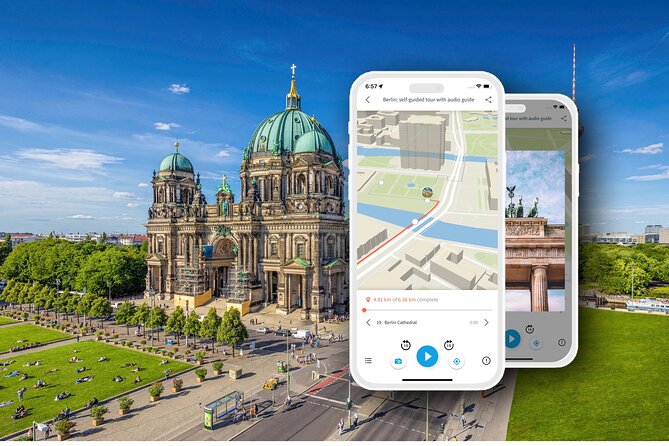
I like two things right away. First, you can pause whenever you want, so a coffee, lunch, or photo stop does not mean missing the rest of the tour. Second, the GPS map and landmark illustrations make it easier to find each stop without keeping a paper route in your hand. The price, $6.61 per person, is also hard to argue with.
The main concern is the technology. The app froze for some people and the GPS was occasionally inaccurate. The advertised time is about two hours, but plan on longer if you stop at museums, take photos, eat lunch, or listen carefully.
Key points to know before you book
- The route links Berlin’s major symbols: Brandenburg Gate, the Reichstag, Checkpoint Charlie, Bebelplatz, Museum Island, and Alexanderplatz all fit into one city walk.
- You control the clock: Pause, replay, skip ahead, or spread the tour over more than one outing during the one-year access period.
- The app works offline: Download the route before walking, then use the map and recordings without relying fully on mobile service.
- The walk is historically serious: The Holocaust Memorial, Führerbunker site, Berlin Wall-era Checkpoint Charlie, and Bebelplatz require quiet attention.
- The route is longer than the headline suggests: Two hours is an estimate. Four hours, including lunch, is a more realistic pace for some people.
- You supply the equipment: Bring your own smartphone and headphones. Transportation, food, entrance tickets, and a human guide are not included.
From Pariser Platz to the Brandenburg Gate

The tour begins at Pariser Platz, the broad square in front of the Brandenburg Gate. This is a good starting point because Berlin’s modern story is packed into one view: Prussian power, wartime destruction, Cold War division, and reunification.
The first recording helps you look beyond the famous columns. Take time to notice the buildings around the square and the way the space funnels your attention toward the gate. The stop is free, but it can be crowded, so an audio tour lets you listen while standing slightly away from the main photo spot.
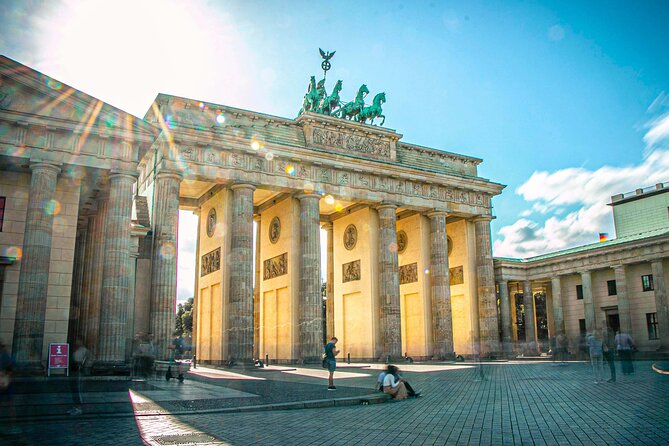
The Brandenburg Gate deserves its own pause. Its neoclassical columns and Quadriga statue are among Berlin’s most familiar sights, but the meaning changed sharply over time. The gate once sat beside a divided city. Today it is a symbol of reunification. The route gives you a useful opening lesson in how Berlin’s monuments can carry several meanings at once.
More Self-Guided Walking Tours in Germany
- Berlin Cathedral Ticket & Audio Tour with a City Walk
★ 4.1 · 28 reviews - Berlin Wall: Greatest Escapes Self-Guided Walking Adventure
★ 4.5 · 27 reviews - Berlin Highlights Self guided scavenger hunt and Walking Tour
★ 4.5 · 4 reviews
The Reichstag and the city’s political center
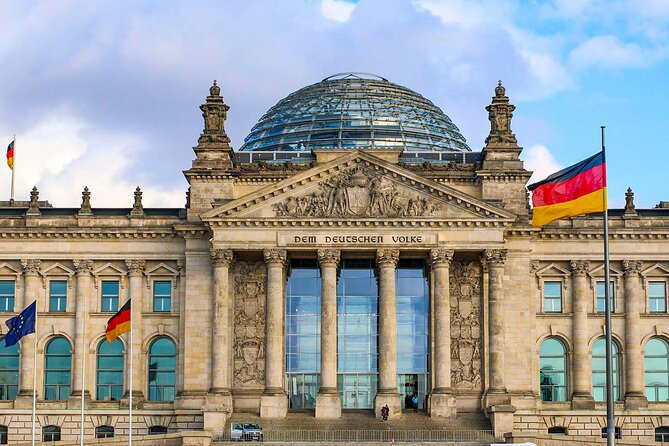
The route continues to the Reichstag, Germany’s parliamentary building. Its glass dome is associated with transparency and democratic government, while the older structure below recalls an earlier political era.
The tour points out the contrast between the historic exterior and the modern glass addition. If you have arranged entry to the dome separately, this is the moment to do it, but the audio tour does not include admission or tickets. Do not assume you can simply walk in as part of the route.
This stop is more about seeing the building and understanding its symbolism than touring the interior. That makes it useful for a first look, but anyone hoping for a full Reichstag visit needs to plan that separately.
A quiet pause at the Holocaust Memorial
The Memorial to the Murdered Jews of Europe is one of the most powerful places on the walk. Its field of gray concrete slabs changes as you move through it. The ground slopes, the blocks vary in height, and the city seems to fade as you walk farther inside.
The audio guide can provide context, but this is a stop where you should not rush. The itinerary allows about ten minutes, yet many people will want longer. The underground Information Centre adds more detail, though entry is not included and may require separate planning.
I appreciate that this part of the route is not treated as a quick photo stop. You should listen quietly, look carefully, and give the memorial room to speak for itself. It is also a practical point to pause the recording before moving on.
The Führerbunker site and the limits of memorial tourism
The former Führerbunker is now an ordinary-looking parking area with an information display. That contrast is the point. The site is not preserved as a dramatic underground attraction, and there is no bunker interior to explore on this walk.
The recording explains the location and its place in the final days of Hitler’s regime. For you, the value comes from understanding how Berlin handles a difficult site without turning it into a spectacle.
Expect a short, sober stop rather than a major landmark. Some people may find the plain setting disappointing, but the modest display helps keep attention on the facts rather than on theatrical presentation.
More Smartphone App Tours in Berlin:
- Berlin World War II and Cold War Self Guided Tour via Mobile App
★ 5.0 · 4 reviews - Rome: Colosseum & Forum with Audio Guide App -Optional Arena
★ 4.2 · 24,770 reviews - Venice: Grand Canal Gondola Ride with App Commentary
★ 4.1 · 23,020 reviews - Florence: Timed Entry to Michelangelo’s David + Audio App
★ 4.6 · 19,496 reviews
East Berlin in small, memorable details
The route then shifts toward everyday signs of Berlin’s divided past. Ampelmännchen, the friendly little pedestrian figures from East German traffic lights, are among the city’s most charming symbols. You may spot them at crossings as you continue through the streets.
The tour also introduces the Trabant, or Trabi, the small East German car that became a symbol of life behind the Iron Curtain. The audio story gives this part of the walk some welcome variety after the heavier memorials and political sites.
These details matter because Berlin’s past is not found only in grand buildings. It also appears in traffic signals, cars, shop goods, and design. The route does a good job of connecting political history with ordinary city life.
Checkpoint Charlie and the Cold War divide
Checkpoint Charlie is one of Berlin’s best-known Cold War locations. The current guardhouse is a replica, not the original crossing point, but the place still helps you picture the former border between East and West Berlin.
The audio guide explains the checkpoint and the attempts people made to cross the border. You can also find a museum in the area, but its admission is separate. The neighborhood around the checkpoint is busy with photo opportunities and commercial displays, so keep your historical attention focused.
This is one of the stronger stops for a first-time visitor. It gives a clear explanation of Berlin’s division, and it connects well with the earlier story of reunification at Brandenburg Gate.
Gendarmenmarkt and Bebelplatz
Gendarmenmarkt brings a change of mood. The square is framed by the German Cathedral, the French Cathedral, and the Konzerthaus, with the Schiller Monument at its center. It is one of Berlin’s grandest urban spaces, and the symmetry is easy to appreciate even if you know little about architecture.
The route allows about ten minutes, enough for a quick look but not a long architectural study. If you care about buildings, pause the audio and inspect the facades, stairs, domes, and spacing of the square.
Bebelplatz is quieter in tone. It is surrounded by the State Opera, St. Hedwig’s Cathedral, and Humboldt University. Beneath the square, a glass window reveals the empty underground library memorial linked to the Nazi book burning.
This is exactly the sort of detail you could miss while walking on your own. The recording points you toward the window and explains why the memorial is placed there. It is a small feature with a serious message about censorship, knowledge, and intellectual freedom.
Unter den Linden and Frederick the Great

The route continues along Unter den Linden, Berlin’s grand central boulevard, to the equestrian monument of Frederick the Great. The statue presents the Prussian king in military dress, high above the surrounding pavement.
The stop helps place Berlin’s political story in a longer timeline. Before the Nazi period, the Berlin Wall, and reunification, Prussia shaped the city’s power and public image. The monument is useful for understanding that earlier chapter.
The nearby German State Opera adds another cultural layer. The building’s neoclassical setting and long performance tradition show that Unter den Linden is not only a political avenue. It is also a place of music, theater, and public ceremony.
You will pass these sights as part of the walking route, but entrance to the opera is not included. Think of this section as an outdoor introduction rather than a performance visit.
Museum Island and Berlin Cathedral
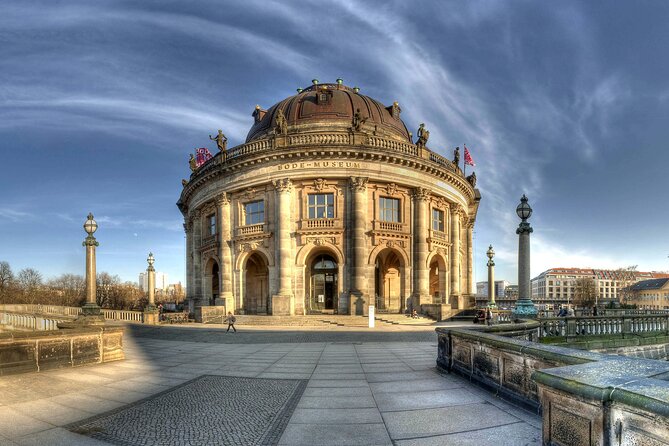
Museum Island sits on the Spree and contains five museums, including the Pergamon Museum and Neues Museum. The audio guide introduces the area as a major cultural center, but the tour does not provide museum admission or enough time for a full museum visit.
If you want to enter one of the museums, plan a separate visit. The walking route is better for getting your bearings and deciding where to return. Museum Island can easily absorb several hours on its own.
Berlin Cathedral is another major sight nearby. Its large dome, ornate interior, and terrace views make it one of the city’s most recognizable buildings. Again, entry is not part of the $6.61 tour price, so you will need a separate ticket if you want to go inside.
This section is especially useful if you are still orienting yourself in central Berlin. The audio stories connect the cathedral, the museums, and the surrounding riverfront into one clear stretch of the city.
Marx, Engels, the Red Town Hall, and Alexanderplatz
Near the later part of the route, the Marx and Engels Forum recalls the founders of communist theory. Statues and reliefs sit in a public park, with remnants of the Berlin Wall nearby. It is a useful stop for understanding the political identity of East Berlin and the changes that followed reunification.
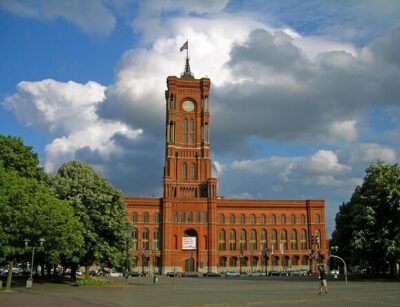
The Red Town Hall adds a different kind of visual interest. Its red-brick Neo-Renaissance facade and nearby Neptune Fountain make it easy to recognize. The building remains Berlin’s seat of government, giving the route another connection between architecture and civic life.
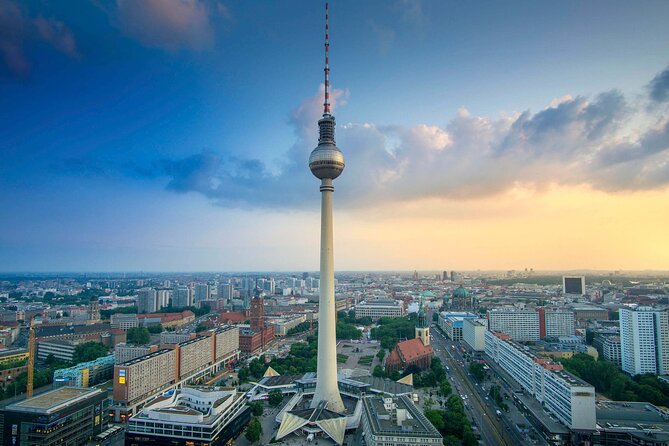
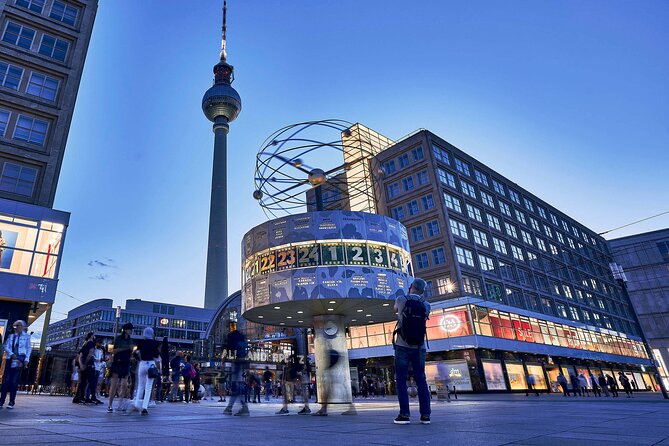
The final major area is Alexanderplatz. The square is a transportation hub and a busy commercial center, with shops, cafes, the Weltzeituhr world clock, and the Television Tower rising above it.
The Television Tower is one of the strongest visual markers in Berlin. You can pay separately to go to its observation deck for city views, but that is not included in the walking tour. Alexanderplatz is a fitting endpoint because it brings together GDR-era design, present-day commerce, public transport, and Berlin’s changing identity.
The activity ends back at the meeting point according to the tour details, though the route description itself finishes at Alexanderplatz. Check the app’s active route when you begin so you know how the return instruction is presented.
How the smartphone format works in real life
You receive an app for iPhone or Android with an offline map, GPS route, landmark illustrations, and 24 audio recordings. Download and activate it before setting off. Bring headphones, since they are not supplied.
The GPS was easy to follow for some people, but it did not always behave perfectly. One practical weakness is that the map may turn with your direction rather than staying fixed north. If that bothers you, keep a basic sense of the surrounding streets and do not rely on the blue route line alone.
The app also froze occasionally. Closing and reopening it restored the tour, so you should not panic if the recording stops. Downloading the material before leaving and keeping your phone charged are sensible precautions.
The voice delivery can sound theatrical at times, and some recordings may feel longer than necessary. Still, the content covers questions you might not think to ask while walking, and you can replay sections instead of trying to catch every word beside a noisy street.
Timing, walking effort, and real value
The stated duration is about two hours, with roughly ten minutes listed at several stops. That is a brisk pace. If you listen to every recording, take photographs, enter a museum, stop for lunch, or pause at the memorials, four hours is possible.
You should expect a substantial walk. One account described more than 10,000 steps, so comfortable shoes matter. Public transportation is near the route, but transportation itself is not included.
At $6.61 per person, the tour is inexpensive compared with a paid group walk. The low price makes the app problems easier to accept, but only if you are comfortable solving small technical issues yourself. You are paying for the route, audio content, and flexibility, not personal questions, crowd management, or a live explanation.
Free cancellation is available if you cancel at least 24 hours before the local start time. Inside that window, the payment is not refunded.
Who should choose this Berlin walk?
I would choose this tour if you want Berlin’s main central sights in one organized route and prefer to set your own pace. It suits independent visitors, couples, and families who may need food, bathroom, or photo breaks without holding up a group.
It is also a good first-day orientation. You get a broad view of the city’s Prussian, Nazi, Cold War, East German, and reunification stories before deciding which museums or memorials deserve more time.
I would choose a live guide instead if you want back-and-forth discussion, detailed architectural analysis, or help when the app fails. The tour is in English only, and the content may feel light for someone seeking a specialist history lecture.
Should you book it?
Book it if you value freedom, low cost, and a well-planned route through Berlin’s central landmarks. The best parts are the flexible pauses, the clear GPS map, and the small details such as the Bebelplatz memorial window and Ampelmännchen.
Skip it if you dislike using your phone while sightseeing or want a human guide to handle directions and context. Plan for more than two hours, bring headphones and a charged phone, and treat the app as a useful companion rather than a flawless replacement for local expertise.
FAQ
Is this a guided walking tour with a human guide?
No. It is a self-guided audio tour delivered through an iPhone or Android app. No human guide accompanies you.
How long does the Berlin audio tour take?
The estimated duration is about two hours. Your visit may take longer if you pause for food, coffee, photos, museums, or extra time at memorials.
Where does the tour begin?
The starting point is Pariser Platz, 10117 Berlin, Germany.
What sights are included on the route?
The route includes Pariser Platz, Brandenburg Gate, the Reichstag, the Holocaust Memorial, the Führerbunker site, Ampelmännchen, the Trabant, Checkpoint Charlie, Gendarmenmarkt, Bebelplatz, Frederick the Great’s monument, the State Opera, Berlin Cathedral, Museum Island, Marx and Engels Forum, the Red Town Hall, the Television Tower, and Alexanderplatz.
Is the tour available in languages other than English?
The supplied tour information lists English as the available language.
Do I need to bring my own headphones and smartphone?
Yes. The tour requires your own smartphone, and headphones are not included.
Are museum and landmark entrance tickets included?
No. Entrance fees and tickets are not included. Food, drinks, and transportation are also excluded.
How long can I access the audio tour?
You receive access for one year after purchase, so you can use it at a time that suits your schedule within that period.
More Self-Guided Walking Tours in Berlin
- Sofia: City Monuments Guided Walking Tour with Audio Guide
★ 4.5 · 825 reviews - Florence: 2.5 hour Audio Guided Walking Tour led by Host
★ 4.6 · 293 reviews - Self Guided Classic Freedom Trail Location Aware (GPS) Walking Audio Tour
★ 4.5 · 258 reviews - Valletta: Self-Guided Historical Walking Tour (Audio Guide)
★ 3.7 · 251 reviews
Just added around Berlin
- Love and War in Berlin: Self-Guided Story Puzzle Walk★ 5.0 · 7 reviews
- Self-Guided Audio Tour-The Fall of the wall: A light for humanity★ 4.5 · 8 reviews
- Berlin Highlights Self guided scavenger hunt and Walking Tour★ 4.5 · 4 reviews
- First Profiler Berlin: Private Self-guided Outdoor Escape Game★ 3.5 · 3 reviews
- Kreuzberg’s Secret Society: Exploration Game and Tour★ 4.5 · 3 reviews
- Berlin Scavenger Hunt and Highlights Self-Guided Tour★ 4.0 · 7 reviews
- Berlin World War II and Cold War Self Guided Tour via Mobile App★ 5.0 · 4 reviews
- Berlin Wall: Greatest Escapes Self-Guided Walking Adventure★ 4.5 · 27 reviews
Berlin Audio Tours, compared.
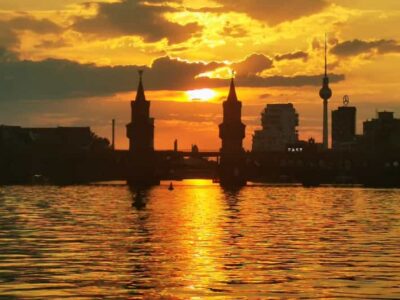
Berlin: Solar Powered Sunset Catamaran Cruise & Audio Guide
Read our review →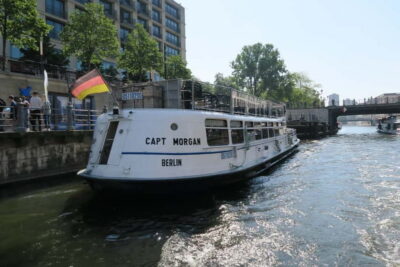
Berlin: Boat Sightseeing Cruise with Audioguide
Read our review →
Berlin: Panoramic Boat Tour with Bilingual Audio Guide
Read our review →

Berlin: Self-Drive City Sightseeing Tour in a Mini Hot Rod
Read our review →
Browse the lists this tour appears in