
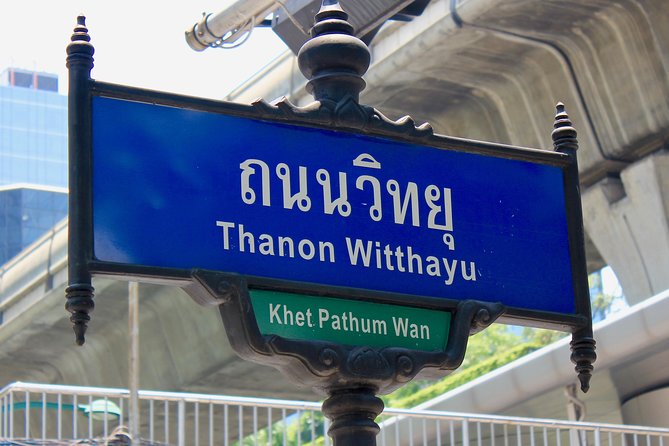
REVIEW · BANGKOK AUDIO TOURS
Bangkok’s Wireless Road: A Self-Guided Audio Tour
Bangkok’s Wireless Road is more than a route between office towers and embassies. With local historian Paul Jorgensen guiding you through the VoiceMap app, ordinary sights become clues to Thai beliefs, Bangkok’s growth, and the long relationship between Thailand and the United States. I like the automatic GPS narration and the chance to explore without keeping up with a group. I also like the low price, which buys lifetime access rather than a one-time listening session.
The main tradeoff is that this is an audio walk, not a live tour. You will need your own smartphone and earphones, and the experience depends on following the route carefully. The tour also returns to its starting point, so allow close to an hour rather than treating it as a quick one-way stroll.
Key points on Bangkok’s Wireless Road
- Paul Jorgensen’s local storytelling: Learn why Wireless Road has its name and how seemingly small details connect to Thai culture.
- Automatic GPS narration: The app plays each story at the right point, so you can keep your phone in your pocket.
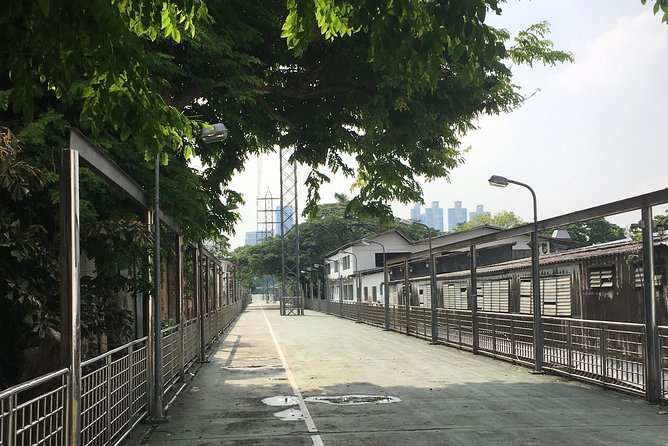
- A green route through central Bangkok: Walk beneath Nai Lert’s rain trees and toward Lumphini Park.
- Embassy and American connections: Hear how the area developed and how a shopping mall grew from former British Embassy grounds.
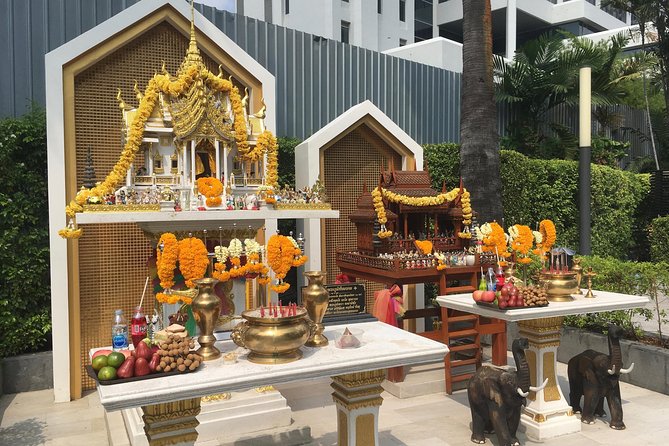
- Spirit houses, Hindu gods, and Thai symbols: The walk explains Trimurti, the number nine, food, color, and the Thai flag.
- Good value for independent walkers: At $7.99, you receive offline maps, audio, and geodata with lifetime access.
Starting at BTS Phloen Chit and finding the story
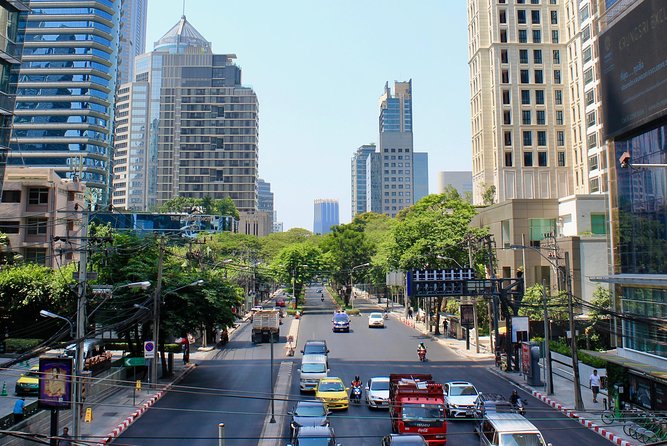
The walk begins and ends at Phloen Chit BTS station, in the Lumphini area of central Bangkok. That is a useful starting point because the Skytrain makes the route easy to reach without arranging a taxi or adding a separate transfer.
Once you open the VoiceMap app and start the tour, the route uses GPS to trigger the narration. You can put the phone away and listen as you walk, which makes the experience feel closer to having a guide beside you than to following a standard travel podcast.
The app works offline, including the audio, map, and location data. Downloading or checking the route before setting out is still sensible, but the offline function matters in Bangkok. You can focus on the streets instead of watching a map load or worrying about mobile data.
The tour lasts about 50 minutes to one hour. The route goes down Wireless Road toward Lumphini Park and then returns to Phloen Chit. Because the walk includes pauses to look around and listen, you should not plan a tight appointment immediately afterward.
The GPS format gives you control. You can stop for a drink, pause the narration, or restart later. That flexibility is especially handy if you are using the walk as an introduction to the neighborhood rather than as a formal sightseeing appointment.
More Audio Tours in the world:
- Barcelona: Sagrada Familia Entry Ticket with Audio Guide
★ 4.6 · 105,312 reviews - Rome: Pantheon Fast-Track Ticket and Official Audioguide
★ 4.5 · 27,353 reviews - Barcelona: Casa Batlló Entry with Self-Audioguide Tour
★ 4.7 · 25,359 reviews
Wireless Road, embassies, and Bangkok’s changing identity
The street’s name gives Paul Jorgensen a natural opening for a larger story about Bangkok. Wireless Road is tied to communications and the city’s growth, but the route does not treat the name as a dry fact to memorize. It uses the street as a way to explain how Bangkok changed from a more traditional capital into the international city you see today.
Embassies are a major part of the walk. You pass grand compounds and formal gates, then hear how this part of Bangkok became linked to foreign governments and international relations. The setting gives the history a physical shape. Instead of reading a list of diplomatic dates, you are standing on the road where those connections took form.
The United States and Thailand receive particular attention. The walk points out how American friendship with Thailand appears in corners and landmarks along this stretch. That makes the tour useful if you want more than temple visits and market stops. It shows how modern Bangkok was shaped by relationships between countries as well as by local traditions.
A shopping mall also enters the story. Its grounds once belonged to the British Embassy, and the change says a lot about Bangkok’s use of valuable central land. A diplomatic compound can become a commercial center, while the surrounding neighborhood remains marked by older trees, shrines, and institutions. You get a small lesson in how the city keeps rebuilding itself without erasing every earlier layer.
Do not expect a full interior tour of embassy buildings or the mall. The experience is a walking commentary through public streets. You see the setting from outside, listen to the context, and continue along the route.
Nai Lert’s rain trees and the green side of central Bangkok
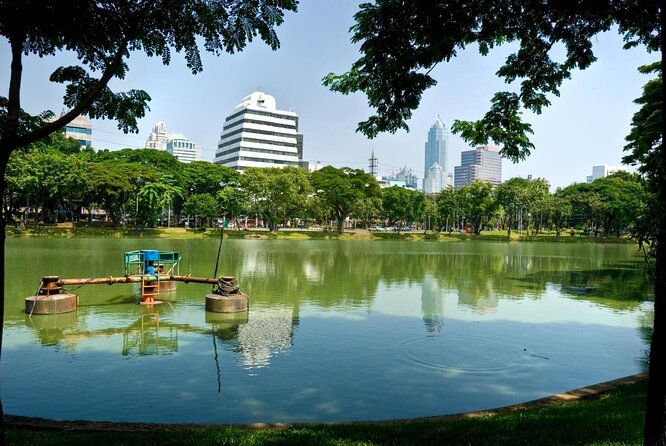
One of the pleasant surprises here is the attention given to the huge rain trees around Wireless Road. Entrepreneur Nai Lert is credited with the trees that help give this neighborhood its leafy character, and Jorgensen explains their unusual background.
That detail changes the feel of the walk. Bangkok is often pictured through traffic, concrete, signs, and heat. Wireless Road offers another side of the city, with broad views and mature trees shading parts of the route. The greenery is not just decoration. It reflects decisions made by a named local entrepreneur and links the area’s present appearance to its past.
I like this kind of story because it gives you something to look for. Once you know why the trees matter, you are less likely to hurry past them. The audio makes a point of treating ordinary features as evidence: a group of motorcycle taxis, a convenience store, or a line of trees can all open a window onto local life.
The route is still an urban walk. You are not heading into a forest or a quiet rural district. Traffic, offices, shops, and city movement remain part of the setting. Still, the trees give the tour welcome breathing room, especially for anyone who has spent the morning in Bangkok’s denser commercial zones.
Thai beliefs in spirit houses and the Trimurti shrine

The tour’s cultural material is one of its strongest features. Jorgensen explains what spirit houses say about Thai beliefs and helps you notice religious details that can otherwise look like small pieces of street decoration.
You also pass through a shrine connected with Trimurti, the Hindu god. This is a good example of how Thai religious life does not fit neatly into a single category. Hindu imagery, Buddhist customs, local spirit beliefs, and everyday offerings can exist close together, and the walk gives you a way to understand what you are seeing without turning the stop into a formal religious lecture.
The advantage of an audio guide is that the explanation arrives while the shrine is in front of you. You can look at the space, listen, and move on at your own pace. If you need more time, pause the track. If the area is busy, you can continue listening and return your attention to the shrine when it suits you.
Be respectful here. The tour explains the site, but it is not an invitation to treat a working shrine as a photo prop. The value comes from noticing how belief appears in daily city life, not from rushing through a checklist of religious sights.
The route also touches on the meaning of food and color in Thai culture, along with the number nine and the Thai flag. These may sound like small subjects, but they give you useful tools for the rest of your time in Thailand. You may start noticing colors, numbers, offerings, and symbols elsewhere in Bangkok and understand that they can carry more weight than their appearance suggests.
Same place, a different route to walk:
- Rome: Colosseum & Forum with Audio Guide App -Optional Arena
★ 4.2 · 24,770 reviews - Venice: Grand Canal Gondola Ride with App Commentary
★ 4.1 · 23,020 reviews - Amsterdam: 75 Minute City Canal Cruise with Audio Guide
★ 4.4 · 19,938 reviews - Florence: Timed Entry to Michelangelo’s David + Audio App
★ 4.6 · 19,496 reviews
The Green Mile toward Lumphini Park
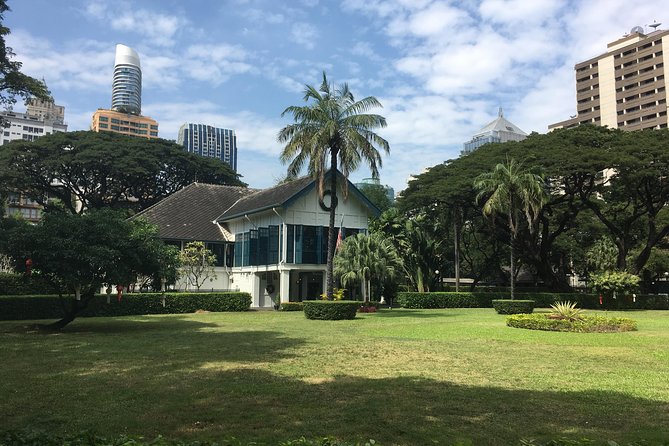
Another notable part of the route is the Green Mile, a special pedestrian pathway connecting Lumphini Park and Benjakiti Park. The walk introduces this link as part of Bangkok’s effort to connect important green spaces through a city built for cars, offices, and dense development.
You do not need to treat the Green Mile as a separate excursion. It fits into the Wireless Road route and gives the walk a change of pace. After embassy walls, shops, and roadside sights, a pedestrian connection lets you think about how people move through the city without relying on vehicles.
The route goes toward Lumphini Park before turning back to Phloen Chit. Since the experience ends where it begins, you get both an outward journey and a return route rather than being left at a distant finish point. That makes the tour easy to combine with a hotel near Phloen Chit or with a day based around the BTS line.
The itinerary information does not promise admission to park attractions, museums, or other paid sites. Treat the walk as an outdoor neighborhood tour. Any food, drinks, or separate entrance tickets are your responsibility, and transportation beyond reaching the start is not included.
How the GPS audio format works in practice
VoiceMap is the core of the experience. You receive the app, audio, map, and geodata, with offline access and lifetime use of the Wireless Road tour. The narration starts automatically at the right location, so you are not constantly tapping through chapters.
That setup suits me better than an audio file with vague instructions. A standard recording might tell you to listen for five minutes and then find the next stop yourself. Here, the GPS is intended to match the story with the place in front of you.
You still need to pay attention to your surroundings. GPS can guide the timing, but it does not replace basic street awareness. Keep an eye on traffic, crossings, curbs, and other people, particularly while wearing earphones. Put the phone away when the narration starts, but do not let the app distract you from the road.
The tour is described as private in the sense that only your group participates. Since it is self-guided, you do not meet a guide at the station or walk in a fixed group. That is good news if you dislike public tour schedules, but it also means you cannot ask Paul a question in the moment.
This format works especially well for independent visitors, repeat visitors who want a fresh angle, and people staying near the route. It is also a useful first Bangkok walk. The cultural explanations reach beyond Wireless Road, giving you background that can help make sense of other parts of the city.
Is $7.99 a fair price?

At $7.99 per person, the value is strong if you want a short, focused introduction to one Bangkok neighborhood. You receive lifetime access, not merely the right to listen during a single scheduled departure. You can also stop and restart, which gives the price more value than a rigid one-hour activity.
The cost is less attractive if you want a live guide, a long day of sightseeing, or entry into attractions. This tour does not include transportation, food, drinks, museums, or other admission fees. It is paying for the route, narration, app, and cultural interpretation.
Think of it as a compact orientation walk. For about an hour, you get a guided look at embassies, trees, a shopping mall’s former grounds, a shrine, the Green Mile, and the small signs of Thai life along the street. That is a fair exchange for the price, especially if you are curious about Bangkok but do not want to commit to a half-day tour.
The booking pattern suggests many people reserve it well ahead of time, with an average of 26 days. Still, the published hours run all day, every day, so the appeal is flexibility rather than a fixed departure. Choose your timing with care. Bangkok’s heat and street conditions can affect how pleasant any walking route feels, even though the tour itself has no scheduled meeting time beyond starting at Phloen Chit.
Who should choose this Wireless Road walk?
I would choose this tour if you like learning from details rather than racing between famous landmarks. It rewards curiosity about why a road has its name, why trees line a district, how a British Embassy site became a mall, and what a Hindu shrine is doing in central Bangkok.
It is also a good match for independent people who want a little structure without a group. You can walk alone, with family, or with your own small party, then pause whenever you need to. Service animals are allowed, and most people can take part, though you should be comfortable walking for roughly an hour.
Families may appreciate the short length and the chance to turn the route into a scavenger hunt for trees, flags, shrines, motorcycle taxis, and other details mentioned in the narration. Young children may not follow every historical point, so the best fit depends on their interest in walking and listening.
I would be less likely to choose it if I wanted a social experience or a guide who could answer questions. The audio cannot adjust its explanation to your interests, and the route does not include a meal, a museum visit, or a major attraction ticket. It is strongest as a thoughtful neighborhood walk, not as a complete Bangkok sightseeing program.
Should you book Bangkok’s Wireless Road audio tour?
Book it if you want a low-cost, flexible way to understand central Bangkok through its streets, trees, embassies, shrines, and everyday symbols. Paul Jorgensen’s narration gives you more than directions, while the GPS system lets you walk at your own pace and return to the audio whenever you like.
Skip it if you need a live guide, dislike listening through earphones, or have only a few minutes before another appointment. For most independent visitors with about an hour to spare, the $7.99 price and lifetime access make this a practical addition to a Bangkok stay, especially near the start of your trip when the wider cultural context will help you read the city more clearly.
FAQ
Where does the Wireless Road audio tour begin?
It begins at Phloen Chit BTS station on Thanon Phloen Chit in Bangkok.
Where does the tour finish?
The walk returns to Phloen Chit BTS station, so it ends at the same meeting point where it starts.
How long does the tour take?
The approximate duration is 50 minutes to one hour.
Do I need a smartphone?
Yes. A smartphone is not included, and you use it to access the VoiceMap app and the tour.
Can I use the tour without mobile data?
Yes. The VoiceMap app provides offline access to the audio, map, and geodata.
Are entrance fees or food included?
No. Transportation, food, drinks, museum admission, and other entrance fees are not included.
Just added around the world
- Dolmabahce Palace Skip the Ticket Line Entry with Audio Guide★ 4.0 · 6 reviews
- Istanbul Bosphorus Sightseeing Cruise with Audio Guide★ 5.0 · 67 reviews
- Hagia Sophia Skip-the-Line Ticket with Audio Guide★ 5.0 · 4 reviews
- Cistern of Theodosius Entry Ticket & Audio Guide★ 3.5 · 6 reviews
- Basilica Cistern Skip-the-Ticket-Line Entry with Audio Guide★ 4.0 · 4 reviews
- Maria Edgeworth Center-A Self-Guided Audio Tour★ 5.0 · 21 reviews
- Self-Guided Tour of Ísafjörður: Art, History, and Architecture★ 5.0 · 23 reviews
- Inverness Quest: Self Guided City Walk & Immersive Treasure Hunt★ 4.0 · 5 reviews
Bangkok Audio Tours, compared.

Bangkok: Tuk Tuk Day Pass App & Boat Chao Phraya River
Read our review →
Private ‘Breeze & Pleased’ Canal Boat Ride – 2hrs (self-guided)
Read our review →
Bangkok: Audio guides for Bangkok, Ayutthaya & Chiang Mai
Read our review →
Bangkok Grand Palace & Emerald Buddha Flexible Pass w/ Audio
Read our review →
Bangkok: Grand Palace & Emerald Buddha Entry with Audioguide
Read our review →

Grand Palace Self-Guided Walking Tour (entry not incl.)
Read our review →Browse the lists this tour appears in