
REVIEW · ITALY AUDIO TOURS
Tivoli: Entrance Ticket to Villa Adriana & App Audioguide
Hadrian’s Villa is not one grand Roman building. It is a huge archaeological park where the Emperor Hadrian created his own world outside Rome, with baths, libraries, fountains, gardens, theaters, and private rooms. The Maritime Theater is the cleverest stop: a round retreat with a pool and artificial island at its center. I like that this ticket lets you explore at your own pace, with a digital audioguide rather than a fixed group schedule.
I also like the scale of the place and the chance to see details beyond the famous views, including Roman mosaics, marble statues, waterworks, and the long Canopo pool. The drawback is that this is an independent visit, not a guided tour, and the one-square-kilometer site takes time and energy. You also need to arrange your own transport from Rome or elsewhere in Lazio.
Key points to know before you go

- The Maritime Theater has a circular portico, pool, artificial island, private rooms, heated baths, and a fountain.
- The Canopo is a large rectangular pool surrounded by sculptures, with the artificial Serapeum grotto nearby.
- The archaeological park covers about one square kilometer, with more than 30 known buildings and much still unexcavated.
- The digital audioguide gives you a self-guided visit, so you can stop, wander, and linger without following a group.
- A printed voucher is required, and you must exchange it at the Villa Adriana ticket office.
- Large bags, suitcases, and rucksacks are not permitted, and you must pass through security before entering.
Why Hadrian built a second home near Tivoli
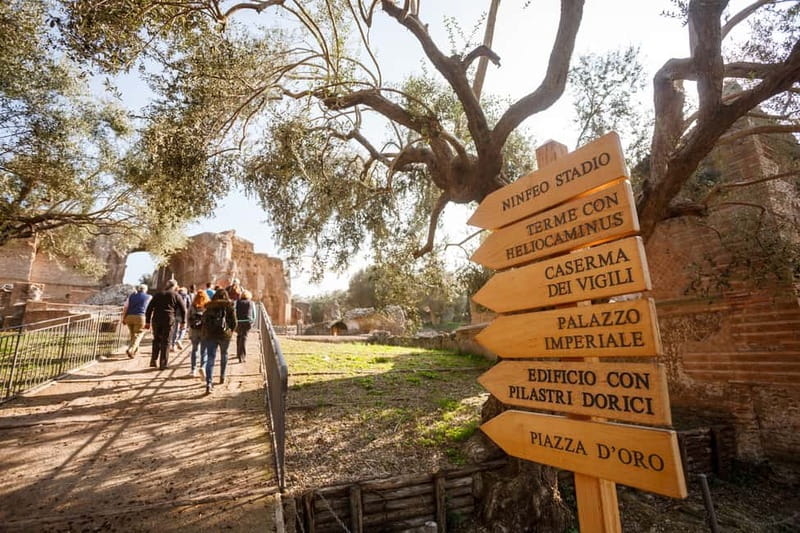
Villa Adriana was the Emperor Hadrian’s country retreat, built east of Rome in Tivoli. The reason was practical as well as personal: Hadrian disliked the Palatine Hill in Rome and preferred this spacious setting for rest, work, and private life.
The villa grew into something far bigger than a country house. It became a vast complex of more than 30 buildings spread across roughly one square kilometer. You will see the remains of baths, libraries, suites, theaters, fountains, pools, porticoes, and service areas.
That scale changes the way you experience the site. You are not simply walking from one preserved room to another. You are crossing a former imperial center, where separate buildings served different jobs and where water, shade, views, and movement were carefully planned.
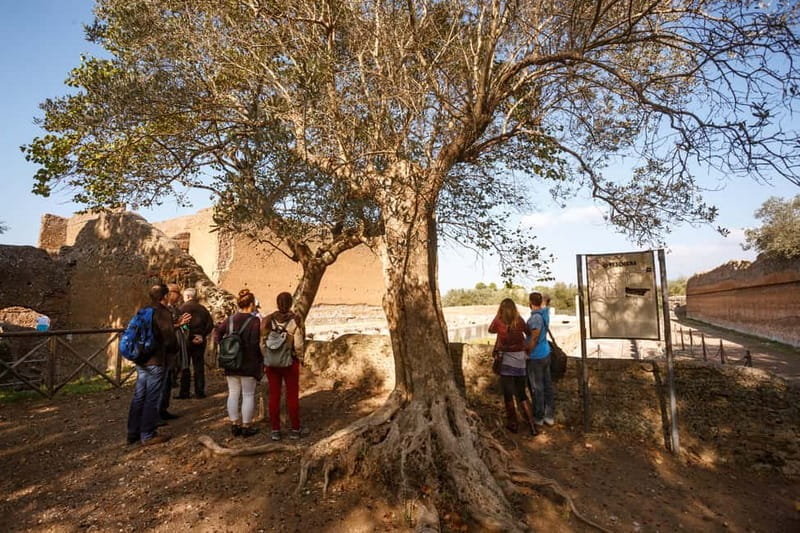
Much of the area has not been excavated. That is part of the appeal, but it also means you will sometimes see grass, earth, foundations, and broken walls rather than complete rooms. You need a little imagination. The audioguide can help connect these scattered remains into a picture of how the villa once worked.
The site is now a UNESCO World Heritage Site, but it does not feel like a polished museum. It is an open archaeological park. That gives you space and atmosphere, while also requiring sensible shoes, patience, and enough time to walk between the major remains.
More Skip-the-Line Audio Guide Tickets in Italy
- Rome: Pantheon Fast-Track Ticket and Official Audioguide
★ 4.5 · 27,353 reviews - Pompeii: Entry Ticket with Audio Guide
★ 4.1 · 13,491 reviews - Venice: La Fenice Opera House Entry Ticket with Audio Guide
★ 4.6 · 11,742 reviews
Starting the visit at the ticket office
Your visit begins at the Villa Adriana ticket office. You must exchange your printed voucher there, so do not rely on showing only a phone screen unless your booking instructions specifically confirm that this is acceptable. The activity includes the entry ticket and digital audioguide, but not transportation or a live guide.
The ticket is valid for one day. That makes it useful for a flexible Tivoli itinerary, since you can choose when to arrive within the available booking time. The ticket also includes skip-the-ticket-line access, though you still need to visit the ticket office to exchange the voucher and pass through security.
Security checks are required before entry. Large bags, suitcases, and rucksacks are not allowed inside. Pack lightly. A small personal bag is the sensible choice, but the supplied information does not specify the exact size limit, so avoid arriving with luggage or a bulky daypack.
Once inside, you are free to set your own pace. There is no group meeting point to chase and no guide waiting for everyone to catch up. That is a real advantage at a site where one person may want to study a wall or mosaic while another would rather move on to the next fountain.
The Maritime Theater, Hadrian’s private retreat

Make the Maritime Theater one of your first major stops. It is one of the most distinctive structures at Villa Adriana, and it shows how unusual Hadrian’s design choices could be.
The building is a circular portico with a barrel vault supported by pillars. Inside is a pool with an artificial island. The water separated the island from the surrounding walkway, creating a private retreat within the already private villa.
The complex included a lounge, library, heated baths, three suites with heated floors, a washbasin, an art gallery, and a large fountain. Those details help you read the ruins as a functioning residence rather than a collection of impressive curves and stones.
The Maritime Theater also gives you a useful lesson in Roman engineering. The round form, water system, heated floors, and controlled access all point to a place designed for quiet retreat and comfort. Hadrian was not simply building rooms. He was creating carefully framed experiences for himself.
Take time to look at the relationship between the circular portico, the pool, and the island. Even in ruin, the basic idea remains clear. It is easy to see why this is one of the most memorable parts of the visit.
The Canopo and the Serapeum
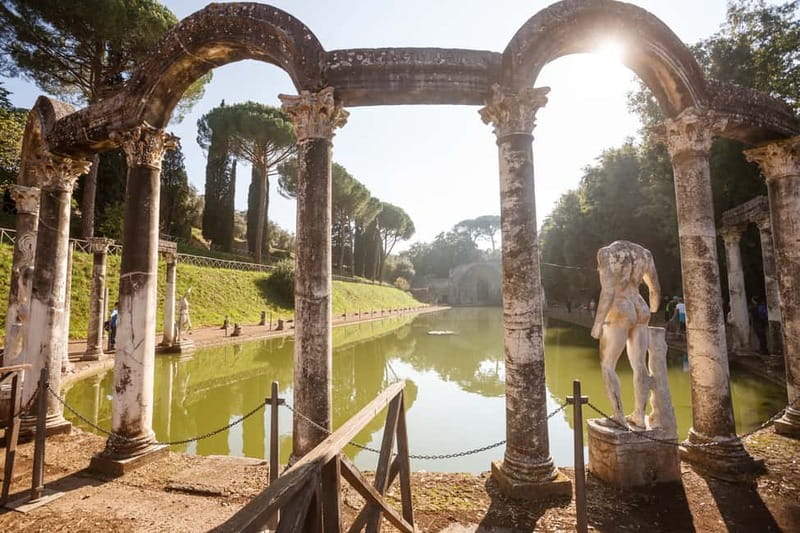
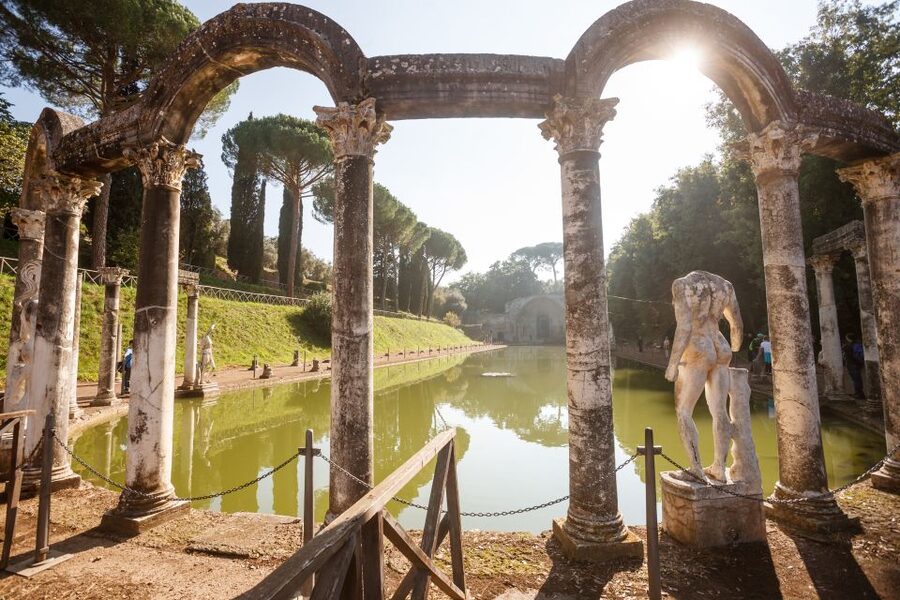
The Canopo is another major highlight. This large rectangular pool was surrounded by sculptures, turning the water into a long ceremonial scene rather than a simple swimming pool or garden feature.
The scale matters. From beside the pool, you can understand how water shaped the villa’s design. It provided decoration, reflected architecture and statues, and created a calm focal point within the grounds.
At one end is the artificial grotto of the Serapeum. The structure is linked to the Egyptian god Serapis and adds another layer to Hadrian’s wide-ranging architectural interests. The grotto also shows the villa’s taste for dramatic settings, combining water, sculpture, shelter, and curved forms.
The Canopo is a good place to slow down. The site has many ruins, and it is easy to rush from one famous feature to the next. Instead, use the audioguide to understand what you are seeing, then spend a few minutes looking at the pool, the surviving sculpture areas, and the way the space was arranged.
Some sculpture and architectural elements are incomplete or weathered. That is normal for an archaeological site of this age. The value here comes from the plan of the complex and the surviving pieces working together.
More Smartphone App Tours in Italy:
- Rome: Colosseum & Forum with Audio Guide App -Optional Arena
★ 4.2 · 24,770 reviews - Venice: Grand Canal Gondola Ride with App Commentary
★ 4.1 · 23,020 reviews - Florence: Timed Entry to Michelangelo’s David + Audio App
★ 4.6 · 19,496 reviews - Rome: Colosseum, Forum, Palatine Hill Entry & Audioguide App
★ 4.4 · 10,957 reviews
Mosaics, statues, and smaller details
The larger ruins make the first impression, but the smaller surviving details can be just as rewarding. The villa contains mosaics from Roman baths and the theater, along with artifacts dating from the period when the complex was built.
The mosaics are especially useful for understanding the level of finish inside the villa. From a distance, a ruined wall can seem plain. A surviving patterned floor or decorated fragment reminds you that these rooms were once carefully furnished and richly finished.
Look for the marble statues of Antinous, Hadrian’s deified lover. Antinous was an important figure in Hadrian’s life, and his presence at the villa adds a personal element to an otherwise enormous imperial project.
The supplied information identifies particularly good mosaics in the former hospital area. Allow time for these details instead of treating the visit as a quick walk to the Canopo and back. The engineering and decoration are closely connected here. Straight walls, curved walls, domes, heated floors, pools, and mosaics all show how much planning went into the estate.
The ruins also reveal how Roman architects handled different shapes. Perfectly straight walls sit beside rounded structures and domed spaces. You can see the contrast clearly at the Maritime Theater and in the remains of the baths.
How long should you allow?
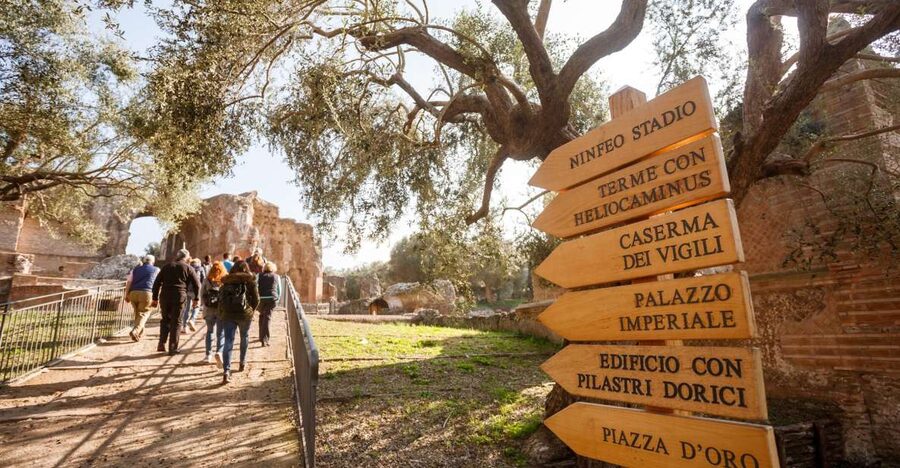
Plan on at least two hours. That is the shortest sensible visit if you want to see the main monuments and understand the site rather than simply enter, take a few photographs, and leave.
Two hours can cover the Maritime Theater, Canopo, Serapeum, major baths, and selected mosaics. It leaves less time for wandering through the wider grounds or pausing at every water feature and statue.
If ancient architecture is a main reason for your visit, give yourself longer. The estate covers about one square kilometer, and the buildings are spread out. The more you walk, the more the villa’s size becomes clear. You may also want time to use the audioguide properly rather than listening only to the highlights.
The grounds are extensive, so pace yourself. There is a difference between seeing the villa and understanding it. A hurried visit can make the site feel like a series of disconnected walls. A slower visit lets you connect the private rooms, public spaces, baths, pools, and ceremonial areas.
This is not a compact stop that you can fit into a spare half-hour. It works best as a planned part of your day in Tivoli.
What the digital audioguide adds
The included digital audioguide is useful because Villa Adriana is spread across a large area and many remains are difficult to interpret without context. The walls alone cannot always tell you what a room was used for, how the water moved, or how one building related to another.
A live guide is not included, so the audioguide is your main source of interpretation during the visit. You can listen as you walk and pause when you want to examine a structure more closely.
This arrangement suits independent visitors who dislike being tied to a group. It is also helpful if your interests are uneven. You might spend extra time at the Maritime Theater and move faster through another set of foundations without making anyone wait.
The tradeoff is that you must manage the experience yourself. No guide will point out a detail you have missed or adjust the explanation to your questions. If you want a discussion-based visit, this ticket may feel basic. If you prefer freedom and a lower price, it does the job.
Is the $19 price good value?
At $19 per person, the ticket is fairly priced for entry to a UNESCO-listed archaeological complex of this size, especially since a digital audioguide is included. You are paying for access to a full historic estate rather than a single monument.
The value is strongest if you intend to stay for at least two hours. The longer you explore, the more the entry fee makes sense. You can see major architecture, water features, mosaics, statues, baths, and extensive grounds in one visit.
The price does not include transportation. That matters if you are coming from Rome, since you must organize your own way to Tivoli and the villa. A cheap entry ticket can become less convenient if your transport plan is uncertain, so sort out the journey before booking.
There is also no live guided tour. Some people will see this as a saving and a benefit. Others may prefer to pay more for an expert who explains the site in person. For a self-guided archaeological visit, $19 offers solid value, but only if you are comfortable exploring independently.
The free cancellation option up to 24 hours before the activity and the reserve-now-pay-later choice add flexibility. These policies are useful if your Lazio plans may change, but check the booking conditions at the time of purchase.
Sending a Pemcard from the villa
The experience also includes the option to send a Pemcard, a digital photograph that can be delivered as a real postcard anywhere in the world. Instructions for downloading the digital postcard are provided through CoopCulture.
This is a small extra rather than a reason to choose the ticket. Still, it gives you a pleasant way to share the visit beyond posting another ordinary phone image. Choose a strong view of the Canopo, the Maritime Theater, or another part of the ruins that shows the scale of the estate.
The postcard option works best as a finishing touch. First give the site your attention, then create the image you want to send.
Who will enjoy Villa Adriana most?
I recommend this visit to anyone interested in Roman architecture, ancient engineering, imperial history, or large archaeological sites. It is also a good choice if you have already seen Rome’s busiest monuments and want a quieter setting with more room to think.
Families with older children may appreciate the pools, tunnels, curved walls, and unusual buildings. The artificial island in the Maritime Theater gives younger visitors something concrete to look for, while the huge Canopo helps explain the villa’s size.
The visit suits independent explorers. You can choose your own route, spend longer at the mosaics, and skip quickly past areas that hold less interest. The digital audioguide provides structure without turning the day into a march.
It may be less suitable if you want a short, tightly organized excursion with transportation included. It is also not ideal if you are carrying luggage, since suitcases and large bags are not allowed. Anyone who dislikes walking through extensive ruins should plan carefully and keep expectations realistic.
Practical advice for a smoother visit
Bring your printed voucher and exchange it at the ticket office before entering. Keep your belongings small because large bags and rucksacks are prohibited.
Set aside at least two hours, and more if you want to explore beyond the headline monuments. The site is spread across extensive grounds, so rushing will reduce the value of both the ticket and the audioguide.
Start with the main structures, then return to smaller details such as mosaics, statues, and bath remains. This gives you a clear sense of the villa’s overall design before you focus on decoration.
Use the one-day validity to fit the visit into your Tivoli plans, but remember that the ticket does not arrange transport. You are responsible for reaching Villa Adriana and returning afterward.
Should you book this Villa Adriana ticket?
Book it if you want to explore Hadrian’s retreat at your own speed and you are happy to arrange transportation and guide yourself with an audioguide. The Maritime Theater, Canopo, mosaics, and sheer size of the estate make this one of the most rewarding ancient sites near Rome.
Skip it if you want a live expert, a short visit, or a package with transport included. For everyone else, the $19 price is a sensible way to spend several hours with Roman architecture, waterworks, sculpture, and the remains of an emperor’s private world.
FAQ
Where is Villa Adriana?
Villa Adriana is in Tivoli, in the Lazio region of Italy, east of Rome.
What does the ticket include?
The ticket includes entry to Villa Adriana and a digital audioguide.
Is transportation included?
No. You must arrange your own transportation to and from Villa Adriana.
How long is the ticket valid?
The ticket is valid for one day. You should check availability for the starting times offered when booking.
Do I need a printed voucher?
Yes. You must bring a printed voucher and exchange it at the Villa Adriana ticket office.
Can I bring a suitcase or large backpack?
No. Suitcases, rucksacks, and large bags are not permitted inside the attraction.
Can I cancel the booking?
Yes. You can cancel up to 24 hours in advance for a full refund, subject to the booking conditions.
Just added around Italy
- Genoa Historic Centre Quest: A Self-Guided Puzzle Adventure★ 4.0 · 3 reviews
- Genova Walking Tour with Audio and Written Guide by a Local★ 4.5 · 33 reviews
- Self-Drive (No Licence) Boat Rental in Portofino Gulf★ 5.0 · 12 reviews
- Finance and Nobility: Explore medieval Genoa on a self-guided audio tour★ 4.5 · 7 reviews
- Florence: Uffizi Gallery Reserved Ticket & Digital Audio Guide★ 4.5 · 3 reviews
- Around Florence Hills: App‑Guided e‑Vespa Tour + Wine&Food★ 4.5 · 22 reviews
- Florence: Uffizi Gallery Audio Guided Tour led by Tour Leader★ 3.5 · 6 reviews
- Uffizi Gallery Audio-Guided Visit with optional Accademia Gallery★ 3.5 · 42 reviews
Italy Audio Tours, compared.

Rome: Pantheon Fast-Track Ticket and Official Audioguide
Read our review →
Rome: Colosseum & Forum with Audio Guide App -Optional Arena
Read our review →
Venice: Grand Canal Gondola Ride with App Commentary
Read our review →
Florence: Timed Entry to Michelangelo’s David + Audio App
Read our review →
Rome: City Sightseeing Hop-on Hop-off Bus with Audioguide
Read our review →
Venice: La Fenice Opera House Entry Ticket with Audio Guide
Read our review →
Rome: Colosseum, Forum, Palatine Hill Entry & Audioguide App
Read our review →Browse the lists this tour appears in