REVIEW · USA AUDIO TOURS
Self-Guided Chicago Loop Tour Explore the City at Your Own Pace
Chicago’s Loop is best understood on foot, where one block can shift from a polished skyscraper to a public sculpture or a grand old lobby. This self-guided audio walk links major sights from DuSable Bridge to Willis Tower, using GPS to play the right information as you move.
I like the $9.99 price and the freedom to stop for photos, coffee, or an extra look inside a building. I also like that the tour works offline after you download it, so you do not need a live phone signal along the way.
The main drawback is that the advertised route takes about two to two and a half hours only if you keep moving. With so many sights, you may easily spend four or five hours, and the app setup requires your own smartphone and a redemption code.
Key points to know before you go
- Start at DuSable Bridge: The route begins at 333 Michigan Avenue and follows a useful north-to-south path through the Loop.
- GPS-triggered audio: Information plays automatically as you reach each location, with a map to keep you oriented.
- Major public art included: You see Cloud Gate, Crown Fountain, Calder’s Flamingo, Picasso, and Miró without paying separate admission.
- Strong value at $9.99: The price is far below a conventional guided walking tour, especially since access never expires.
- Plan extra time: The official estimate is two to two and a half hours, but you can use the route for much longer.
- Finish near Willis Tower: The walk ends at 233 South Wacker Drive, near Chicago Union Station and the South Branch of the Chicago River.
Why this Chicago Loop walk works well
I like this tour because it gives you structure without forcing you to keep up with a group. You get a route, a map, and spoken explanations, but you decide when to pause. That matters in downtown Chicago, where a five-minute photo stop can turn into a look inside a building or an unexpected architectural discovery.
The audio is GPS-triggered, so you are not constantly searching through a long recording to find the right section. Once the app and tour are downloaded, the experience works without cell service. Download everything before you set out, then keep your phone charged and your headphones ready.
This is not a private walking guide in the usual sense. No person accompanies you. The activity is private because only your group uses the tour, which is useful if you want to move slowly or take breaks without holding anyone up.
At $9.99 per person, the value is easy to see. You are getting access to a full downtown route with more than a dozen stops, an audio guide, and unlimited use. The tour does not expire, so you can pause it and return later. A traditional guided walk may offer more conversation and the chance to ask questions, but this option costs less and gives you much more control.
More Audio Tours in the USA:
- Fort Sumter Admission and Self-Guided Tour with Roundtrip Ferry
★ 4.5 · 3,343 reviews - San Francisco: Alcatraz Ticket, Ferry, & Self-Guided App
★ 4.5 · 2,460 reviews - Los Angeles: Hop-On Hop-Off Bus Tour with Audio Guide
★ 3.7 · 2,030 reviews
Starting at DuSable Bridge and the Chicago River
Begin at DuSable Bridge, at 333 Michigan Avenue. This is a smart starting point because the bridge places you beside the Chicago River and near several major downtown sights.
The bridge is a double-deck, double-leaf bascule bridge. In plain terms, its two movable sections can lift to let boats pass. Its decorative towers honor Jean Baptiste Point DuSable, widely associated with Chicago’s founding, and include scenes connected to the city’s past.
The river is central to understanding Chicago. It cuts through the downtown core and helps explain why the bridges, trading district, and old commercial buildings developed where they did. The tour gives you that setting before leading you farther into the Loop.
One practical point: five minutes is enough to see the bridge, but not necessarily enough to appreciate the river, towers, and traffic around it. Let the audio play, then take a few minutes to look up and around.
Nearby, the bridgehouse offers a different angle on the same story. A working bridgehouse lets you see the gears used to lift the Michigan Avenue Bridge, while exhibits explain the river’s role in Chicago’s growth. This is one of the more unusual stops because it connects engineering with city history. The supplied route information does not provide a separate time estimate for the bridgehouse, so check the app for its exact placement and access details.
The Loop’s art, finance, and grand interiors
As you continue, the route brings together several parts of Chicago that can feel unrelated when seen separately.
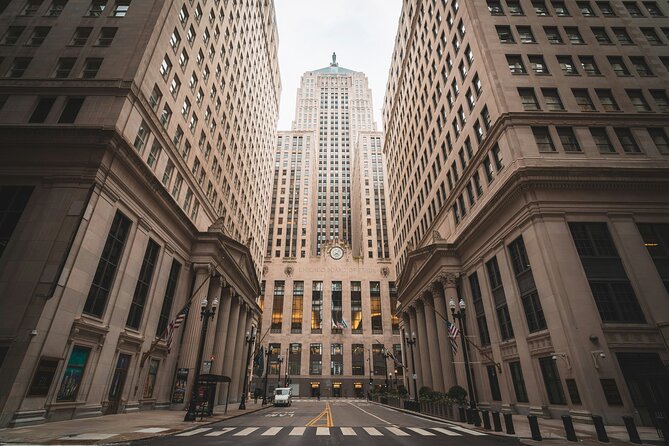
The Chicago Board of Trade Building is a soaring Art Deco tower crowned by a statue of Ceres, the Roman goddess of agriculture. Its lobby offers a look at the city’s trading legacy. You do not need an admission ticket for the stop, but the five-minute estimate suggests a quick exterior and lobby visit rather than a long building tour.
The Rookery Building gives you a different architectural period. This early high-rise combines Romanesque forms with the new technology of the skyscraper age. Its interior light court was redesigned by Frank Lloyd Wright, and the building’s design makes a good case for looking inside rather than simply photographing the facade.
Another unnamed museum stop points to the city’s great art museum, housed in a Beaux-Arts building and known for works such as American Gothic. The information provided does not include a separate admission detail or time estimate for entering it, so treat it as an optional extension rather than assume it fits neatly into the two-hour route. If you want to see the collection properly, you will need more time than a short audio stop allows.
This mix is one of the tour’s strengths. You are not only ticking off famous sculptures. You are moving between finance, architecture, art, and civic space, with each stop showing a different side of the city.
Millennium Park, from Cloud Gate to the Pritzker Pavilion
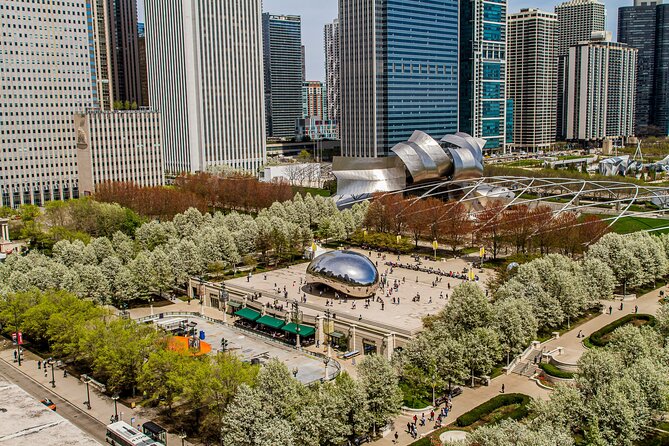
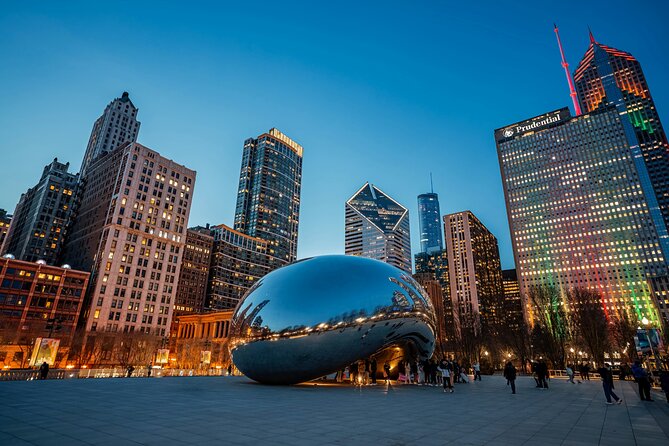
Millennium Park is the busiest part of the route in terms of famous sights. Cloud Gate, better known as the Bean, is the obvious centerpiece. Its polished surface reflects the skyline, the park, and your own group. Walk beneath it for the full effect, since the underside changes the view and makes the sculpture feel more like a room than a solid object.
The five-minute stop is enough for a quick look, but it can be too short if you want clear photos. The sculpture’s reflective surface attracts attention from every angle, and you may need patience to get an unobstructed view.
Crown Fountain is nearby. Two glass-block towers display video portraits and spray water during summer. The work is playful and interactive, but its appeal depends partly on the season and operating conditions. It is worth allowing extra time if the water is running.
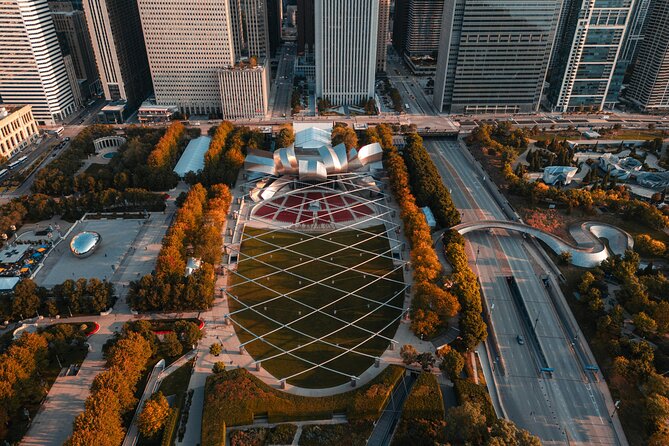
Jay Pritzker Pavilion, designed by Frank Gehry, anchors the park with sweeping steel ribbons and an outdoor performance space. Even without a concert, the structure is worth pausing for. Its sound system and stage design show how a public park can also function as a serious performance venue.
The Millennium Monument is a semicircular colonnade that recreates a 1917 landmark. It gives the modern park a classical note and offers a quieter contrast to the Bean and Crown Fountain. The audio route’s short stop can point out the key idea, but you will get more from it if you look at how the colonnade frames the surrounding buildings.
Same place, a different route to walk:
- City Sightseeing Hop-On Hop-Off Bus Tour with Audio Guide
★ 3.0 · 1,083 reviews - Medieval Torture Museum Ticket with Audio Guide and Ghost Hunting
★ 5.0 · 962 reviews - Gettysburg Battlefield Self-Guided Driving Audio Tour
★ 4.5 · 910 reviews - Ryman Auditorium Self-Guided Tour with Souvenir Photo Onstage
★ 4.5 · 903 reviews
Calder, Picasso, Miró, and Chicago’s outdoor gallery
Chicago’s Loop is unusually good for public art, and this tour makes that clear.
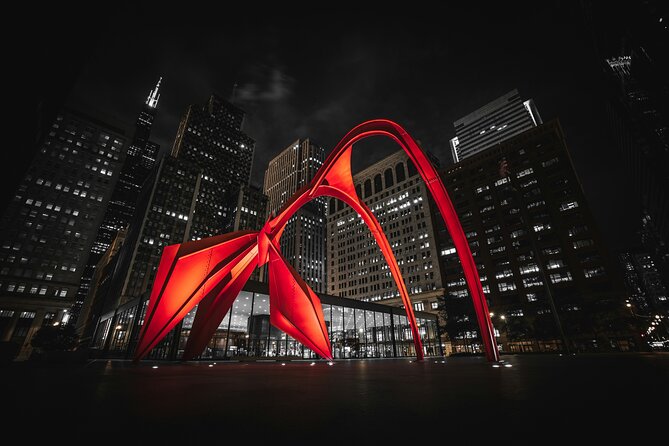
Calder’s Flamingo is a huge red sculpture by Alexander Calder. Its curved form and strong color cut through the surrounding steel and glass. The work is large enough to read from a distance, but walking around it helps you see how it changes the space.
The Picasso is another major public artwork, though its abstract steel form is less immediately understandable. That is part of its appeal. The meaning is open, and the sculpture rewards a few minutes of looking rather than a quick photograph.
Miro’s Chicago brings a more playful tone. Joan Miró’s colorful sculpture has an abstract shape that invites several interpretations. It is a good reminder that the Loop is not simply a collection of old buildings and office towers. Art is built into the daily route of the city.
These stops are all free, and that improves the value of the tour. You can see important works without planning museum tickets or paying separate admission. Still, public art depends on your attention. The audio can explain why each piece matters, but you should pause long enough to study the shapes, reflections, and relationship to the street.
The Cultural Center, Buckingham Fountain, and the city’s open spaces
The Chicago Cultural Center occupies a former library and is known for its stained-glass domes. It now hosts art exhibits and performances, making the building more than a quick photo stop. If the doors are open, go inside and look up. The interior details are the reason to visit.
Clarence F. Buckingham Fountain offers a very different experience. Inspired by Versailles, it is one of the world’s largest fountains, with a central jet that reaches 150 feet. Water displays are choreographed, and the skyline provides the backdrop.
The fountain is free, but its full effect depends on the display schedule. The route assigns five minutes, which is enough for a brief stop but not necessarily enough to watch a complete water sequence. If the fountain is operating, you may want to linger.
These two locations also provide a useful break from the denser streets. The Cultural Center gives you an interior pause, while the fountain opens the view toward Grant Park and the skyline. You will appreciate both more if you do not treat the entire walk as a race.
The Chicago Theatre, library, and a quieter finish

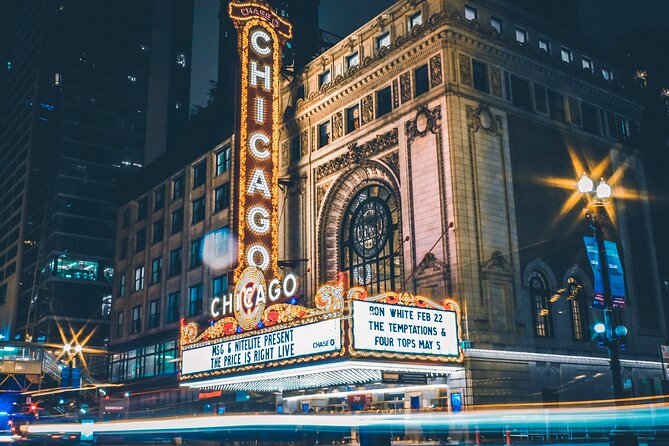
The Chicago Theatre is easy to recognize from its marquee and remains one of the city’s best-known entertainment buildings. Inside, its French Baroque design provides a sharp contrast to the modern office towers nearby. The route includes it as a point of interest, though the supplied details do not promise an interior tour or admission.
The Harold Washington Library Center is another notable interior possibility. Its glass atrium brings daylight into the building, and the Winter Garden offers a calm place away from the street. If you need a quiet pause, this may be one of the most useful stops on the route.
The Vietnam Veterans Memorial Plaza provides a more reflective moment beside the river. Polished granite walls carry names and memories, creating a quiet space amid downtown activity. This stop changes the tone of the walk and deserves respectful attention rather than a hurried photo.
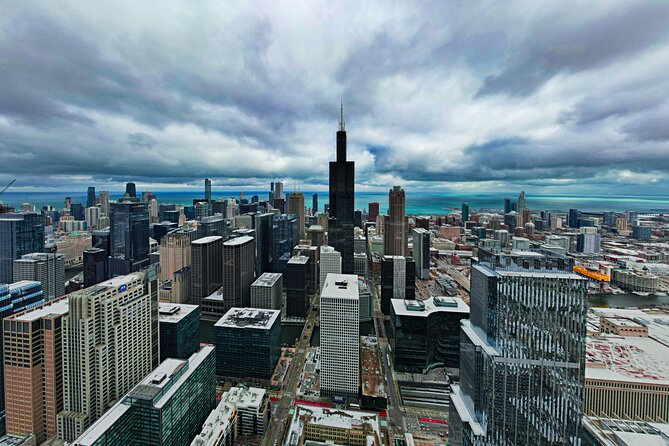
The route also includes Willis Tower, formerly the tallest building in the world, with its Skydeck on the 103rd floor and the glass-floor Ledge. The tour ends outside at 233 South Wacker Drive. Skydeck admission is not included, so consider it an optional add-on rather than part of the $9.99 experience.
Timing, app setup, and practical planning
The stated duration is about two to two and a half hours. That is a reasonable moving time, but it does not leave much room for museum visits, building interiors, long photo stops, meals, or the Skydeck. One useful detail is that the route can be used for four or five hours if you want to explore at a relaxed pace.
You need your own smartphone. Download the Drives & Detours app and the tour before arriving, then use the supplied code to redeem it. The tour works entirely offline after download, and the audio can be replayed for many days.
The access window provided for this experience runs daily from 8:00 a.m. to 8:00 p.m., from August 12, 2025, through March 1, 2027. The tour itself has no fixed appointment time, and access never expires, so you can use it on any day and at any time within the stated operating information.
Public transportation is nearby, making the start and finish practical. Since the route crosses busy downtown streets and includes outdoor sights, comfortable shoes and a charged phone are sensible, though those items are not supplied.
Free cancellation is available if you cancel at least 24 hours before the local start time. Cancellations made within 24 hours are not refunded, and last-minute changes are not accepted.
Who should book this tour?
I would choose this walk if you want a low-cost introduction to central Chicago and prefer to set your own rhythm. It suits first-time visitors who want the main public sights, architecture fans who like mixing historic interiors with modern sculpture, and couples or families who do not want to follow a guide’s fixed pace.
It is less suitable if you want a live expert to answer questions, provide long stories at each site, or manage the route for you. The app gives direction and context, but you are responsible for starting it, following the map, and deciding which buildings deserve extra time.
Should you book the Chicago Loop audio tour?
At $9.99, I think this is a strong buy for an independent walk through downtown. The GPS audio, offline use, unlimited access, and free public landmarks give you plenty for the price.
Book it if you are comfortable using your phone and want flexibility. Plan on at least three hours if you like photos and architecture, and four or five hours if you want to add interiors or the Skydeck. Skip it only if you strongly prefer a human guide or want a tightly managed two-hour outing.
FAQ
How long does the self-guided Chicago Loop tour take?
The estimated duration is two to two and a half hours. You can spend four or five hours if you stop for photos, explore buildings, or take breaks.
Where does the tour start and finish?
It starts at DuSable Bridge, 333 Michigan Avenue, Chicago, and finishes at Willis Tower, 233 South Wacker Drive.
Does the tour work without cell service?
Yes. Download the app and tour in advance, and the experience works entirely offline afterward.
Is a smartphone included?
No. You must bring your own smartphone and download the Drives & Detours app before using the tour.
Is the tour available in English?
Yes. English is the available language.
Can I cancel for a full refund?
Yes, if you cancel at least 24 hours before the experience start time. Cancellations or changes made within 24 hours are not accepted for a refund.
Just added around the USA
- Smartphone-Guided Walking Tour of Downtown Indianapolis Sights & Stories★ 4.0 · 25 reviews
- Springfield Self-Guided Walking Audio Tour★ 4.0 · 5 reviews
- Smartphone Guided Indianapolis Downtown Sites Audio Walking Tour★ 4.5 · 7 reviews
- Indiana Dunes National Park Self-Guided Audio Tour★ 3.5 · 4 reviews
- Self-Guided Audio Driving Tour in Kancamagus Highway★ 4.5 · 6 reviews
- An Epic Scavenger Hunt: Bloomington Scenic Southern Indiana★ 3.5 · 6 reviews
- Huntsville Rocket City Smart Phone Self Guided Audio (GPS/APP) Walking Tour★ 4.5 · 5 reviews
- Sights of Downtown Houston Smartphone Audio Walking Tour★ 4.0 · 7 reviews
USA Audio Tours, compared.
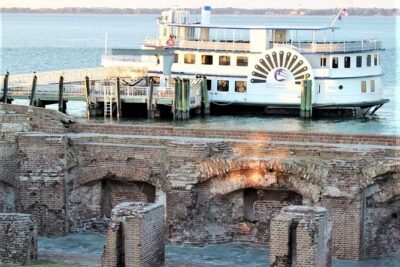
Fort Sumter Admission and Self-Guided Tour with Roundtrip Ferry
Read our review →
San Francisco: Alcatraz Ticket, Ferry, & Self-Guided App
Read our review →
Los Angeles: Hop-On Hop-Off Bus Tour with Audio Guide
Read our review →
City Sightseeing Hop-On Hop-Off Bus Tour with Audio Guide
Read our review →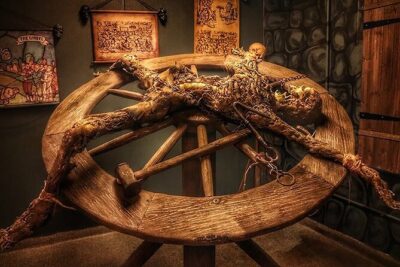
Medieval Torture Museum Ticket with Audio Guide and Ghost Hunting
Read our review →
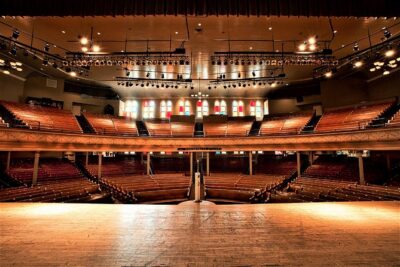
Ryman Auditorium Self-Guided Tour with Souvenir Photo Onstage
Read our review →