

REVIEW · ROME AUDIO TOURS
Rome: Roman Forum Super Pass Entry with Audio Guide App
Rome’s ancient center is far more than a pile of broken columns. With this pass, you can walk through the Roman Forum, climb Palatine Hill, enter frescoed rooms usually missed on a quick visit, and follow the long Imperial Forum route toward Trajan’s Column. The best part is freedom: there is no guide hurrying you past the House of Augustus or the Forum Museum.
I especially like the access to the SUPER sites, including the House of Livia, House of Augustus, and Aula Isiaca and Loggia Mattei. I also like the $25 price for a pass valid across the wider archaeological area. The catch is that the audio route and phone map can be confusing, some rooms close for conservation, and the ticket does not include the Colosseum.
Key points at a glance
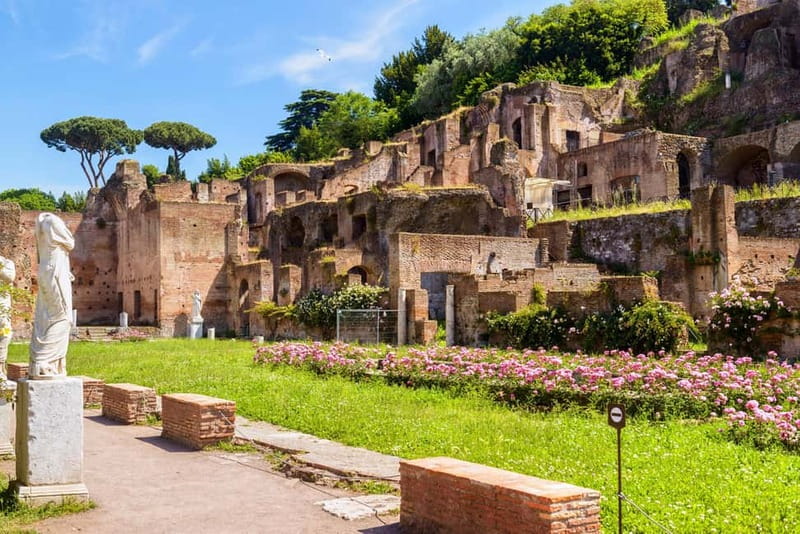
- The $25 pass covers more than the main Forum: You also enter Palatine Hill, several museums, the Imperial Forum, and special archaeological rooms.
- The House of Augustus and House of Livia are the stars: Their surviving frescoes give you a rare look at imperial domestic life.
- You enter without a fixed time reservation: Use the ticket within 30 days of purchase, but once scanned, it is valid only that day.
- The audio guide works at your pace: Download it before arriving, and expect a useful but not always perfectly mapped route.
- Plan at least three hours: A half-day is more realistic if you want the museums, hill, frescoes, and Imperial Forum.
- The Colosseum is not included: You need a separate ticket if you want to visit Rome’s famous amphitheater.
What the $25 Forum Pass really gives you
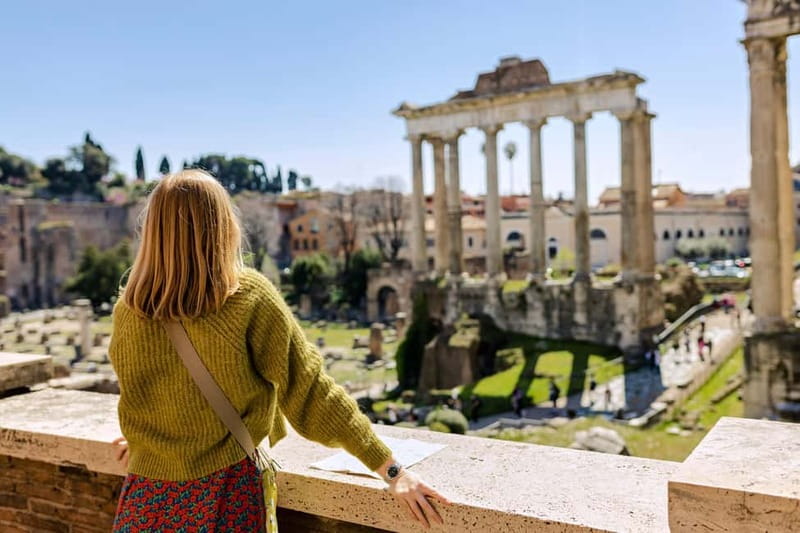
At $25 per person, this is a good-value choice if you want more than a quick walk through the open-air ruins. The pass includes the Roman Forum, Palatine Hill, the Forum Museum, Palatine Museum, Imperial Forum, Temple of Romulus, Curia Iulia, Santa Maria Antiqua, Domus Tiberiana, House of Augustus, House of Livia, and the special-access rooms of Aula Isiaca and Loggia Mattei.
That list matters because the Roman Forum alone can feel visually confusing. You see temples, arches, foundations, and scattered marble, but the indoor rooms and museum displays add objects, paintings, and explanations. They help you understand what the ruins once meant instead of simply admiring their age.
The ticket is valid for 30 days from purchase, but this does not mean you can return every day. You choose your visit day when you first use it, and the pass is then valid for that day only. There is no fixed time reservation, which gives you useful flexibility in a city where weather, meals, and other timed attractions can disrupt a strict plan.
The ticket is non-refundable, so check names carefully when booking. Every participant’s name must be supplied, or entry can be refused. Your booking confirmation contains the instructions for the audio guide app.
More Colosseum and Roman Forum Audio Tours in Rome:
- Rome: Colosseum & Forum with Audio Guide App -Optional Arena
★ 4.2 · 24,770 reviews - Colosseum, Roman Forum & Palatine Hill with Audioguide App
★ 4.4 · 6,291 reviews - Rome: Colosseum, Forum, & Palatine Hill with Audio Guide
★ 4.3 · 4,591 reviews
Choosing the best entrance
You can present your voucher at several entrances: Via Sacra near the Arch of Titus, Via di San Gregorio, Via del Tulliano, Via del Foro Romano, or Piazza della Madonna di Loreto near Trajan’s Column.
There is no person waiting to meet you. You simply go to an entrance and show your voucher. That is easy once you understand it, but the lack of a host can be confusing if you expect a guided meeting point.
Your entrance affects the order of your visit. Entering at Via Sacra puts you near the Roman Forum and Arch of Titus. Entering near Trajan’s Column places you at the Imperial Forum end. The audio guide route may assume a different starting point, so take a moment to match your location with the map before setting off.
I would start at an entrance that lets you see the Roman Forum and Palatine Hill first, then finish near Trajan’s Column if that suits your wider Rome plans. If you enter Via Sacra, you might end up doing the Palatine section in reverse. That is not a serious problem, but it can make the numbered audio stops harder to follow.
Walking through the Roman Forum
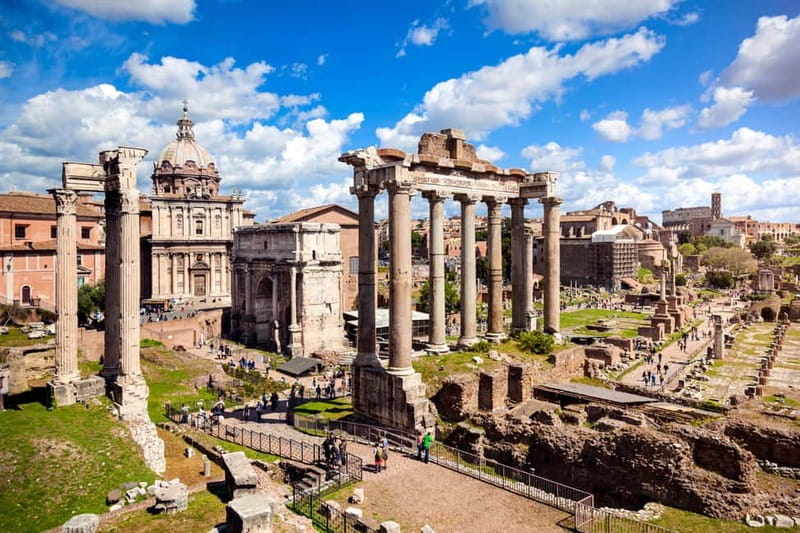
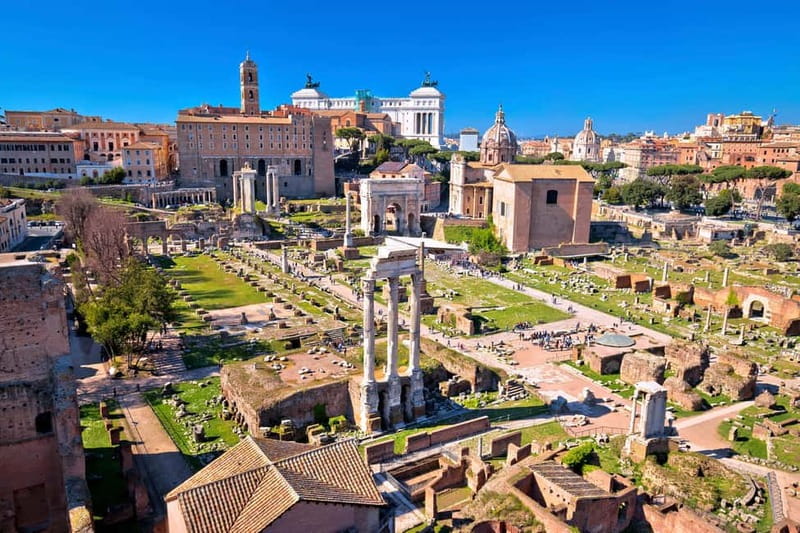
The Roman Forum was the center of public life in ancient Rome. Here you move among the remains of temples, political buildings, meeting spaces, and ceremonial monuments. The setting is powerful because the ruins are not isolated in a museum. You walk through the same broad valley where Roman public life took place.
Begin slowly. The site spreads out, and it is easy to rush past a low wall or half-buried structure that turns out to be an important part of the ancient city. The audio guide helps by explaining significant areas and statues, though its coverage does not extend equally to every corner.
The Curia Iulia is one of the most valuable stops. This was the Senate house, and its surviving form gives you a clearer idea of Roman political space than the scattered foundations elsewhere. The Temple of Romulus is another useful stop, especially because its structure remains more recognizable than many nearby ruins.
Santa Maria Antiqua adds something different. This former Christian church contains preserved painted decoration and sits against the slope of Palatine Hill. Its rooms show how the ancient center changed over time, rather than freezing Roman history at the moment of the empire’s greatest power.
Expect some closures or altered routes. Archaeological work and conservation can close sections, and the audio map may not always match the current path. The site is still broad enough to explore, but you should treat the app as a guide rather than a perfect turn-by-turn navigation system.
Palatine Hill and the imperial homes
Palatine Hill is the physical and emotional high point of the pass. It is the centermost of Rome’s Seven Hills, and the higher ground gives you broad views over the Roman Forum and a strong view toward the Colosseum from the museum area.
The hill also explains why Rome’s richest families and emperors wanted to live here. The remains of imperial residences spread across the site, including the Domus Tiberiana and the House of Augustus. You see fragments of huge palace complexes, courtyards, walls, and rooms that are much easier to appreciate after the Forum’s public spaces.
The House of Augustus is one of the most worthwhile special-access stops. Its surviving frescoes bring color and detail to an otherwise stone-heavy visit. The scale is more intimate than the monumental Forum, and the painted rooms give you a better sense of the private world behind Rome’s public power.
The House of Livia is another important stop. Its frescoes are famous for their delicate decoration, and the rooms offer a close look at Roman taste and domestic design. Check opening days carefully: the House of Augustus is closed on Mondays, while the House of Livia is closed on Tuesdays.
The Palatine Museum helps fill in the gaps. It contains sculptures and frescoes found in and around the hill, while an interactive presentation explains the development of Palatine Hill. This is a good place to pause when the exposed ruins start to blur together.
The hill is not just a list of palace remains. The Ninfeo della Pioggia and Domus Tiberiana add variety, showing water features and large imperial construction. Access to SUPER sites is restricted at times to protect fragile paintings, so do not assume every room will be open simply because it is included.
More Smartphone App Tours in Rome:
- Rome: Pantheon Priority Entry Ticket & Interactive App
★ 4.1 · 5,114 reviews - Rome: Castel Sant’Angelo Entry Ticket & Audio App
★ 4.3 · 4,952 reviews - Rome: Pantheon Priority Entry Tickets with Interactive App
★ 4.6 · 4,108 reviews - Rome: Colosseum Access with Official AI App & Arena Option
★ 3.5 · 2,964 reviews
Frescoes, temples, and special rooms
The pass earns its name through the extra rooms. The Aula Isiaca and Loggia Mattei are particularly useful for anyone interested in Roman painting. These spaces are more delicate and enclosed than the main ruins, with decorative details that reward a slower look.
The House of the Vestals is another memorable stop. The Vestal Virgins guarded the sacred fire and held an unusual religious position in Roman society. The remains of their residence let you connect the Forum’s political monuments with the people who maintained one of Rome’s central religious traditions.
Access to these special areas can be limited to protect paintings and other fragile remains. If you find a door closed, it may be a conservation restriction rather than a problem with your pass. The Domus Transitoria is closed and cannot be visited, so do not plan your route around seeing it.
This is where the pass is much stronger than a basic walk through the Forum. You are not only looking at grand public ruins. You are also seeing painted rooms, museum objects, religious spaces, and palace remains that offer different views of Roman life.
The Imperial Forum route toward Trajan’s Column
The Imperial Forum is separate from the main Roman Forum in layout and character. It stretches along the modern road near Piazza Venezia and Trajan’s Column, with long lines of monumental remains tied to emperors who built their own public centers.
The route works well as a final chapter. After the compact ruins of the Forum and the palace remains on Palatine Hill, the Imperial Forum opens into a more linear walk. The Forum of Caesar and Forum of Nerva help show how Rome kept adding new public spaces as the older Forum became crowded.
Trajan’s Column provides a useful endpoint near the entrance at Piazza della Madonna di Loreto. You can admire its carved spiral scenes from outside, then connect the monument to the surrounding Imperial Forum ruins. The route gives you a better sense of the scale of imperial building than a single viewpoint can.
Allow time for this section. It is easy to underestimate the distance because the ruins sit beside busy modern streets. If your main aim is only the Roman Forum and Palatine Hill, you might find the Imperial Forum less essential. If you want the full pass experience, it is an important extension.
How useful is the audio guide app?
The digital audio guide is one of the main reasons to choose this ticket instead of entering with no explanation. It gives short, direct commentary at key areas, and it can work offline once downloaded. One useful feature is automatic playback as you approach certain significant spots or statues.
The guide is not a substitute for a live archaeologist. It does not cover every location, and the map can be difficult to follow on a small phone screen. Construction work and temporary closures can also force you away from the intended route.
Download the app before you arrive. Make sure your phone is charged, and read the instructions in your booking confirmation. If the audio starts at the wrong point, stop and orient yourself rather than walking around while listening to an unrelated section.
I like the freedom of this format. You can pause, repeat a section, take photos, or sit quietly without keeping pace with a group. If you want detailed answers about every structure, a private or live guided tour may suit you better. For independent exploration, the app gives enough structure to keep the ruins from becoming a blur.
Time, heat, queues, and practical comfort
Give yourself at least three hours. That is enough for a focused visit, but a half-day is better if you want the Roman Forum, Palatine Hill, museums, frescoed rooms, and Imperial Forum without rushing.
The site is exposed, and much of the route is outdoors. Bring water and food because you may be inside the archaeological area for several hours, and the available food may not suit you. Toilet queues can be long, so use facilities when you have the chance rather than waiting until the last moment.
Even with a ticket, you may face an entry queue. One reported wait was only about 10 minutes, while another visit involved a long line. Arriving early can help, but no fixed entry time is required.
The full route is barrier-free and wheelchair accessible. Small dogs are allowed in special carriers, but dog prams are not allowed. The pass is also limited to a small group of up to 10 participants, though the actual experience is self-guided and there is no guide waiting at the entrance.
Opening times for the main special sites change by season. From March through September 2025, the Palatine Museum, Aula Isiaca and Loggia Mattei, House of Augustus, House of Livia, and Domus Tiberiana were scheduled for 9:00 AM to 6:00 PM, with last entry at 5:30 PM. Santa Maria Antiqua was open until 6:30 PM, with last entry at 6:00 PM. Check current hours before setting out, especially if you are visiting near closing time.
Free days can change the usual arrangement. On the first Sunday of the month and April 25, entry may require a first-come, first-served ticket, and this pass does not work in the usual way. Avoid those dates if you are counting on the pass for a smooth planned visit.
Who should buy this pass?
I recommend it for independent sightseers who want to set their own pace and see more than the most famous ruins. It suits people who enjoy archaeology, painting, and Roman political history, and it is especially useful if you have a morning or half-day available.
Families and couples may like the flexibility. You can stop when someone needs a break, skip an area, or spend extra time in the frescoed rooms. The wide site also gives you room to spread out, even when many people are present.
A live guide may be a better choice if you want a clear story from start to finish, help with confusing ruins, or someone to answer questions. This pass also does not include the Colosseum, so do not mistake it for an all-in-one ancient Rome ticket.
Should you book the Roman Forum Super Pass?
Book it if the House of Augustus, House of Livia, Palatine Museum, and special rooms appeal to you. Those additions make the $25 price worthwhile, especially when you plan to spend three to five hours on site.
Skip it if you only want a quick exterior look at the Forum or if you prefer a guide to lead every step. Download the audio app early, check closure days, bring water and food, and choose your entrance with the route in mind. With those small preparations, this pass gives you a flexible and unusually full day among Rome’s ancient public spaces, palace ruins, and painted rooms.
FAQ
How long is the Roman Forum Super Pass valid?
You can use the ticket within 30 days of purchase. Once you validate it at the site, it is valid only for that day.
Does the pass include the Colosseum?
No. Access to the Colosseum is not included and requires a separate ticket.
Do I need to reserve a time?
No fixed time reservation is required. You can enter through any of the listed entrances during the applicable opening hours.
Is a tour guide included?
No live tour guide is included. The pass includes a digital audio guide app, and no person waits at the meeting point.
Which sites are included?
The pass includes the Roman Forum, Palatine Hill, Imperial Forum, Forum Museum, Palatine Museum, Temple of Romulus, Domus Tiberiana, Santa Maria Antiqua, Curia Iulia, House of Augustus, House of Livia, Aula Isiaca and Loggia Mattei, House of the Vestals, and ongoing exhibitions.
Are the House of Augustus and House of Livia always open?
No. The House of Augustus is closed on Mondays, and the House of Livia is closed on Tuesdays. Opening hours for special sites can also change, so check the current schedule before visiting.
Just added around Rome
- Rome: St. Peter’s Basilica and Dome Entry + Audio Guide★ 4.5 · 13 reviews
- St. Peter’s Basilica: Hosted Entrance & Digital Audioguide★ 4.1 · 35 reviews
- Sorrento & Pompeii Day Trip from Rome Audio Guide Tour★ 4.2 · 50 reviews
- Rome:Ostia Antica Skip-the-line Ticket & Audioguide★ 4.3 · 11 reviews
- Rome+Jubilee Audioguide – TravelMate app for your smartphone★ 4.2 · 38 reviews
- Rome:St. Peter’s Basilica Hosted Entry + Official Audioguide★ 3.4 · 10 reviews
- Rome: St. Peter’s Basilica Entry Ticket and AudioGuide★ 4.4 · 57 reviews
- Colosseum, Roman Forum, Palatine Hill access and AudioGuide★ 4.7 · 12 reviews
Rome Audio Tours, compared.
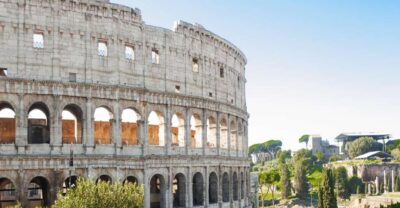
Rome: Colosseum & Forum with Audio Guide App -Optional Arena
Read our review →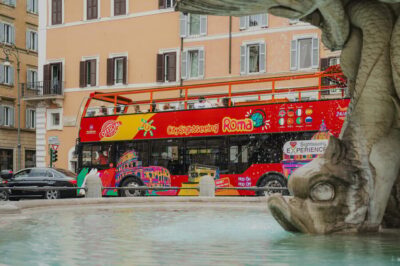
Rome: City Sightseeing Hop-on Hop-off Bus with Audioguide
Read our review →
Rome: St. Peter’s Basilica & Dome Entry Ticket & Audio Tour
Read our review →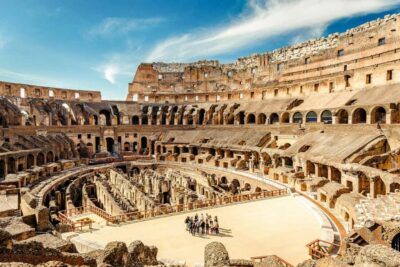
Colosseum, Roman Forum & Palatine Hill with Audioguide App
Read our review →
Vatican & Sistine Chapel Ticket with Optional Audio Guide
Read our review →
Rome: Castel Sant’Angelo Entry Ticket & Digital Audioguide
Read our review →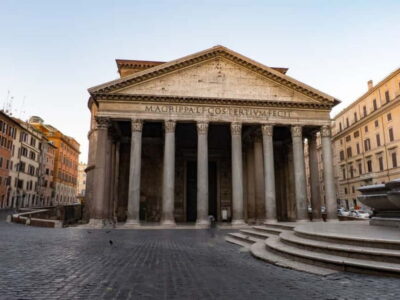
Rome: Pantheon Priority Entry Ticket & Interactive App
Read our review →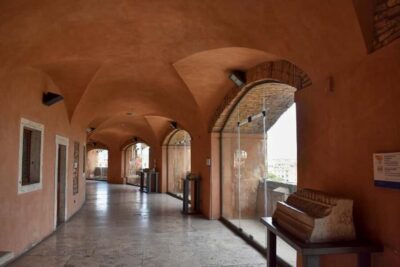
Rome: Castel Sant’Angelo Entry Ticket & Audio App
Read our review →Browse the lists this tour appears in