
REVIEW · USA AUDIO TOURS
Michigan Lakeshore, M-22 Self-guided Driving Audio Tour
Michigan’s M-22 is not simply a pretty road beside Lake Michigan. It is a long, story-filled route through beaches, marshes, lighthouses, old fishing towns, and Sleeping Bear Dunes National Lakeshore. This self-guided audio tour lets you make the drive in your own car while the app explains what you are seeing.
I like the pay-per-car price, since up to four people share the $14.99 cost. I also like the freedom to stop for a hike at Pyramid Point, wander historic Fishtown, or pause for a beach break without waiting for a group. The main drawback is that the route is long, some stops close seasonally, and one user wished the tour appeared directly in the phone’s GPS rather than relying on the separate app.
Key things to know before driving M-22

- 121-plus miles of touring: The route includes more than 78 audio stories and takes roughly 8 to 9 hours if you make stops along the way.
- Sleeping Bear Dunes is the centerpiece: The tour covers the visitor center, Dune Climb, Alligator Hill, Old Indian Trail, and nearby scenic hikes.
- You control the day: Start, pause, skip, or resume the tour over multiple days instead of following a fixed schedule.
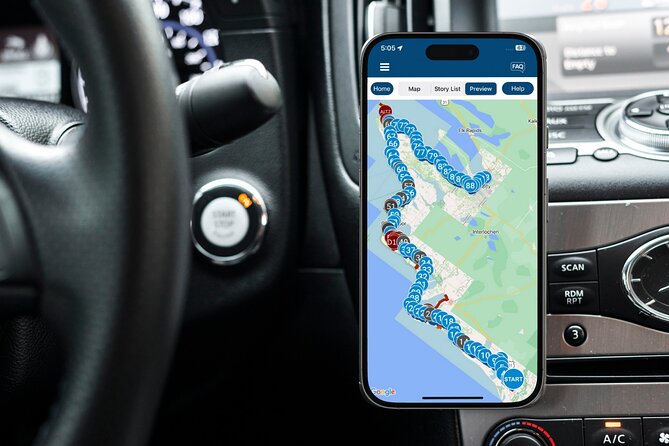
- The audio plays by location: Once downloaded, stories begin automatically as you reach the correct points along the route.
- The route ends near Traverse City: Along the way, you pass Frankfort, Point Betsie, Glen Arbor, Leland, Northport, Suttons Bay, and other M-22 communities.
- Season matters: Beaches, museums, lighthouse tours, and park facilities may not all be open when you arrive.
A road trip shaped like Michigan’s mitten
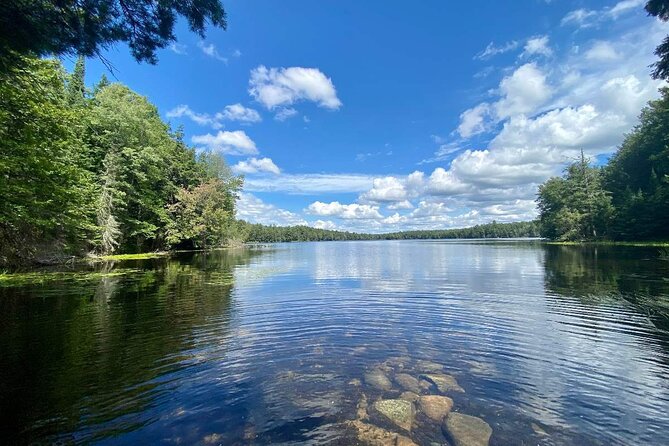
Michiganders often use their hands as a map of the Lower Peninsula. This drive follows the pinky side of that mitten, beginning around Frankfort and continuing along Lake Michigan toward Traverse City.
The opening stories explain the Great Lakes, which contain about 21 percent of the world’s surface freshwater. That fact gives the rest of the trip a useful frame. You are not just passing water on your left. You are following a connected freshwater system that reaches toward the Atlantic through lakes and rivers.
The tour contains more than 78 stories, while the main itinerary highlights 28 major stops. That means the audio fills in the spaces between the headline sights. You get short pieces about geology, ship traffic, Native American communities, lumber, local settlements, and the changing role of the lakeshore.
The first audio portion takes about two to four hours if you drive without making many long stops. The complete outing is closer to eight or nine hours once you add walks, photos, meals, beaches, and park visits. I would not treat this as a quick afternoon drive.
More Self-Guided Driving Tours in the USA
- Gettysburg Battlefield Self-Guided Driving Audio Tour
★ 4.5 · 910 reviews - Joshua Tree National Park Self-Guided Driving Audio Tour
★ 4.5 · 762 reviews - Ultimate Acadia National Park Self-Guided Driving Audio Tour
★ 4.0 · 521 reviews
From Portage Lake to Arcadia Marsh
Early on, the route introduces Portage Lake and Michigan’s lumber era. During the mid-1800s, timber mills appeared along the Lake Michigan coast, and logs were processed before being shipped across the Great Lakes. The story gives meaning to the small settlements and waterways you pass rather than presenting them as isolated scenic stops.
Arcadia Marsh Nature Preserve is one of the best early chances to leave the car. It is one of only 15 remaining coastal marshes along the Lower Peninsula shoreline of Lake Michigan. A dry, raised boardwalk leads through the marsh, making this a practical stop for bird, butterfly, and plant watching.
The turn can be easy to miss, so pay attention to the audio cue. Dogs are not allowed at the preserve. If you want to walk here, allow more than the suggested 30-minute stop, especially if you hope to pause for wildlife.
The route then reaches Crystal Lake, which was once an open bay of Lake Michigan. Sand dunes closed it off roughly 2,000 years ago. The nearby alpaca stop adds a lighter, more unusual note to the geology and lumber stories.
Green Point Dunes offers a more active break. The hike is about two miles through wooded terrain to a sandy Lake Michigan beach, with wooden stairs leading down toward the water. The short 10-minute audio stop does not represent the full time needed if you plan to hike to the beach and back.
Frankfort beaches and Point Betsie Lighthouse
Frankfort is a useful place to pause, stretch your legs, and find food or supplies. Frankfort Public Beach is reached by continuing along Forest Avenue toward the water. The beach includes a pier and the town’s picturesque lighthouse.
The next major stop is Point Betsie Lighthouse, one of Michigan’s most photographed lighthouses. Its sandy beach makes it more than a quick photo stop. You can walk the grounds, and guided tours are offered from Memorial Day weekend through late October for a small fee.
That seasonal schedule matters. The audio tour itself may still guide you to Point Betsie outside those dates, but the interior or guided portion may not be available. Check current opening information before building your day around a lighthouse visit.
The tour does not include admission fees, reservations, or attraction passes. That keeps the base price low, but you should allow for separate charges if you choose paid lighthouse access or other attractions along the route.
Sleeping Bear Dunes deserves a full day
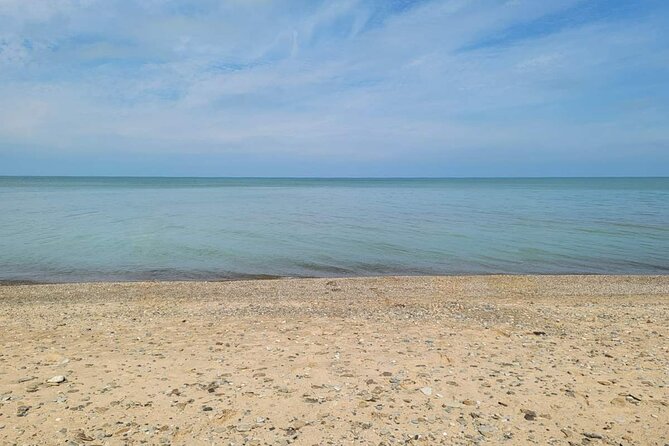
Sleeping Bear Dunes National Lakeshore is the major reason many people choose this road. The audio begins preparing you before arrival, explaining the park and pointing out ways to use your time.
Start at the Philip A. Hart Visitor Center in Empire if you want an orientation before tackling the park. The tour gives clear driving directions to the bluish building and parking area. This is a sensible place to gather information, check conditions, and decide which walks fit your energy and schedule.
The Dune Climb is one of the park’s most famous stops. The main dune rises nearly 300 feet, and this is one of the few spots in the park where climbing the dunes is encouraged. It looks inviting from the parking area, but the climb can take more effort than the short audio segment suggests. Wear practical shoes and do not underestimate the return walk.
For a quieter option, Old Indian Trail has two loops of about 2.5 miles each. The trail follows part of a route established by early Native Americans between a camp and fishing areas. It provides a useful alternative if the Dune Climb is too strenuous or if you have several days in the region.
Alligator Hill is another worthwhile side trip. The route to Islands Lookout is about three miles roundtrip and climbs gradually. On a clear day, you can see toward the Manitou Islands. The tour presents it as a reasonable uphill walk rather than a quick roadside stop, so plan accordingly.
You can also visit Glen Arbor, a pleasant base for a longer stay. Its galleries, wine and cider tasting rooms, and cafes give the town more to do than simply pass through. If you are trying to fit all of Sleeping Bear Dunes into one day, you may have to choose between several hikes and town stops.
Same place, a different route to walk:
- Fort Sumter Admission and Self-Guided Tour with Roundtrip Ferry
★ 4.5 · 3,343 reviews - San Francisco: Alcatraz Ticket, Ferry, & Self-Guided App
★ 4.5 · 2,460 reviews - Los Angeles: Hop-On Hop-Off Bus Tour with Audio Guide
★ 3.7 · 2,030 reviews - City Sightseeing Hop-On Hop-Off Bus Tour with Audio Guide
★ 3.0 · 1,083 reviews
Manitou Islands, Pyramid Point, and Good Harbor Bay

The audio introduces North Manitou Island and South Manitou Island as part of Sleeping Bear Dunes National Lakeshore. Both are largely uninhabited, and their presence adds another layer to the region’s story. You will hear more about the islands even though this driving tour does not take you onto them.
Pyramid Point is one of the strongest scenic stops on the northern part of the route. The trail is about three miles from the trailhead, and the reward is a broad view over Lake Michigan. Give this walk real time. A 10-minute audio segment tells you about the stop, but it does not replace the hike.
The Manitou Passage, the waterway between the islands and mainland, also has a strong maritime connection. From the mid-1800s into the early 1900s, ships carried goods through these waters. The nearby Manitou Passage Golf Club is included as a reference point, but the wider value of this section is the explanation of how shipping shaped the coast.
Good Harbor Beach offers a simpler break. You can walk the sand, swim, or watch the sunset. There are no lifeguards, and the water may have waves and rip currents, so use care before entering. The tour’s practical warning is important here, since beautiful Lake Michigan beaches can look calm from shore.
Leland’s Fishtown and the Leelanau Peninsula

As the road reaches the Leelanau Peninsula, the audio turns toward names, communities, and local identity. Leelanau County was named by Henry Schoolcraft, a United States Indian agent in the 1820s. His relationship with Jane Johnston, whose background included Odawa and Ojibwe heritage, is part of the story behind the region’s early naming and administration.
Leland is one of the most rewarding town stops. Historic Fishtown sits where the Leland River reaches Lake Michigan. The location offered a natural fish ladder and attracted fishing activity long before modern tourism. You can walk among old fishing buildings and get a clearer sense of the working waterfront that once defined the town.
This is the kind of stop that benefits from walking instead of simply listening from the car. The audio gives you context, but Fishtown is best understood at street level, with time to look closely at the river and waterfront structures.
The route also discusses Beaver Island, the largest island in Lake Michigan. Its past includes a period as a self-proclaimed theocratic monarchy, an unusual episode that gives the tour one of its more memorable historical detours.
Northport, the lighthouse, and Odawa history

Northport sits on Grand Traverse Bay and was settled in the mid-1800s. A smallpox epidemic in Michigan helped hasten the scattering of settlers across the state, part of the complicated background behind the community’s growth.
At the northern end of the peninsula, Grand Traverse Lighthouse Museum adds another maritime stop. The tour tells the story of lighthouse keeper Philo Beers, who followed David Moon. Moon lasted only about eight months in the position, a reminder that lighthouse work could be demanding and isolated.
The lighthouse museum may require separate admission, and opening dates can vary. Check hours before making it the anchor of your day, especially outside the main summer period.
Near Peshawbestown, the road passes through part of the Grand Traverse Indian Reservation. The tour explains the connection to the Odawa community and the earlier settlement of Eagle Town, later renamed Peshawbestown after Chief Peshaba. This section is valuable because it gives you a better sense of Native communities still connected to the area, rather than presenting the peninsula only through vacation towns and scenery.
Suttons Bay and the finish in Traverse City

Suttons Bay was named for Harry C. Sutton, who founded the port in 1854. The community was first called Suttonsburg and served as a type of supply stop for steamships. Cordwood was loaded onto ships and burned to heat their boilers.
These small details make the drive more than a string of beaches. They explain why towns formed where they did and how the lake supported industry before the area became known mainly for recreation.
The route ends in Traverse City, at the head of the east and west arms of Grand Traverse Bay. Traverse City makes a practical end point because you can use it as a base for several days, including more time at Sleeping Bear Dunes and the Leelanau Peninsula.
The Dennos Museum Center adds an indoor option at the end of the trip. Its rotating exhibits have included work by Dale Chihuly, Mathias J. Alten, Orna Ben-Ami, Andy Warhol, and the traveling Bodies Human exhibition. Current exhibits change, so check what is showing before you plan your final stop around the museum.
How the app works on the road
After booking, you receive setup instructions and a password by email and text. Search for audio tour if the message is hard to find. You must download the separate Action Tour Guide app and download the tour while you have a strong cellular connection or Wi-Fi.
Once the route is stored on your phone, it works offline. Go to the starting point, open the correct version of the tour, and the first story should begin when you reach its location. Later stories play automatically as you follow the route.
Connect your phone to the car stereo by Bluetooth, USB, or AUX. Apple CarPlay is supported for audio playback, while Android Auto support is described as forthcoming. The tour recommends an iPhone with iOS 15 or later, an Android device with version 9 or later, or an iPad or tablet with GPS and cellular access.
One practical weakness is that the tour does not simply appear as a standard GPS route. You need to use the separate app and follow its directions. Stick to the suggested route and speed for the best timing, and keep a passenger in charge of the phone whenever possible.
Price, timing, and who should book
At $14.99 per group of up to four, this is good value for a private road trip. Four people pay less than $4 each, and you avoid the fixed schedule and per-person cost of a bus or guided vehicle. The value is strongest if you plan to make several stops and listen to the historical background throughout the day.
The tour is not a substitute for park admission, museum tickets, lighthouse tours, or reservations. It is a driving guide with audio stories, not a package covering every attraction.
The information supplied with the tour says access is new, lifetime, and without an expiry date. A provider response also describes the tour as valid for a year, so I would confirm the exact access period at booking if long-term reuse matters to you. In either case, the ability to pause and continue on another day is useful for a route this long.
Free cancellation is available up to 24 hours before the start time. Changes or cancellations inside that window are not refundable.
Should you book the M-22 audio tour?
Book it if you want to drive independently but still want the coast, towns, and park sights explained as you go. It is especially useful for couples, families, or friends sharing one car, and for anyone who likes choosing their own hiking and beach stops.
Skip it if you want a live guide, a tightly managed schedule, or a simple point-to-point GPS navigation tool. The route works best when you treat it as a full-day or multi-day companion, download everything before leaving strong service, and check seasonal closures before you go.
For the right kind of road trip, the $14.99 price is hard to argue with. The real question is not whether the audio is affordable. It is whether you are willing to slow down enough to let M-22 be more than a scenic shortcut.
FAQ
Where does the Michigan Lakeshore M-22 tour take place?
The route begins around Frankfort and follows Michigan’s M-22 corridor toward Traverse City, passing through Sleeping Bear Dunes, Glen Arbor, Leland, Northport, Suttons Bay, and other lakeshore communities.
How long does the tour take?
The full experience takes about 8 to 9 hours, depending on how many walks, beaches, museums, and town stops you make. The audio stories themselves take roughly 2 to 4 hours to complete while driving.
How much does the tour cost?
The price is $14.99 per group of up to four people.
Is this a private tour?
Yes. Only your group participates, and no guide meets you at the starting point.
Is the tour available in languages other than English?
The tour is offered in English.
Does the tour include attraction admission?
No. Attraction passes, entry tickets, and reservations are not included.
Does the audio work without cell service?
Yes. You must download the tour while you have strong Wi-Fi or cellular service. After download, the audio and offline maps work without a connection.
How does the audio start?
Go to the starting point and open the Action Tour Guide app. The first story should begin when you reach its location, and later stories play automatically as you follow the route.
Can I stop and continue the tour later?
Yes. You can pause the tour, take breaks, explore side trips, and continue later. The supplied access information says you can use it at your own pace and over multiple days.
What devices are recommended?
An iPhone running iOS 15 or later, an Android device running version 9 or later, or an iPad or tablet with GPS and cellular connectivity is recommended. You can connect the phone to your car stereo with Bluetooth, USB, or AUX.
Just added around the USA
- Smartphone-Guided Walking Tour of Downtown Indianapolis Sights & Stories★ 4.0 · 25 reviews
- Springfield Self-Guided Walking Audio Tour★ 4.0 · 5 reviews
- Smartphone Guided Indianapolis Downtown Sites Audio Walking Tour★ 4.5 · 7 reviews
- Indiana Dunes National Park Self-Guided Audio Tour★ 3.5 · 4 reviews
- Self-Guided Audio Driving Tour in Kancamagus Highway★ 4.5 · 6 reviews
- An Epic Scavenger Hunt: Bloomington Scenic Southern Indiana★ 3.5 · 6 reviews
- Huntsville Rocket City Smart Phone Self Guided Audio (GPS/APP) Walking Tour★ 4.5 · 5 reviews
- Sights of Downtown Houston Smartphone Audio Walking Tour★ 4.0 · 7 reviews
USA Audio Tours, compared.
Fort Sumter Admission and Self-Guided Tour with Roundtrip Ferry
Read our review →
San Francisco: Alcatraz Ticket, Ferry, & Self-Guided App
Read our review →
Los Angeles: Hop-On Hop-Off Bus Tour with Audio Guide
Read our review →
City Sightseeing Hop-On Hop-Off Bus Tour with Audio Guide
Read our review →
Medieval Torture Museum Ticket with Audio Guide and Ghost Hunting
Read our review →

Ryman Auditorium Self-Guided Tour with Souvenir Photo Onstage
Read our review →
Red Rock Canyon Self-Guided Electric Bike Tour
Read our review →Browse the lists this tour appears in