
REVIEW · USA AUDIO TOURS
Eastside Chicago The Heist Exploration Game and Tour
Chicago’s Millennium Park becomes your game board in this self-guided city quest. You follow clues from the Art Institute of Chicago to public sculptures, fountains, gardens, and monuments, learning a little about each place as you go. It is part sightseeing walk, part scavenger hunt, and part phone-based puzzle.
I like the freedom to start at any hour and pause whenever you need a snack, restroom break, or closer look at the art. I also like the low price, about $7.20 per person, and the fact that the game works offline, which removes one common worry on a city walk.
The main catch is the route’s dependence on physical access and location range. Construction can block a clue, and one player reported trouble reconnecting near a fountain. You should also expect a fair amount of walking, so comfortable shoes matter.
Key points to know before you play
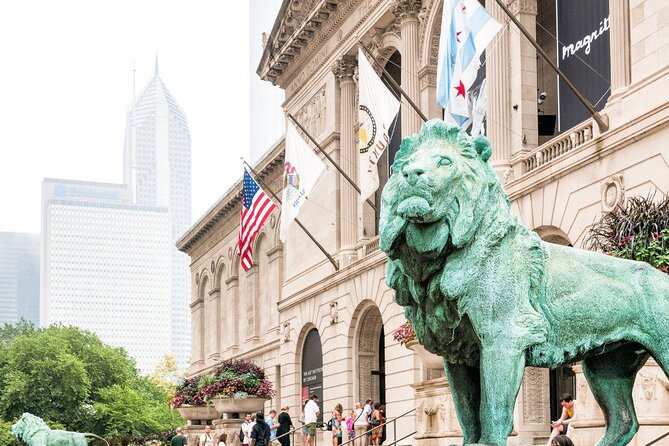
- The route links major Chicago sights: You visit the Art Institute, Cloud Gate, Crown Fountain, Lurie Garden, Buckingham Fountain, and several lesser-known monuments.
- The game is self-guided: No physical guide joins you, and only your group participates.
- Offline play is included: You do not need an internet connection once the game is ready to use.
- Plan for about 95 minutes: The walk covers a broad area around Millennium Park and Grant Park.
- The price is modest: At about $7.20 per person, it costs less than most guided city walks, but the app supplies less help than a live guide.
- Wear walking shoes: One hour and 35 minutes can pass quickly, but the route covers plenty of pavement and open park space.
How the Chicago heist game works
This is not a traditional tour with a guide pointing out details as you move. Instead, your phone leads you from one location to the next. At each stop, you look around for an answer, enter it into the game, and receive the next part of the route.
The format works best if you enjoy a little structure while exploring. You are not simply wandering through the park and reading signs. The game gives you a reason to inspect a sculpture, notice a detail on a building, or look for a clue that you might otherwise miss.
You can play alone, with family, or with friends. Since it is a private activity, your group is not combined with strangers. That makes it easy to set your own pace, though it also means there is no live person to explain a confusing clue or reroute you around a blocked path.
The app can be played offline, a useful feature in a city center where your phone may switch between networks or lose a steady signal. Still, you should make sure the game is ready on your device before setting off. A location-based game is only as smooth as the phone, app, and surroundings allow.
More Scavenger Hunts in the USA
- An Epic Scavenger Hunt: New York City Central Park Adventure
★ 4.5 · 244 reviews - Pirate Escape Charleston Scavenger Hunt and Free Museum
★ 5.0 · 40 reviews - Seattle Downtown Quest: Self-Guided History Adventure
★ 4.0 · 26 reviews
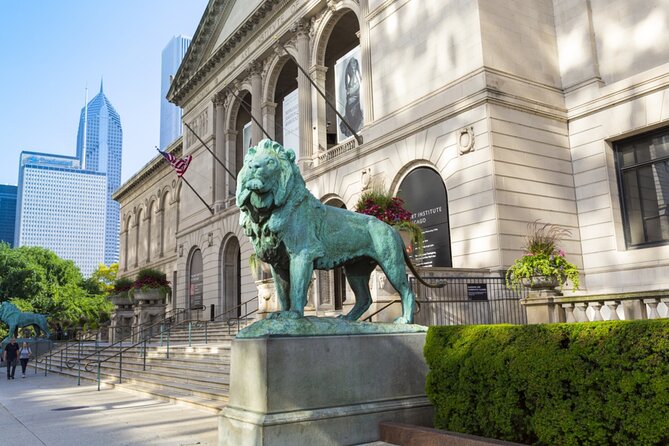
Starting at the Art Institute of Chicago
The meeting point is at 111 South Michigan Avenue, by the Art Institute of Chicago. This is a sensible place to begin because the museum and its surrounding buildings give you an immediate lesson in Chicago’s civic story.
The Art Institute was founded in 1879 as both a museum and a school for fine arts. Chicago was rebuilding after the Great Fire of 1871, and institutions such as this helped shape the city’s cultural identity. The challenge asks you to look around the site for the answer before the route continues.
You should not expect admission to the museum as part of this activity. The game uses the exterior area and public surroundings. If you want to visit the galleries, plan that as a separate stop and allow extra time.
This opening section is a good fit for people who like context with their sightseeing. It also gives the game a clear start. You begin with a major Chicago institution, then move toward public art rather than spending the whole route inside one park.
Alexander Calder’s Flying Dragon
The next stop features Flying Dragon, a stainless steel work by American artist Alexander Calder. Its red-orange coating reflects Calder’s familiar use of strong color, also seen in his giant Flamingo in Chicago’s Federal Center Plaza.
The challenge encourages you to inspect the work and its setting. That small act changes how you see public sculpture. Instead of walking past a large abstract object, you pause to notice its form, color, and place in the city.
The Calder stop also shows the game’s limits. The information is brief, and the questions may feel simple if you prefer a more traditional art talk. If your group enjoys solving clues, the simplicity keeps the game moving. If you want detailed discussion of Calder’s career, you will need another source.
Crown Fountain and the people of Chicago

Crown Fountain is one of Millennium Park’s most recognizable public works. Spanish artist Jaume Plensa designed the interactive video sculpture, which opened in July 2004. Krueck and Sexton Architects carried out the architectural work.
The fountain uses large video displays and water to create a public artwork that feels connected to everyday city life. The game asks you to search the area for an answer, so you may find yourself looking closely at the fountain’s details instead of treating it as a quick photo stop.
This is one of the route’s strongest locations because it gives you both a visual attraction and a short explanation of how the work came together. It is also an open public space, so conditions can affect your progress. Crowds, events, maintenance, or barriers may make it harder to reach the exact game zone.
Same place, a different route to walk:
- Fort Sumter Admission and Self-Guided Tour with Roundtrip Ferry
★ 4.5 · 3,343 reviews - San Francisco: Alcatraz Ticket, Ferry, & Self-Guided App
★ 4.5 · 2,460 reviews - Los Angeles: Hop-On Hop-Off Bus Tour with Audio Guide
★ 3.7 · 2,030 reviews - City Sightseeing Hop-On Hop-Off Bus Tour with Audio Guide
★ 3.0 · 1,083 reviews
Cloud Gate, the route’s big photo stop
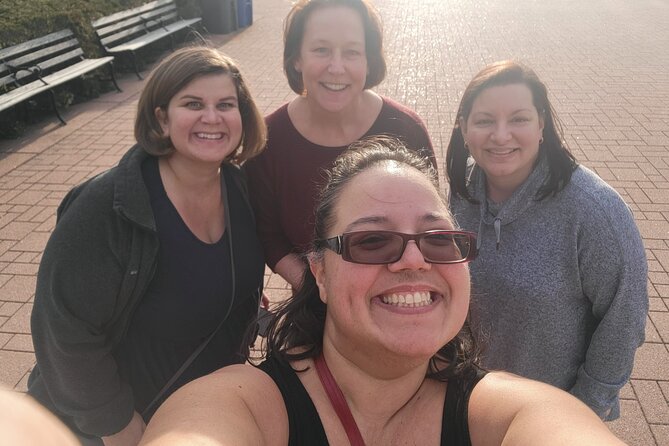
No visit to Millennium Park feels complete without seeing Cloud Gate, Anish Kapoor’s polished stainless steel sculpture. The 110-ton work is made from a seamless series of steel plates and reflects the skyline, clouds, and people around it.
The game uses Cloud Gate as another challenge point. You will probably want to pause here for photographs, but remember that the activity is timed for roughly 95 minutes. If you spend a long while taking pictures, the route may take longer than advertised.
Cloud Gate is valuable in this game because its surface gives you plenty to observe. You can look at the distorted skyline, the changing sky, and the way people appear in the sculpture. The location also helps break up the historical stops with a piece of modern public art.
A practical warning comes from the location-based design. One participant had trouble getting the game to recognize the group at a fountain and needed to expand the radius. You may need to use a hint or wider range if the app does not register your position. That can take some of the satisfaction out of solving everything without help.
Wrigley Square and the Millennium Monument

Wrigley Square offers a quieter change of pace. Its Millennium Monument is a nearly full-size recreation of a semicircle of paired Roman Doric columns that once stood in this part of Grant Park from 1917 to 1953.
The square also includes a lawn and public fountain. Compared with Cloud Gate and Crown Fountain, it is a less obvious stop, which makes it useful in a scavenger hunt. The game draws your attention to a piece of park design that you might otherwise pass without understanding.
This is the kind of stop that gives the route more substance than a list of famous photo locations. You are asked to connect the present park with what occupied the site in earlier decades. The challenge itself may not satisfy every puzzle fan, but the location offers a good reason to slow down and look.
Lurie Garden and Chicago’s changing ground
Lurie Garden occupies a site with an unusual past. The area was low and watery, then filled and raised using much of the rubble left by the Great Fire. It was later built over the roof of a parking garage, creating the platform for the garden you see today.
That layered story makes Lurie Garden one of the more interesting stops on the walk. It links the natural setting, the city’s fire, construction, and modern park planning in one place.
The game asks you to find an answer in the garden area before moving on. Treat the garden as more than a passage between Millennium Park attractions. You may want to pause to look at the paths and planting, though the supplied information does not promise a guided garden explanation or a specific seasonal display.
The Chicago Stock Exchange Arch

Near the Art Institute, the Chicago Stock Exchange Arch is a surviving fragment of the Chicago Stock Exchange building designed in 1893. It is an excellent example of how Chicago’s architectural story is often told through pieces that have outlived their original buildings.
The arch gives the game a useful shift from modern park art to older civic architecture. You are still solving a challenge, but the setting asks you to consider what remains when a major building disappears.
This stop may be easy to miss without a route. That is one reason the game format can work well. It directs you toward a detail that does not have the instant fame of Cloud Gate, yet it helps explain the city’s long interest in architecture and public design.
Buckingham Fountain and Grant Park
Buckingham Fountain sits in Grant Park between Queen’s Landing and Congress Parkway. Dedicated in 1927, it is one of the world’s largest fountains and one of Chicago’s most familiar public landmarks.
The fountain is a natural high point on the route, but it is also where location problems can matter most. The game requires you to be within a certain range, and barriers or restricted areas may prevent you from reaching the ideal position. Stay on public paths and do not try to enter a fountain area that is closed or inaccessible just to trigger the next clue.
The fountain’s scale makes it a good place for a short break. You can look across the basin, check your phone, and let the group regroup before continuing. Because the game is flexible, you do not have to rush through this section.
Lincoln, Solti Garden, and a quieter memorial stop
Another stop features a sculpture of a contemplative Abraham Lincoln seated in a chair and looking down into the distance. The description provided for the activity does not identify the sculptor, so the game appears to focus on observing the work rather than offering a full artist profile.
The sculpture was moved to Grant Park and rededicated in October 2006 in the Sir Georg Solti Garden, near Symphony Center, home of the Chicago Symphony Orchestra. This gives you a chance to see a quieter corner of the park near an important music institution.
The contrast is useful. Millennium Park is known for large, modern works and crowds around famous photo spots. The Lincoln sculpture and Solti Garden offer a more reflective stop. If your group wants only headline attractions, this may feel less exciting. If you like public art with a civic purpose, it adds balance to the walk.
Taft’s Fountain of the Great Lakes
The route ends at Taft’s Fountain of the Great Lakes, near East Jackson Boulevard. Created in 1913, it was the first commission funded by the Benjamin F. Ferguson Fund, established to support statues and monuments along Chicago’s boulevards and in other public places.
The sculpture connects Chicago’s public art program with the Great Lakes, a central part of the city’s identity and location. It also provides a fitting final challenge because the route has moved from museum culture to major modern art, historic fragments, gardens, and civic monuments.
The listed end point is Fountain of the Great Lakes on East Jackson Boulevard. Since the activity covers a broad area, use the final stop as your finish rather than assuming you will return to the starting point.
Pritzker Military Museum and the School of the Art Institute
The route also points toward the Pritzker Military Museum & Library on Michigan Avenue. It is a nonprofit museum and research library focused on military history. Its collections include material connected with Winston Churchill and war-related sheet music.
You should check the exact game instructions as you approach this area, since the supplied route information does not describe a separate challenge in detail for every listed site. The building adds another type of institution to the walk, especially if you like museums that focus on a specific subject.
The School of the Art Institute of Chicago provides another useful piece of context. It began in 1866 with 35 artists under the name Chicago Academy of Design. Its early success led to a building that opened on November 22, 1870.
Together, these stops reinforce a theme running through the whole route: Chicago’s public spaces are shaped by art schools, museums, monuments, libraries, and civic projects. You get more from the game if you treat each clue as a prompt to notice the city around you, not just as a test to answer quickly.
Price, pace, and who should book
At about $7.20 per person, this is inexpensive for a private activity lasting around one hour and 35 minutes. Group discounts may make it better value for families or friends traveling together. You are paying mainly for the route, app, challenges, and background information, not for a guide’s time.
That distinction matters. A live guide can explain a confusing clue, change the order, avoid a construction zone, and answer follow-up questions. This game cannot promise those services. Its value comes from flexibility, privacy, and the chance to explore at your own pace.
I would choose it for a family with older children, a group of friends, or a solo visitor who likes phone-based games. It also suits anyone who wants a low-cost introduction to the public art around Millennium Park and Grant Park.
I would be cautious if you dislike puzzles, depend on a guide for directions, or want every stop explained in depth. The challenge questions may feel silly to some players, and unclear directions have the potential to slow you down. Construction and app range issues are practical risks, not just minor annoyances.
The activity is offered in English. It is available every day around the clock, and confirmation is sent at booking. Service animals are allowed, public transportation is nearby, and most people can participate. You can cancel for a full refund up to 24 hours before the start time. Inside that window, the payment is not refunded.
Should you book this Chicago city game?
Book it if you want a cheap, private, flexible walk that adds a game to Chicago’s best-known public art. The route includes enough variety to keep the hour moving, from the Art Institute and Calder’s Flying Dragon to Cloud Gate, Buckingham Fountain, and Taft’s Fountain of the Great Lakes.
Skip it if your priority is expert commentary, flawless directions, or a carefully managed walking route. Download and prepare the game before you start, wear comfortable shoes, keep an open mind about using hints, and allow extra time if you want photographs or encounter barriers. For the right group, the small price makes the experiment worthwhile. Just think of it as a sightseeing puzzle, not a full substitute for a guided Chicago tour.
FAQ
How long does the Eastside Chicago Heist Exploration Game take?
The activity lasts approximately 1 hour and 35 minutes. Your actual time may be longer if you pause, take photographs, or stop for a break.
Where does the game start and finish?
It starts at 111 South Michigan Avenue, Chicago, Illinois 60603, near the Art Institute of Chicago. The listed end point is Fountain of the Great Lakes on East Jackson Boulevard.
Is there a physical tour guide?
No. This is a self-guided activity played through a smartphone. Only your private group participates.
Do I need an internet connection?
No. The city game is designed to work offline, so you do not need an internet connection to play.
Can I pause the game and continue later?
Yes. You can start at any hour, take a break at any time, and resume later.
What is the cancellation policy?
You can cancel at least 24 hours before the experience start time for a full refund. Cancellations or changes made less than 24 hours before the start time are not accepted and are not refunded.
Just added around the USA
- Smartphone-Guided Walking Tour of Downtown Indianapolis Sights & Stories★ 4.0 · 25 reviews
- Springfield Self-Guided Walking Audio Tour★ 4.0 · 5 reviews
- Smartphone Guided Indianapolis Downtown Sites Audio Walking Tour★ 4.5 · 7 reviews
- Indiana Dunes National Park Self-Guided Audio Tour★ 3.5 · 4 reviews
- Self-Guided Audio Driving Tour in Kancamagus Highway★ 4.5 · 6 reviews
- An Epic Scavenger Hunt: Bloomington Scenic Southern Indiana★ 3.5 · 6 reviews
- Huntsville Rocket City Smart Phone Self Guided Audio (GPS/APP) Walking Tour★ 4.5 · 5 reviews
- Sights of Downtown Houston Smartphone Audio Walking Tour★ 4.0 · 7 reviews
USA Audio Tours, compared.
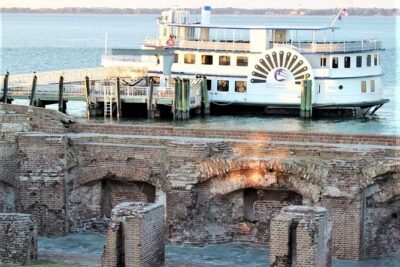
Fort Sumter Admission and Self-Guided Tour with Roundtrip Ferry
Read our review →
San Francisco: Alcatraz Ticket, Ferry, & Self-Guided App
Read our review →
Los Angeles: Hop-On Hop-Off Bus Tour with Audio Guide
Read our review →
City Sightseeing Hop-On Hop-Off Bus Tour with Audio Guide
Read our review →
Medieval Torture Museum Ticket with Audio Guide and Ghost Hunting
Read our review →
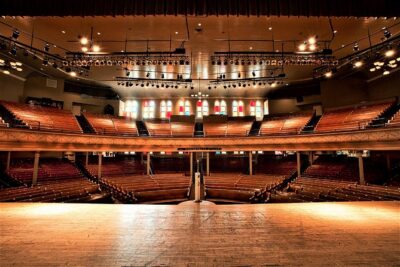
Ryman Auditorium Self-Guided Tour with Souvenir Photo Onstage
Read our review →
Red Rock Canyon Self-Guided Electric Bike Tour
Read our review →Browse the lists this tour appears in