
REVIEW · GREECE AUDIO TOURS
Crete: Palace of Knossos E-Ticket and Audio Guide
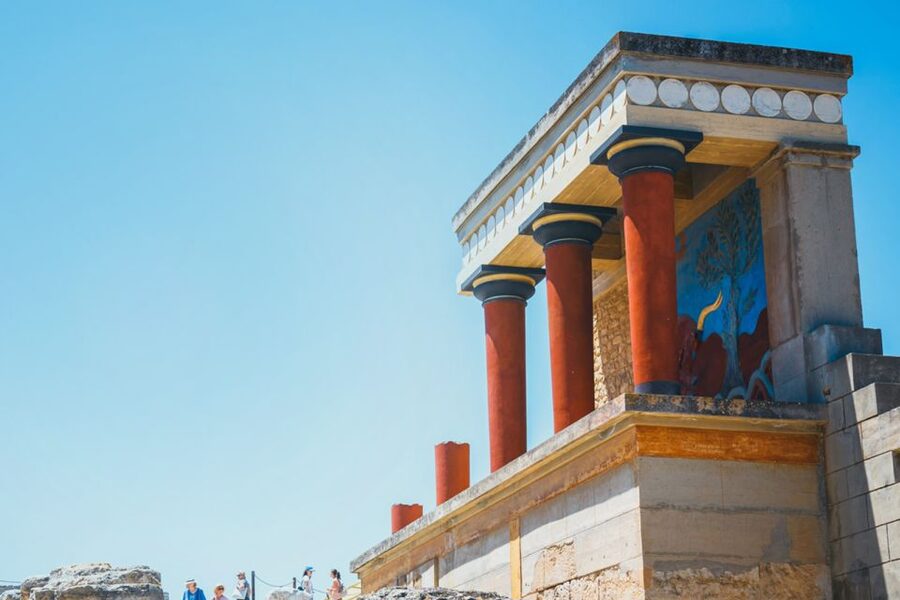
Knossos is the place where Crete’s Bronze Age past becomes physical: storage rooms, painted walls, royal apartments, and broad stone courtyards spread across a hill south of Heraklion. The pre-booked ticket matters most at busy times, when the ticket queue can stretch well beyond the entrance.
I like two things here. First, you can explore at your own speed instead of staying beside a group. Second, the audio guide connects the ruins to ordinary Minoan life, from hairstyles and cosmetics to trade records and bathroom habits. The main drawback is that the audio directions can be hard to match with the site, especially when areas are closed or the route changes.
Key points to know
- Skip the ticket-office line: Go directly toward the entrance with your digital ticket rather than joining the queue to buy one on site.
- Allow one to two hours: You can move through quickly in about an hour, but the audio stops and displays reward a slower visit.
- Bring your own gear: You need a charged Android or iPhone, headphones, and about 100 to 150 MB of storage.
- Expect broad cultural context: The audio explains Minoan customs, trade, fashion, and daily life, but does not always identify the exact object in front of you.
- Plan for sun and heat: Shade is limited, so comfortable shoes, water, a hat, and sunglasses are sensible.
- Check closures as you go: Maintenance or restricted areas can interrupt the audio route.
What you actually buy for $34

For $34 per person, this experience combines admission to Knossos Palace with a self-guided audio tour on your phone. You receive the ticket and instructions by email, then download the tour before or during your visit.
That price is easiest to justify when Knossos is busy. A useful ticket-only visit can take an hour, but a long queue can eat up much of your morning. One visitor arrived at a peak time in August and found a line of about 45 minutes for on-site tickets. Another arrived around 8 a.m., spent two hours at the palace, and left before the crowds became much heavier.
The value is less clear if you visit very early or late in the day and find no queue. In that case, you are paying mainly for convenience and the audio content. That can still work well, but you should know what you are buying: this is not a private historian, small group tour, or live guide.
The optional package choices may include the Heraklion Archaeological Museum, a Heraklion city audio tour, and audio for Phaistos Palace. Check the exact option before paying, since the meeting point and included material depend on your selection.
More Skip-the-Line Audio Guide Tickets in Greece
- Crete: Knossos Palace Entry Ticket with Optional Audio Guide
★ 3.9 · 2,251 reviews - Rhodes: Lindos Acropolis Entry Ticket & Optional Audio Guide
★ 4.4 · 1,285 reviews - Acropolis & Parthenon Entrance Ticket w/optional SG Audio Tours
★ 3.5 · 606 reviews
Entering Knossos without the long wait
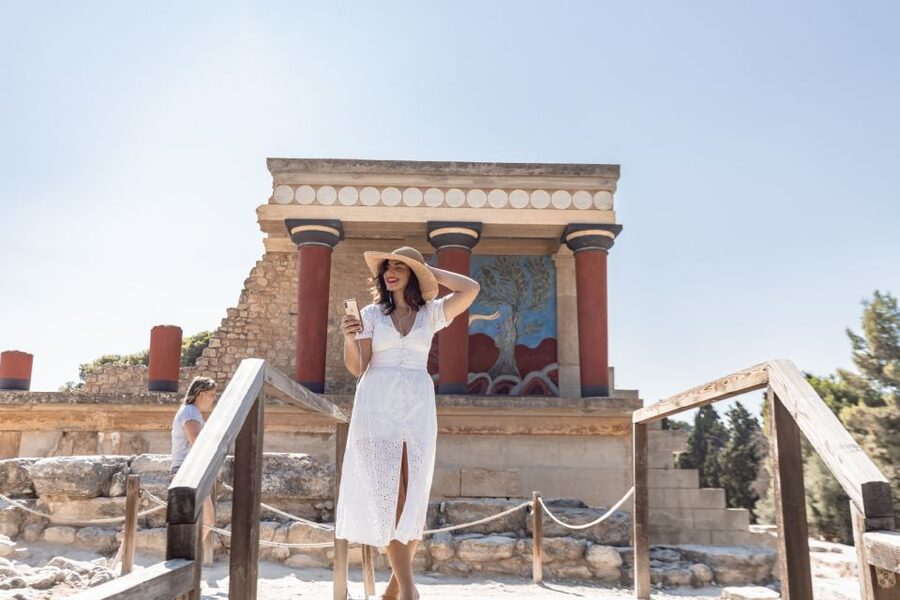
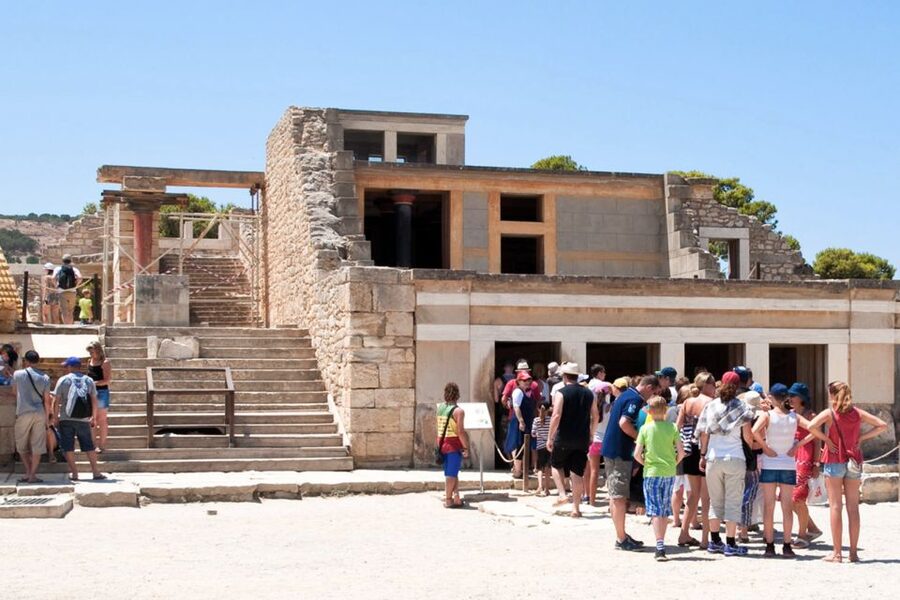
When you reach Knossos, do not automatically join the first line you see. The ticket counter and the actual entry point are not always the same. Your email instructions should explain where to go, and the digital ticket is intended to let you bypass the ticket-purchase queue.
This is particularly useful in summer and when cruise passengers arrive in Heraklion. The site can turn crowded quickly, and lines to see especially popular areas, such as the throne room, may slow your progress.
I would aim for opening time if you want clearer views and a calmer route. Early morning also helps with the heat. Late afternoon can work too, and one visit at around 4:30 p.m. had no line, but you should still check the available entry time and allow enough daylight for the full walk.
You need your passport or ID card in some circumstances, especially if you are claiming a reduced or free ticket. EU citizens aged 0 to 25 can enter free, but they must wait in line to show identification. Greek and other EU citizens over 65 receive a 50 percent reduction from April 1 through October 31, purchased on the day at the ticket office. Children under six from outside the EU can receive free entry with a passport showing age and country of origin.
A palace rebuilt in the imagination
Knossos is not a neatly preserved ancient city. It is a large archaeological site with original ruins, reconstructed sections, painted copies, concrete, and modern protective work. That mixture is central to the experience.
The restored parts help you picture the palace as a functioning center rather than a pile of low walls. At the same time, you need to keep asking what is original and what was added during modern reconstruction. The audio guide gives cultural and historical background, but it does not always settle that visual question for you.
You will move through courtyards, corridors, stairways, storage areas, and rooms associated with royal life. The site’s size is one of its strengths. It also explains why the route can feel confusing. The palace does not unfold like a simple museum gallery with one obvious direction.
Take the free site map if one is available, and use the audio map as a helper rather than your only navigation tool. The route markings and audio numbers do not always match perfectly. If a direction sounds unclear, stop and look around before starting the next track. Listening while walking can cause you to miss the turn.
Frescoes, processions, and Minoan style
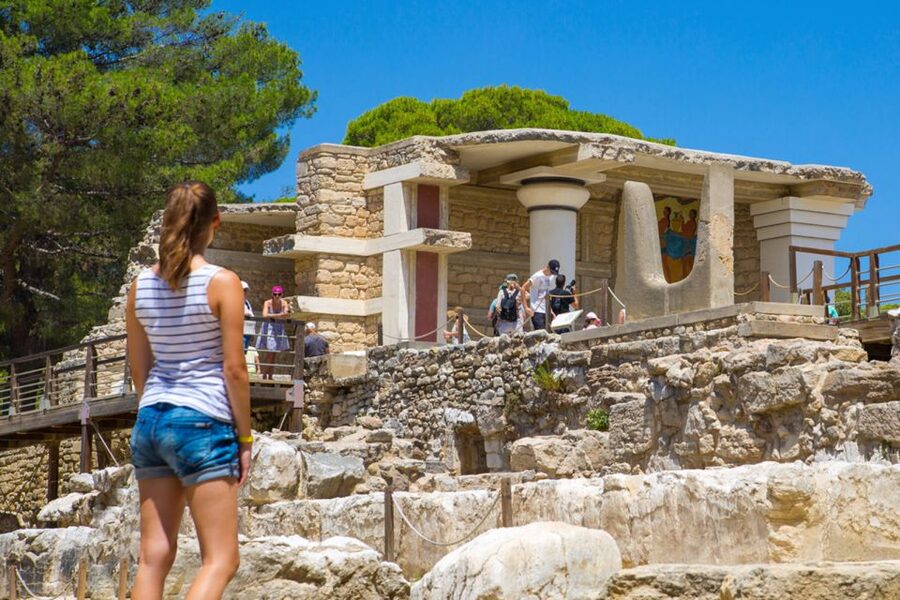
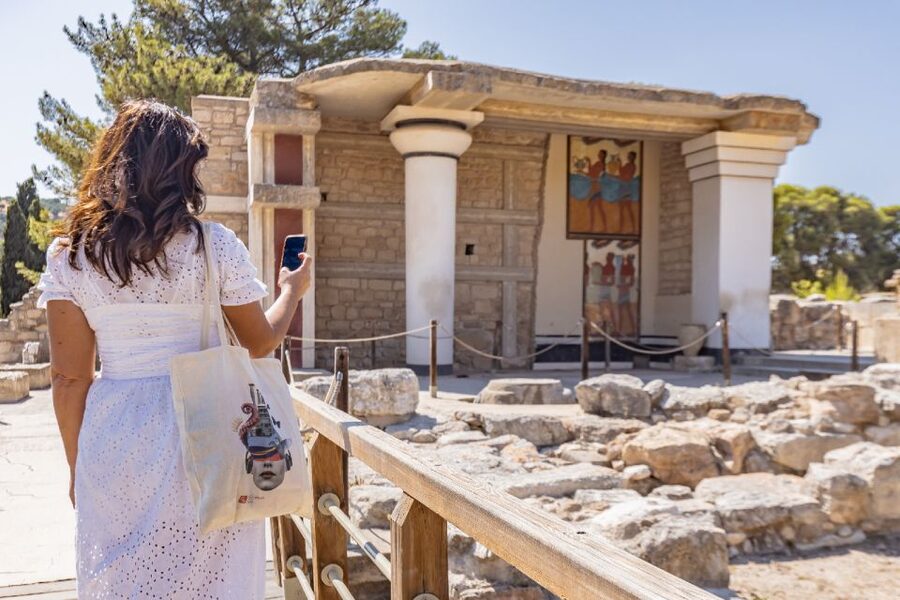
The South Propylaeum is one of the most useful early stops because its cupbearers and procession scenes give you a sense of Minoan ceremonial life. The images show carefully arranged figures, clothing, movement, and ritual activity.
The original frescoes are not all sitting intact in their first locations. Some displays are copies or reconstructions, so the audio is helpful when you want to understand how the artwork fits into the palace story. The presentation also gives you a look at Minoan taste beyond kings and myths.
I especially like the sections on fashion and personal care. You hear about hairstyles, clothing, and beauty products, which makes the palace feel less remote. Instead of treating Minoan Crete as a collection of dates and ruins, the commentary asks how people dressed, prepared themselves, and presented their status.
This is also where the audio’s broad approach becomes clear. You may be standing beside a wall or fresco while the narration discusses social customs rather than describing every stone directly in front of you. If you want precise art-history labels for each fragment, the signs and a printed map may serve you better.
More Castle and Palace Audio Tours in Greece:
- Crete: Knossos Palace and Museum E-Tickets with Audio Guides
★ 4.0 · 828 reviews - Rhodes: Palace of Grand Master Ticket & Rhodes SG audio tour
★ 4.0 · 324 reviews - Heraklion: Palace of Knossos 3D Virtual Audio Tour by Tablet
★ 4.0 · 230 reviews - Rhodes: Palace of the Grand Master E-Ticket & Audio Tour
★ 4.2 · 216 reviews
The West Magazines and the Minoan economy
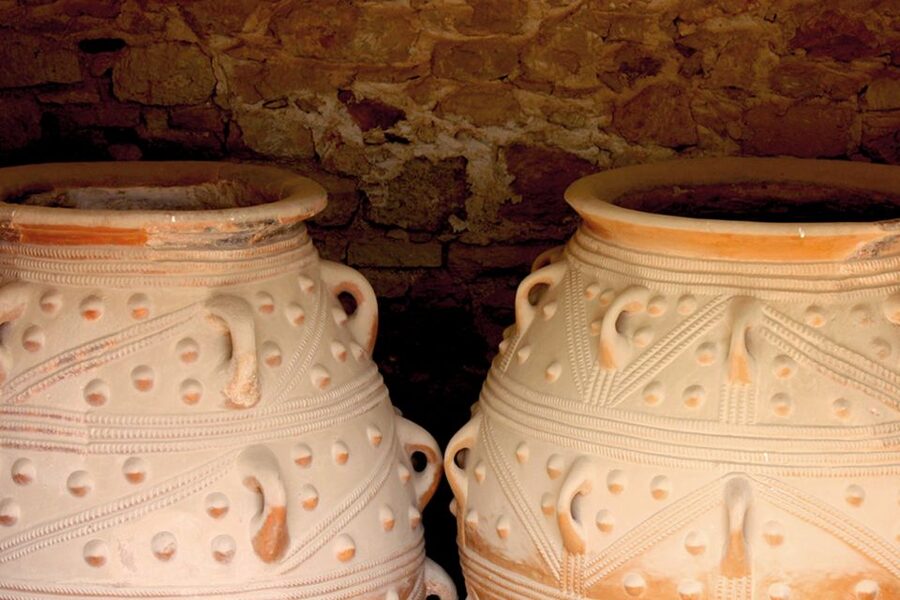
The West Magazines contain long storage areas that help explain how the palace worked day to day. Large containers and organized rooms point to the movement of food, goods, and supplies through a central system.
The audio connects these spaces with bureaucracy, early forms of Linear writing, and trade links across the Minoan world. This is valuable context because the palace was not simply a royal residence. It was also an administrative and economic center.
You can use this stop to picture workers recording goods, managing storage, and supporting a complicated institution. The audio is at its best here because the rooms alone do not always reveal their purpose to a casual visitor.
Again, the route may not be perfectly clear. You might need to pause the narration, read the nearby signs, and decide which part of the storage complex the commentary is describing. The information is useful, but the app sometimes gives you more background than exact visual instruction.
The South Entrance and Mount Juktas
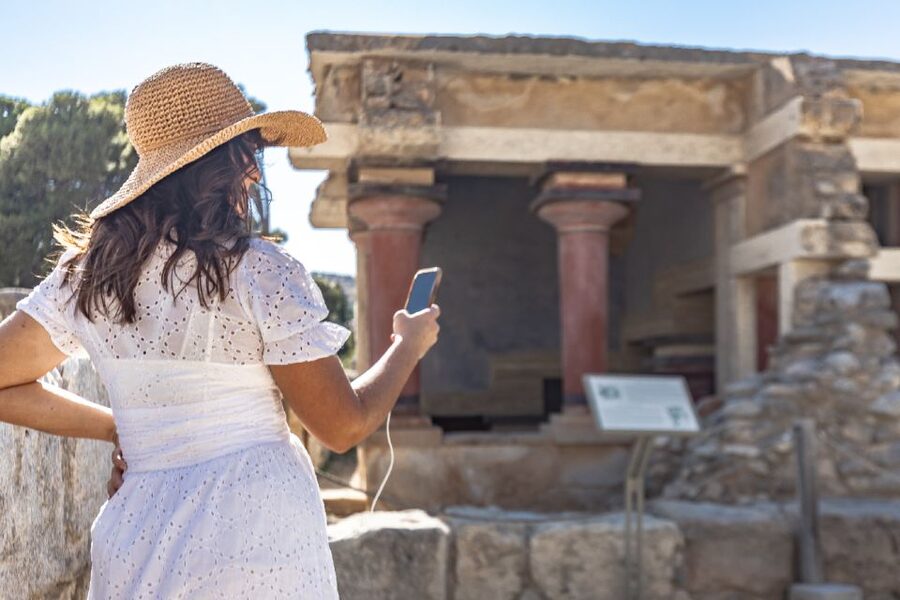
At the South Entrance Corridor, you encounter a copy of the Prince of the Lilies fresco. The display is one of the site’s more familiar images, and the surrounding ruins help show how art, movement, and ceremony may have worked together.
From the palace, look toward Mount Juktas. The mountain is framed by worn palace walls, creating one of Knossos’s most memorable views. This is a good place to stop the audio for a moment and simply look. The setting helps connect the palace to the wider Cretan environment without requiring a long explanation.
The Mount Juktas view is also a reminder that Knossos is an outdoor visit. Sun, stone, and uneven ground shape your experience as much as the audio does. Wear sturdy shoes and carry water. Shade is limited, particularly in the hotter months.
The Queen’s Megaron and palace plumbing
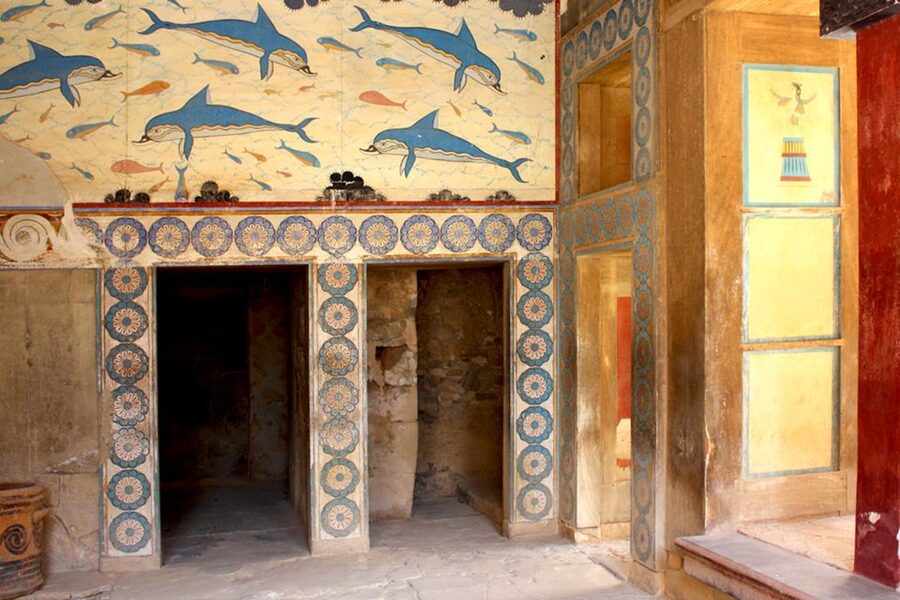
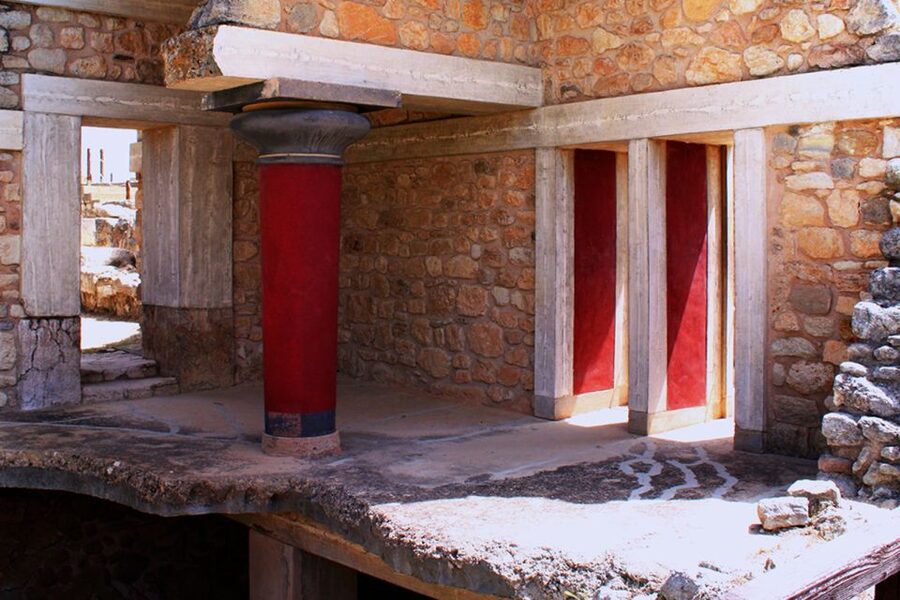
The Queen’s Megaron is another highlight because it shows a more private side of palace life. The room is associated with the famous blue dolphins fresco and includes a bathroom and toilet area.
The audio explains Minoan bathing habits and the practical systems connected with the room. These details are more revealing than another list of rulers. You begin to see how people washed, rested, decorated their rooms, and managed domestic space.
This stop also shows why a self-guided audio tour can be useful. You can replay a section if you miss a detail, or read the text instead of listening. That flexibility suits you if you prefer to stop often for photographs or if members of your group move at different speeds.
How good is the smartphone audio guide?
The guide is available in English, German, French, Spanish, and Italian. You download it to your own phone and use your own headphones. There is no live guide included, and no phone or headset is supplied.
The narration is clear and generally easy to understand. It contains more than a short label beside each ruin, with stories about Minoan society, fashion, administration, trade, and mythology. You can listen before or after your visit, which helps if you want to prepare or revisit a section later.
The weak point is navigation. Several audio stops do not correspond neatly with the site markings, and the spoken directions can leave you wondering which way to walk next. Some users found it easier to turn off the sound and read the correct section on screen. Others enjoyed the content but used the map and physical signs to find their way.
Maintenance work or temporary closures can make this worse. If a passage is blocked, the original route may no longer fit the audio. The guide may still explain a closed area, but you should not expect every stop to be reachable on every day.
Before leaving your accommodation, download the app or audio files, charge your phone, and check that the content works. The system requires Android 5.0 or later or a compatible iPhone. It does not support Windows Phones, iPhone 5, iPhone 5C, older iPods, or older iPads listed in the instructions. You need roughly 100 to 150 MB of free storage.
How long should you allow?
The stated duration is one to five hours, but most people will find one to two hours practical for the palace itself. An hour gives you a quick look at the main areas. Two hours lets you listen to more commentary, pause at the fresco displays, and spend time in the storage rooms and Queen’s Megaron.
Five hours would make sense only if your chosen package includes additional audio tours or if you plan to move very slowly. You should also allow extra time for transport, entry, photographs, and waiting at crowded points.
The site is close to Heraklion, and one visitor found the local bus easy to use and inexpensive, at about $1.50 each way at the time of that visit. The exact fare can change, so check locally. The key point is that you do not need to depend on a private tour vehicle simply to reach Knossos.
Who will enjoy this visit most?
I would choose this option if you want independent pacing, a digital ticket, and enough explanation to make sense of broad ruins. It suits couples, families with older children, and independent visitors who do not want to follow a fixed group.
It is also a good fit if you enjoy cultural background as much as architectural detail. The audio spends time on daily life, fashion, writing, trade, and customs. You will get a wider picture of Minoan Crete, but not always a precise description of the stone or fresco directly in front of you.
I would think twice if you need step-free access. The experience is not suitable for wheelchair users, and the site includes outdoor paths and uneven areas. It may also frustrate you if you expect a perfectly signposted route or a live guide who can answer questions.
Strollers are not allowed, and pets are not allowed. For anyone sensitive to heat, an early visit, a hat, sunglasses, comfortable shoes, and plenty of water are important rather than optional extras.
Should you book the Knossos audio guide?
Book it if you are visiting at a busy time and want to avoid the ticket-office queue. The skip-the-line benefit can save real time, especially in August or when cruise groups arrive. The audio adds worthwhile context, particularly for the West Magazines, Minoan customs, the Queen’s Megaron, and the fresco displays.
Do not book it expecting a polished live tour with flawless turn-by-turn directions. Use the audio for interpretation, and use the site map and signs for navigation. At $34, the strongest value comes from combining the ticket convenience with a full visit, not from buying admission merely to walk around for an hour when the site is quiet.
For many visitors, Knossos is a must-see in Crete. This option makes the visit easier and more informative, provided you arrive prepared, keep your phone charged, and accept that some reconstruction and route confusion are part of the experience.
FAQ
Is a live guide included?
No. This is a self-guided experience using an audio tour on your smartphone. A live guide is not included.
What languages are available for the audio guide?
The audio guide is available in English, German, French, Spanish, and Italian.
Do I need to bring my own phone and headphones?
Yes. You need a charged Android or iOS smartphone and your own headphones. The phone and headphones are not included.
How much storage does the audio tour require?
You need about 100 to 150 MB of free storage on your phone to download the audio material.
Can EU citizens under 25 enter Knossos for free?
Yes. EU citizens aged 0 to 25 are entitled to free admission, but they must wait in line to show an ID card or passport.
Is Knossos suitable for wheelchair users?
No. This activity is listed as unsuitable for wheelchair users. Baby strollers and pets are also not allowed.
Just added around Greece
- Jeep exploration 4X4 self drive★ 5.0 · 3 reviews
- Knossos Palace & Archeological Museum: E-Tickets with Audio Tours★ 4.0 · 18 reviews
- E-Ticket to Heraklion Archaeological Museum with Audio Guide★ 4.5 · 26 reviews
- Full-Day 4×4 Self-Drive Safari in East Crete with Lunch★ 5.0 · 8 reviews
- Kasos Audio-Tour from Karpathos by Art and Walk★ 4.5 · 4 reviews
- Delphi: Self-guided Audiovisual Tour with 3D Representations★ 5.0 · 5 reviews
- Delphi Self-guided Audio Tour on Your Phone (no ticket)★ 3.5 · 10 reviews
- Delphi: Archaeological Site & Museum Ticket with Audio★ 3.5 · 24 reviews
Greece Audio Tours, compared.

Athens: Acropolis Ticket with Optional Audio or Live Guide
Read our review →
Athens: Cape Sounio & Poseidon Temple Trip with Audio Guide
Read our review →
From Athens: Delphi Full Day V.R. Audio Guided Tour
Read our review →
Athens: Acropolis Museum Ticket with optional Audio Guide
Read our review →
Athens: Acropolis Ticket & Optional Self-Guided Audio Tours
Read our review →
From Athens: Small-Group Delphi, Museum & Arachova Day Trip
Read our review →
Parthenon & Acropolis Museum with Audio or Live Tour Option
Read our review →Browse the lists this tour appears in