
REVIEW · USA AUDIO TOURS
Chicago Riverwalk Self-Guided Walking Tour
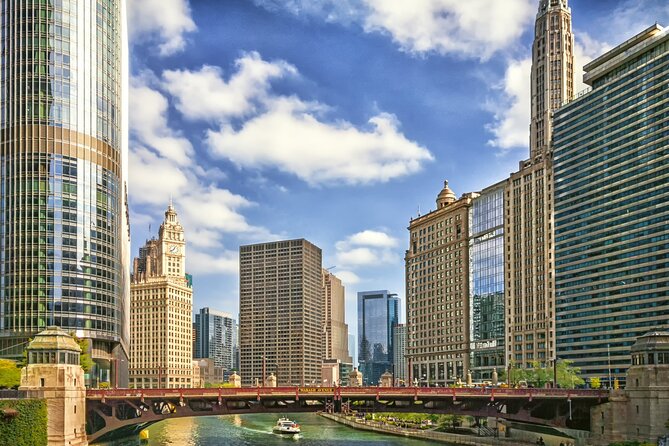
Chicago’s riverfront gives you a fine lesson in how Chicago grew upward. This self-guided audio tour links the Wrigley Building, Michigan Avenue Bridge, Marina Towers, Merchandise Mart, Tribune Tower, and other landmarks in about one to two hours. The narration starts as you reach each location, so your phone becomes both guidebook and map.
I like the offline GPS maps, which matter when tall buildings make phone service patchy. I also like the lifetime access: pay $14.99 once, then use the tour again on future Chicago trips or share access across the number of devices booked. The main drawback is simple: no person meets you, and the route depends on your phone, battery, GPS, and headphones working properly.
Key points at a glance
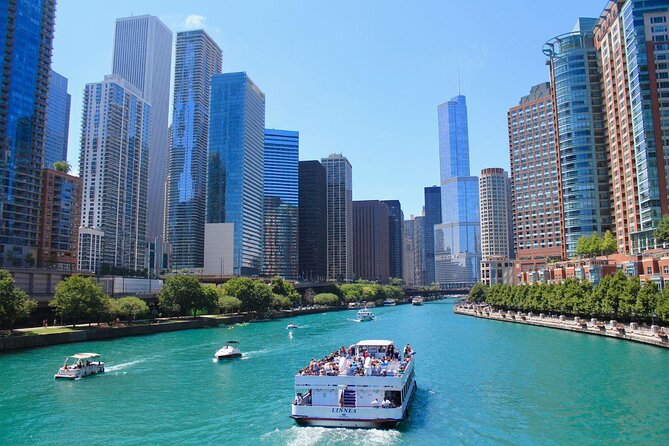
- Twelve riverfront stops: Follow a route that connects major bridges, towers, memorials, and museums.
- Automatic audio stories: The app plays narration when you reach each location, allowing hands-free walking.
- Lifetime access for $14.99: Use the tour on any trip, with no expiration date.
- Offline navigation: Download the route before you begin, then explore without Wi-Fi or cellular service.
- Flexible timing: Start between 6:00 AM and 9:00 PM, pause for food or photos, and resume later.
- A good architecture sampler: You get Chicago history, design, engineering, and city-building stories in one walk.
A riverfront lesson in Chicago architecture

I like this tour because it does not treat the Chicago River as mere scenery. The waterway becomes the thread connecting old office buildings, ambitious modern towers, bridges, memorials, and public spaces.
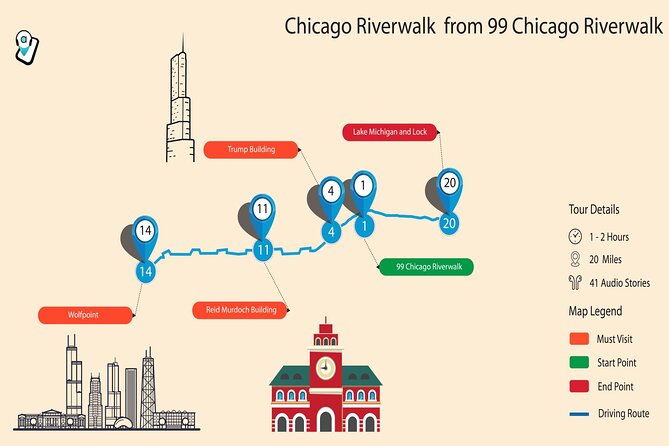
You begin at 99 Chicago Riverwalk and finish at the River Esplanade near 60611. Along the way, the audio explains why each stop matters. You hear about chewing-gum money at the Wrigley Building, bridge design at the DuSable and Dearborn Street bridges, and the unusual community life inside Marina Towers.
The route is designed for about one to two hours, with roughly five minutes assigned to each stop. That timing is a useful guide rather than a strict schedule. You can walk quickly, pause for pictures, or stop the tour while you grab a snack. The app lets you skip a story or play extra material if a particular building catches your interest.
The experience has a current rating of 4.2 from six reviews. The strongest praise centers on the pleasant river walk and the way the audio connects architecture with Chicago’s past. That is the real appeal here: you are not simply ticking off buildings. You are getting short explanations that help the city make more sense.
More Self-Guided Walking Tours in the USA
- Self Guided Classic Freedom Trail Location Aware (GPS) Walking Audio Tour
★ 4.5 · 258 reviews - Self-Guided Smartphone Ghost Walking Tour in Salem
★ 4.5 · 225 reviews - Cape Cod & Provincetown Self-Guided Driving & Walking Audio Tour
★ 4.0 · 207 reviews
Before you start: prepare the phone
This is a private activity for your own group, not a scheduled walk with a human guide. After booking, you receive setup instructions and a password by email and text. Search for audio tour if the message is not easy to find.
You must download the separate Action Tour Guide app and enter the password before setting out. Download the tour while you have a strong Wi-Fi or cellular connection. Once loaded, it works offline.
For the smoothest start, use an iPhone with iOS 15 or later, an Android phone running version 9 or later, or an iPad or tablet with GPS and cellular connectivity. Bring earbuds or headphones. Couples can save money by sharing one tour with split headphones, though each person may find separate earbuds easier while walking.
At the start point, nobody checks you in. Open the app, choose the version with your intended starting point and direction if more than one appears, then enter the first story location. The audio should begin automatically as you reach the correct spot.
Keep the phone charged and allow the app to use location services. If sound fails, the instructions direct you to contact support. Staying close to the suggested route and walking at a steady pace should give the GPS the best chance of triggering each story at the right place.
Stops 1 to 3: gum money, bridge flags, and a giant glass tower
The Wrigley Building
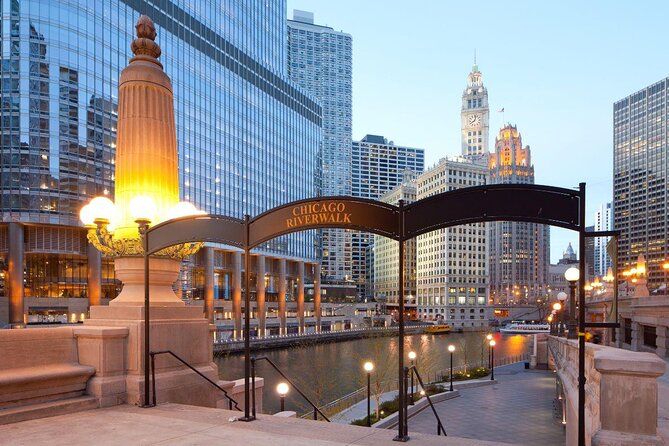
The Wrigley Building is an easy first landmark to recognize. Its terra-cotta exterior and oversized clock tower make it one of the riverfront’s most familiar buildings. The story links the name to William Wrigley Jr., whose fortune came from chewing gum.
This is a good opening stop because it gives you a quick example of how commerce shaped Chicago’s famous skyline. The nearby Hotel Intercontinental adds another detail: an observatory hidden inside the building. The tour mentions it, but you should note that entrance tickets and reservations are not included. Treat the detail as a prompt for further planning, not as part of your admission.
Same place, a different route to walk:
- Fort Sumter Admission and Self-Guided Tour with Roundtrip Ferry
★ 4.5 · 3,343 reviews - San Francisco: Alcatraz Ticket, Ferry, & Self-Guided App
★ 4.5 · 2,460 reviews - Los Angeles: Hop-On Hop-Off Bus Tour with Audio Guide
★ 3.7 · 2,030 reviews - City Sightseeing Hop-On Hop-Off Bus Tour with Audio Guide
★ 3.0 · 1,083 reviews
Michigan Avenue Bridge, also called DuSable Bridge
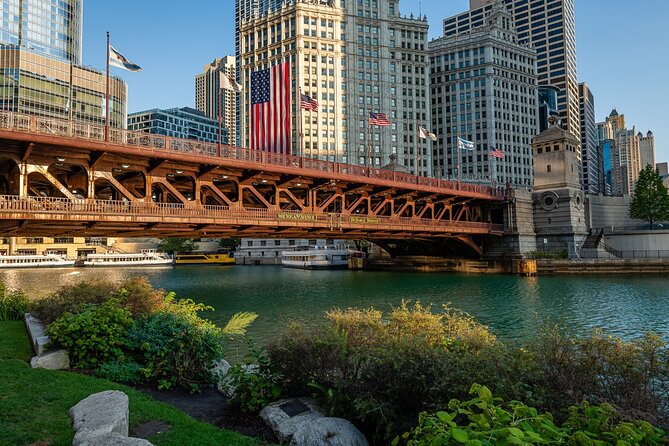
The Michigan Avenue Bridge is handsome from the river, but its details matter more once you know what to look for. The audio points you toward the flags and explains their history.
This is exactly the kind of information that can be easy to miss on a normal walk. You might photograph the bridge, admire the stonework, and keep moving. The narration gives you a reason to pause and inspect the symbols around you.
401 N Wabash Avenue
The huge glass tower at 401 N Wabash is hard to overlook. At 1,399 feet and 98 stories, it ranks among the tallest buildings in the United States. Its construction used the same building technique associated with Dubai’s Burj Khalifa, the world’s tallest building.
The stop works well as a contrast with the Wrigley Building. In only a few minutes, you move from terra-cotta ornament to high-rise engineering. I would take a moment here to look upward, but keep your phone ready for the audio cue and watch your footing along the riverfront.
Stops 4 to 6: memory, community, and a disliked bridge
Vietnam Veterans Memorial
The Vietnam Veterans Memorial is quieter than the nearby towers. It consists of a sunken rectangular pool and fountain honoring Illinois residents who died in the Vietnam War.
The design creates a pause in the walk. After several large buildings, you encounter a place made for remembrance rather than commerce or spectacle. Give this stop the attention it deserves. The five-minute audio segment may be brief, but the setting calls for a slower moment.
Marina Towers Condominium Association
Marina Towers is one of the route’s most memorable buildings. The twin structures are often compared to giant corn cobs, a playful description that fits their rounded balconies.
The useful part of the story is not just the appearance. Marina Towers was designed as a city in a city, with its own theater, gym, pool, ice rink, bowling alley, roof deck, and marina. The audio helps you understand the towers as a self-contained community rather than a pair of unusual residential buildings.
The listed facilities are part of the building’s identity, not included attractions on this tour. You view the towers from the route and hear their story. Do not assume the roof deck, pool, or other private facilities are open to tour participants.
Dearborn Street Bridge
The Dearborn Street Bridge dates from 1962 and replaced an earlier bridge that residents strongly disliked. The story explains what went wrong with the first design and how people responded.
That makes this stop useful for understanding Chicago as a working city, not just a collection of grand buildings. Bridges are practical structures, but they also affect how neighborhoods connect and how people experience the river. The tour’s short format keeps the explanation moving without asking you to stand at one bridge for too long.
Stops 7 to 9: old offices, a huge marketplace, and the river itself
325 N La Salle Drive
The building at 325 N La Salle Drive dates from 1914 and now houses the Encyclopedia Britannica headquarters. Beside newer towers, it may look modest. That is part of its value.
The stop gives you a visual lesson in changing ideas about height and style. Chicago’s skyline is not one single era. Older buildings can appear almost small beside modern towers, yet they explain where the city’s high-rise tradition came from.
Merchandise Mart
Merchandise Mart is enormous, with four million square feet and its own ZIP code. Its Art Deco design gives the sheer size some visual order.
This is one of the route’s strongest stops for scale. You hear about a building that functions almost like a district within the city. If you enjoy design, business, or urban planning, allow extra time here for photographs and a closer look.
The audio stop does not include entry to the building. The tour is primarily an exterior walking experience, and the general admission notes make clear that attraction tickets and reservations are not included.
McCormick Bridgehouse and Chicago River Museum
This stop brings the river itself to the center of the story. The McCormick Bridgehouse and Chicago River Museum explains the river’s importance to Chicago and includes bird’s-eye views from its top floor.
This is also the one stop where you may want to check opening details before planning your day inside. The self-guided route does not include museum admission. You can still enjoy the building and the river views from outside, then decide if you want to return for a separate visit.
The museum helps balance the tour’s focus on towers. You are reminded that Chicago was shaped by its waterway, bridges, and engineering decisions as much as by office buildings.
Stops 10 to 12: newspaper ambition, modern bridge design, and Art Deco style
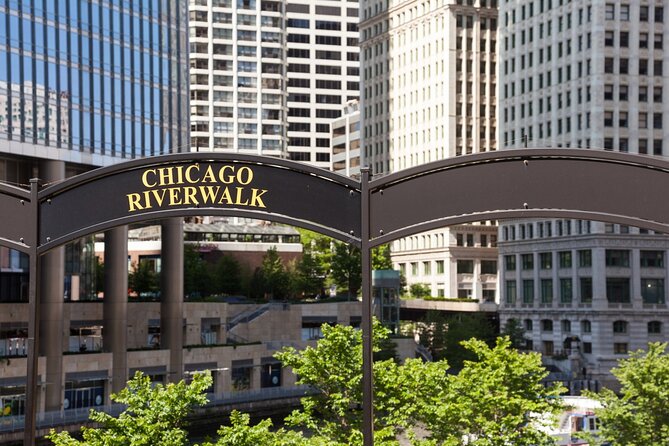
Tribune Tower
Tribune Tower is one of the route’s most decorative buildings. Its neo-Gothic design came from a competition held for the Chicago Tribune’s 75th anniversary.
The newspaper wanted a new headquarters that would be the most beautiful and distinctive office building in the world. The winning design reveals that ambition in its stonework and vertical lines. This is a stop where I would pause longer than five minutes if the architecture interests you.
Tribune Tower also makes a nice comparison with the glass high-rise at 401 N Wabash. One building reaches for height through modern engineering, while the other uses historic-looking detail to create drama. The contrast is a compact lesson in Chicago’s competing architectural moods.
William P. Fahey Bridge, also called Columbus Drive Bridge
The William P. Fahey Bridge, commonly known as the Columbus Drive Bridge, is Chicago’s newest river-spanning bridge on this route. Its story looks forward rather than backward, focusing on how construction methods and city planning changed over time.
This is a valuable final stretch because the tour is not only about famous older landmarks. You also see how Chicago continues to adjust its river crossings and public spaces. The bridge gives the route a sense of movement through different periods of city building.
NBC Tower
NBC Tower closes the route with another strong Art Deco example. Its design was modeled after 30 Rockefeller Center in New York City.
The building also has a connection to television history. It was once used as a recording location for The Jerry Springer Show and The Steve Harvey Show. That detail gives the final stop a lighter, more familiar note after the memorial and engineering stories earlier in the walk.
The route ends at the River Esplanade, so you finish near the river rather than returning to the starting point. Plan your next movement from there. The tour is one-way in practice, and you should not count on the app to guide you back to 99 Chicago Riverwalk unless you retrace your steps or use another map.
What $14.99 really buys you
At $14.99 per person, the price is modest for a private walking experience with twelve stops. You are paying for the narration, route design, GPS functions, offline maps, extra stories, and the ability to use the tour without a fixed appointment.
The lifetime access changes the value calculation. If you expect to return to Chicago, you can reuse the tour on another visit without buying it again. You can also pause over several days, although the route itself is short enough for most people to finish in one outing.
The deal is less compelling if you prefer a live guide who can answer questions, change the route, or point out details based on your interests. It is also less useful if you do not want to manage an app. You need to download the correct program, enter a password, carry a charged phone, and respond to GPS cues.
For two people, sharing one tour with split headphones may reduce the total cost. The password can be used on the same number of devices as the number of people booked, so larger groups should book enough access for everyone who wants a separate device.
Who will enjoy this walk most?

I would recommend it to first-time Chicago visitors who want a structured introduction without joining a group. It suits people who like architecture but do not want a long lecture. The five-minute stories keep the pace moving, while the pause and replay controls let you spend more time at buildings that interest you.
It is also useful for independent planners. You can start any time during the stated 6:00 AM to 9:00 PM operating window, take a break, and continue later. You can fit the route around meals, museum visits, or other plans.
Families and couples may appreciate the freedom to stop often. The route is also a good option for people who prefer not to follow a guide holding a sign. Most people can participate, and the path is near public transportation.
I would choose a live walking tour instead if personal questions and group conversation are important to you. I would also avoid relying on this as your only plan if you are uncomfortable with phone navigation or cannot download the content before arriving.
Booking, cancellation, and practical timing
You receive confirmation at booking. Free cancellation is available up to 24 hours before the experience start time for a full refund. Changes or cancellations made within 24 hours are not accepted for a refund, and the cut-off follows local Chicago time.
The tour is commonly booked about 18 days ahead, but its flexible format means you do not need to coordinate with a guide’s daily departure. Choose a start time when you can walk comfortably and still have time for photos.
The stated route hours run from 6:00 AM to 9:00 PM, Monday through Sunday, for the listed operating period. You should still download the tour before reaching the riverfront. Once you are at the start, the route is designed to work without Wi-Fi or cellular data.
Should you book the Chicago Riverwalk Self-Guided Walking Tour?
Book it if you want a low-cost, flexible introduction to Chicago’s riverfront architecture and you are comfortable using your phone as your guide. The strongest reasons are the twelve carefully connected stops, the offline maps, and the lifetime access at $14.99.
Skip it if you want a human guide, included museum entry, or a fully hands-off experience that does not require setup. For everyone else, bring headphones, download the app on strong Wi-Fi, start at the Wrigley Building, and let the riverfront’s bridges and towers tell the story one short stop at a time.
FAQ
How long does the Chicago Riverwalk Self-Guided Walking Tour take?
The tour takes about one to two hours. Each of the twelve listed stops has an estimated five-minute audio segment, but your total time will depend on walking speed, photos, breaks, and any extra stories you choose to hear.
Where does the tour start and end?
The tour starts at 99 Chicago Riverwalk, Chicago, Illinois 60601. It ends at the River Esplanade, Chicago, Illinois 60611.
Is this a guided group tour?
No. This is a private, self-guided activity. No guide meets you at the starting point. The app provides the audio stories, route directions, and GPS-triggered narration.
Does the tour work without cell service?
Yes, after you download the tour correctly. You must download it while connected to strong Wi-Fi or cellular service. The offline maps and audio then work without Wi-Fi or cellular data.
What phone or device should I use?
The recommended devices are an iPhone running iOS 15 or later, an Android device running version 9 or later, or an iPad or tablet with GPS and cellular connectivity.
Are admission tickets included?
No. Attraction passes, entry tickets, and reservations are not included. The walking tour covers the route and audio stories, while any museum or building admission must be arranged separately.
Can I cancel for a full refund?
Yes, if you cancel at least 24 hours before the experience start time. Cancellations or changes made less than 24 hours before the start time are not eligible for a refund.
Just added around the USA
- Smartphone-Guided Walking Tour of Downtown Indianapolis Sights & Stories★ 4.0 · 25 reviews
- Springfield Self-Guided Walking Audio Tour★ 4.0 · 5 reviews
- Smartphone Guided Indianapolis Downtown Sites Audio Walking Tour★ 4.5 · 7 reviews
- Indiana Dunes National Park Self-Guided Audio Tour★ 3.5 · 4 reviews
- Self-Guided Audio Driving Tour in Kancamagus Highway★ 4.5 · 6 reviews
- An Epic Scavenger Hunt: Bloomington Scenic Southern Indiana★ 3.5 · 6 reviews
- Huntsville Rocket City Smart Phone Self Guided Audio (GPS/APP) Walking Tour★ 4.5 · 5 reviews
- Sights of Downtown Houston Smartphone Audio Walking Tour★ 4.0 · 7 reviews
USA Audio Tours, compared.
Fort Sumter Admission and Self-Guided Tour with Roundtrip Ferry
Read our review →
San Francisco: Alcatraz Ticket, Ferry, & Self-Guided App
Read our review →
Los Angeles: Hop-On Hop-Off Bus Tour with Audio Guide
Read our review →
City Sightseeing Hop-On Hop-Off Bus Tour with Audio Guide
Read our review →
Medieval Torture Museum Ticket with Audio Guide and Ghost Hunting
Read our review →
Ryman Auditorium Self-Guided Tour with Souvenir Photo Onstage
Read our review →
Red Rock Canyon Self-Guided Electric Bike Tour
Read our review →Browse the lists this tour appears in