

REVIEW · USA AUDIO TOURS
Gettysburg Downtown Self-Guided Walking Audio Tour
Gettysburg’s most affecting stories are often found away from the famous battlefield. This self-guided walk takes you through town, where homes became shelters, courthouses became hospitals, and ordinary families faced the Civil War at their own front doors. Jennie Wade’s story gives the route its emotional center.
I like the freedom to start whenever you wish and pause for food, shops, photos, or a closer look at a building. I also like the price: at $9.99, it is a reasonable way to add context without committing to a scheduled group tour. The main caution is the app. Navigation and audio depend on your phone, and street noise or a poor GPS connection can make the experience frustrating.
Key points to know before you go
- More than 21 audio stories cover a walk of over one mile, with the listed route taking about 1 to 2 hours.
- Jennie Wade, Tillie Pierce, and Hettie Shriver bring civilian voices into a story often told mainly through generals and troop movements.
- The Action Tour Guide app works offline, but you must download the tour while you have a strong internet connection.
- Lifetime access lets you return to the tour, replay stories, or split the route across more than one visit.
- The $9.99 price is strongest for independent visitors who want history and flexibility rather than a live guide.
- Use headphones carefully, since city traffic and other street sounds can make narration hard to hear.
A town tour shaped by civilian stories
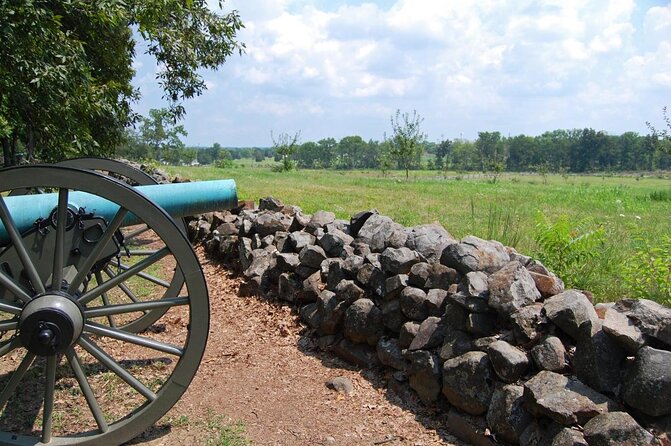
Gettysburg is famous for the three-day battle that changed the course of the Civil War, but this walk keeps bringing you back to the people who lived through it. Instead of treating the town as a backdrop to military events, the narration asks what happened inside houses, public buildings, hotels, and churches as the fighting closed in.
You begin at the Gettysburg Heritage Center at 297 Steinwehr Avenue. No guide waits there. You open the separate Action Tour Guide app, enter the password sent by email and text, and walk to the first story point. The audio is designed to start automatically as you reach each location.
The route includes more than 21 audio stories, although the main stops are grouped around 12 landmarks. Each listed stop has roughly five minutes of narration, but your actual time will depend on how often you pause, look around, shop, eat, or follow extra material in the app.
I like this format for Gettysburg because the town rewards slow looking. A house wall, a statue, or a courthouse can seem ordinary until you know what happened there. The app supplies the background, then lets you decide how long to spend with the building itself.
More Self-Guided Walking Tours in the USA
- Self Guided Classic Freedom Trail Location Aware (GPS) Walking Audio Tour
★ 4.5 · 258 reviews - Self-Guided Smartphone Ghost Walking Tour in Salem
★ 4.5 · 225 reviews - Cape Cod & Provincetown Self-Guided Driving & Walking Audio Tour
★ 4.0 · 207 reviews
Jennie Wade House: the human cost arrives first

The first stop introduces Jennie Wade, the only civilian killed during the Battle of Gettysburg. The story places her and her mother at Jennie’s sister Georgia’s house as Confederate troops advanced. The family feared soldiers might force their way inside, and they gathered together as the battle began.
That is a strong opening because it puts you inside the uncertainty of those days. You are not starting with a map of troop movements or a list of commanders. You are starting with a family trying to stay safe in a town about to become a battlefield.
The house also helps establish the tour’s focus on civilian experience. Gettysburg’s residents did not choose the battle, yet they had to shelter soldiers, care for the wounded, flee their homes, and live among the dead afterward.
Admission to the house is not included. You can listen from the tour route without buying an entry ticket, but you will need a separate ticket if you want to go inside any paid attraction.
Gettysburg National Cemetery: shallow graves and a national address
The route continues to Gettysburg National Cemetery, where the aftermath becomes the subject. Soldiers initially buried the dead near where they fell, Union and Confederate alike. Many graves were only about 12 inches deep because the army had to move on to other battles.
This short story gives you a useful reminder: the famous cemetery did not appear as a neat, finished memorial immediately after the fighting. The first task was simply to deal with thousands of bodies in a town already overwhelmed by destruction and sickness.
The cemetery also connects naturally to Abraham Lincoln and the Gettysburg Address, which becomes more important later at the David Wills House. You can treat this stop as a quiet pause in the route, but do not expect the audio alone to explain every cemetery detail. It is a brief story, not a full cemetery tour.
Admission is not included. The tour gives you the historical setting, while any visit inside a museum or paid site requires its own ticket.
Tillie Pierce House Inn: a teenager sees war up close
Tillie Pierce was 15 when the battle reached Gettysburg. Before the cannon fire began, she watched Union soldiers ride past with the excitement and curiosity of a young person witnessing history. Once the fighting started, that excitement gave way to fear.
She fled with Hettie Shriver and Hettie’s family to a farm three miles south of town, but distance did not protect her from the battle’s effects. The story is especially useful because it shows how quickly curiosity could turn into terror.
You will notice a pattern here. Jennie Wade, Hettie Shriver, and Tillie Pierce are not presented as famous political figures. They are people making hurried decisions with limited information. That makes the tour easier to connect with than a sequence of military facts.
The stop is outside the Tillie Pierce House Inn, and admission is not included. You may want to slow down here and give the story your full attention, since the route moves through active town streets.
Same place, a different route to walk:
- Fort Sumter Admission and Self-Guided Tour with Roundtrip Ferry
★ 4.5 · 3,343 reviews - San Francisco: Alcatraz Ticket, Ferry, & Self-Guided App
★ 4.5 · 2,460 reviews - Los Angeles: Hop-On Hop-Off Bus Tour with Audio Guide
★ 3.7 · 2,030 reviews - City Sightseeing Hop-On Hop-Off Bus Tour with Audio Guide
★ 3.0 · 1,083 reviews
Gettysburg Heritage Center: more than army movements

At the Gettysburg Heritage Center, the tour broadens its message. The battle made Gettysburg famous, but the town’s story is not only about soldiers and commanders. It is also about shopkeepers, families, children, wounded men, escaped residents, and people trying to restore daily life after the armies left.
This is one of the more useful stops for first-time visitors because it explains how to read the rest of the walk. Look beyond signs about regiments and generals. Ask what a building might have meant to the people living there in 1863.
The center is also the listed starting point, so it gives you a convenient place to get the app working before you set off. Download the tour before arriving, then test your phone, headphones, and GPS while you still have a strong signal.
Gettysburg Museum of History: artifacts and the problem of collecting

The Gettysburg Museum of History contains more than 4,000 Civil War artifacts in one of the country’s larger private collections of its kind. The narration uses the museum to talk about objects, battlefield remains, and the complicated history of collecting.
After the battle, residents and government workers tried to recover bodies and equipment. Some remained in shallow graves or in places that were difficult to find. Over time, some of those remains disappeared. The story adds an uncomfortable layer to the familiar image of Gettysburg as a carefully preserved historic site.
Admission is not included, so this stop works in two ways. You can listen from outside and continue, or you can pay separately to explore the collection. If you have only 1 to 2 hours, the audio story may be enough. If you enjoy objects and personal artifacts, you may want extra time here.
The Witness Tree and Abraham Lincoln’s route

The Witness Tree is tied to the battle, but its strongest connection is to Abraham Lincoln. He passed directly by the tree on his way to deliver the Gettysburg Address.
That detail helps link the town’s streets with the larger national story. Lincoln’s speech is usually remembered as something that happened at a ceremony, but this stop reminds you that he had to move through the town to reach it.
The route does not turn the tree into a long lecture. It gives you a clear detail, then lets you think about Lincoln’s journey and the town he was entering. As with many downtown stops, the nearby street setting may not feel solemn at every moment, so headphones help you focus.
Adams County Court House: public buildings become hospitals

During and after the battle, Gettysburg needed hospital space almost everywhere. Wounded soldiers were taken into available buildings, including the Adams County Court House, where doctors tried to treat injuries under grim conditions.
This stop shows why a downtown walking tour can add something that a battlefield drive cannot. You are looking at a civic building that had one purpose in normal times and another during the crisis. The courthouse was part of the town’s public life, then became part of the emergency medical system.
The story is brief, but its placement in the walk matters. It shifts the focus from people fleeing the battle to people who stayed behind and dealt with the wounded.
Shriver House Museum and the decision to flee

Hettie Shriver’s story returns you to the civilian experience. When fighting broke out, she took her family south to her parents’ farm, about three miles from town. Her choice was familiar to many Gettysburg residents who had to decide whether to remain near home or leave with whatever they could carry.
The Shriver House Museum offers a more focused look at this story, but entry is not included. You can still hear the narration outside and understand why the house matters.
I find these linked stories about Hettie, Tillie, and Jennie especially useful. They prevent the tour from turning Gettysburg into a distant military pageant. You hear about fear, hurried travel, shelter, and the danger faced by people who had no command over the events around them.
David Wills House: from local attorney to national memory
David Wills was a Gettysburg attorney and an important local figure. He helped organize the creation of the national cemetery, giving him a central role in how the town responded to the dead.
The house also connects directly to Lincoln’s Gettysburg Address. It is one of the route’s most important stops because it links local administration with national memory. Gettysburg was not only a place where soldiers fought. It was also a place where residents had to organize burials, hospitals, public order, and memorial plans.
Admission is not included. If you are trying to keep the outing close to two hours, listen to the story and continue. If you have time for paid attractions, this is one of the locations that deserves extra attention.
Hotel Gettysburg and the town before the battle
The Hotel Gettysburg building dates to 1797. Before it became a hotel, it began as a tavern and was owned for a time by the prominent McClellan family.
This stop widens the time frame. Gettysburg was not created by the Civil War. It had businesses, families, lodging, and a commercial life before the battle brought national attention. That older layer helps you see the town as a real community rather than a historic stage set.
The stop is also a useful break in the rhythm of battlefield stories. You get a small piece of local architecture and town history before returning to questions of memory and public meaning.
The Lincoln statue and the common citizen
Near the Wills House, a statue shows Lincoln beside an unnamed man. The man has no personal name because he represents the common citizen.
It is a simple idea, but a useful one. Lincoln is often treated as a monument in human form, while the unnamed figure brings the story back to ordinary people. The sculpture asks you to consider why Gettysburg still matters to people who are not soldiers, politicians, or historians.
This is a good place for a photo and a pause. The audio adds meaning that may not be obvious from the statue alone.
GAR Hall and the long afterlife of the war
The final listed stop is the Grand Army of the Republic Building, usually called GAR Hall. The government established the organization after the war to support Union veterans. Members gathered, shared stories, and helped one another through later hardships.
This ending moves the tour beyond 1863. Gettysburg was not finished with the battle when the armies left. Veterans continued to shape the town’s identity, and organizations such as the GAR helped preserve bonds formed during the war.
The stop is free, unlike most of the museum and house attractions along the route. It also gives the walk a sensible closing thought: history is not only what happened during the battle. It is also what people chose to remember and how they cared for one another afterward.
How the app works in real conditions
Before you arrive, download the Action Tour Guide app and the Gettysburg tour while you have strong Wi-Fi or cellular service. Enter the password sent by email and text. Search for audio tour in your messages if the instructions are hard to find.
The tour is designed to work offline after downloading. Audio stories should begin as you reach their location, and the map can guide you between points. You can pause, skip stories, return to earlier sections, or listen to extra material at your own speed.
The technology is also the tour’s weak point. One person had trouble getting the map and audio to match the location and stopped using it. Another found that street noise made the narration hard to hear and relied on the written information instead.
I suggest using one device per booked person when possible. The password can be used on the same number of devices as the number of people booked. Couples can share one tour by splitting headphones, but that is less convenient on a noisy street.
The listed route starts and ends at the Gettysburg Heritage Center. At least one account described the walk as one-way and ending near the train station, requiring a walk back, so I would leave extra time and confirm the route in the app before setting out. The tour is more than one mile, and the route may feel longer if you stop at attractions or return to the starting point.
Is $9.99 a fair price?
For $9.99 per person, this is a modest way to add structure to a downtown visit. You get narrated stories, written material, videos, offline maps, location-based playback, extra content, and lifetime access. That last point matters if you plan to return to Gettysburg or want to replay the tour at home.
The value is strongest if you want to explore independently. You can start any day, use the tour over multiple days, and take breaks without holding up a group. You also avoid the higher cost of a private guide.
A live guide may suit you better if you want to ask questions, avoid phone navigation, or hear clearly without headphones. The app cannot react to your interests or adjust the route when a building is crowded. At this price, though, it is a useful supplement to a wider Gettysburg visit.
Free cancellation is available until 24 hours before the scheduled start time. Inside that window, the amount paid is not refunded.
Who should book this walk?
Book it if you like history in small portions, want freedom over your schedule, and are comfortable using a phone app. It is particularly good for someone with only a short downtown visit who wants more context than plaques provide.
Families may appreciate the stories about Jennie Wade, Tillie Pierce, and Hettie Shriver, though younger children may need help with the app and the difficult subject matter. People who prefer a fully guided experience should choose a live tour instead.
My practical advice is simple: download everything before you arrive, bring headphones, charge your phone, and allow more than the advertised 1 to 2 hours if you plan to enter museums, eat, shop, or retrace part of the route. Keep the written text available in case street noise overwhelms the narration.
Should you book the Gettysburg downtown audio tour?
Yes, if you want a low-cost, flexible introduction to Gettysburg’s town center. Its best material focuses on civilians, hospitals, burials, veterans, and the way Lincoln’s visit fit into local life. The self-paced format is genuinely useful.
Skip it if app navigation regularly frustrates you or if you want a guide who can answer questions on the spot. For everyone else, $9.99 is a fair buy, especially because access never expires and you can use it again on a future Gettysburg visit.
FAQ
Where does the Gettysburg audio tour start?
It starts at the Gettysburg Heritage Center, 297 Steinwehr Avenue, Gettysburg, Pennsylvania.
How long is the walking tour?
The route is over one mile and takes about 1 to 2 hours, depending on your pace and how often you stop.
How many audio stories are included?
The tour includes more than 21 audio stories. The listed route groups them around 12 main stops.
Is the tour available in languages other than English?
No. The tour is offered in English.
Are museum and attraction tickets included?
No. Entry tickets, attraction passes, and reservations are not included. The GAR Hall stop is listed as free.
Do I need cellular service during the walk?
You must download the tour while using strong Wi-Fi or cellular service. After downloading, the tour works offline with offline maps.
Can I use the tour more than once?
Yes. The tour provides lifetime access with no expiry. You can use it on another visit or listen to it at home.
Just added around the USA
- Springfield Self-Guided Walking Audio Tour★ 4.0 · 5 reviews
- Smartphone Guided Indianapolis Downtown Sites Audio Walking Tour★ 4.5 · 7 reviews
- Smartphone-Guided Walking Tour of Downtown Indianapolis Sights & Stories★ 4.0 · 25 reviews
- Indiana Dunes National Park Self-Guided Audio Tour★ 3.5 · 4 reviews
- Self-Guided Audio Driving Tour in Kancamagus Highway★ 4.5 · 6 reviews
- An Epic Scavenger Hunt: Bloomington Scenic Southern Indiana★ 3.5 · 6 reviews
- Huntsville Rocket City Smart Phone Self Guided Audio (GPS/APP) Walking Tour★ 4.5 · 5 reviews
- Sights of Downtown Houston Smartphone Audio Walking Tour★ 4.0 · 7 reviews
USA Audio Tours, compared.
Fort Sumter Admission and Self-Guided Tour with Roundtrip Ferry
Read our review →
San Francisco: Alcatraz Ticket, Ferry, & Self-Guided App
Read our review →
Los Angeles: Hop-On Hop-Off Bus Tour with Audio Guide
Read our review →
City Sightseeing Hop-On Hop-Off Bus Tour with Audio Guide
Read our review →
Medieval Torture Museum Ticket with Audio Guide and Ghost Hunting
Read our review →

Ryman Auditorium Self-Guided Tour with Souvenir Photo Onstage
Read our review →
Red Rock Canyon Self-Guided Electric Bike Tour
Read our review →Browse the lists this tour appears in