
REVIEW · FRANCE AUDIO TOURS
Dijon City Self Guided Walking Tour through Smartphone App
Dijon’s best stories are tucked into ordinary streets: a tiny owl on a church wall, a mustard shop with centuries of flavor, and a palace built by dukes who once rivaled the French king. This self-guided smartphone tour links those sights into one clear walk, from Darcy Square to the Archaeological Museum.
I like the freedom to pause for coffee, enter a church, or linger over the market without holding up a group. I also like the mix of grand sights and small details, especially the owl, the Bareuzai wine-harvester statue, and the glazed tiles of Hôtel de Vogüé. The main drawback is timing: the tour is advertised at about two hours, but the full route can take longer, particularly if you stop inside museums or wait to climb the tower.
Key points to know before you go
- Fourteen stops connect Dijon’s major sights from Darcy Square to the Archaeological Museum.
- The audio and written guide work offline after you download the tour, so you do not need a constant internet connection.
- Tour Philippe Le Bon requires 316 steps, making the tower visit the most physically demanding part.
- The route mixes food, architecture, religion, and politics, from Dijon mustard and gingerbread to the Dukes of Burgundy.
- You control the pace, but map directions may take a little getting used to at first.
- The price is $8.47 per person, a low-cost choice if you want orientation and background without hiring a private guide.
From Darcy Square to Dijon’s art and civic story
The route begins at Darcy Square, at 21 Place Darcy. This is a practical starting point because the walk quickly moves into Dijon’s central streets, where the city’s public art and political past begin to overlap.
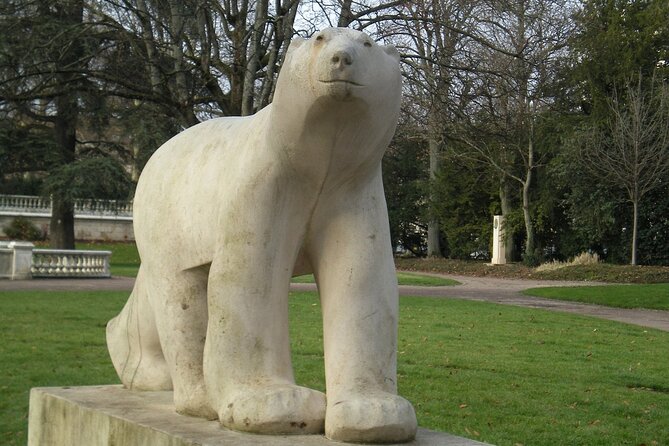
One early stop focuses on François Pompon’s Polar Bear in its Stride. The statue connects Dijon with Pompon’s artistic legacy and gives you an easy introduction to the city’s place in French art. The tour also explains Henry Darcy’s contribution to Dijon, adding a civic and engineering thread to the opening section.
I appreciate this start because it does not rush straight to the most famous church or palace. You get a sense of the people who helped shape the city, both through art and public works. The explanations are delivered through the app, so you can look at the statue first and then listen without trying to keep up with a walking guide.
The next major sight is Porte Guillaume. What you see today is tied to several periods of Dijon’s past. The tour explains how this gateway changed from a medieval entrance into a triumphal arch honoring important historical figures, including connections to the Prince of Condé.
Take time to inspect the reliefs. They are not just decoration. They help tell the story of Dijon’s changing political identity. This is one place where the audio format earns its small price, since a quick glance at the arch gives you only part of the picture.
More Self-Guided Walking Tours in France
- Arles Vincent Van Gogh Walking Tour with an APP
★ 3.8 · 64 reviews - Strasbourg Walking Tour with Audioguide on Your Smartphone
★ 4.0 · 42 reviews - Toulouse “Ville Rose”: Interactive Game & Walking Tour
★ 3.5 · 24 reviews
Mustard, medieval streets, and Bareuzai Square
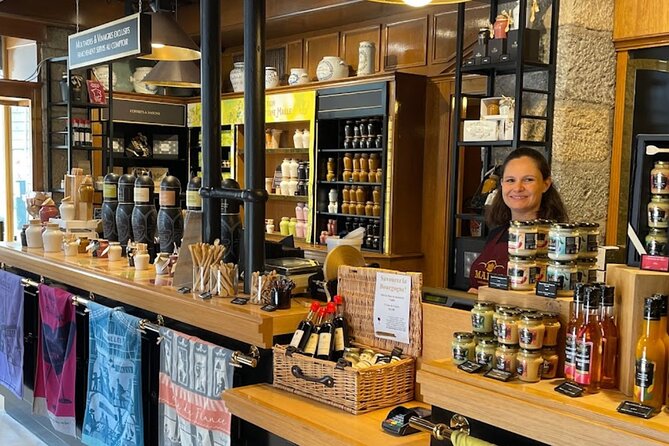
Dijon’s food identity arrives early at the Maille boutique. The stop explains the shop’s connection to Dijon mustard and the traditional, artisanal process behind it. This is useful context before you start sampling local foods elsewhere in the city.
The tour does not include snacks, so plan to buy anything you want to taste separately. That is not a serious weakness at this price, but it matters if you are expecting a food tour. This is a walking tour with food history, not a tasting experience.
From there, the route brings you along François Rude Street. Medieval and Renaissance buildings give this part of the walk a strong sense of place, and the app points out details you might otherwise pass without a second look.
Bareuzai Square adds a more playful note. Its wine-harvester statue recalls Burgundy’s vineyard culture and gives the square a clear local identity. I like this section because it connects architecture with everyday regional traditions rather than treating Dijon as a list of monuments.
The app’s images help you identify each stop. That is especially helpful when a detail is small or when several nearby streets look similar. The map uses smartphone GPS, though one person found that the route took a little time to understand at first. I would download everything before setting out and spend a minute checking how the map advances from one stop to the next.
The covered market and Dijon’s food culture
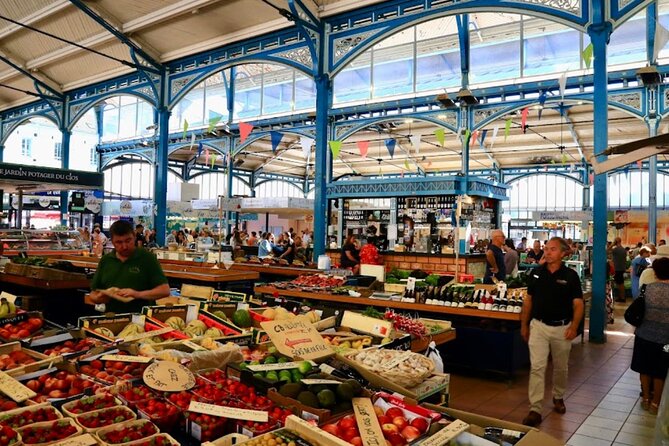
The historic indoor market is one of the route’s strongest stops. Its design is linked to Gustave Eiffel, giving the building an architectural interest beyond its stalls and food counters.
This is where you can pause the tour and take in Dijon’s food culture at your own speed. The stop points you toward local delicacies and unusual regional products, but it does not promise a guided tasting or a set snack. Bring some spending money if you want to sample what catches your eye.
I find the market particularly valuable as a travel stop because food says a great deal about a city. The route gives you enough background to understand why Burgundy is more than wine and mustard, while leaving you free to explore rather than funneling you through a fixed tasting plan.
The two-hour estimate includes both listening and walking time. A quick, focused visit could fit close to that schedule, but I would allow extra time for the market, photographs, food purchases, and any museum or church interiors that are open.
Notre-Dame and Dijon’s famous little owl
Notre-Dame is one of the route’s central landmarks. The tour covers its Gothic character, stories of miracles, and the Black Madonna. These religious symbols give the church an unusual layer of meaning beyond its stonework and stained glass.
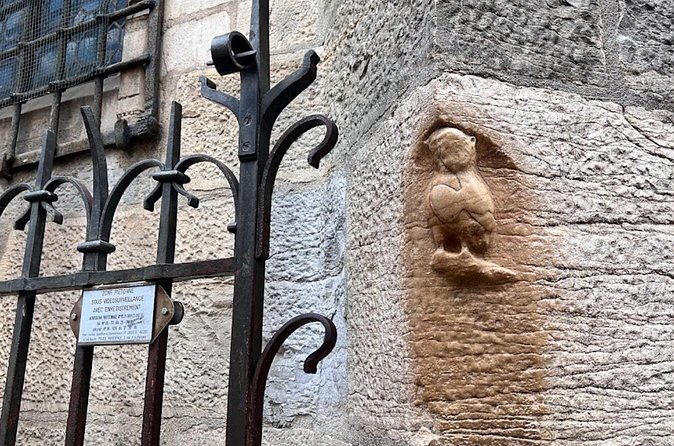
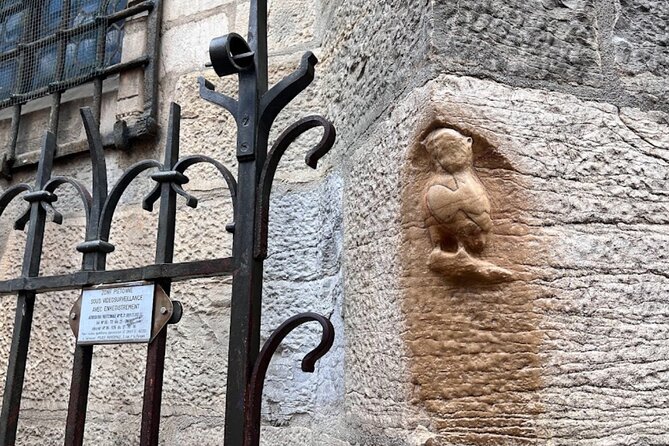
The famous Dijon owl is nearby and has become one of the city’s best-known small attractions. The app explains the legends and local customs connected to the sculpture, including why people treat it as a protective sign or talisman.
This is an excellent example of the tour’s balance. You get a major Gothic church, then a tiny carved figure that has captured the city’s imagination. Look carefully at the owl when you reach it. The route is designed to help you identify the spot, but you still need to pay attention to the building and street around it.
Because this is a self-guided walk, you can pause the narration while taking photographs or listening to the surroundings. That freedom is more useful here than it would be on a tightly managed group tour.
More Smartphone App Tours in France:
- Paris: Orsay Museum Entry Ticket and Digital Audio Guide App
★ 4.4 · 3,170 reviews - Caen: Memorial Museum Entry Ticket & Optional Audio App
★ 4.6 · 272 reviews - Paris: Louvre Ticket with Audioguide App and Seine Cruise
★ 3.5 · 71 reviews - Paris: Rodin Museum Ticket & Optional Digital AudioGuide App
★ 4.7 · 56 reviews
Hôtel de Vogüé and Saint Michael’s Church
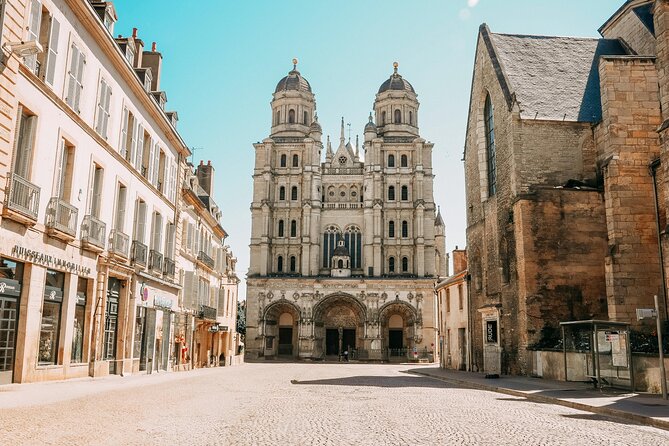
Hôtel de Vogüé is a Renaissance building known for Burgundy’s patterned glazed roof tiles. The tour explores the building’s interiors and the people and events connected with it over the centuries.
The tiles are one of the visual highlights of Dijon. They make the building easy to recognize and show how local architecture can be both practical and decorative. If the interior is open when you pass, you can decide for yourself how long to stay. The app provides the background, but it does not replace seeing the rooms in person.
Saint Michael’s Church offers a different architectural lesson. Gothic and Renaissance elements appear together, creating a building that reflects changing styles rather than a single clean design. The stop also introduces Saint Elisabeth of the Trinity and the lasting effect of her faith.
I like this pairing because it keeps the route from becoming a parade of similar churches and palaces. Hôtel de Vogüé gives you civic and residential architecture. Saint Michael’s adds religious art and personal devotion.
The Dukes of Burgundy and 316 steps above Dijon
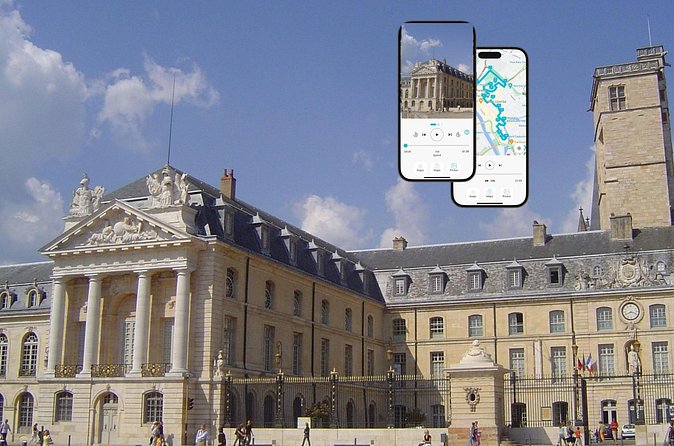
The Palace of the Dukes of Burgundy is the political heart of the route. The tour explains how Dijon grew under powerful dukes whose wealth and influence could rival the French monarchy.
This stop helps you read the city’s grand buildings in context. The palace was not simply an attractive government building. It expressed power, ambition, and the importance of Burgundy within medieval and early modern France.
The route then turns upward at Tour Philippe Le Bon. Reaching the top requires climbing 316 steps, so this is the one part of the experience that needs a clear physical commitment. The reward is a broad view over Dijon, along with stories about the duke associated with the tower and the prestigious Order of the Golden Fleece.
I would not treat the tower as a casual add-on. If stairs are difficult for you, the tour remains worthwhile without making the climb. If you are comfortable with the ascent, schedule enough time for the steps and the view rather than trying to squeeze them into a strict two-hour plan.
The tower is also where the audio format has an advantage. You can listen before climbing, pause during the ascent, and continue when you reach the top. No guide is waiting for the whole group to gather.
Saint-Bénigne, gingerbread, and the final museum
Cathédrale Saint-Bénigne brings the route back to Dijon’s religious and architectural past. The tour covers the Gothic cathedral, stained glass, carvings, and the old crypt below. Together, these details show how the building changed over time and why it remains one of Dijon’s key sights.
The crypt adds a different mood from the open streets and busy market. Check the cathedral’s access when you visit, since the tour can explain a feature even if you cannot spend much time inside.
Next comes the Mulot and Petitjean Gingerbread Factory. This stop introduces more than two centuries of local baking tradition and the flavors associated with Dijon’s signature gingerbread.
Like the mustard stop, this is culinary background rather than an included tasting. You can treat it as a shopping opportunity if the shop is open, or simply use the narration to understand another part of the city’s food identity. The combination of mustard and gingerbread gives the walk a welcome change from architecture and church interiors.
The route ends at the Musée Archéologique de Dijon, at 7 Rue Dr Maret. The museum covers Burgundy’s ancient past through objects ranging from prehistoric tools to Roman burial monuments. It is a fitting finish because the walk has moved through Dijon’s medieval, Renaissance, religious, political, and culinary stories before arriving at the region’s earliest known remains.
The listed opening hours are 9 a.m. to 7 p.m., Monday through Sunday, for the stated operating period. Since museum schedules can change, check before you set out if entering the museum is important to your plan.
How the app works in real use
You receive access instructions by email from Tourific after booking. The tour is available for one year on iOS and Android, and you can listen to it as often as you like during that period.
Both audio and written information are included. That is useful if you prefer reading, need to replay a section, or are walking with one shared phone and earbud. One person used a single earplug for two people, which worked, though a small speaker or two sets of earbuds may be more comfortable.
The interactive map includes images for identifying stops and uses GPS to guide you along the route. It is not entirely foolproof. Give yourself a moment to learn how the map signals the next stop, especially near clustered buildings and narrow streets.
Download the tour before leaving Wi-Fi. Offline access means you can continue without a data connection, and it also helps preserve your phone battery and data plan.
The access period is generous, but the route itself is designed as one walk. You can split it up if you want, though the experience works best when you have enough time to follow the story from the city’s western starting point to the Archaeological Museum.
Is $8.47 good value?
At $8.47 per person, this is inexpensive for a route covering fourteen stops and a wide range of subjects. You are paying for a planned route, historical explanation, written notes, images, GPS guidance, and year-long app access.
The strongest value comes from the breadth. A short walk can take you from Pompon and Darcy to Porte Guillaume, mustard, market architecture, Notre-Dame, the owl, the ducal palace, the tower, Saint-Bénigne, gingerbread, and archaeology.
The price is less compelling if you want a live guide, personal questions, or included food. There is no guide named for the experience because it is fully self-guided, and snacks are not included.
The satisfaction guarantee also lowers the risk. You can request a full refund if you do not like the tour, provided you follow the stated cancellation terms and cancel at least 24 hours before the start time. Within 24 hours, the payment is not refunded.
Who should choose this Dijon walk?
I would choose this tour if you want a low-cost introduction to Dijon and prefer to set your own pace. It suits independent visitors, couples, families who do not want to keep a group schedule, and anyone who likes having both audio and written material.
It is also a good fit for a first visit because the route gathers many of Dijon’s signature sights in one walk. You can use it for orientation, then return later to the market, palace, churches, or museum that interests you most.
I would choose a live guided tour instead if you want conversation, detailed answers, or help making quick route decisions. I would also avoid treating the two-hour estimate as a hard promise. The route can take longer, especially if you climb Tour Philippe Le Bon, enter museums, stop for food, or pause often.
Should you book the Tourific Dijon walk?
Book it if you want structure without a schedule. The route gives you a clear path through Dijon while leaving room for coffee, photos, churches, food, and spontaneous stops.
Its best features are the broad subject range, the low price, and the freedom to replay information. The main cautions are the longer real-world timing, the need to learn the app’s map, and the 316-step tower climb.
For $8.47, I think it is a sensible way to meet Dijon before deciding where to spend more time. Download it in advance, start with a full phone battery, allow at least a little more than two hours, and treat the route as a flexible framework rather than a race.
FAQ
Where does the Dijon walking tour start?
The tour starts at Darcy Square, 21 Place Darcy, 21000 Dijon, France.
Where does the tour finish?
It finishes at the Musée Archéologique de Dijon, at 7 Rue Dr Maret, 21000 Dijon, France.
How long does the walking tour take?
The stated duration is about two hours, including walking and listening time. You may need longer if you linger at stops, visit museums, or climb the tower.
How much does the tour cost?
The listed price is $8.47 per person.
Is the tour guided in person?
No. It is a self-guided experience accessed through a smartphone app.
What languages are available?
The tour is offered in English.
Does the app work without internet access?
Yes. You can use the tour offline after downloading it.
Is a mobile ticket included?
Yes. The experience provides a mobile ticket and app access instructions by email.
Does the tour include food or snacks?
No. Snacks are not included.
How many steps are there to the top of Tour Philippe Le Bon?
The tower climb involves 316 steps.
How long can I access the tour?
You receive one year of access on iOS or Android and can listen as often as you like during that period.
Can I cancel for a refund?
Yes. Free cancellation is available up to 24 hours before the experience start time. Cancellations within 24 hours are not refunded.
Just added around France
- Grenoble Scavenger Hunt and Sights Self-Guided Tour★ 3.0 · 4 reviews
- Metz Scavenger Hunt and Highlights Self Guided Audio Tour★ 4.5 · 3 reviews
- Dijon with an Archaeologist: A Self-Guided Audio Tour★ 4.5 · 26 reviews
- Colmar Walking Tour with Audioguide on Your Smartphone★ 4.5 · 22 reviews
- Self-Guided and Interactive City Tour – Colmar★ 4.5 · 45 reviews
- Colmar Self Guided Tour with Mobile Application★ 4.0 · 10 reviews
- Colmar Scavenger Hunt and Sights Self-Guided Tour★ 4.5 · 24 reviews
- Colmar Scavenger Hunt and Highlights Self Guided Audio Tour★ 4.0 · 24 reviews
France Audio Tours, compared.
Paris: Illuminations River Cruise with Audio Commentary
Read our review →
Paris: Louvre Museum Hosted Entry and Mona Lisa Audioguide
Read our review →
Paris: Orsay Museum Entry Ticket and Digital Audio Guide App
Read our review →
From Paris: Giverny Day Trip with Audio Guide or Live Guide
Read our review →
Paris: Eiffel Tower Access w/ Audioguide and Optional Cruise
Read our review →
Giverny and Monet’s House Half Day Trip from Paris Guide or Audio
Read our review →
Paris: Catacombs Entry & Seine River Cruise with Audio Guide
Read our review →
Paris: Tootbus Panoramic by Night Bus Tour with Audioguide
Read our review →Browse the lists this tour appears in