
REVIEW · COLOGNE AUDIO TOURS
Roman Cologne: A Self-Guided Audio Tour
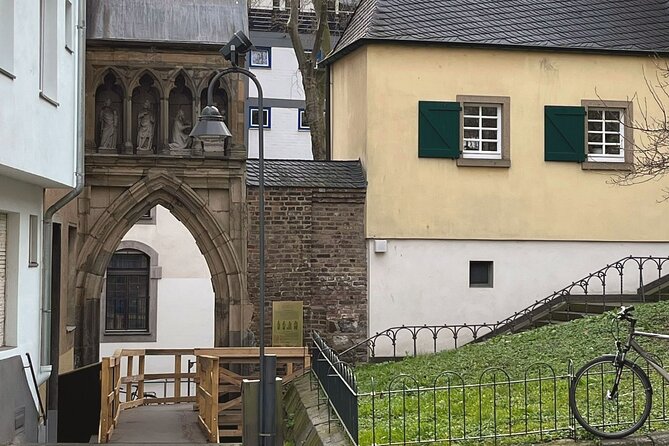
Roman Cologne is easiest to understand when you realize that much of the ancient city sits beneath the modern one. This self-guided walk uses the VoiceMap app to connect visible landmarks, buried remains, and odd details, from the Roman harbor road to a moon-landing reference carved into Cologne’s story.
I like the go-at-your-own-pace format and the fact that you can download the audio, map, and location data for offline use. I also like the route’s range: you get the cathedral, Roman government buildings, a huge mosaic, medieval churches, and lesser-known clues in one short walk.
The main catch is that this is a narrative route, not a flexible map tour. Start at the dedicated point near the Kreuzblume and follow the route forward. If you begin somewhere else, or try to walk it backward, the GPS-triggered commentary can become confusing.
Key points to know before you go
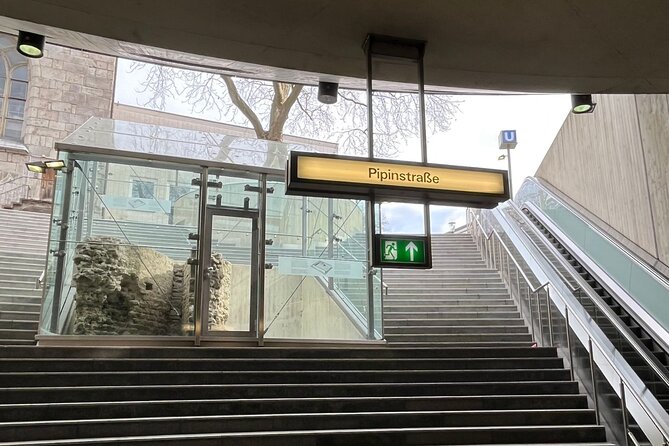
- Roman Cologne beneath today’s streets: Hear how ancient roads, palace remains, harbor structures, and temple sites relate to the modern city.
- A 60 to 90 minute walking route: The tour covers a compact central area and ends near the Ubii Monument.
- Offline after setup: Download the audio, map, and geodata to your Android or iOS phone before setting out.
- English narration only: The tour is designed for listeners who want historical context while walking, rather than a live guide.
- Several unusual details: Look for Roman soldiers on a Gothic facade and learn what the 1969 moon landing has to do with Cologne’s ancient past.
- No admission fees included: You pass museums and monuments, but entrance tickets, food, drinks, transport, headphones, and a smartphone are your responsibility.
Start at the cathedral, then look below the pavement
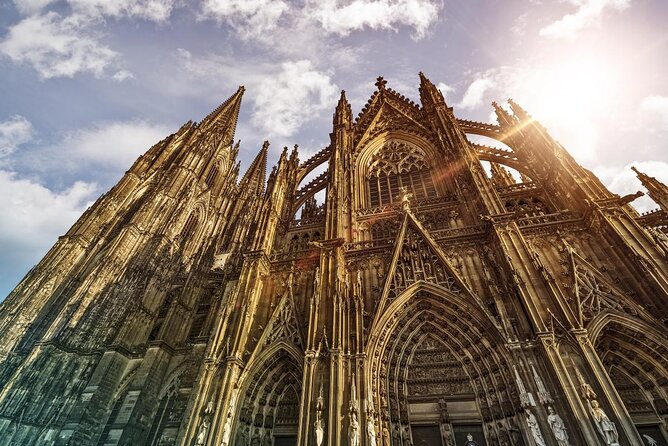
The tour begins in front of the Kreuzblume, beside Cologne Cathedral at Domkloster 4. The cathedral itself is not the main subject of the route, but it gives you a useful first lesson in Cologne’s layered past. You will hear about the great church as you walk by, while the commentary shifts your attention from the Gothic building above to the Roman city below.
This opening works best if you arrive a few minutes early and get your bearings. The route is designed to move forward from its dedicated start, and one poor experience came from beginning somewhere other than the cathedral and trying to follow the audio in reverse.
The app uses your phone’s location to trigger sections as you reach the right places. That means you can usually put the phone away and listen while walking, but you should still check the instructions before leaving. Download everything first, including the map and geodata, so you are not depending on mobile data or international roaming.
More Audio Tours in Germany:
- Dortmund: BVB Self-Guided Stadium Walk
★ 4.5 · 3,195 reviews - Neuschwanstein Castle Skip-the-Line Ticket with Audio Guide
★ 4.4 · 1,388 reviews - Berlin: Solar Powered Sunset Catamaran Cruise & Audio Guide
★ 4.6 · 1,043 reviews
Cologne Cathedral and the Romans’ Northern Gate
The cathedral is an impressive first landmark, even if you are mainly here for Roman remains. The commentary helps place it in the larger story of the city instead of treating it as an isolated church. You pass by rather than take a cathedral tour, so do not expect interior access or a detailed explanation of every Gothic feature.
From there, the route points toward the Romans’ Northern Gate. This is the kind of stop that benefits from narration because the modern street pattern does not always make ancient Cologne easy to picture. Audio can explain what the gate meant as part of the Roman city, while you use the present-day street to imagine its former position.
I like this early contrast. The cathedral gives you Cologne’s most famous medieval and modern sight, then the Roman gate reminds you that the city’s story began long before the building you came to photograph.
A Roman mosaic viewed through a museum window
One of the route’s most practical stops comes at the Roman-Germanic Museum. You look through a window to see one of the world’s largest and best-preserved Roman mosaics.
This is a good example of how the tour handles attractions that may not be part of your ticket plan. You get a view and an explanation without an included museum visit. Since entrance fees are not covered, the window view matters for anyone taking the walk as a low-cost activity or visiting when a museum stop does not fit the schedule.
The mosaic also gives the Roman period a human scale. Roads, gates, and palace remains can feel abstract. A carefully made floor, seen at close range, offers a clearer sense of the wealth and skill present in Roman Cologne.
The imperfect Roman Harbour road at Kurt Hackenberg Platz
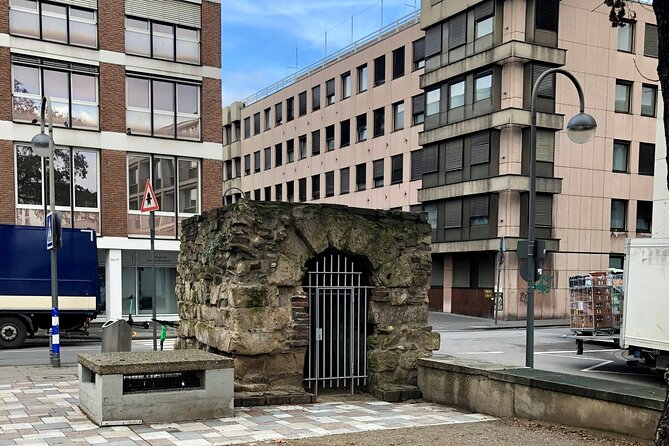
The route continues down Die Römische Hafenstraße in Köln, the Roman harbor road. The key point here is not simply that an old road existed, but that its reconstruction at Kurt Hackenberg Platz is imperfect.
That imperfection becomes part of the lesson. Reconstructed archaeology is an interpretation, not a time machine. The audio explains why the road was rebuilt as it was, giving you a useful warning against treating every modern stone arrangement as untouched Roman fabric.
This is one reason an audio route can work well in Cologne. You may walk past a paved feature without knowing what it represents, how accurate it is, or why it sits in that particular place. The narration adds that missing link without requiring you to read a long panel.
Same place, a different route to walk:
- Berlin: Boat Sightseeing Cruise with Audioguide
★ 4.6 · 947 reviews - Füssen: Neuschwanstein Castle Express Ticket and Audio Guide
★ 3.9 · 788 reviews - Neuschwanstein Castle Ticket With Audio Guided Tour
★ 3.5 · 473 reviews - Berlin: Self-Drive Boat Tour
★ 4.9 · 430 reviews
The Roman Praetorium and the power center of the city
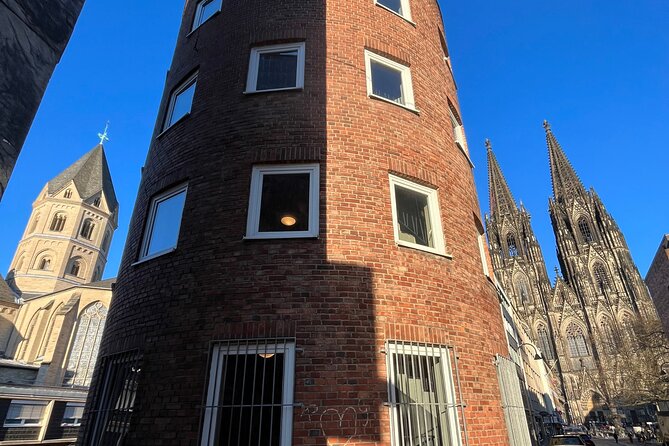
Next comes the Römisches Praetorium, described as the largest Roman palace in the Rhineland. This was a major administrative and political site, so it gives the route a stronger sense of scale.
The stop is especially useful if you enjoy understanding how cities were run, not just seeing old stones. The commentary connects the remains to Roman authority in the region and helps explain why Cologne mattered.
You pass the site rather than receive a guided archaeological visit inside it. That keeps the tour simple and inexpensive, but it also means the experience depends on the audio and whatever you can see along the route. If you want a museum-style presentation, you will need to arrange that separately.
Alter Markt and Great St Martin Church
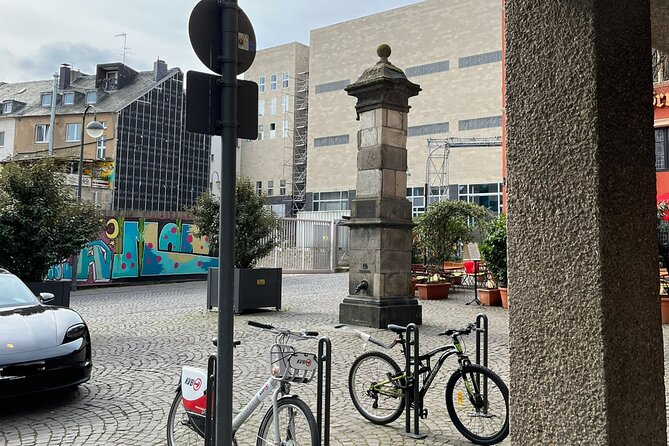
The route then passes through the Alter Markt, Cologne’s old market area. This section shifts from Roman government to the later city that grew over and around the ancient one.
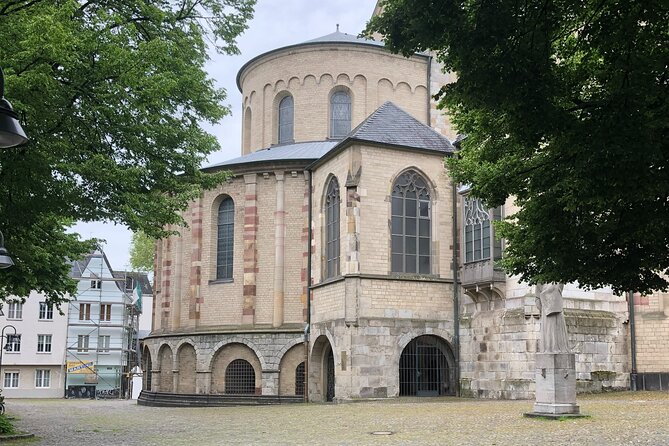
Great St Martin Church adds another useful connection. The medieval church was built on the foundations of a Roman warehouse. That fact neatly sums up the tour’s main idea: later Cologne did not replace Roman Cologne so much as build over it, reuse it, and occasionally reveal it.
I find this kind of connection more valuable than a list of dates. You begin to see the city as a set of old uses layered under new ones. A warehouse can become a church foundation, a harbor road can become a reconstructed feature, and a modern plaza can preserve a clue to ancient trade.
Schmitz Säule and the strange moon-landing connection
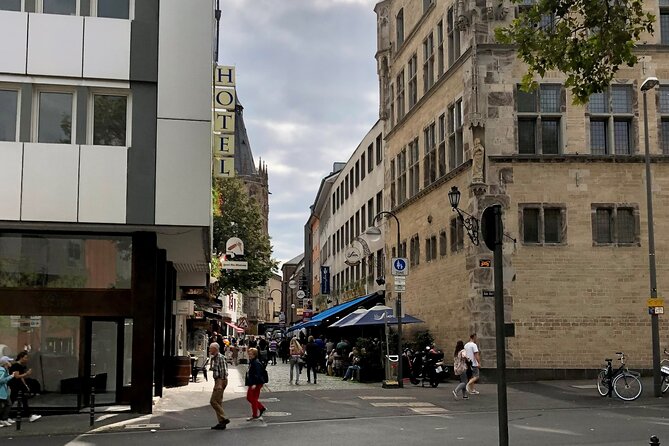
At Schmitz Säule, the audio explains what the 1969 moon landing has to do with the ancient Romans in Cologne. This is one of the route’s more unusual turns, and it helps prevent the walk from becoming a steady march through predictable ruins.
The supplied information does not spell out the full story in advance, which is a good reason to keep this section in the audio rather than reducing it to a quick fact here. You will encounter the connection at the site, where the surrounding city gives the story its setting.
Stops like this also suit people who already know Cologne. One person who had lived in the city for almost 30 years still learned new things about places including the Höherstraße and Gürzenich. You do not need to be a Roman-history specialist to benefit from the route.
Roman soldiers on the Gürzenich facade
The tour next points out the celebrated Roman soldiers Marsilius and Agrippa on the imposing Gothic facade of Gürzenich Köln. This is a fine example of how the route looks for Roman references outside formal archaeological sites.
You are not just moving from ruin to ruin. Instead, the commentary asks you to notice how later buildings and public spaces remembered, reshaped, or displayed the Roman past. The Gothic facade becomes part of the Roman story because of the figures shown on it.
This stop rewards careful listening. If you walk with the phone in your pocket, as the app intends, make sure you still look up when the directions cue you to inspect a building. The audio is useful, but the physical details are the point.
The former temple district and St Maria im Kapitol
The walk passes through the former Roman temple district and by St Maria im Kapitol. Here, the tour returns to religion and public life in ancient Cologne, while showing how a later church occupies the same broad historical setting.
As with Great St Martin, the interest lies in the change of use. The present building belongs to a later era, but the route uses it to explain the Roman district that came before. That makes the stop more rewarding than simply photographing the church and moving on.
By this stage, the route has covered government, commerce, religion, roads, military imagery, and domestic art. The range helps explain Roman Cologne as a working city rather than a collection of isolated ruins.
Finish near the Ubii Monument
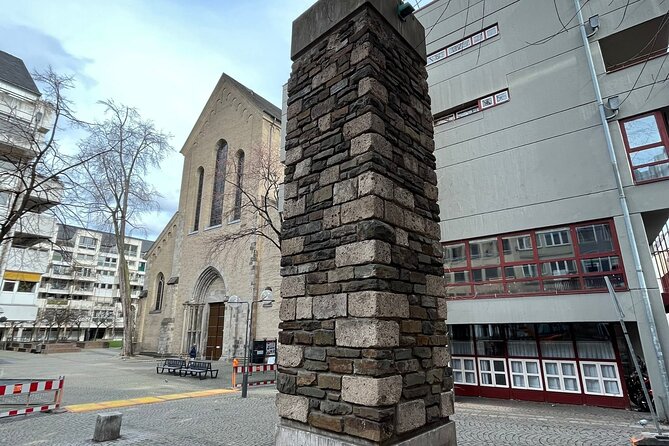
The tour ends near the Ubii Monument at Mühlenbach 35. The monument is described as the oldest stone tower in Germany, giving the walk a strong final stop.
Ending here works well because the monument brings the focus back to the city’s earliest Roman-era foundations. It also gives you a clear endpoint instead of leaving you to guess when the commentary is finished.
The route does not include transport back to your hotel or starting point. Plan your next move after reaching the Ubii Monument, especially if you have a timed booking elsewhere. The walk is compact, but the one-way format still matters.
What the $11.99 price gets you
At $11.99 per person, this is a modest-cost way to add structure to a walk through central Cologne. You are paying for lifetime access to the English tour, the VoiceMap app, the audio, the map, and the location data. There is no expiry date, so you can use it on a later visit if the timing is not right today.
The value is strongest if you want context but do not need a live guide. You can pause at a cafe, stop for photos, skip a location, or split the route across part of a day. You also avoid the cost of a private guide, though you give up the chance to ask questions.
The price does not cover museum admission, attractions, food, drinks, transportation, a smartphone, or headphones. Those exclusions are normal for an audio walk, but remember them when comparing the cost with a guided city tour.
How the app works in real life
You receive confirmation at booking and use the VoiceMap app on Android or iOS. Download the tour before you start. The included files are meant to let you access the audio, map, and geodata offline.
One complaint came from someone who expected the tour to work without internet but could not use it. The provider’s response says the downloaded files are stored on the phone, so the practical lesson is simple: complete the download and setup before reaching the start. If the app asks for permissions or directions, handle those while you have a reliable connection.
The GPS format is convenient because the audio can play automatically at the right location. It also explains why walking backward is not recommended. The route follows a narrative sequence, and the app is built around that forward order.
Who will like this walk most
I would choose this tour if you enjoy history but prefer to set your own pace. It suits a solo visitor, a couple, or a small private group that wants to explore together without a guide setting the rhythm.
It is also useful on days when many attractions are closed. The route remains an outdoor activity, and it can fill roughly an hour to an hour and a half while showing you parts of Cologne you might otherwise pass without noticing.
Families may appreciate the short length and the strange details, though the amount of historical explanation will suit older children more than very young ones. People who want a polished live performance, detailed museum access, or spontaneous questions should choose a different format.
The overall rating is 3.9 from 15 reviews, which suggests a mixed but generally useful experience. The strongest praise centers on the easy pace, the pleasant narration, and the way the audio puts visible places into context. The main complaints involve starting in the wrong place, finding the story dull, or failing to prepare the offline download.
Should you book Roman Cologne?
Book it if you want an affordable, English-language walk that explains what lies beneath Cologne’s streets. The best reasons are the Roman mosaic, Praetorium, harbor road, temple district, and the odd connections at Schmitz Säule and Gürzenich.
Skip it if you want entrance tickets, a live guide, or a route you can freely reverse. Start at the Kreuzblume, download the full tour, bring headphones, and follow the sequence. With that small amount of preparation, the walk offers a useful historical frame for central Cologne without tying you to a timetable.
FAQ
How long does the Roman Cologne audio tour take?
The tour takes approximately one hour to one hour and 30 minutes.
What language is the tour offered in?
The tour is offered in English.
Where does the tour start?
It starts in front of the Kreuzblume near Cologne Cathedral. The listed meeting address is Cologne Cathedral, Domkloster 4, 50667 Köln, Germany.
Where does the tour end?
It ends near the Ubii Monument at Mühlenbach 35, 50676 Köln, Germany.
Can I use the tour offline?
Yes. Download the audio, map, geodata, and related files to your Android or iOS device before starting. The tour is designed for offline access after download.
Are museum tickets or attraction fees included?
No. Museum tickets and entrance fees for attractions along the route are not included.
Can I cancel or change the booking?
No. The experience is non-refundable and cannot be changed for any reason after booking.
Just added around Germany
- Heidelberg Old Town: Romantic Walking Tour & Game★ 4.0 · 7 reviews
- Heidelberg Scavenger Hunt and Highlights Self Guided Audio Tour★ 4.0 · 9 reviews
- Heidelberg’s Altstadt: A Self-Guided Audio Tour★ 4.0 · 26 reviews
- Heidelberg Self Guided Sherlock Holmes Murder Mystery Game★ 5.0 · 3 reviews
- Self Guided Scavenger Hunt and Tour in Heidelberg★ 4.0 · 7 reviews
- Self-Guided Crime Tour Hannover City Center★ 3.5 · 5 reviews
- Hamburg Waterfront Adventure: Self-Guided Pirate Quest★ 3.5 · 4 reviews
- Hamburg’s Historical Highlights: A Self-Guided Audio Tour★ 4.5 · 5 reviews
Cologne Audio Tours, compared.
Cologne Haunted Quest: The Witch Self-Guided Tour
Read our review →Cologne Cathedral tour audio guide with mobile phone
Read our review →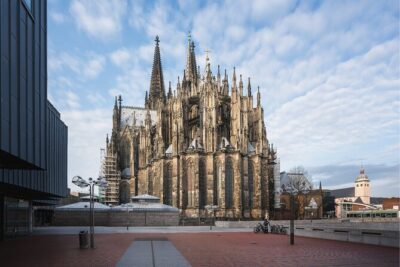
Cologne Scavenger Hunt and Highlights Self Guided Audio Tour
Read our review →
Aachen Scavenger Hunt and Highlights Self Guided Audio Tour
Read our review →
Aachen Scavenger Hunt and Sights Self-Guided Tour
Read our review →
Private audio book city rally in the Volksgarten in Cologne
Read our review →Browse the lists this tour appears in