

REVIEW · ROME AUDIO TOURS
Rome: Borghese Gallery Ticket and Optional Audio Guide
The Borghese Gallery is one of Rome’s best art stops because its masterpieces are packed into a manageable villa rather than spread across a huge museum. In about two hours, you can see major works by Bernini, Caravaggio, and Canova at close range, with enough space to stop and look properly.
I like the limited admission, which keeps the rooms from feeling packed, and the reserved entry, which matters when regular tickets have sold out. The optional audio guide also gives you useful background without tying you to a group. The catch is the price: $70 is a steep markup over the gallery’s regular admission, and the phone guide can be awkward to download or follow.
Key points before you book
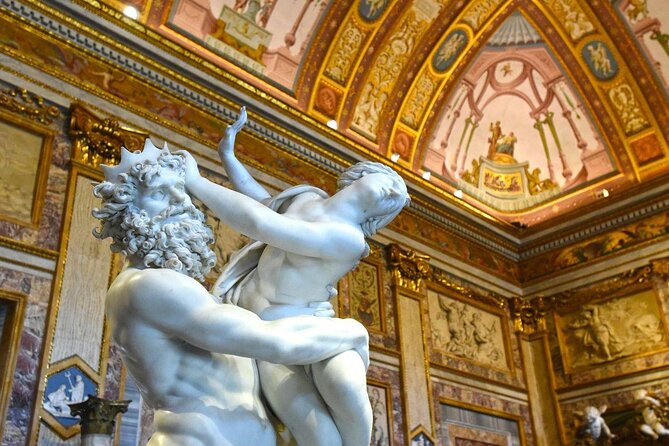
- Timed entry keeps the villa relatively calm: Admission is limited, so you can view the art without the crush found at larger Rome museums.
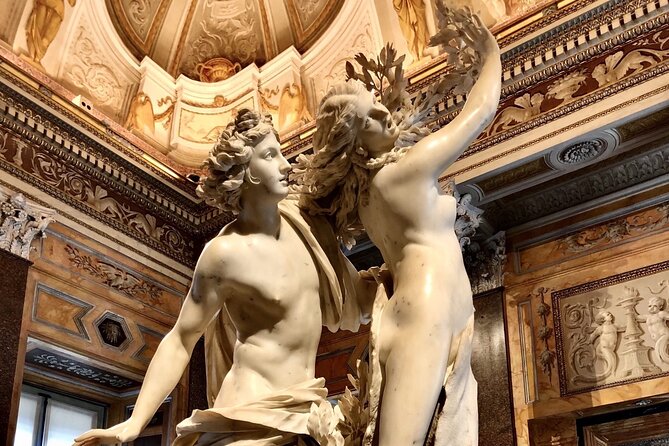
- Bernini gets the spotlight: See Apollo and Daphne, The Rape of Proserpine, David, and the early Goat Amalthea with Infant Jupiter and Faun.
- Caravaggio’s paintings are close and memorable: Look for Young Sick Bacchus and Boy with a Basket of Fruit.
- The ticket process is simple but not fully guided: Collect your physical ticket at the desk using the code sent by email or WhatsApp.
- The audio guide needs preparation: Download the app before you arrive, bring headphones, and allow time for the 100 to 150 MB download.
- The gardens add time to your visit: The Borghese grounds include long paths, fountains, lemon trees, a train, and rental bikes.
Why the Borghese Gallery deserves two hours

The Borghese Gallery works particularly well if you want a major art experience without giving up an entire day. The collection is housed in the former Villa Borghese, and the visit covers roughly 20 rooms over a two-hour time slot.
That compact format is useful. You are not walking past dozens of lesser works simply to reach one famous painting. Instead, the rooms keep presenting major sculpture and painting, often at a scale that makes the visit feel personal.
I would not call this a museum for only serious art specialists. Bernini’s sculptures are immediate and easy to appreciate, even if you do not usually spend much time in galleries. The figures twist, strain, recoil, and reach across the marble. You can see how the stone has been shaped to suggest hair, fabric, skin, and movement.
The visit is also controlled by timed admission. That matters here because the rooms are not enormous. A smaller number of people makes it easier to stand in front of a sculpture without blocking someone else, and several people found the quiet setting a welcome break from Rome’s crowded sights.
The limit is the two-hour visit. That is enough for a focused look, but you should not expect to study every painting at length. If you read every label and listen to every audio stop, you will need to choose your priorities.
More Museum Audio Guides in Italy
- Rome: Borghese Gallery Skip-the-Line Ticket & Audioguide
★ 4.3 · 4,318 reviews - Rome: Borghese Gallery Ticket + Audioguide or Guided Tour
★ 4.6 · 3,219 reviews - Rome: Borghese Gallery Skip-the-Line Tickets with Audioguide
★ 4.6 · 2,562 reviews
Collecting the ticket without a tour group
This is not a traditional guided tour. You do not meet a guide, join a walking group, or follow someone from room to room. Instead, you receive a code by email, and sometimes by WhatsApp, on the afternoon before the visit.
On the day, go to the ticket desk and show the code. The desk issues the physical entrance ticket. The GetYourGuide voucher itself is not the entrance ticket, so keep checking your email and spam folder if the final ticket has not arrived.
This arrangement has two advantages. You can enter without standing in the standard ticket line, and you are free to move at your own pace once inside. It also has one small point of friction: you need to understand that the code is used to collect the actual ticket. The process may feel unclear if you expect a normal downloadable admission pass.
Arrive early enough to find the desk and get settled. Do not cut it close. Late arrival can cause trouble, and the ticket may be released if you miss your time. The reserved entry is valuable only if you use it at the appointed hour.
The ground-floor rooms and Bernini’s marble

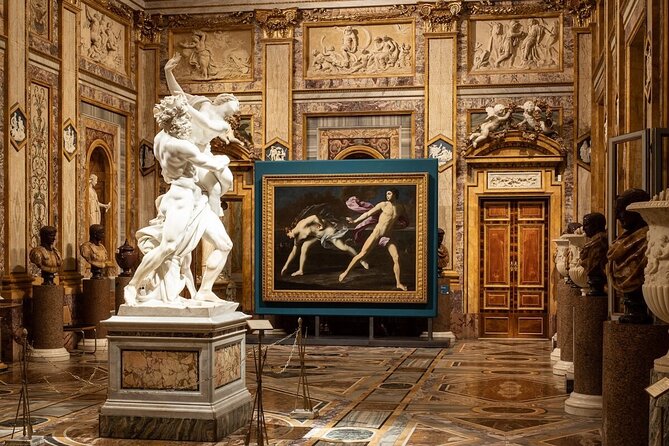
The ground floor is the heart of the visit for many people. This is where Bernini’s sculptures create the strongest visual impact, with the rooms arranged to let you see the works from several angles.
Begin with Goat Amalthea with Infant Jupiter and Faun, an early work that gives you a useful starting point for Bernini’s development. Then look for the more dramatic pieces, especially The Rape of Proserpine. The sculpture captures a violent moment, yet the marble appears soft where Pluto’s fingers press into Proserpine’s body.
That contrast is one reason the Borghese works so well in person. A photograph can show the overall composition, but it cannot fully convey the change in surface from polished skin to rough hair or the way a sculpture controls the room around it.
Apollo and Daphne is the essential stop. The story comes from classical mythology: Apollo pursues Daphne, and she turns into a laurel tree to escape him. Bernini shows the transformation as it happens. Daphne’s fingers become leaves, her hair streams into branches, and her feet begin to root into the ground.
The optional audio guide explains the story and points out details that are easy to miss. If you already know the myth, the guide can still help you notice how Bernini directs your eye through the sculpture. Walk around it rather than viewing it from only one position.
You will also find Bernini’s David, another useful comparison. This is not the calm, idealized figure seen in some earlier Renaissance versions. Bernini catches David in the middle of action, his body turned and his face set with effort.
The villa itself is part of the experience. Decorative rooms, painted ceilings, and rich materials frame the sculptures, so you are looking at art in a setting designed for art. That can be visually overwhelming in the best sense, but it also means you should pause occasionally and look upward.
Caravaggio, Canova, and the paintings upstairs
Caravaggio’s paintings provide a strong change of pace after Bernini’s marble. Look for Young Sick Bacchus and Boy with a Basket of Fruit. These works are not grand palace scenes. Their power comes from direct observation, strong light, and the physical presence of the people and objects.
Young Sick Bacchus has an unusual, almost uncomfortable directness. The figure does not look like an untouchable god. The pale complexion and tired expression make the painting feel personal and grounded.
In Boy with a Basket of Fruit, notice the fruit itself, the boy’s expression, and the way the light picks out the basket and skin. Caravaggio makes ordinary details carry the picture. I recommend standing close enough to see those details, then stepping back to understand how the light controls the whole scene.
Canova’s work adds another layer. His sculptures are smoother and more restrained than Bernini’s dramatic Baroque figures. Seeing both artists in the same museum lets you compare different ideas of beauty, movement, and emotion without needing a long lecture.
The gallery also includes works by Raphael and other important artists. The exact display can change, and some rooms may close during refurbishment. The upper floor has been closed at times, so check the latest message before you go, especially during Jubilee-related restoration work.
Do not plan your visit around seeing every named work in perfect order. Room layouts, restoration, and temporary closures can alter the route. Focus on the major pieces and enjoy the villa as a whole.
More Museum Audio Guides in Rome
- Rome: Borghese Gallery Skip the line ticket and Audioguide
★ 4.3 · 1,535 reviews - Borghese Gallery, Home to Canova’s Art – Entry with Audioguide
★ 4.0 · 884 reviews - Rome: Borghese Gallery Skip-the-Line Ticket & Audioguide
★ 4.0 · 768 reviews - Borghese Gallery entry ticket and audioguide App
★ 4.7 · 570 reviews
How useful is the phone audio guide?

The audio guide is offered in English and Italian and runs through an app on your own phone. It can be a good choice if you want context for the myths, artists, and individual works but do not want a live guide.
You need to download the application before starting. The guide requires roughly 100 to 150 MB of free space, and you should allow extra time for the download. One visitor needed about ten minutes just for this step.
Bring headphones or AirPods. Headphones are not included, and using the guide aloud would not be practical in the gallery. An Android phone running version 5.0 or later, or a compatible iPhone, is required. Older devices and several older Apple products are not supported.
The main weakness is navigation. The audio guide may use numbers that do not match the room numbers inside the museum, making it hard to know which track belongs to the room you are in. Some sections also discuss works in different rooms, so the sequence is not always clear.
My advice is to download the app and content before leaving your hotel, confirm that it opens, and carry a reliable internet connection. If you prefer simple directions, you may enjoy the art more by reading the labels and selecting only a few audio stops.
The audio option is most useful for first-time visitors who want stories and basic interpretation. It is less useful if you expect a polished, room-by-room guided tour.
The gardens behind the villa

Allow extra time for the grounds if your schedule permits. The Borghese gardens are large, and the paths around the villa offer a pleasant change after two hours indoors.
You can look for fountains, lemon trees, and the area behind the gallery. A small train is available, and you can rent two-person or four-person bikes. These options may help if you want to cover more ground, though the ticket described here is for the gallery rather than a full garden tour.
The gardens are not a minor add-on. They help explain why the villa was such an appealing setting for a private collection. If you have only a short time in Rome, see the gallery first and treat the park as extra time. If you have a free afternoon, the grounds can turn the visit into a longer outing.
Is $70 a fair price?
The $70 price buys convenience and availability, not a luxury guided experience. The regular gallery admission is much lower, and several visitors considered the markup excessive. You should go into this purchase knowing that a large part of the cost covers arranging a reserved place when official tickets are difficult to obtain.
That can still be worthwhile. Borghese tickets are limited, same-day admission cannot be relied on, and popular time slots sell out. If your Rome dates are fixed and the official site has no availability, paying more may be preferable to losing the visit entirely.
The value is weaker when you are visiting in a quiet period and can obtain an official ticket directly. It is also weaker if you are buying mainly for the audio guide, since the app has technical and navigation limits.
I would think of this as an availability solution. You are paying to secure entry to a small, high-demand museum. If that certainty matters, the cost may feel reasonable. If you have flexibility and can book directly, compare prices before committing.
Timing, bags, and accessibility

Plan on two hours inside, with more time for the gardens. Earlier entry can be a smart choice because the gallery may feel busier later in the day, and it gives you more room to explore the park afterward.
Large bags and luggage are not allowed. Several practical details matter here: carry only what you need, wear comfortable shoes, and bring your phone and headphones if you selected the audio option. You should expect to store restricted belongings rather than take them into the rooms.
The experience is not suitable for wheelchair users or people with mobility impairments. Restoration work can also change access routes, so read any update sent before your visit.
Who should book this experience?

I recommend it most strongly for:
- First-time Rome visitors who want to see Bernini and Caravaggio
- People who value a quiet, limited-capacity museum
- Families or pairs who prefer to move independently
- Visitors who find official Borghese tickets unavailable
- Art lovers who can prepare the audio guide in advance
I would be more cautious if you are watching your budget, carrying luggage, using a wheelchair, or expecting a live guide. You may also prefer a direct ticket if official availability remains open.
Final decision: book or skip?
Book this experience if seeing the Borghese Gallery is a priority and regular tickets are gone. The villa’s concentrated collection, limited admission, and outstanding Bernini sculptures make it one of Rome’s most rewarding two-hour stops.
Skip the third-party ticket if you can buy directly at a much lower price and have enough flexibility to find a suitable time. If you choose this option, download the audio guide before arriving, check your email and WhatsApp for the final ticket, arrive early, and bring no large bag.
FAQ
How long does the Borghese Gallery visit last?
The scheduled duration is two hours. You can spend additional time in the surrounding Borghese gardens if you wish.
Is this a guided tour?
No. You collect your physical ticket at the desk and explore the gallery independently. An optional phone audio guide is available in English or Italian.
How do I collect the entrance ticket?
You receive a code by email, and possibly by WhatsApp, on the afternoon before your visit. Show the code at the desk to receive the physical ticket. The GetYourGuide voucher is not the entrance ticket.
What languages are available for the audio guide?
The audio guide is available in English and Italian.
Do I need to bring headphones?
Yes. Headphones or AirPods are not included, so bring your own if you select the audio guide.
Can I bring luggage or a large bag?
No. Luggage and large bags are not allowed inside the gallery.
Is the gallery accessible to wheelchair users?
No. This activity is not suitable for wheelchair users or people with mobility impairments.
Just added around Rome
- Rome: St. Peter’s Basilica and Dome Entry + Audio Guide★ 4.5 · 13 reviews
- St. Peter’s Basilica: Hosted Entrance & Digital Audioguide★ 4.1 · 35 reviews
- Sorrento & Pompeii Day Trip from Rome Audio Guide Tour★ 4.2 · 50 reviews
- Rome:Ostia Antica Skip-the-line Ticket & Audioguide★ 4.3 · 11 reviews
- Rome+Jubilee Audioguide – TravelMate app for your smartphone★ 4.2 · 38 reviews
- Rome:St. Peter’s Basilica Hosted Entry + Official Audioguide★ 3.4 · 10 reviews
- Rome: St. Peter’s Basilica Entry Ticket and AudioGuide★ 4.4 · 57 reviews
- Colosseum, Roman Forum, Palatine Hill access and AudioGuide★ 4.7 · 12 reviews
Rome Audio Tours, compared.

Rome: Colosseum & Forum with Audio Guide App -Optional Arena
Read our review →
Rome: City Sightseeing Hop-on Hop-off Bus with Audioguide
Read our review →
Rome: St. Peter’s Basilica & Dome Entry Ticket & Audio Tour
Read our review →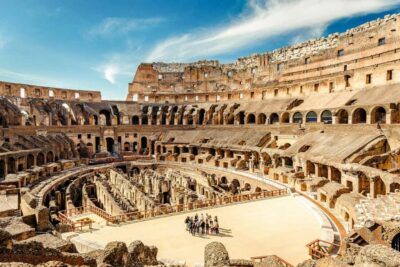
Colosseum, Roman Forum & Palatine Hill with Audioguide App
Read our review →
Vatican & Sistine Chapel Ticket with Optional Audio Guide
Read our review →
Rome: Castel Sant’Angelo Entry Ticket & Digital Audioguide
Read our review →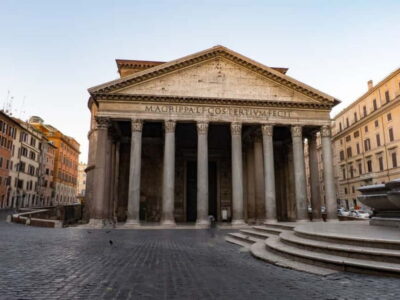
Rome: Pantheon Priority Entry Ticket & Interactive App
Read our review →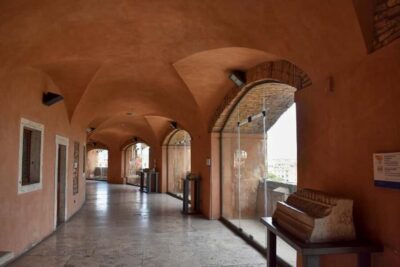
Rome: Castel Sant’Angelo Entry Ticket & Audio App
Read our review →Browse the lists this tour appears in