
REVIEW · BATH AUDIO TOURS
Bath Self-Guided Private Tour
Bath is a city made for wandering, and this self-guided audio tour gives you a clear route through its best-known sights. You begin at Bath Abbey, pass the Roman Baths and Pulteney Bridge, then work through Georgian streets, gardens, museums, and parks before finishing at Thermae Bath Spa. Helen provides the narration, with maps, GPS directions, photos, videos, and recommendations built into the app.
I like the freedom to stop for coffee, linger in a park, or spend extra time taking photographs without holding up a group. I also like the price: at $12.33 per person, it costs far less than a private guide. The main caution is technical. Some users had trouble with app crashes, battery use, missing activation emails, or audio playback, so you should prepare your phone before setting out.
Key points to know before you book
- Helen narrates the tour: You hear a human voice rather than a computer-generated one, with historical commentary at each stop.
- The route covers Bath’s main sights: Roman Baths, Bath Abbey, Pulteney Bridge, Pulteney Weir, the Circus, Royal Crescent, and Thermae Bath Spa all appear.
- Three weeks of app access: You do not have to finish the walk on one particular day.
- It is private, but not guided in person: Only your group takes part, yet you navigate with your own phone.
- Plan for two to three hours, or much longer: The route can take about two and a half hours, but parks, refreshments, and museum visits can stretch it to five hours.
- Technical preparation matters: Download instructions carefully, keep your phone charged, and read the Before You Go section before arriving.
A low-cost way to meet Bath
This tour is best understood as a walking route with a recorded guide, not as a traditional private tour. You meet at Abbey Chambers beside Bath Abbey, open the app, and follow the route at your own speed. There is no guide waiting with a sign, no group to join, and no ticket office to find.
That distinction matters. The word private can suggest a dedicated local guide, but here it means only your group participates. The commentary, directions, and sightseeing all happen through your phone.
At $12.33 per person, the value is strong if you want orientation and background without paying for a full guided walk. You also receive three weeks of unlimited access, so you can pause the route, return to a section, or spread the walk over more than one day.
The price does not include entry to paid attractions. The Roman Baths, the Holburne Museum, No. 1 Royal Crescent, and Thermae Bath Spa are presented as points along the route, but the tour price itself does not provide admission. The free admission notes refer to the tour stops and outside viewing, not to indoor entry tickets.
More Audio Tours in Bath:
- Bath: Roman Baths Entry Ticket with Audio Guide
★ 4.7 · 425 reviews - Bath Private Self-Guided Walking Audio Tour
★ 3.0 · 21 reviews - Bath : 2 Hour Historic Walking Tour With An App
★ 3.6 · 19 reviews
Start beside Bath Abbey and the Roman Baths
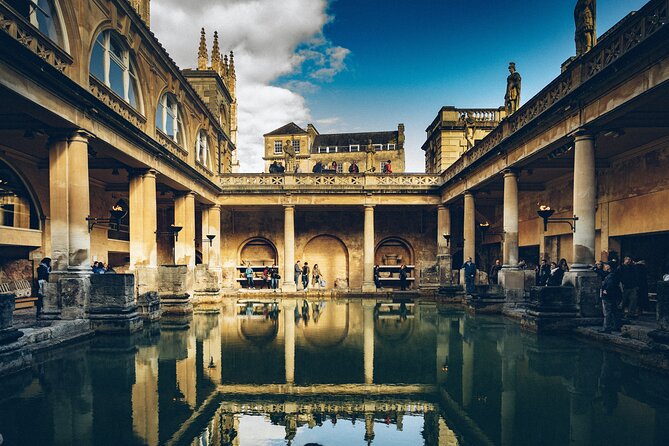
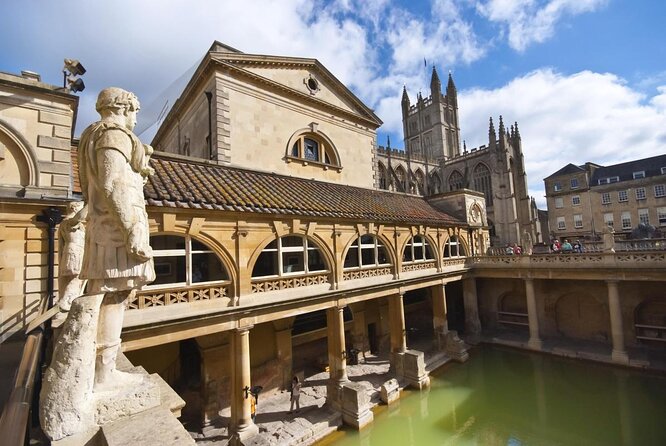
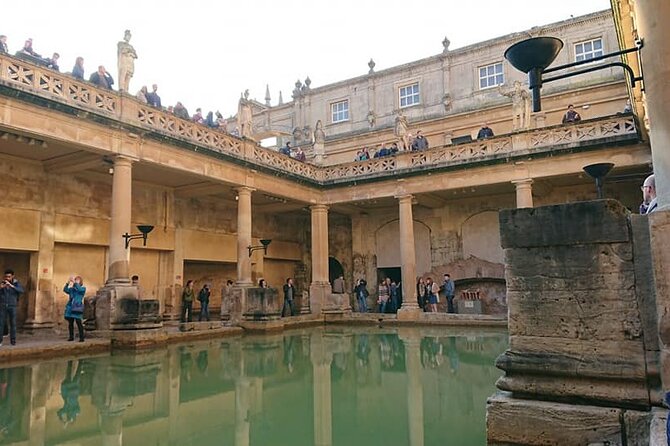
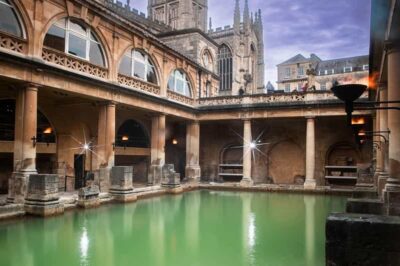
The walk begins in the Abbey Courtyard area, a useful place to get your bearings. Bath Abbey forms one of the city’s main reference points, and the Roman Baths sit nearby. Together, they show why Bath has attracted visitors since Roman times.
The Roman settlement was known as Aquae Sulis and is thought to have been occupied from around AD 43. The Roman Baths building is both a Grade I listed building and a Scheduled Monument, so this is not simply a quick photo stop. You can use the audio commentary to understand the Roman setting before deciding if you want to pay for a separate visit inside.
Bath Abbey is also one of the Southwest’s most visited attractions. The tour treats the area as the city center, which makes sense for a first walk through Bath. It is a practical start because you are close to several major sights, shops, streets, and public transport connections.
From the Abbey Courtyard, the route heads toward York Street through Kingston Parade. Despite its name, Kingston Parade is more square than promenade. It is a gathering place with good views toward the Abbey and Roman Baths, making it one of the better early stops for photos and orientation.
The York Street section lasts about 10 minutes and has no admission fee. You can keep moving if you are eager to reach the river, or pause here to study how Roman and later Georgian Bath sit side by side.
North Parade Passage and Sally Lunn’s
The next stop takes you into North Parade Passage, once known as Old Lilliput Lane. This narrow passage contains some of Bath’s pre-Georgian character, a useful contrast to the grand terraces that come later.
Many timber-framed buildings in Bath were rebuilt over time, but Sally Lunn’s at number 4 North Parade Passage retains its timber framework. The tour gives you about 10 minutes here, enough for a look at the building and the surrounding lane.
Sally Lunn’s is also associated with food, but the supplied tour details do not promise a meal or tasting. Treat this as a historic building stop unless you choose to make your own dining visit. That is one of the benefits of a self-guided route: you can turn a short audio stop into a longer break without asking a guide to wait.
The river, Parade Gardens, and Pulteney Bridge
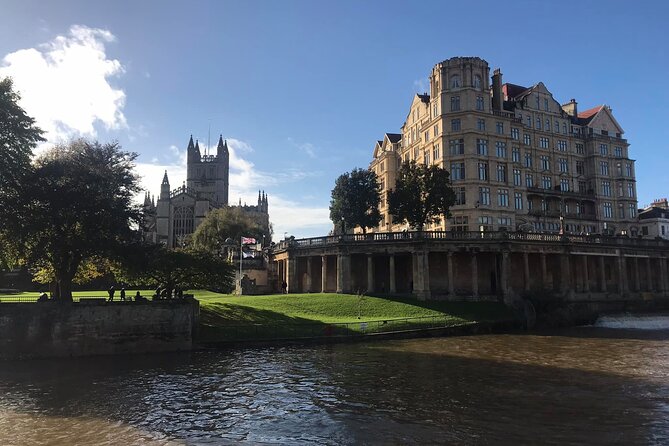
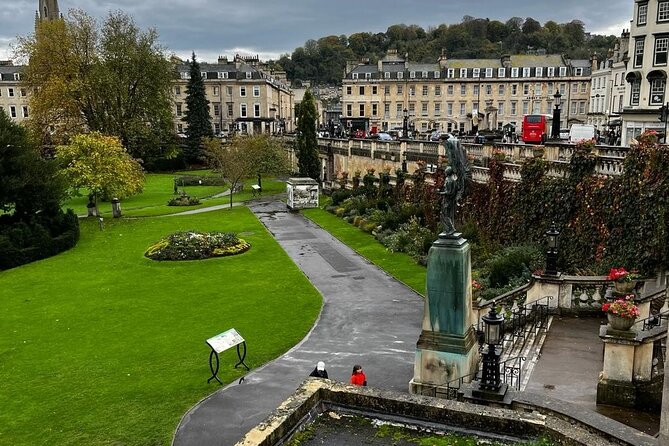
Parade Gardens brings you beside the River Avon. This two-and-a-half-acre park dates from 1709 and is a Grade II-listed park. The route allows about 10 minutes, though you may want longer if you enjoy gardens or need a quiet pause.
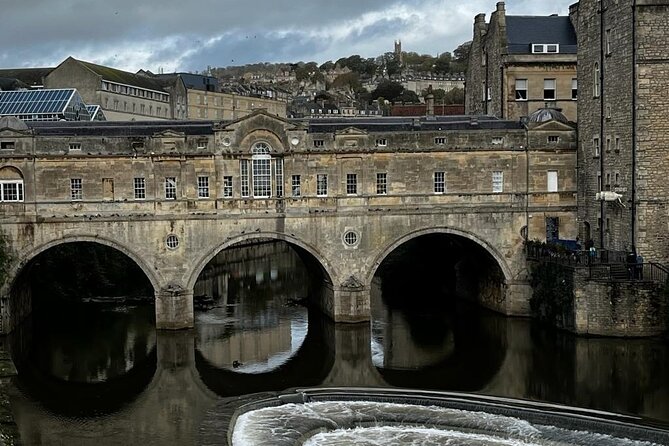
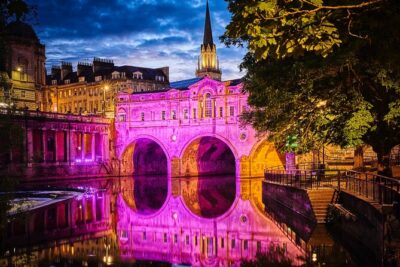
From there, you reach Pulteney Bridge, one of Bath’s most memorable pieces of architecture. Shops run across the full span on both sides, a design believed to occur on only four bridges worldwide. The bridge idea came from William Johnston Pulteney, whose name remains attached to the crossing.
This is one of the tour’s strongest sections because the sights are close together but feel different. You move from formal gardens to the river, then to a bridge that functions as both crossing and shopping street. The audio guide can add context while you stand in the area, but you should keep an eye on your phone and surroundings rather than walking with your attention fixed on the screen.
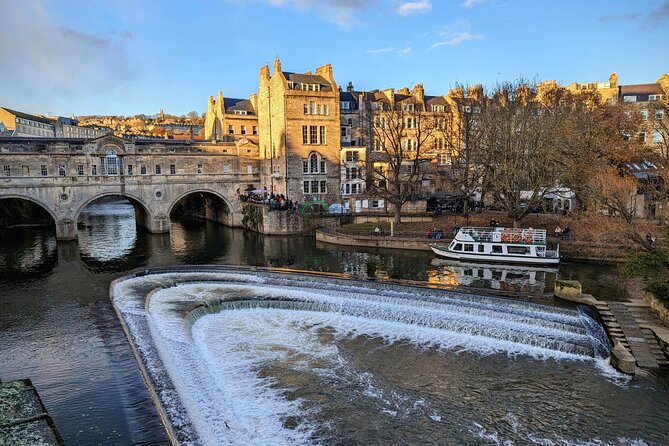
Pulteney Weir is only about five minutes from the bridge. It has appeared on maps of Bath since 1603 and was originally built to power two corn mills, one on each side of the river. The weir gives you a good reason to look beyond the bridge itself. The water, stonework, and broad river setting make this a short but worthwhile stop.
Same place, a different route to walk:
- Private Smartphone photography Walking Tour Around Bath
★ 5.0 · 20 reviews - Bath: Bridgeton Walking Tour with an APP
★ 3.8 · 14 reviews - Small Group smartphone Bath Walking Tour around Bath
★ 5.0 · 8 reviews - Bridgerton’s Filming Locations in Bath Audio Guide
★ 5.0 · 7 reviews
Henrietta Park and the Holburne Museum
Henrietta Park is a quieter change of pace. The seven-acre park opened in 1897 to mark Queen Victoria’s Diamond Jubilee. It sits a little away from the heaviest sightseeing flow, so the 15-minute stop can feel like a breather after the central streets.
I like this part of the route because it shows Bath as a lived-in city, not only a collection of famous façades. You can walk through the park, sit for a moment, or simply use the stop to rest your feet. The route does not charge admission for the park.
The Holburne Museum follows in this part of the walk. It holds objects once owned by Sir William Holburne, who inherited a modest fortune and spent part of it travelling around Europe. The audio material explains the person behind the museum as well as the collection itself.
The museum is presented as a stop, not an included entry. If you want to go inside, allow extra time and check admission details separately. The standard route timing does not leave much room for a full museum visit, especially if you are also stopping in Henrietta Park.
Great Pulteney Street and Bath’s Georgian order
Great Pulteney Street is one of Bath’s grandest streets and the widest thoroughfare on this route. Its broad pavements were designed as part of the street’s formal appearance, and in places they are almost as wide as the road.
This is a good section for understanding Bath’s Georgian planning. The scale changes from narrow lanes and river crossings to a long, carefully ordered avenue. The audio commentary is particularly useful here because the street’s importance comes from its design and proportions rather than from one single building.
Upper Borough Walls then brings you back toward the older city. Its name recalls the original medieval town wall, and many houses along the road are listed buildings. The stop helps connect medieval Bath with the later Georgian city.
The route is not a straight march from landmark to landmark. That is a strength if you want a wider picture of Bath, though it means you should keep the map open and follow the GPS line. Users have found the map assistance useful, especially when listening ahead or revisiting information at the next location.
The Circus, Royal Crescent, and Victoria’s park
The Circus is arguably the clearest single display of Bath’s Georgian architecture. It was originally called the King’s Circus and was designed as a circular arrangement of buildings rather than a conventional square.
The tour gives you about five minutes here. That is enough for the audio explanation and a quick look, but not necessarily enough if you want to examine the stonework, take photographs, and enjoy the full curve of the buildings. You can pause the narration and spend as long as you like.
No. 1 Royal Crescent offers another famous Georgian setting. The crescent was built from 1767 to 1775 and contains 30 Grade I-listed houses. Bath has several other Georgian crescents, including Lansdown Crescent and Somerset Place, but Royal Crescent is the most familiar name on this route.
Again, the tour points you to the building but does not include an indoor ticket. No. 1 Royal Crescent is an important stop for anyone interested in Georgian domestic life, yet you should allow extra time and budget separately if you plan to visit inside.
Royal Victoria Park opened in 1830, when Princess Victoria was 11 years old and still the future queen. The route allows five minutes, which makes this more of a brief orientation stop than a full park visit.
If you enjoy green spaces, this is another place where the advertised two to three hours can expand. One particularly useful feature of this app tour is that you can ignore the suggested pace. A five-minute audio stop does not mean you must leave after five minutes.
Gay Street, Queen Square, and the Theatre Royal
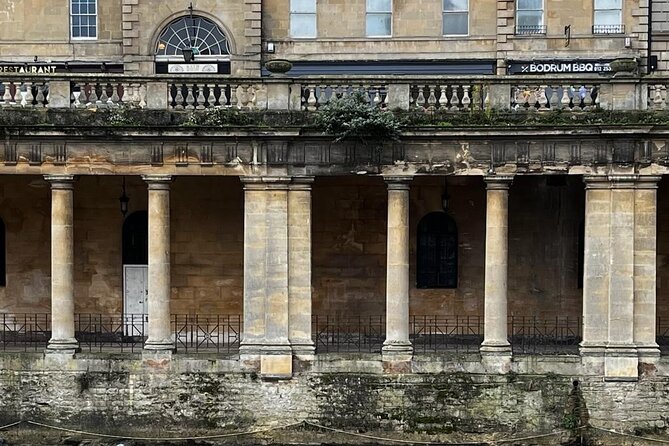
Gay Street formed part of the Circus development. John Wood the Elder designed it, and John Wood the Younger completed the work after his father died. Many buildings along the street are Grade I or Grade II listed.
This is a street to walk slowly. The interest is in the repeated façades, proportions, and relationship between Gay Street, the Circus, and the wider Georgian plan. The app provides a reason to stop and look rather than simply passing through on the way to the next landmark.
Queen Square is a one-acre communal garden surrounded by Grade I-listed buildings. It was dedicated to Queen Caroline, the wife of George II. The square gives you another view of Bath’s formal urban planning, with an open garden framed by elegant stone buildings.
The Theatre Royal Bath is a Georgian building constructed in 1805 and refurbished in 2010. It is described as one of the oldest and most attractive theatres in the country. The tour allows five minutes, so treat this as an exterior stop unless you have a separate performance or visit planned.
These central stops are close enough to combine with your own shopping or meal break. The tour also includes recommendations for ice cream, pubs, and coffee shops. That is a small but useful touch, since a walking route is more enjoyable when you can stop without having to research every break yourself.
Finish at Thermae Bath Spa
The final stop is Thermae Bath Spa, built on the site of the former Beau Street swimming baths. It opened in 2006 and uses naturally thermal water from the Minerva Bath.
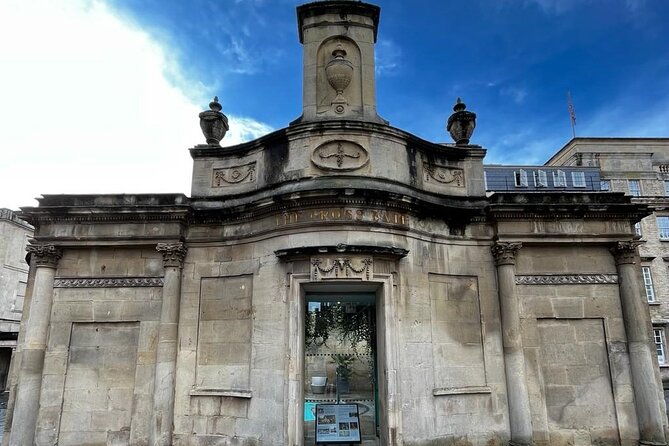
The route ends at The Hetling Pump Room on Hot Bath Street. After the audio tour, you are free to continue around Thermae Bath Spa and the Cross Bath. The tour does not include spa admission, so check the separate entry arrangements if you want to use the facilities.
Ending here makes practical sense. You have crossed much of central Bath, passed Roman and Georgian landmarks, and finished near one of the city’s modern thermal attractions. You can stop the tour at the end and make your own plans rather than being rushed back to a meeting point.
Timing, walking effort, and phone use
The stated duration is about two to three hours, with the route itself estimated at roughly two and a half hours. That is a reasonable walking time if you keep moving and treat most sights as short stops.
You can easily take five hours if you spend longer in Henrietta Park, stop for refreshments, enter a museum, or pause at the Roman Baths and Royal Crescent. One useful feature is the three-week access period. You can complete the central sights one day and return for the parks or indoor attractions later.
You need a moderate level of physical fitness. The tour involves walking through city streets and parks, and the supplied information does not promise a vehicle transfer or transport between stops. The route is near public transportation, and service animals are allowed.
Your phone is the weak point. The tour depends on app access, maps, GPS, and audio playback. Technical problems have included crashes, high battery use, missing activation emails, and individual audio clips failing to play. Before you start, charge your phone, read the activation email carefully, and check the Before You Go instructions. The booking reference is not the activation code, so do not assume the wrong number will open the tour.
The provider has said the app is being updated and rebranded as Exploro, with improvements intended to address earlier stability and performance problems. Still, I would not rely on a phone that is nearly out of battery or on an uncertain internet connection. Carry a charger if you have one, and keep the route details available before leaving.
Who should book this Bath walk?
I would choose this tour if you want a cheap, flexible introduction to Bath and prefer to set your own pace. It suits couples, families, and small groups who do not want to join a fixed walking group. It also works well for repeat visitors who want a structured route through the main sights without committing to an in-person guide.
The tour is especially useful if you like listening ahead, replaying information, and choosing your own stopping points. Helen’s narration gives the route a human voice, and the photos, videos, maps, and recommendations add more than a simple list of directions.
I would be more cautious if you expect a local guide to answer questions on the spot or if you dislike depending on an app. You should also compare the price with Bath’s free walking options if you only want basic orientation. The value here comes from having the route, narration, and extra material together, not from entry to attractions or personal guiding.
Cancellation is strict: the experience is non-refundable and cannot be changed. Make sure you understand that before paying.
Should you book it?
Book it if you want Bath’s major sights arranged into one flexible route for $12.33 per person. The combination of Roman landmarks, river views, Georgian streets, parks, and a spa finish gives you a useful first look at the city, while three weeks of access lets you slow down.
Skip it if a faulty app would ruin your day or if you specifically want a live guide. For everyone else, prepare your phone carefully, allow more than two and a half hours if you enjoy stopping, and treat the route as a framework rather than a race.
FAQ
Is this a guided tour with a person in Bath?
No. It is a self-guided app tour with audio narration by Helen. There is no in-person guide, and only your own group participates.
How long does the Bath tour take?
The approximate duration is two to three hours, with about two and a half hours given as a typical completion time. You can take longer by stopping for food, parks, museums, or photographs.
Where does the tour start and end?
It starts at Abbey Chambers, Church Street, beside Bath Abbey. It ends at Thermae Bath Spa, The Hetling Pump Room on Hot Bath Street.
Are attraction admission tickets included?
No. The tour includes the app, audio, maps, directions, GPS route, videos, photos, and recommendations. Admission to attractions such as the Roman Baths, museums, and Thermae Bath Spa is not included.
How long can I use the self-guided tour?
You receive three weeks of unlimited access to the tour through the app.
Is the tour suitable for people using public transportation or service animals?
The route is near public transportation, and service animals are allowed. You should have a moderate level of physical fitness for the walking route.
Just added around Bath
- Bridgerton’s Filming Locations in Bath Audio Guide★ 5.0 · 7 reviews
- The Splendour of Georgian and Victorian Era Bath: A Self-Guided Audio Tour★ 4.0 · 3 reviews
- Bath Bridgerton walking tour of filming location with Mobile App★ 5.0 · 3 reviews
- Jane Austen Self-Guided Audio Walking Tour in Bath★ 4.0 · 4 reviews
- Bath Tour App, Hidden Gems Game and Big Britain Quiz (1 Day Pass) UK★ 3.5 · 3 reviews
- Medieval Bath: A Self-Guided Audio Tour along the City Wall★ 4.5 · 3 reviews
- Small Group smartphone Bath Walking Tour around Bath★ 5.0 · 8 reviews
- Bath : 2 Hour Historic Walking Tour With An App★ 3.6 · 19 reviews
Bath Audio Tours, compared.
Bath: Roman Baths Entry Ticket with Audio Guide
Read our review →
Private Smartphone photography Walking Tour Around Bath
Read our review →



Bridgerton’s Filming Locations in Bath Audio Guide
Read our review →
Jane Austen Self-Guided Audio Walking Tour in Bath
Read our review →Browse the lists this tour appears in