
REVIEW · USA AUDIO TOURS
Baltimore Walking & Driving Self-Guided Audio Tour
Baltimore’s story is unusually easy to hear from the driver’s seat. This self-guided route links the harbor, Fells Point, Federal Hill, Poe country, baseball history, and Fort McHenry, with more than 42 audio stories triggered by your location. You get a city tour without being tied to a group or a departure time.
I like the one-car price, which makes $16.99 a sensible deal for up to four people. I also like the lifetime access, since you can pause for lunch, return another day, or replay the stories at home. The main caution is navigation: the GPS and app can be fussy, especially if you miss a turn, encounter a road closure, or try to listen while driving alone.
Key points at a glance
- More than 42 stories across roughly 9 miles: Expect about one to two hours of moving time, or up to three hours with stops and pauses.
- A strong mix of subjects: The route covers Frederick Douglass, Edgar Allan Poe, the War of 1812, Babe Ruth, African-American maritime history, and Baltimore neighborhoods.
- Best value for a carload: One purchase covers up to four people, and the audio can play through your vehicle stereo.
- Walking is optional: You can drive the route, stop for short walks, or use headphones when exploring on foot.
- Offline use is built in: Download the tour over a strong connection before you begin, then use it without cellular or Wi-Fi service.
- App performance needs attention: Follow the route and speed guidance carefully, and keep Google Maps available as a backup.
A city tour built around Baltimore’s biggest stories

This is not a traditional walking tour with a guide waiting at the starting point. It is a private, self-guided audio experience that begins near the Baltimore Visitor Center on Light Street and finishes near the Star-Spangled Banner National Historic Trail by Fort McHenry.
The route is designed for a car, but you are not locked inside it. You can listen through Bluetooth, USB, or AUX, then get out at places that deserve a closer look. For short walking sections, headphones or earbuds are the better choice.
I like this arrangement because Baltimore’s major sights are spread out. The Inner Harbor and Fells Point are pleasant on foot, but Fort McHenry, Mount Clare, and the B&O Railroad Museum are easier to reach by car. A fixed walking route would force you to skip too much or spend a long day crossing the city.
The app plays stories automatically when you reach the right location. That hands-free setup is convenient, but it also creates the tour’s biggest weakness. If you drive too quickly, arrive at the next checkpoint before a story finishes, or leave the suggested route, the narration can cut short or fail to restart cleanly.
More Audio Tours in the USA:
- Fort Sumter Admission and Self-Guided Tour with Roundtrip Ferry
★ 4.5 · 3,343 reviews - San Francisco: Alcatraz Ticket, Ferry, & Self-Guided App
★ 4.5 · 2,460 reviews - Los Angeles: Hop-On Hop-Off Bus Tour with Audio Guide
★ 3.7 · 2,030 reviews
Start at the Visitor Center and get your bearings
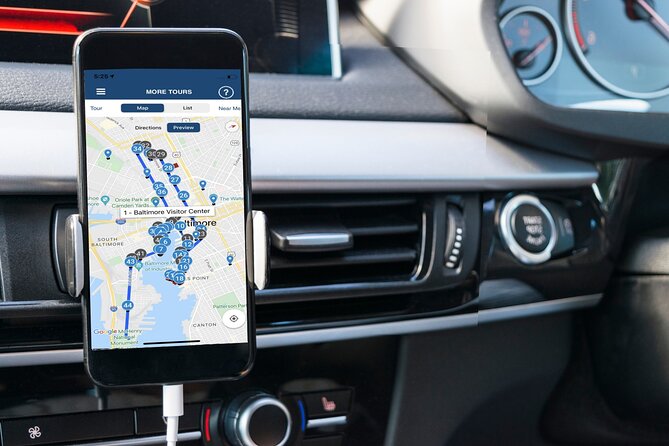
Begin at the Baltimore Visitor Center, the practical meeting point near the Inner Harbor. No person meets you there. You simply arrive, open the Action Tour Guide app, choose the correct Baltimore tour, and enter the first story point.
The opening sets up Baltimore as a port city shaped by commerce, immigration, politics, war, literature, and the lives of figures such as Frederick Douglass and Edgar Allan Poe. Download the tour before you arrive, since the app must be installed and activated while you have a strong Wi-Fi or cellular connection.
From the Visitor Center, the route introduces the Inner Harbor, Baltimore’s main tourist district. This is a useful first stop because it puts the city’s waterfront attractions in context before you move toward older neighborhoods and historic sites.
The harbor section includes the USS Constellation, the National Aquarium, and the Seven Foot Knoll Lighthouse. Admission is not part of the $16.99 price, so treat the audio tour as an introduction rather than an entry ticket.
The Inner Harbor links ships, aquariums, and a floating cleanup machine
The USS Constellation is one of the most memorable stops. This three-masted ship predates the Civil War and is connected to the history of the suppression of illegal trafficking in enslaved people. You can hear the story from outside, or pay separately to visit the ship if it fits your schedule.
The National Aquarium is the harbor’s major family attraction, with more than 20,000 sea and land creatures. The audio tour gives you the background and points out the attraction, but it does not include admission or a reserved time. If you plan to go inside, check its opening details separately before building your day around it.
Nearby, the Seven Foot Knoll Lighthouse offers a smaller, more unusual stop. It once helped guide ships into the Chesapeake area and now adds a bit of maritime character to the waterfront route.
The route also points out Mr. Trash Wheel, an inventive harbor-cleanup device. It is a good example of the tour’s broad approach. You are not hearing only about grand monuments. You also get small, modern Baltimore stories that make the waterfront feel like a working place rather than a collection of attractions.
Frederick Douglass and Isaac Myers give the harbor a human story
The Frederick Douglass-Isaac Myers Maritime Park is one of the most important stops for understanding Baltimore beyond its architecture. The park honors two African-American maritime figures who worked at the shipyard once located here at different times.
Frederick Douglass is often taught mainly as an abolitionist, but the stories here also cover his support for women’s rights. He argued that voting rights should apply to Americans regardless of race or sex, and he attended the first women’s rights convention in Seneca Falls in 1848.
The route later adds Douglass Place, a group of homes associated with Douglass. You hear how he moved from enslavement and shipyard work into national politics and the fight for civil rights.
This is where the audio format earns its keep. A plaque can name a person, but a spoken story can connect the dockyards, housing, labor, race, and politics. If you stop at the park, allow extra time beyond the five-minute audio segment. The route gives you the essential thread, not a full museum visit.
Same place, a different route to walk:
- City Sightseeing Hop-On Hop-Off Bus Tour with Audio Guide
★ 3.0 · 1,083 reviews - Medieval Torture Museum Ticket with Audio Guide and Ghost Hunting
★ 5.0 · 962 reviews - Gettysburg Battlefield Self-Guided Driving Audio Tour
★ 4.5 · 910 reviews - Ryman Auditorium Self-Guided Tour with Souvenir Photo Onstage
★ 4.5 · 903 reviews
Fells Point is best treated as a neighborhood, not a quick checkpoint

Fells Point began as an independent town in 1763 and still has a strong historic identity. The route explains its connection to shipping, cheap housing, and the free and enslaved African-American workers who helped keep the port operating.
The Horse You Came In On Saloon is one of the neighborhood’s distinctive landmarks. It occupies a Colonial-era building and offers drinks, pub food, and live music. The tour also connects the saloon with Edgar Allan Poe, who was said to drink there and whose ghost is part of the establishment’s local lore.
You can drive through Fells Point, but this is one area where getting out makes more sense. Streets may be closed or difficult to follow, and one road closure can throw off the app’s location triggers. Park where permitted, walk the short section, and restart the audio only after you are positioned near the next point.
That approach solves two problems at once. You get a better look at the neighborhood, and you reduce the chance of racing past a checkpoint while the previous story is still playing.
City Hall, Mount Vernon, and Poe create the strongest history sequence

The tour then moves toward Baltimore City Hall, a grand building with a memorable story attached to it. In 1883, a political argument outside the building became a gunfight between James Busey and William Harig. Harig killed Busey, and the episode captures the rough political atmosphere of the era more sharply than a standard architectural description would.
At Mount Vernon Place, you see Baltimore’s Washington Monument. It is not simply a smaller copy of the monument in Washington, D.C. It came first. Architect Robert Mills later used the design again for the much larger monument in the capital.
The Poe stops are among the most entertaining parts of the route. At Edgar Allan Poe’s grave, the audio recounts the mystery of the Poe Toaster, a person who appeared around Poe’s birthday in dark clothing, left three roses and a partly finished bottle of cognac, and vanished before anyone could identify him.
The route also covers the site of Poe’s death, associated with Church Home and Hospital. Poe disappeared after setting out from Richmond in 1849 and was later found in Baltimore in poor condition. The circumstances of his final days remain uncertain, which gives this portion of the tour an appropriately eerie tone.
The H. L. Mencken House adds another literary stop. The itinerary also includes the Walters Art Museum, which broadens the city’s cultural story beyond Poe. Entry fees and opening times are separate from the tour, so use the audio to decide where you want to spend your limited time.
Sports and science give the route a welcome change of pace
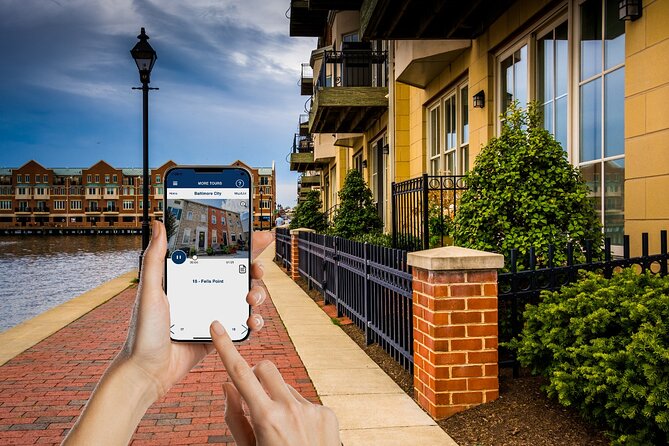
The Babe Ruth Birthplace and Museum brings the tour into Baltimore’s sports history. Ruth is one of the city’s best-known baseball figures, and this stop pairs naturally with Oriole Park at Camden Yards.
You do not need a game ticket to appreciate Oriole Park from the outside, though you will need separate admission for any event or interior visit. The stop works well for families and baseball fans who want a break from monuments and literary history.
The Maryland Science Center provides another change of subject. It is one of the country’s older scientific institutions and offers family-friendly exhibits, but admission is not included. If you are planning a full day, choose between the science center, aquarium, museums, and Fort McHenry instead of assuming you can comfortably see everything in one pass.
Fort McHenry is the tour’s main historical payoff

Fort McHenry is the route’s most important destination. In 1814, the fort faced a British naval attack by 19 warships. Major George Armistead commanded about 1,000 defenders, and the fort’s reinforced structure helped it withstand the bombardment.
The story connects directly to Francis Scott Key, who watched the American flag remain above the fort and wrote the poem that later became the national anthem. The nearby Star-Spangled Banner Flag House adds more context about the flag and the poem.
Unlike several city stops that work mainly as audio viewpoints, Fort McHenry rewards a proper visit. The tour points you there and supplies the historical frame, but the grounds and exhibits require separate admission if applicable. Check operating details before you go, since attraction hours can change even when the audio tour remains available.
The route ends near the Star-Spangled Banner National Historic Trail by Fort Avenue. If you have time, make Fort McHenry the part of the day where you stop, walk, and listen rather than simply passing through in the car.
The west side adds railroads, colonial history, and Elizabeth Seton

The itinerary also reaches the Mount Clare Museum House and the B&O Railroad Museum. These stops shift attention toward Baltimore’s industrial and transportation past.
The B&O Railroad Museum is especially fitting in a city whose growth depended on its port and rail connections. The audio points out the site, but the museum visit is separate. Mount Clare adds an older layer, with a historic house connected to Baltimore’s colonial and early industrial development.
The Mother Seton House offers a different kind of story. Elizabeth Ann Seton, born in New York in 1774, lived there temporarily and later became the first American-born person canonized as a saint. Her move to Italy with her ill husband led to her conversion to Catholicism after his death, then to her religious work in the United States.
These western and central stops make the tour feel less like a harbor loop and more like a survey of the whole city. They also make route planning more important. If you are short on time, prioritize the Inner Harbor, Fells Point, Poe sites, and Fort McHenry. Save the museums for a return visit.
Price, timing, and app setup
At $16.99 per group of up to four, the value is strongest when several people share one car. Two people pay less per person than they would for separate tickets to a traditional guided tour, and four people get an especially low per-person cost.
The audio tour itself takes about one to two hours if you keep moving. Allow closer to three hours if you stop for photographs, walk through Fells Point, visit the harbor, or pause the route for food. You can also split it across multiple days because access never expires.
The app supports offline maps and audio, but setup matters. After booking, look for the password and instructions in your email and text messages. Download the separate Action Tour Guide app, enter the password, and load the tour before you leave reliable service.
For the car, connect your phone through Bluetooth, USB, or AUX. Apple CarPlay is supported for audio playback. Android Auto support is still being developed according to the supplied information, so do not assume that every dashboard connection will work as expected.
If you are driving alone, be cautious. The app is not a full replacement for a navigation service, and it may not redirect you well after a missed turn. Let a passenger manage the phone when possible, or pull over before checking the route.
What the audio format does well, and where it falls short
The strongest feature is the storytelling. The route covers more than a list of buildings, connecting places to Douglass, Poe, the War of 1812, African-American labor, women’s rights, baseball, religion, and industrial growth.
The automatic playback is also useful when it works properly. You can keep your attention on the road and hear the next story without constantly tapping the screen. The offline function matters in a city route because it reduces dependence on a mobile signal.
The weak point is route control. A few technical problems can have an outsized effect: GPS may struggle among tall buildings, a road closure can disrupt the sequence, and moving too quickly can cut off the current narration when the next story begins.
My practical fix is simple. Download in advance, start at the exact first point, follow the suggested speed, and pause when necessary. Keep another map app available, but never try to operate it while driving.
Who should book this Baltimore tour?
I would choose this tour if you want a low-cost introduction to Baltimore, prefer setting your own schedule, or have a car and several people sharing the cost. It also suits families and mixed-interest groups because you can skip a museum, stop for food, or replay a story without holding up a guide.
It is less suitable if you want a polished chauffeur-led route, precise turn-by-turn navigation, or a fully guided museum experience. Solo drivers should be especially realistic about the app’s limitations.
Before booking, decide which sites matter most. If you want Fort McHenry, the Inner Harbor, Fells Point, Poe, and Douglass in one flexible outing, this is a useful format. If you want to enter several attractions, add admission costs and extra time, then use the audio as a planning tool rather than the whole day.
Free cancellation is available up to 24 hours before the scheduled start time. Within 24 hours, the payment is not refundable. Since the access does not expire, you can also save the tour for a later Baltimore visit if your schedule changes.
FAQ
How long does the Baltimore audio tour take?
The route covers more than 9 miles and usually takes about one to two hours to drive. Allow up to three hours if you stop for photos, short walks, meals, or attraction visits.
Can I use the tour without cellular service?
Yes. You must download the app and tour while you have strong Wi-Fi or cellular service. After that, the offline maps and audio can work without a signal.
Is this a driving tour or a walking tour?
It is primarily a driving tour, but walking sections are optional. You can use the car stereo for the driving portions and headphones or earbuds when you get out to explore.
Does the $16.99 price cover everyone in my group?
The price covers one group of up to four people. It is charged per group or car rather than per person.
Are attraction tickets included?
No. Entry to places such as the National Aquarium, USS Constellation, Fort McHenry, museums, and other attractions is not included.
Does the tour expire?
No. The audio tour provides lifetime access with no expiration date. You can use it on another Baltimore visit, pause it over several days, or replay the stories whenever you wish.
Just added around the USA
- Springfield Self-Guided Walking Audio Tour★ 4.0 · 5 reviews
- Smartphone Guided Indianapolis Downtown Sites Audio Walking Tour★ 4.5 · 7 reviews
- Smartphone-Guided Walking Tour of Downtown Indianapolis Sights & Stories★ 4.0 · 25 reviews
- Indiana Dunes National Park Self-Guided Audio Tour★ 3.5 · 4 reviews
- Self-Guided Audio Driving Tour in Kancamagus Highway★ 4.5 · 6 reviews
- An Epic Scavenger Hunt: Bloomington Scenic Southern Indiana★ 3.5 · 6 reviews
- Huntsville Rocket City Smart Phone Self Guided Audio (GPS/APP) Walking Tour★ 4.5 · 5 reviews
- Sights of Downtown Houston Smartphone Audio Walking Tour★ 4.0 · 7 reviews
USA Audio Tours, compared.
Fort Sumter Admission and Self-Guided Tour with Roundtrip Ferry
Read our review →
San Francisco: Alcatraz Ticket, Ferry, & Self-Guided App
Read our review →
Los Angeles: Hop-On Hop-Off Bus Tour with Audio Guide
Read our review →
City Sightseeing Hop-On Hop-Off Bus Tour with Audio Guide
Read our review →
Medieval Torture Museum Ticket with Audio Guide and Ghost Hunting
Read our review →

Ryman Auditorium Self-Guided Tour with Souvenir Photo Onstage
Read our review →