

REVIEW · ATHENS AUDIO TOURS
Athens: Peloponnese Highlights Day Trip and V.R. Audio Guide
The most rewarding part of this day trip is the sweep of ancient Argolis: Mycenae’s Lion Gate, the great theater at Epidaurus, and pretty Nafplion all fit into one long day from Athens. The virtual reality device helps you picture ruined buildings as they may once have looked, while the audio guide lets you explore at your own pace.
I like the easy central-Athens pickup and the chance to hear the famous acoustics at Epidaurus for yourself. I also like the useful balance of ruins and town time in Nafplion. The tradeoff is simple: this is an 11-hour outing with long coach rides, and Nafplion can feel rushed if you want a full meal and a proper walk.
Key points at a glance
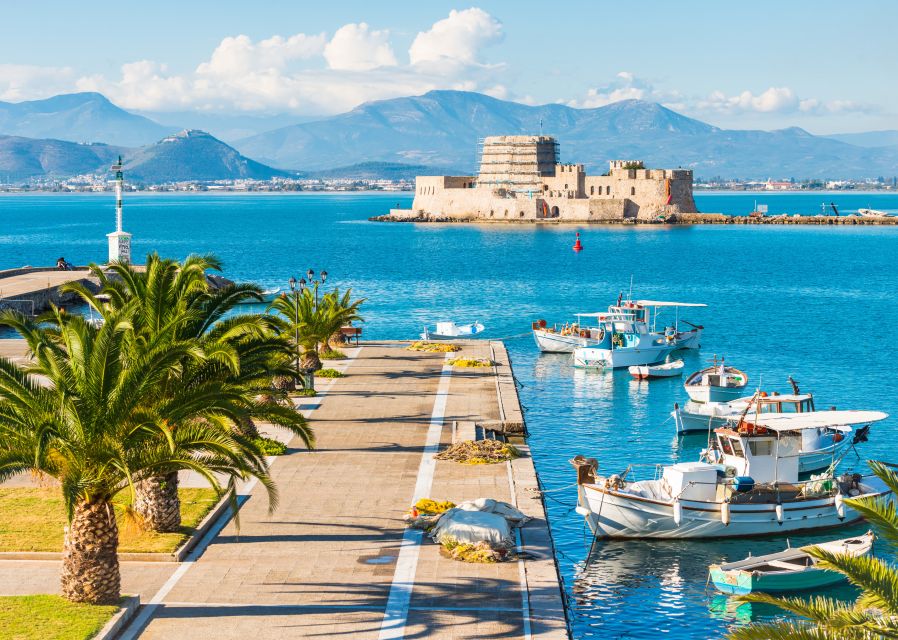
- Mycenae gives you the day’s strongest ancient setting: Walk through the Cyclopean walls, see the Lion Gate, and visit the tomb associated with Agamemnon.
- The Epidaurus theater is more than a photo stop: Test its celebrated acoustics from the center of the stage.
- Nafplion provides a welcome change of pace: Use the free time for alleys, Venetian buildings, coffee, lunch, or a short walk toward Arvanitia Beach.
- The VR device adds visual context: Reconstructed views can make scattered stones and foundations easier to understand.
- Central pickup keeps the morning manageable: Pickup is available near Plaka, the Greek Parliament, Omonia Square, and Karaiskaki Square.
- The price is low for the coverage: At $33.31 per person, transport and the main tour services offer strong value, but check if your selected option includes entry fees.
Why this Peloponnese day trip works
Athens has enough ancient sights to fill several days, yet some of Greece’s most important ruins lie beyond the city. Mycenae and Epidaurus are difficult to combine by public transport in one day, especially if you also want time in Nafplion. This coach tour solves that problem in one organized run.
You leave central Athens in an air-conditioned minibus or coach and head toward the Peloponnese. The first drive takes about an hour. The full route includes roughly two hours back to Athens at the end, so this is not a light half-day jaunt. It is a full historical outing with a lot of ground covered.
I see the appeal for anyone with limited time in Greece. You get the Corinth Canal, a major Mycenaean site, one of the finest surviving Greek theaters, and one of the country’s most attractive small cities. You do not get long, unhurried time at each place, but you get a useful first look at the Argolis region without arranging several separate journeys.
The human guide matters here. Tour leaders such as George, Christopher, Angela, Nancy, and Irene have been praised for keeping the day organized, answering questions, and adding stories without talking over every quiet stretch of the ride. George in particular is noted for clear explanations, good humor, and keeping the group in good spirits when traffic or weather slows the schedule.
More Day Trips in Athens:
- From Athens: Small-Group Delphi, Museum & Arachova Day Trip
★ 4.8 · 2,476 reviews - Meteora Day Trip with central Pick up & optional Lunch
★ 5.0 · 590 reviews - Athens: Meteora Day Trip with Central Pickup & Audio Guide
★ 4.6 · 394 reviews
The Corinth Canal makes a quick first stop
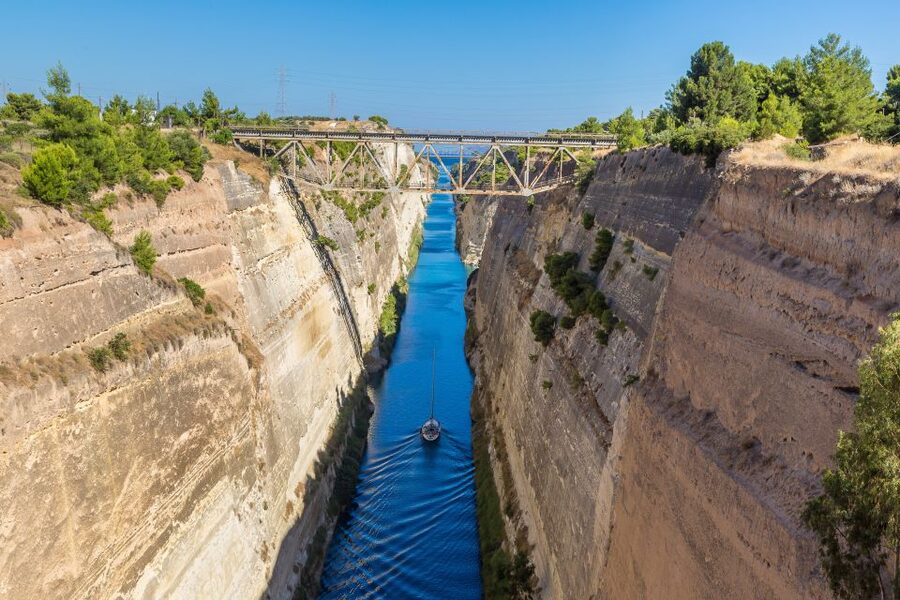
After about an hour on the road, the coach stops at the Corinth Canal for around 20 minutes. This is mainly a photo and viewing stop, not a full canal visit, so keep your expectations in check.
The canal cuts through the narrow Isthmus of Corinth and links the Gulf of Corinth with the Saronic Gulf, giving ships a route between the Ionian and Aegean sides of Greece. From the viewing area, the scale of the cut is the point: steep walls drop toward a thin strip of water far below.
Twenty minutes is enough to stretch your legs and take photographs. It is not enough for a long walk or a detailed look at the engineering. I like this early pause because it breaks up the first drive and gives the day a clear start. Just be ready to return to the vehicle on time. The schedule depends on keeping these brief stops brief.
Mycenae brings the Bronze Age to life
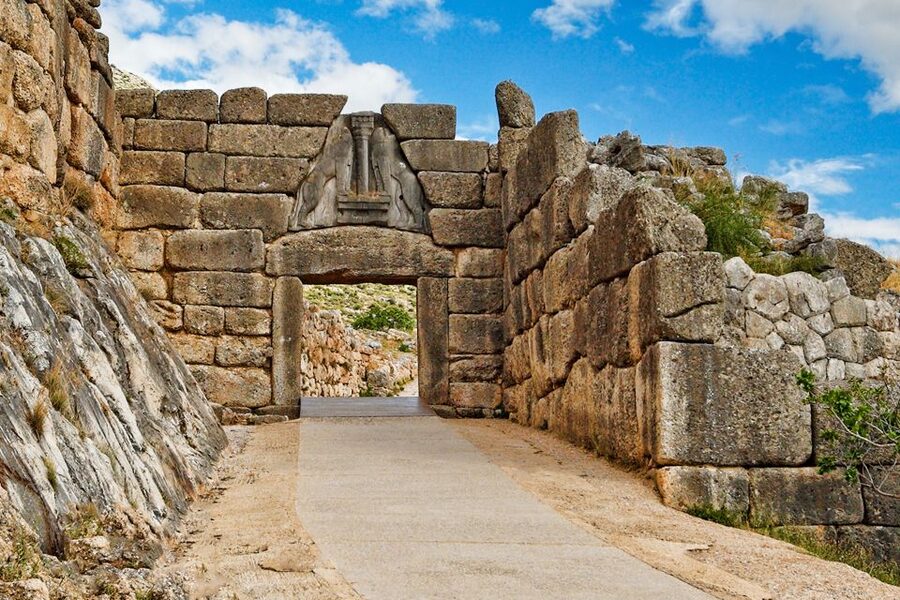
Mycenae is the main archaeological stop, with about two and a half hours set aside. That is the largest block of time on the tour, and rightly so. The site feels powerful even before you study the details. Huge stone walls surround the citadel, and the Lion Gate gives you an immediate sense of the authority of the Mycenaean rulers.
The walls are often called Cyclopean because later Greeks thought only giants could have moved such enormous blocks. You can walk through the citadel, see the remains of the ancient kingdom, and visit the tomb linked with Agamemnon. The site also includes an archaeological museum, which can help connect the stones outside with the objects and stories of the Mycenaean period.
The tomb associated with Agamemnon is often called the Treasury of Atreus. The name comes from later tradition, not a confirmed identification, but the beehive-shaped chamber is striking in its own right. Its carefully built stonework gives you a strong sense of the skill and ambition behind the wider site.
The terrain needs attention. You will walk over uneven ground and take paths that rise and fall, so comfortable shoes are important. The tour is listed as unsuitable for people with mobility impairments, and that warning should be taken seriously. Bring a hat as well, since much of the time at the ruins is outdoors.
The VR device is most useful here. Ancient Mycenae is a ruin, so it can take effort to imagine roofs, walls, and daily life from foundations alone. The reconstructed views offer a visual bridge between the surviving stones and the ancient city. The technology is not perfect: a GPS issue has occasionally made the device less precise, but it remains a helpful extra rather than the sole way to understand the site.
You also receive an audio guide. The supplied information lists English, French, German, Italian, Spanish, Russian, Portuguese, Polish, Chinese, and Japanese, though another description refers to eight languages. Check the language selection when booking or before departure if this matters to you.
Nafplion gives the day a human scale
From Mycenae, the coach continues to Nafplion, usually for about 30 minutes. You have roughly an hour and a half here. This is a good contrast with the archaeological sites: instead of examining fallen stones, you can wander streets, look at old houses, sit by the port, or choose a café.
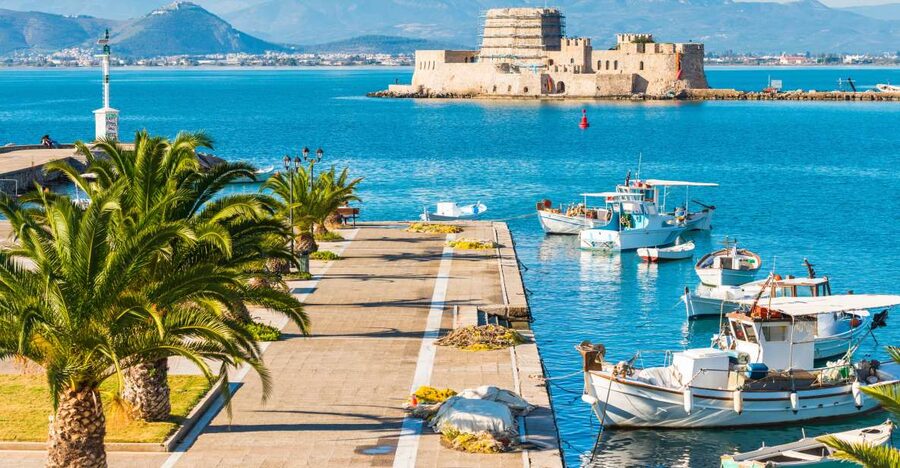
Nafplion served as Greece’s first capital after independence and has long been an important port. Its history is easy to read in the town itself, with Venetian houses, neoclassical buildings, narrow lanes, and waterfront cafés. Three fortresses reflect the city’s strategic position: the large Palamidi fortress above town, Akronafplia, and Bourtzi, the small water castle on an islet.
With only 90 minutes, you will need to choose. A relaxed lunch can take most of the stop, especially if service is slow. If you prefer to walk, use the time for the old streets and quayside rather than trying to reach every fortress. You might also take a short look toward Arvanitia Beach, where swimming is possible in summer, but do not count on fitting in a full beach visit alongside lunch and town sightseeing.
This is the part of the day most likely to feel short. Several people have found they wanted another 30 minutes in Nafplion. I agree that the schedule favors seeing the main sights over lingering in town. Still, the stop earns its place. After Mycenae, a coffee beside the port and a few quiet streets make the day feel less like a series of ruins.
More Audio Tours in Athens:
- Athens: Cape Sounio & Poseidon Temple Trip with Audio Guide
★ 4.4 · 4,521 reviews - Athens: Acropolis Ticket with Audio Guide
★ 4.0 · 3,575 reviews - From Athens: Delphi Full Day V.R. Audio Guided Tour
★ 4.6 · 3,028 reviews - Athens: Acropolis Museum Ticket with optional Audio Guide
★ 4.4 · 2,652 reviews
Epidaurus rewards a simple sound test
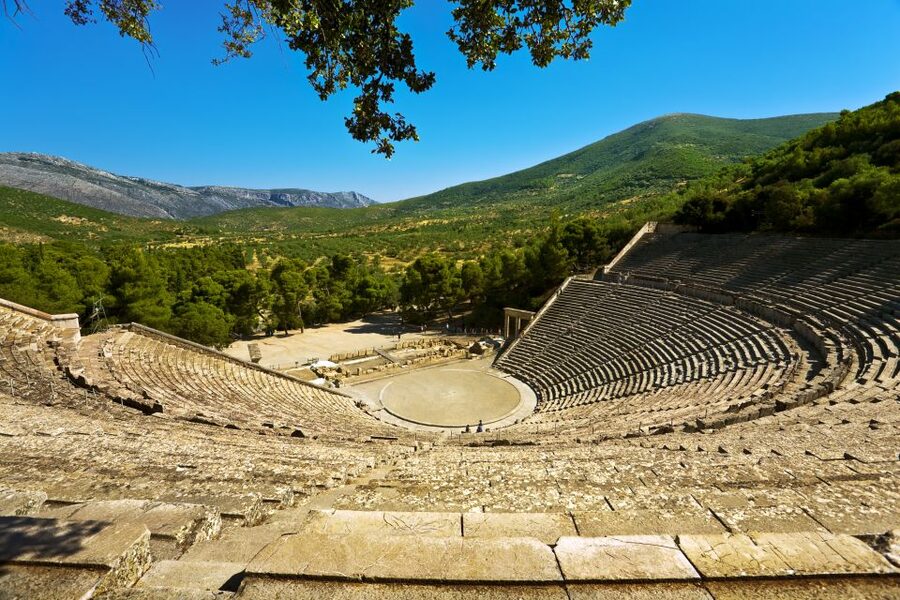
The final major stop is the Ancient Theater of Epidaurus, with about two hours planned. Built in the fourth century BCE, it is one of the best-preserved Classical Greek structures in the country. Its curved seating, orderly stonework, and open setting make it easy to understand why it remains one of Greece’s defining ancient sites.
The theater can hold up to 14,000 people. Its restored entrance is framed by Corinthian pilasters, and the site is still used for performances of ancient Greek drama during the annual Hellenic Festival.
Do not just photograph the stage. Walk to the center and try the famous sound test. A coin dropped there is said to be audible from the highest seats, and the design really does make quiet sounds carry remarkably well. You may find the effect less dramatic if the theater is crowded or noisy, but the experiment takes only a moment and makes the architecture memorable.
Two hours gives you time to explore the theater without a frantic rush. It also leaves room to take in the wider sanctuary area, though the exact amount of free time depends on the group and the guide’s timing. The audio guide can supply background while you walk, and the tour leader can help explain what you are seeing.
The drive back to Athens takes about two hours. Traffic can make the return tiring, particularly after a full day outside. A few minutes of rest on the coach can be useful, so keep water and a small snack with you.
The coach, guide, and daily rhythm
Pickup is available from central locations, including the Melina Mercouri Monument near Plaka at 7:45 a.m., the Greek Parliament at 7:50, Omonia Square at 8:00, and Karaiskaki Square at 8:05. Some booking information also lists other nearby pickup and drop-off points, so check your exact meeting place carefully.
Look for the blue Sights of Athens hop-on hop-off bus sign. Arrive early, since several central pickup points are close together and the vehicle cannot wait long at each one.
The transport is air-conditioned, which matters during a long summer day. Reports on the vehicle itself are mixed: it is generally comfortable, but one account found an older bus with limited power. That did not prevent the trip from running, but it is a reminder that this is practical group transport, not a luxury touring vehicle.
The day is guided in English, with the audio guide offering additional language choices. This arrangement gives you some independence at the ruins. You can listen while looking around rather than staying beside the tour leader every minute. The guide’s role is often more about timing, orientation, and useful commentary than delivering a nonstop lecture.
That can be a strength. Guides such as George and Christopher have been praised for being available without overwhelming the group. If you have a specific question about the sites, ask it during a quiet moment on the coach or at the entrance.
What the $33.31 price really buys
At $33.31 per person, this is unusually good value for the distance covered. You are paying for round-trip transport, a driver, a tour leader, the VR device, and audio commentary. The cost of the archaeological entries depends on the option you select, so confirm that detail before paying. Food and drinks are not included.
The value is strongest if you want logistics handled for you. A private taxi or self-arranged trip to all four places would require more planning and could cost far more. The low price also makes this a sensible choice for a first visit when you want to sample the Peloponnese before deciding where to return for a longer stay.
The compromise is time. You are paying for access and coverage, not a slow archaeological study. Mycenae and Epidaurus receive useful blocks of time, but Nafplion is short for anyone hoping to shop, eat slowly, climb Palamidi, and swim.
Practical advice before you leave Athens
Wear shoes with a firm sole. Mycenae has uneven surfaces, and you will be outdoors for much of the day. A hat and water are sensible, especially in warm weather.
Bring a passport or ID card, or a copy, as requested in the tour information. Pack snacks if you like to eat on your own schedule. Nafplion offers time for coffee or lunch, but the stop is limited and food is not included.
Keep your phone charged, since the Corinth Canal, Lion Gate, tomb, theater, and Nafplion all invite photographs. One useful caution from the experience is that the VR device may not always track perfectly, so treat it as an extra layer rather than a replacement for looking carefully at the actual ruins.
Free cancellation is available up to 24 hours before departure, and you can reserve now and pay later. Pickup and drop-off are included from central Athens points, but the exact stop matters, so check the address and meeting instructions before the morning of the trip.
Should you book this Peloponnese tour?
Book it if you want a low-cost, well-organized introduction to the Peloponnese and you value seeing several major places in one day. It suits first-time visitors, families with older children, history fans, and anyone who does not want to arrange buses or rental-car driving.
Skip it if you dislike long coach days or want deep, unhurried time in Nafplion. People with mobility limitations should also choose carefully because of the uneven archaeological sites and the tour’s stated suitability warning.
For most visitors with only a few days in Athens, I think the balance works. Mycenae supplies the drama, Epidaurus supplies the memorable sound test, Nafplion supplies the pleasure of simply wandering, and the Corinth Canal breaks up the road. Just accept that you are sampling a large region in one day, not settling into it.
FAQ
How long is the Athens to Peloponnese day trip?
The tour lasts about 11 hours. The planned route includes coach travel, a stop at the Corinth Canal, visits to Mycenae and Epidaurus, and free time in Nafplion.
Where does pickup take place in Athens?
Listed pickup points include the Melina Mercouri Monument near Plaka, the Greek Parliament, Omonia Square, and Karaiskaki Square. Pickup times are approximately 7:45 to 8:05 a.m., depending on the location.
Is food included?
No. Food and drinks are not included. You can bring snacks, and you have free time in Nafplion for coffee or lunch.
Is the audio guide available in languages other than English?
Yes. The listed audio-guide languages are English, French, German, Italian, Spanish, Russian, Portuguese, Polish, Chinese, and Japanese. The tour also has an English-speaking guide.
Are entry fees included?
Entry fees are included when you select the option that includes them. Check the exact booking option because the supplied tour details distinguish between options.
What should I bring?
Bring comfortable shoes, a hat, and a passport or ID card. A copy of the document is accepted, and you may also want water, snacks, and any personal items needed for a full day away from Athens.
Just added around Athens
- Temple of Olympian Zeus: Self-Guided Audio Tour on your Phone (without ticket)★ 4.0 · 8 reviews
- Self Guided Tour In Athens With 100 Captivating Audio Stories★ 4.0 · 4 reviews
- Athens National Archaeological Museum E-Ticket with Audio Guide★ 3.0 · 57 reviews
- Athens: Acropolis Museum Ticket with Self-Guided Audio tour App★ 3.5 · 40 reviews
- Athens Highlights Self guided scavenger hunt and Walking Tour★ 4.5 · 6 reviews
- Ancient Agora of Athens: A Self-Guided Audio Tour★ 3.5 · 3 reviews
- Athens Hop-On Hop Off w/ Acropolis & Acr.Museum tickets & 3 audio★ 3.0 · 5 reviews
- Shore Excursion: Athens Half Day Self-Guided Tour with Private Driver★ 4.5 · 8 reviews
Athens Audio Tours, compared.
Athens: Cape Sounio & Poseidon Temple Trip with Audio Guide
Read our review →
From Athens: Delphi Full Day V.R. Audio Guided Tour
Read our review →
Athens: Acropolis Museum Ticket with optional Audio Guide
Read our review →
From Athens: Small-Group Delphi, Museum & Arachova Day Trip
Read our review →
Athens: Acropolis Museum Ticket with Audio Guide
Read our review →
Athens: National Archaeological Museum Ticket w/ Opt. Audio
Read our review →
Acropolis & Parthenon Entrance Ticket w/optional SG Audio Tours
Read our review →Browse the lists this tour appears in