

REVIEW · GERMANY AUDIO TOURS
Munich: Self-guided sightseeing scavenger hunt for families
Munich’s city center becomes a giant family game board in this self-guided scavenger hunt led by the illustrated mascots Lili and Oskar. You follow eight envelopes from Hofgarten to Viktualienmarkt, solving puzzles and learning about Bavarian life as you go. I especially like the freedom to stop for ice cream, a museum, a playground, or a detour into the English Garden without losing the thread.
The flexible timing is the strongest feature, and the box gives children something to do besides trail behind adults looking at buildings. The $47 price covers a group of up to eight, which can be good value for a family or two traveling together. The main caution is language: everything is in German, and some of the written material may feel too long or dry for younger children.
Key points to know before you book
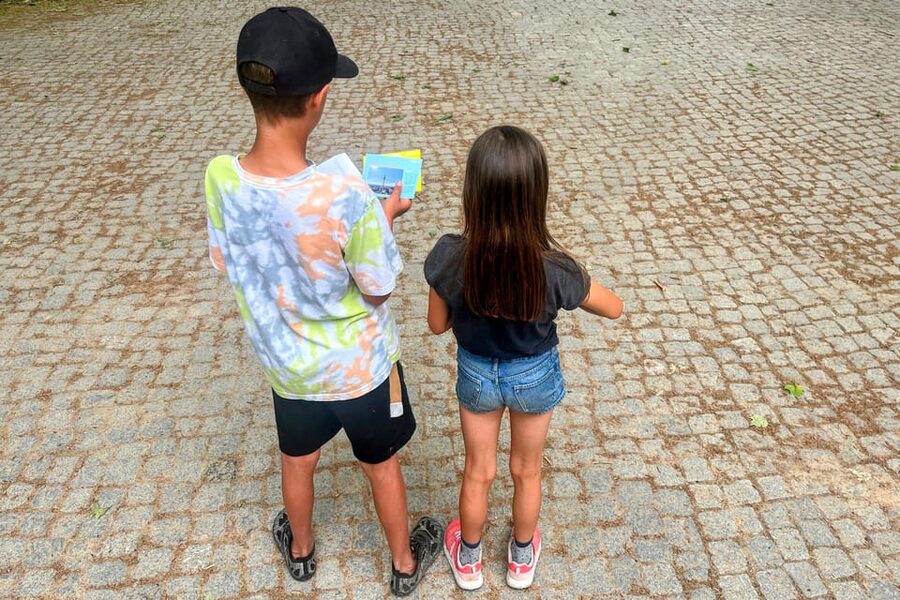
- Eight envelopes guide the route: Each station brings new information, directions, puzzles, and activities.
- Hofgarten to Viktualienmarkt: The walk starts in Munich’s city center and finishes near one of the city’s best food stops.
- Lili and Oskar add local character: The two Munich mascots share Bavarian words, jokes, facts, and tips.
- You set the pace: The planned duration is 150 minutes, but you can pause for museums, parks, food, or an ice cream.
- The box arrives by post: Order it online and have it sent to your home, hotel, or holiday flat.
- German is required: The material is written for children and adults, but there is no English version or live guide.
Why this works better than a standard family city tour
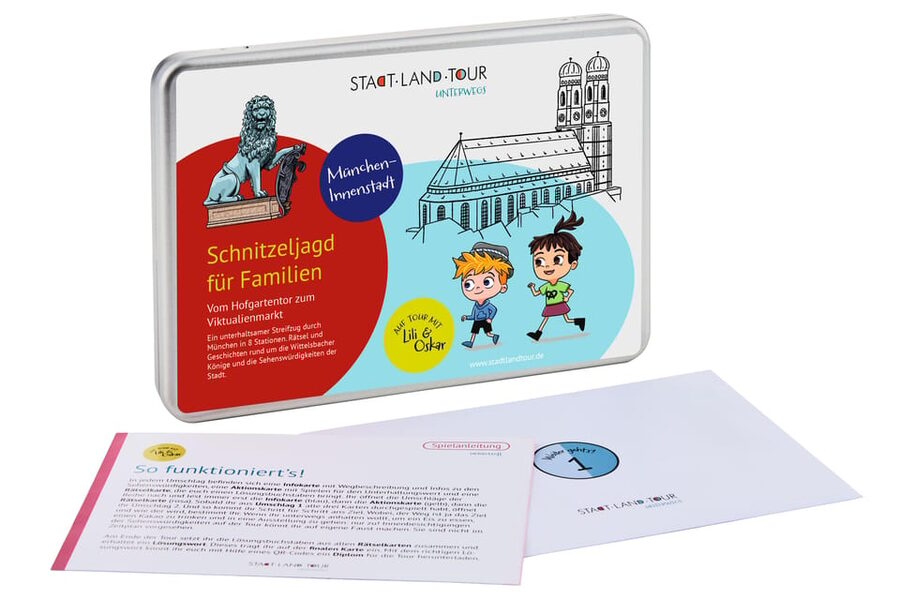
A regular sightseeing walk asks children to look, listen, and remember. This one asks them to act. At each stop, your family opens another envelope, reads about the attraction, and tackles a puzzle or creative task before moving on.
That small change matters. Children have a reason to study a statue, notice a building, or search a square. You are not simply telling them that Munich has famous kings and a long Bavarian past. You are giving them a job to do while those facts arrive.
Lili and Oskar keep the tone light. They are illustrated Munich natives who explain local customs, share bits of dialect, and add jokes that are meant to amuse adults as well as children. The approach is warm rather than academic. You get an introduction to the city’s people and habits, not just a list of dates.
Still, this is a paper-based activity. Some children will love opening envelopes and solving clues. Others may lose interest when a paragraph runs long. One useful criticism of the experience is that parts of the text can be too dry for children, so adults should be ready to read aloud, shorten an explanation, or turn the information into a quick question.
More City Highlights Audio Tours in Germany
- Berlin: Boat Sightseeing Cruise with Audioguide
★ 4.6 · 947 reviews - Berlin: Self-Drive City Sightseeing Tour in a Mini Hot Rod
★ 4.8 · 75 reviews - Lübeck Scavenger Hunt and Highlights Self Guided Audio Tour
★ 4.0 · 30 reviews
Starting at Hofgarten with room to wander
Your first map gives you the starting point and directions. The route begins at Hofgarten, a practical place to get settled before the city center becomes busier with sights, shops, and pedestrians.
The box does not give you a guide to meet. You arrive when you choose, take out the first envelope, and begin. This is a major advantage for families with uneven energy levels. You do not have to get everyone dressed, fed, and across town for a fixed departure time.
Hofgarten also gives you room for a small detour. You can move toward the English Garden if you want extra open space before continuing. The activity does not force you to follow every suggested stop at top speed, so you can decide how much of Munich your children can handle that day.
The first envelope sets the pattern for the rest of the walk. You receive information about the next attraction, instructions for the task, and the clue that sends you onward. Keep the envelopes together and bring a pen. The pen is not included, and you will need it to complete the puzzles.
Eight stations, eight reasons to keep moving
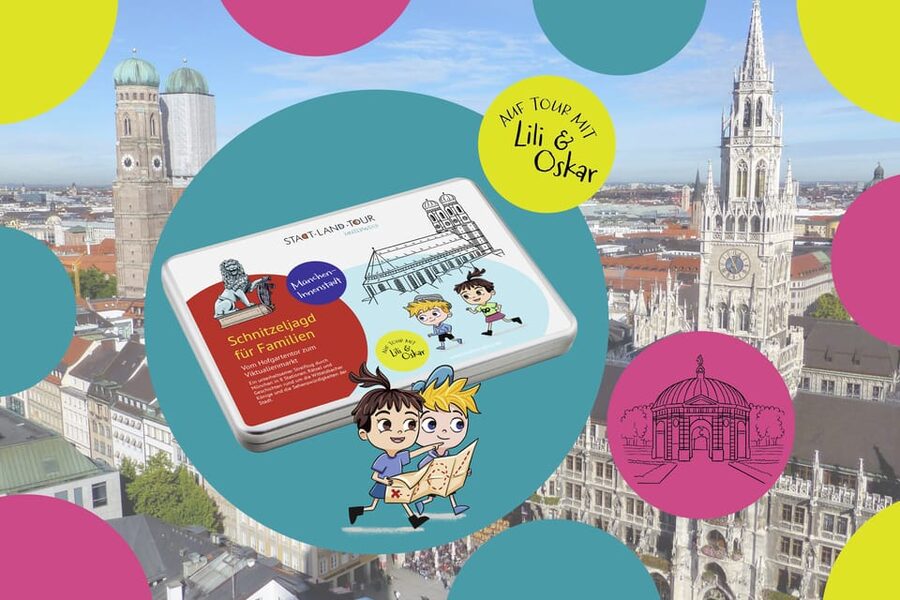
The exact attractions remain part of the surprise, but the format is clear. You visit eight stations across the center, with each envelope tied to the place in front of you. That structure gives the walk a useful rhythm: arrive, read, solve, act, and continue.
The stations are designed to mix sightseeing with participation. You might be asked to examine something closely, answer a city question, or complete a creative challenge. The supplied material does not promise a particular type of puzzle at every stop, so you should expect variety rather than a strict escape-room format.
This also means the experience works best when the adults play along. If you treat the envelopes as worksheets and rush the children through them, the walk will feel like homework. If you let the family debate answers, make guesses, and enjoy the occasional wrong turn, the city becomes part of the game.
The text aims at two audiences. Children get short tasks and illustrations, while adults receive local information that gives the stops more meaning. Non-Bavarians can follow the explanations, and the Bavarian words add a little flavor without requiring previous knowledge of the dialect.
Lili and Oskar explain Munich in a child-friendly way

The mascots are more than decoration. They are the voices of the tour, guiding your family from one envelope to the next. Their role helps soften subjects that could otherwise feel distant, such as Bavarian history, Munich’s rulers, and local customs.
You also get small pieces of everyday Munich. The aim is not only to identify famous places, but to understand something about how people in the city speak and live. That is useful for families who want their children to notice local character rather than simply collect photographs.
The Bavarian dialect section is a nice touch. You may not come away speaking Bavarian, but you can pick up a few local expressions and understand that language changes from place to place. Lili and Oskar deliver these details with jokes and a wink, which keeps the material from becoming a formal history lesson.
The balance is not perfect for every age. Younger children may need an adult to explain the longer passages. Older children who can read German independently may get more from the clues and information. If no one in your group is comfortable reading German, this is not the right activity.
More Scavenger Hunts in Germany
- Hamburg: Scavenger Hunt Self-Guided Tour for Children
★ 4.5 · 319 reviews - Dresden: Old Town Self-Guided Scavenger Hunt Tour
★ 4.5 · 151 reviews - Berlin: Self-Guided Family and School Class Scavenger Hunt
★ 4.6 · 128 reviews - Düsseldorf: Scavenger Hunt Self-Guided Tour
★ 4.6 · 127 reviews
The route leaves space for museums, parks, and snacks
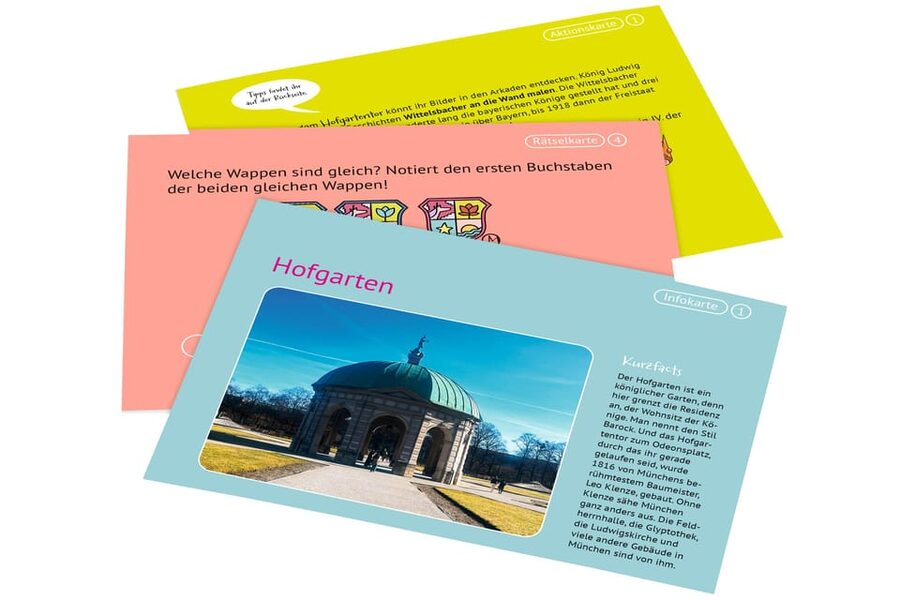
The advertised duration is 150 minutes, but that is better understood as a plan than a hard limit. You are encouraged to stop along the route for an ice cream, a museum, a playground, or a park.
This freedom is one of the most useful parts of the design. Families rarely move at a steady pace. One child wants lunch, another wants to sit down, and an unexpected museum catches an adult’s eye. Because there is no live guide waiting for you, you can pause and restart when it suits you.
The bonus tips point out places near the route that are not part of the core puzzle. You choose whether to follow them. That keeps the tour from feeling like a race and lets you adapt it to weather, mood, and opening times.
There is one tradeoff. A self-guided route does not provide real-time answers about the city or help with every puzzle. You get a solution envelope if you are stuck, plus a motivational envelope if the group runs out of energy. Those safety nets help, but they are not a substitute for a person who can adjust the activity to your children.
Finishing at Viktualienmarkt

The final station brings you to Viktualienmarkt, a smart ending for a family walk. After two and a half hours of clues and city sights, you can stop for food and talk over the answers.
The market also gives the tour a practical finish. You are not left at an arbitrary street corner with everyone hungry and tired. The final envelope contains a small surprise, provided you have solved the puzzles and found the solution word.
You do not need to worry too much about getting every answer right. Lili and Oskar offer helpful hints along the way, and the solution envelope is there if your group reaches a dead end. The point is to keep the day enjoyable, not to test your family under pressure.
Still, the ending depends on your interest in the puzzle itself. If your children prefer a clear guide and a steady stream of spoken stories, they may find the final solution less rewarding. If they like a goal and enjoy discovering an answer together, the closing envelope gives the walk a satisfying finish.
What $47 means for a family group
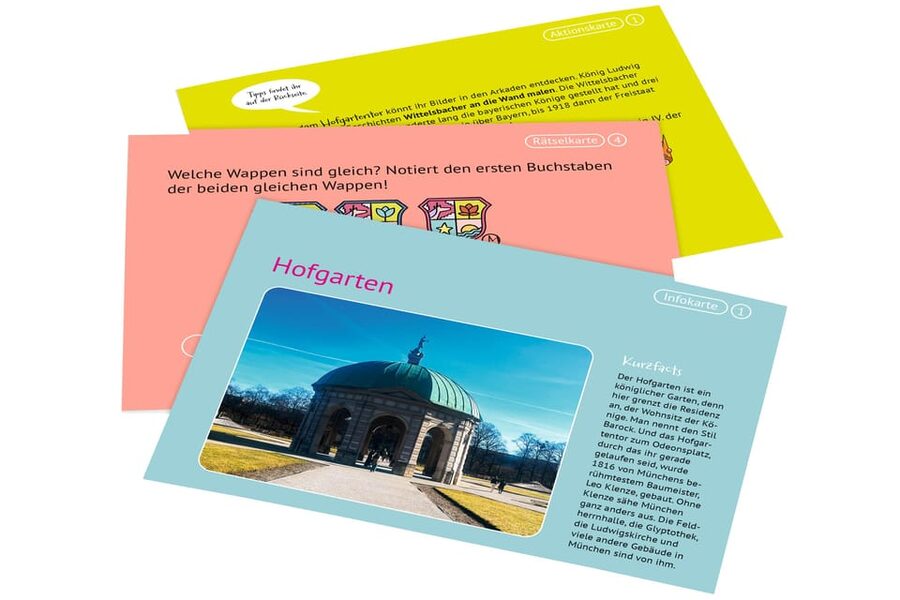
The price is $47 per group of up to eight people, not per person. For one family, that is a reasonable cost if you use the box with several children or share it with another family.
The value comes from the combination of sightseeing and entertainment. You are paying for a prepared route, eight envelopes, illustrations, local information, puzzles, hints, and the final surprise. You are not paying for a live guide, museum tickets, or public transportation.
That distinction matters. A family of four may find the price worthwhile because the activity fills much of an afternoon and gives adults a break from inventing ways to keep children engaged. A couple or a very small group of adults may get less value from the child-focused design.
Admission fees are extra if you follow the museum suggestions. Bus and train tickets are also not included. You should budget for those separately, although the walk itself is designed to be completed on foot.
The sturdy metal box is a practical part of the package. It protects the envelopes and gives the activity a physical sense of occasion, which can help children feel that the day is different from an ordinary walk. You do need to plan ahead because the box is mailed to you rather than handed over at a meeting point.
Delivery planning matters more than the booking page suggests

You can start the hunt at any time, but you cannot start until the box arrives. Delivery within Germany usually takes at least two to four working days, so do not order it at the last moment.
You can have it sent to your home or directly to your hotel or holiday flat in Munich. If you use accommodation as the address, tell the hotel staff or property manager to expect a package. Include a shipping address when ordering.
The activity is available only in German. That affects more than the puzzle answers. The directions, historical notes, jokes, and Bavarian language material all depend on reading German. A bilingual family can make this work well, with an adult translating as needed, but the product is not designed as a German-English activity.
Bring comfortable shoes and a pen. There is no need to meet a guide, arrange a transit ticket, or arrive at a fixed time. The box itself contains the game instructions, route information, envelopes, and clues.
Cancellation is allowed up to 24 hours before the activity for a full refund, and you can reserve now and pay later. Those policies give you some flexibility, but they do not remove the need to plan for delivery.
Who will enjoy this Munich scavenger hunt most?

I would choose this for families with children who enjoy puzzles, drawing, word games, or small challenges. It is also a good fit when you want to see the center without committing to a formal guided walk.
The activity suits families who value control over their day. You can start late, pause for lunch, take an English Garden detour, or stop at a museum without holding up a group. That freedom was the most praised feature, and it is easy to see why.
It is less suitable if you want detailed spoken commentary from a local guide. There is no game master at the starting point, and the tour does not include a live person to answer questions. You also should skip it if your group cannot comfortably use German.
Age matters too, although no exact age range is given. Children who can follow simple written instructions and discuss answers will likely get the most from it. Younger children can still join, but adults may need to read the text and keep the game moving.
My verdict: book it for flexibility, skip it for English-language guidance
I recommend this scavenger hunt for a family that wants a relaxed Munich walk with a clear purpose. The Hofgarten start, eight-envelope format, Lili and Oskar characters, Bavarian language tips, and Viktualienmarkt finish create a pleasant half-day plan.
Book it when your priority is flexible sightseeing and shared family time. The $47 group price is sensible for up to eight people, especially if you use the activity as the backbone of an afternoon.
Think twice if your children dislike reading, if long explanations lose them quickly, or if you need English. The puzzles and tasks are the heart of the experience, but the written sections can feel dry to some children. For the right family, that is a small flaw in an otherwise smart way to see central Munich together.
FAQ
How long does the Munich scavenger hunt take?
The planned duration is 150 minutes. You can take longer because the activity is self-guided and allows breaks for food, museums, parks, playgrounds, or other stops.
Where does the scavenger hunt start and finish?
It starts at Hofgarten in Munich city center and ends at Viktualienmarkt. The game instructions in the box provide the starting directions.
Is there a live guide or game master?
No. There is no guide at the meeting point and no game master during the walk. Lili and Oskar provide the written guidance through the envelopes.
What is included in the price?
You receive a sturdy metal box, eight envelopes with information and puzzles, a motivational envelope, a solution envelope, a final envelope with a small surprise, illustrations, and family-friendly local information.
Is the activity available in English?
No. The scavenger hunt is available only in German, including the instructions, puzzles, information, and local language material.
What should I bring?
Bring comfortable shoes and your own pen. The game box is supplied and contains the maps, envelopes, instructions, and puzzles.
How is the box delivered?
The scavenger hunt box is sent by post to your home, hotel, or holiday flat in Munich. Delivery within Germany usually takes at least two to four working days, so you should provide a shipping address and arrange for the accommodation to accept the parcel.
Just added around Germany
- Heidelberg Old Town: Romantic Walking Tour & Game★ 4.0 · 7 reviews
- Heidelberg Scavenger Hunt and Highlights Self Guided Audio Tour★ 4.0 · 9 reviews
- Heidelberg’s Altstadt: A Self-Guided Audio Tour★ 4.0 · 26 reviews
- Heidelberg Self Guided Sherlock Holmes Murder Mystery Game★ 5.0 · 3 reviews
- Self Guided Scavenger Hunt and Tour in Heidelberg★ 4.0 · 7 reviews
- Hamburg Waterfront Adventure: Self-Guided Pirate Quest★ 3.5 · 4 reviews
- Self-Guided Crime Tour Hannover City Center★ 3.5 · 5 reviews
- Hamburg’s Historical Highlights: A Self-Guided Audio Tour★ 4.5 · 5 reviews
Germany Audio Tours, compared.


Neuschwanstein Castle Skip-the-Line Ticket with Audio Guide
Read our review →
Berlin: Solar Powered Sunset Catamaran Cruise & Audio Guide
Read our review →
Berlin: Boat Sightseeing Cruise with Audioguide
Read our review →
Füssen: Neuschwanstein Castle Express Ticket and Audio Guide
Read our review →
Neuschwanstein Castle Ticket With Audio Guided Tour
Read our review →

Browse the lists this tour appears in